Complex Numbers and Quadratic Equations
- 1. Why do we need a new kind of number?
- 2. What is a complex number?
- 3. Adding and subtracting complex numbers
- 4. Multiplying complex numbers
- 5. Dividing one complex number by another
- 6. Why the powers of i go round in a circle
- 7. Square roots of negative numbers
- 8. Do the old algebra identities still work?
- 9. Modulus and conjugate
- 10. Complex numbers as points: the Argand plane
- Review
2 of 10·NCERT §4.2·4 min
What is a complex number?
The big ideaA complex number is a real number plus a real multiple of \( i \), written \( a + ib \); two of them are equal only when their real parts match and their imaginary parts match.
In simple words
Think of a number that comes in two parts, like a train ticket with a seat number and a coach number. One part is an ordinary number. The other part is an ordinary number stuck to \( i \). You never mix the two parts. Two tickets are the same only if both the seat and the coach match.
The form \( a + ib \)
A number of the form
\[ z = a + ib, \qquad a, b \text{ real numbers} \]is called a complex number. We usually call it \( z \). Some examples: \( 4 + 3i \), \( -1 + i\sqrt{2} \), \( \tfrac{1}{2} - 7i \), \( 0.6 + 0i \), \( 0 - 5i \).
The order of writing does not matter: \( 4 + 3i \), \( 4 + i3 \) and \( 3i + 4 \) are the same number. NCERT often writes \( i \) first, as in \( 2 + i5 \).
- \( a \) is the real part of \( z \), written Re z.
- \( b \) is the imaginary part of \( z \), written Im z.
So for \( z = 4 - 9i \): \( \text{Re}\, z = 4 \) and \( \text{Im}\, z = -9 \). Notice that the imaginary part is the real number \( -9 \), not \( -9i \).
Real numbers are complex numbers too
- If \( b = 0 \), then \( z = a + i0 = a \), an ordinary real number. So every real number is a complex number with imaginary part 0. The real numbers sit inside the complex numbers, the way whole numbers sit inside fractions.
- If \( a = 0 \) and \( b \ne 0 \), then \( z = ib \), for example \( 5i \) or \( -\tfrac{2}{3}i \). Such numbers are called purely imaginary.
When are two complex numbers equal?
Two complex numbers \( z_1 = a + ib \) and \( z_2 = c + id \) are equal when
\[ a = c \quad \text{and} \quad b = d \]Both parts must match. This is very useful: one equation between complex numbers gives you two equations between real numbers. We call this "equating real and imaginary parts".
Try it before the worked example: hit the target by matching both parts.
Worked example
Find real numbers \( x \) and \( y \) if \( (2x - 1) + i(x + 3y) = 5 + 9i \).
- Equate real parts: \( 2x - 1 = 5 \), so \( x = 3 \).
- Equate imaginary parts: \( x + 3y = 9 \). With \( x = 3 \): \( 3y = 6 \), so \( y = 2 \).
- Check: \( (6 - 1) + i(3 + 6) = 5 + 9i \). Correct.
Worked example
For which real \( k \) is \( (k^2 - 4) + i(k + 2) \) equal to 0?
- 0 means \( 0 + 0i \), so both parts must be 0.
- Real part: \( k^2 - 4 = 0 \) gives \( k = 2 \) or \( k = -2 \).
- Imaginary part: \( k + 2 = 0 \) gives \( k = -2 \).
- Only \( k = -2 \) makes both zero.
Don't mix these up
- \( \text{Im}(3 - 8i) = -8 \), not \( -8i \). The imaginary part is a real number.
- Equating parts works only when \( x \) and \( y \) are known to be real. Always check that the question says so.
- Complex numbers cannot be put in order: "\( 2 + i \gt 1 + i \)" has no meaning. Only equality makes sense.
Try it. (a) Write Re z and Im z for \( z = -\sqrt{3} + \tfrac{1}{2}i \) and for \( z = -6i \). (b) Find real \( x, y \) if \( 3x + i(x - y) = 12 + 7i \).
Answer
Just remember
Three conventions: someone had to choose, and these are the choices everyone now uses. Hooks below, and a way to rebuild each one.
- \( \text{Im}\, z \) is \( b \), not \( ib \)
- Think of \( i \) as the label on the second seat, like "coach" on a train ticket: the imaginary part is the number sitting in that seat, without the label. Rebuild: \( z = \text{Re}\, z + i\,\text{Im}\, z \) must give \( z \) back. If \( \text{Im}(4 - 9i) \) were \( -9i \), you would get \( 4 + i(-9i) = 4 + 9 = 13 \), not \( z \).
- \( 2 + i5 \) and \( 2 + 5i \) are the same number
- NCERT often writes the \( i \) first; most other books write it last. Order of writing never changes a number, just as \( 3 \times 4 = 4 \times 3 \). In an exam, either way is fine.
- "Imaginary" and "complex" are only names
- Imaginary came from Descartes in 1637, as a put-down. Complex came from Gauss in 1831, meaning "made of parts", like a housing complex with two blocks: the real block and the imaginary block. Neither name means "unreal" or "difficult". (The story is in the deep dive below.)
- Complex number
- A number \( a + ib \) with \( a \), \( b \) real.
- Real part, Re z
- The \( a \) in \( a + ib \).
- Imaginary part, Im z
- The \( b \) in \( a + ib \): a real number.
- Purely imaginary
- A number \( ib \) with real part 0 and \( b \ne 0 \).
- Equating parts
- Setting real part equal to real part and imaginary to imaginary.
Words to know
What is Im z for \( z = 7 - 2i \)?
- \( -2i \)
- \( -2 \)
- \( 7 \)
If \( x + iy = 4 - 3i \) with \( x, y \) real, what are \( x \) and \( y \)?
- \( x = 4, y = 3 \)
- \( x = 4, y = -3 \)
- \( x = -3, y = 4 \)
The real number 15 is ...
- not a complex number, because it has no \( i \)
- a complex number with imaginary part 0
- a purely imaginary number
Deep dive · optional
Why can't one complex number be bigger than another?
Why equality needs both parts, why "bigger than" is gone for good, and how a + ib turned out to be nothing more mysterious than a pair of ordinary numbers. The exam needs only the rules on this page; this is the reason behind them.
The roots: no order, and two parts that never mix
Start with the rule you already use: equal means both parts equal. Here is why it has to be so, using only \( i^2 = -1 \) and one fact about real numbers.
- Why must the real parts match and the imaginary parts match?Suppose \( a + ib = c + id \), with \( a, b, c, d \) real. Move things across: \( a - c = i(d - b) \). Now square both sides. The left side becomes \( (a - c)^2 \), and the right side becomes \( i^2 (d - b)^2 = -(d - b)^2 \).
- So what?The left side is the square of a real number, so it is zero or positive. The right side is minus a square, so it is zero or negative. A number that is both \( \ge 0 \) and \( \le 0 \) is 0. So \( a - c = 0 \) and \( d - b = 0 \): both parts match. The real part can never "make up" for the imaginary part.
- Then why can't we say \( 2 + i \gt 1 + i \)?A "bigger than" is only useful if the old rules of inequalities still hold: you may add the same number to both sides, and multiplying two positive numbers gives a positive number. Without those rules you could not solve a single inequality.
- Why do those rules rule out an order?They force every non-zero square to be positive. If \( z \) is positive, \( z \times z \) is positive. If \( z \) is negative, then \( -z \) is positive, and \( (-z)(-z) = z^2 \) is positive again. So \( 1 = 1^2 \) is positive, and \( -1 \) is negative.
- And underneath?\( i \) is not 0, so \( i^2 \) would have to be positive. But \( i^2 = -1 \), which we just showed is negative. Contradiction. There is no way to line up the complex numbers that keeps the rules of inequalities: the same rule that makes the sign flip when you multiply an inequality by a negative number.
So when you compare complex numbers you compare their parts (\( \text{Re} \), \( \text{Im} \)) or their sizes (the modulus \( |z| \) of page 9), never the numbers themselves. A real number like 3 is still bigger than 2: the usual order lives happily on the real line. It just cannot be stretched to the whole set.
And what is \( a + ib \), if not a mysterious sum? It is simply a pair of real numbers, \( (a, b) \), with two rules for combining pairs:
\[ (a, b) + (c, d) = (a + c,\; b + d) \] \[ (a, b)(c, d) = (ac - bd,\; ad + bc) \]Call the pair \( (0, 1) \) by the name \( i \). The second rule gives \( (0, 1)(0, 1) = (0 - 1,\; 0 + 0) = (-1, 0) \), which is the real number \( -1 \). Nothing has been imagined: only pairs and a multiplication rule. Two pairs are equal exactly when both entries match, which is the rule of this page.
The story: a put-down, a complaint and a pair
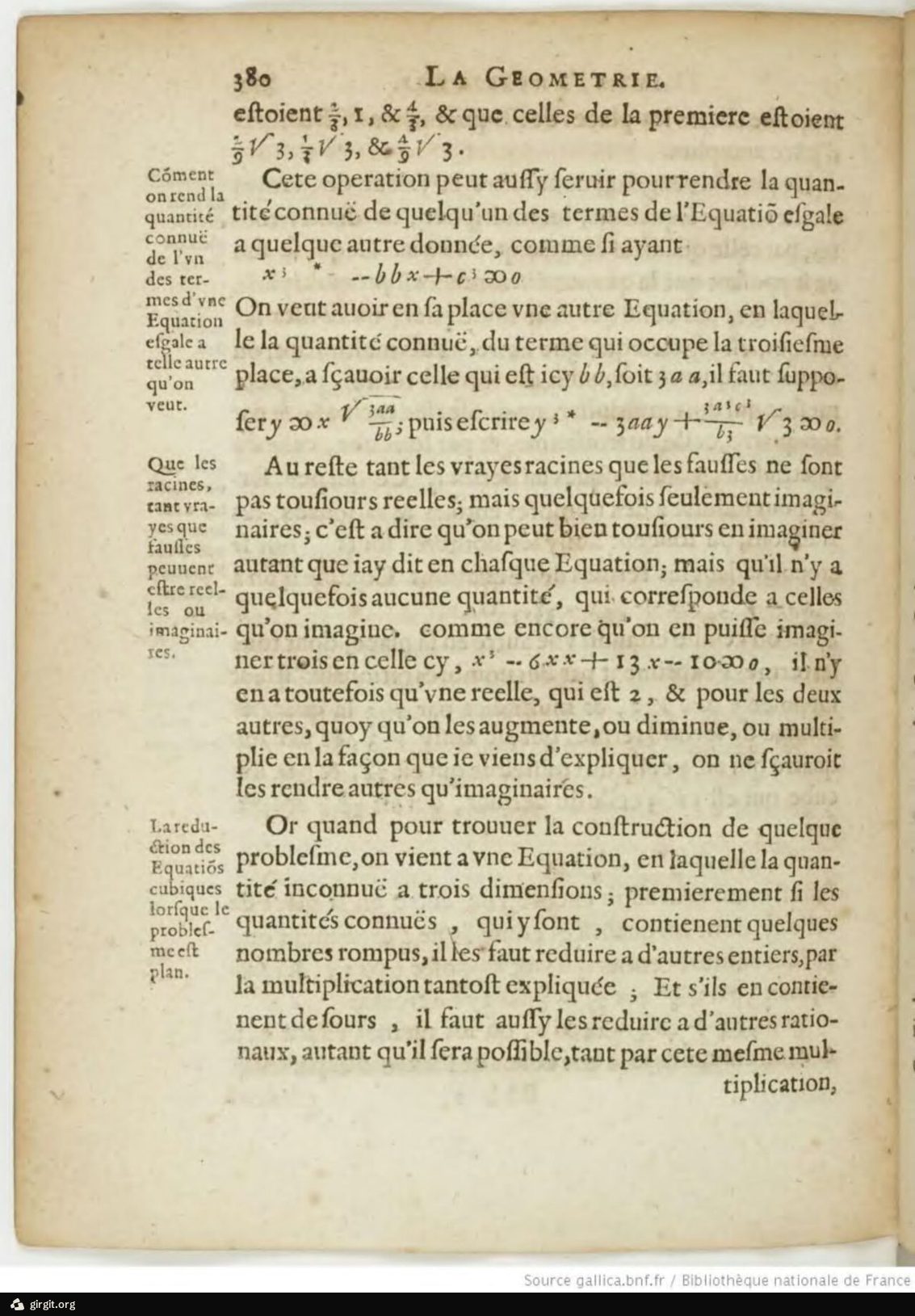 imaginaires: only imagined rootsx³ − 6x² + 13x − 10 = 0
See it: try to give the plane a positive side
Any order on numbers must split them into positive and negative, with every non-zero number on exactly one side, its negative on the other. For points of a plane the natural way is a line through O. Tilt the line to any angle you like, then drag \( z \) and watch its square. Then tap "Show every square".
Whatever tilt you choose, half of the positive numbers have squares on the negative side. The reason is a fact you will meet properly on page 4: squaring a complex number doubles its angle. The positive side is half a turn wide, so its squares spread over a whole turn and must cross into the negative side. On the real line this never happens, because the only "angles" there are 0 and a half turn, and doubling either gives 0.
Solve it
Spot the error
A student writes: "\( x + iy = 3 + 4i \), so \( x = 3 \) and \( y = 4 \)." The question did not say that \( x \) and \( y \) are real. Find another pair \( x, y \) that also works, and say what went wrong.
Hint
Answer
Solve it (a proof step)
Using only \( i^2 = -1 \), prove: if \( a \) and \( b \) are real and \( a + ib = 0 \), then \( a = 0 \) and \( b = 0 \).
Hint
Answer
Solve it (Descartes's equation)
Check that 2 is a root of Descartes's cubic \( x^3 - 6x^2 + 13x - 10 = 0 \). Divide out \( (x - 2) \) and find the two roots he called imaginary.
Hint
Answer
Which of these statements has a meaning?
- \( 3 + i \gt 2 + 5i \)
- \( \text{Re}(3 + i) \gt \text{Re}(2 + 5i) \)
- \( i \gt 0 \)
Connect it
Connect it
- Ordered pairs, Ch 2. Hamilton's couples are the ordered pairs of Chapter 2, where \( (a, b) = (c, d) \) means \( a = c \) and \( b = d \). Equating parts is that rule.
- The sign flip, Ch 5. The rule that kills ordering, "positive times positive is positive", is the same rule that makes an inequality flip its sign when you multiply by a negative number.
- The Argand plane, page 10. A pair \( (a, b) \) is a point, so every complex number is a point of the Argand plane. Points of a plane have no natural "bigger".
- Vectors. Two vectors are equal exactly when their components are equal: the same two-parts rule, in physics and in Class 12 vectors.
- Size, page 9. What you can compare is the size \( |z| \), a real number: modulus and conjugate.
Still confused?
Can't I just compare real parts first, and imaginary parts if those tie?
You can line up all complex numbers that way, like words in a dictionary. But it is not an order you can calculate with. In that line-up \( i \) comes after 0 (equal real parts, and \( 1 \gt 0 \)), so \( i \) would be "positive". Then positive × positive should be positive, yet \( i \times i = -1 \) comes before 0. The line-up exists; the rules of inequalities do not survive it.
Is \( 7 + 0i \gt 5 + 0i \) allowed?
Yes. These are the real numbers 7 and 5, and on the real line the usual order works perfectly. What fails is any order that includes \( i \) as well.
If \( a + ib \) is "just a pair", why write it with \( i \) at all?
Because the \( i \) form lets you multiply by opening brackets, as in ordinary algebra, instead of memorising the pair rule \( (ac - bd, ad + bc) \). The two ways of writing give exactly the same answers; the \( i \) form is easier to calculate with.
Sources
- Descartes, Discours de la méthode with La Géométrie (Leiden, 1637), scan of p. 380, Wikimedia Commons (Bibliothèque nationale de France).
- Imaginary number (Descartes coined "imaginary" in La Géométrie, meant as derogatory), Wikipedia.
- Complex number: history (Descartes's p. 380 passage; Gauss 1831, "complex", "norm", the "lateral units" passage; the pair definition), Wikipedia.
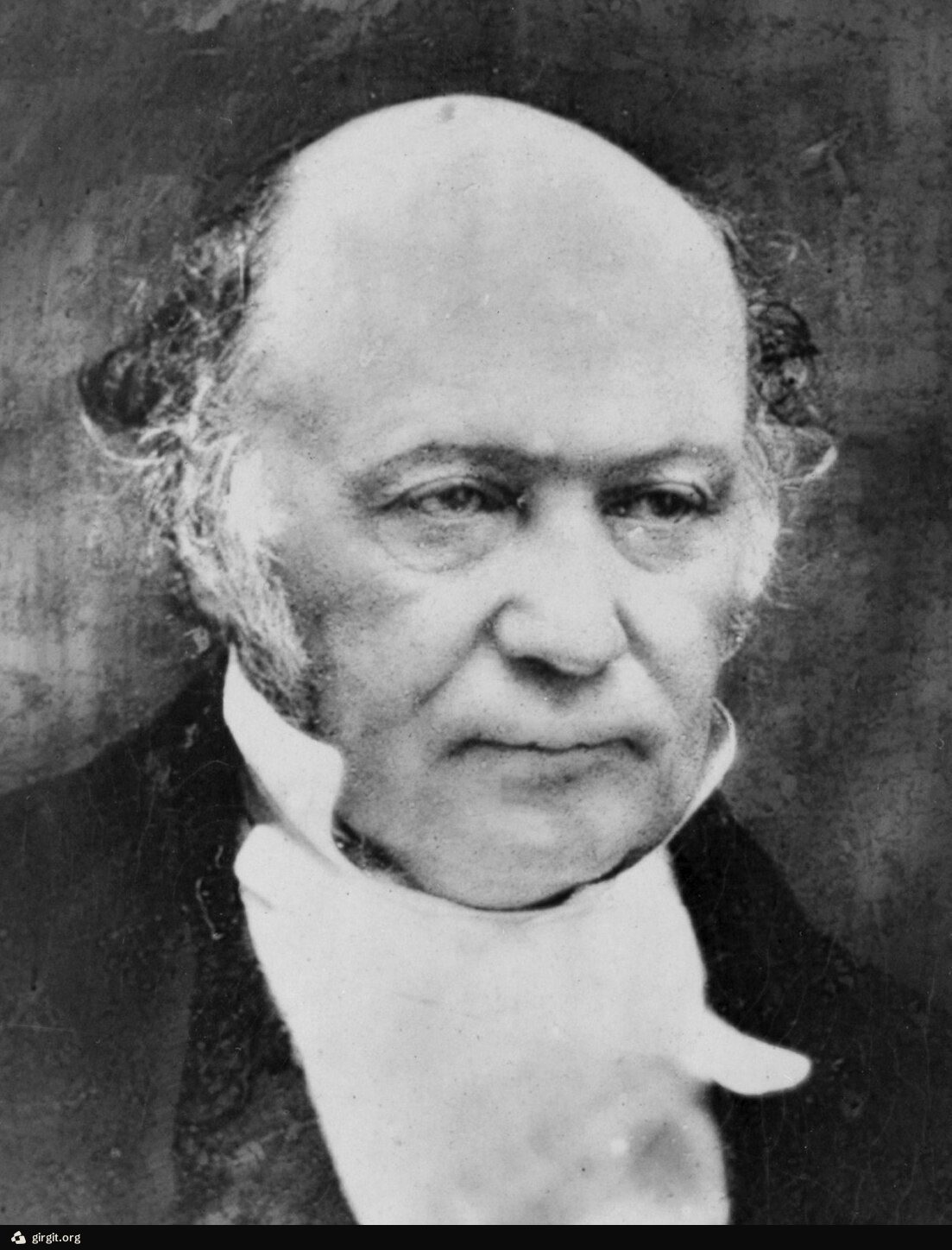
- William Rowan Hamilton (paper on algebraic couples read to the Royal Irish Academy, 4 November 1833), Wikipedia; and Hamilton, MacTutor History of Mathematics, St Andrews.
- Ordered field (squares are non-negative; the complex numbers cannot be ordered because −1 = i²), Wikipedia.
Picture and video credits