Complex Numbers and Quadratic Equations
- 1. Why do we need a new kind of number?
- 2. What is a complex number?
- 3. Adding and subtracting complex numbers
- 4. Multiplying complex numbers
- 5. Dividing one complex number by another
- 6. Why the powers of i go round in a circle
- 7. Square roots of negative numbers
- 8. Do the old algebra identities still work?
- 9. Modulus and conjugate
- 10. Complex numbers as points: the Argand plane
- Review
3 of 10·NCERT §4.3 · §4.3.1 · §4.3.2·4 min
Adding and subtracting complex numbers
The big ideaTo add or subtract complex numbers, add or subtract the real parts and the imaginary parts separately; the familiar laws of addition all carry over.
In simple words
You have two bags. Each bag holds some plain beads and some star beads. Pour both bags together and count: plain beads with plain beads, star beads with star beads. You never turn a plain bead into a star bead. Taking away works the same way: take plain from plain and stars from stars.
With complex numbers defined, we now build their algebra: the rules for adding, subtracting, multiplying and dividing them. Every rule is chosen so that, when the imaginary parts are 0, it gives the ordinary rule for real numbers.
Addition
Let \( z_1 = a + ib \) and \( z_2 = c + id \). Their sum is defined as
\[ z_1 + z_2 = (a + c) + i(b + d) \]In words: real part of the sum = sum of the real parts; imaginary part of the sum = sum of the imaginary parts. The answer is again a complex number.
Example: \( (4 + 7i) + (-1 - 3i) = (4 - 1) + i(7 - 3) = 3 + 4i \).
Try it: drag the two points and watch the parts add on their own axes.
The laws of addition
Addition of complex numbers obeys the same laws as addition of real numbers. For all complex numbers \( z_1, z_2, z_3 \):
- Closure law: \( z_1 + z_2 \) is again a complex number.
- Commutative law: \( z_1 + z_2 = z_2 + z_1 \). Order does not matter.
- Associative law: \( (z_1 + z_2) + z_3 = z_1 + (z_2 + z_3) \). Grouping does not matter.
- Additive identity: the number \( 0 + i0 \), written 0 and called the zero complex number, satisfies \( z + 0 = z \) for every \( z \). Adding it changes nothing.
- Additive inverse: for \( z = a + ib \), the number \( -a + i(-b) \), written \( -z \) and called the negative of \( z \), satisfies \( z + (-z) = 0 \). It undoes \( z \).
Each law holds because it holds separately for the real parts and for the imaginary parts, which are real numbers.
Subtraction
The difference of \( z_1 \) and \( z_2 \) is defined as adding the negative:
\[ z_1 - z_2 = z_1 + (-z_2) \]So with \( z_1 = a + ib \), \( z_2 = c + id \): \( z_1 - z_2 = (a - c) + i(b - d) \).
Worked example
- \( (5 - 2i) - (1 + 6i) = (5 - 2i) + (-1 - 6i) = 4 - 8i \).
- Swap them: \( (1 + 6i) - (5 - 2i) = (1 + 6i) + (-5 + 2i) = -4 + 8i \). The answer is the negative of the first one, so subtraction is not commutative.
- \( 3(2 - i) - i(4 - 5i) \): here you meet a product, which the next concept handles. But only \( i \times 5i = 5i^2 = -5 \) is new: \( 6 - 3i - 4i + 5i^2 = 6 - 7i - 5 = 1 - 7i \).
- Find \( z \) if \( z + (2 - 9i) = 7 + i \). Subtract: \( z = (7 + i) - (2 - 9i) = 5 + 10i \).
Don't mix these up
- When you subtract, the minus sign goes to both parts: \( -(1 + 6i) = -1 - 6i \), not \( -1 + 6i \).
- \( z_1 - z_2 \) and \( z_2 - z_1 \) are negatives of each other, not equal.
- The negative of \( z \) (written \( -z \)) is not the conjugate; the conjugate (concept 9) changes only the sign of the imaginary part.
Remember
- \( (a + ib) \pm (c + id) = (a \pm c) + i(b \pm d) \).
- Zero is \( 0 + i0 \); the negative of \( a + ib \) is \( -a - ib \).
- Addition is closed, commutative and associative.
Try it. (a) \( (-3 + 4i) + (8 - 10i) \). (b) \( \left(\tfrac{1}{2} + 2i\right) - \left(\tfrac{3}{2} - i\right) \). (c) Find \( z \) if \( z - (4 + 4i) = -1 + 3i \).
Answer
Just remember
The rules themselves need no memorising: they come from adding the two parts separately. What you do have to learn are the names of the laws, because exam questions ask for them by name.
- Closure law
- A closed club: combine two members and you get a member, never an outsider. Complex + complex is complex.
- Commutative law: \( z_1 + z_2 = z_2 + z_1 \)
- A commuter goes home to office and office to home: same trip, either way round. The two numbers swap places.
- Associative law: \( (z_1 + z_2) + z_3 = z_1 + (z_2 + z_3) \)
- Who you associate with: the brackets decide which two are grouped first. The answer does not care.
- Identity 0 and inverse \( -z \)
- Adding the identity lets \( z \) keep its identity; adding the inverse undoes \( z \) and leaves 0. Rebuild all five laws by checking them on the real parts and on the imaginary parts separately.
- Closure law
- Adding two complex numbers always gives a complex number.
- Commutative law
- \( z_1 + z_2 = z_2 + z_1 \).
- Associative law
- \( (z_1 + z_2) + z_3 = z_1 + (z_2 + z_3) \).
- Additive identity
- The zero complex number \( 0 + i0 \).
- Additive inverse, \( -z \)
- The negative \( -a - ib \), which adds to \( z \) to give 0.
Words to know
What is \( (2 - 3i) - (-4 - 3i) \)?
- \( 6 \)
- \( 6 - 6i \)
- \( -2 \)
What is the additive inverse of \( -5 + 2i \)?
- \( -5 - 2i \)
- \( 5 - 2i \)
- \( 5 + 2i \)
Which law says \( z_1 + z_2 = z_2 + z_1 \)?
- Associative law
- Commutative law
- Closure law
Deep dive · optional
Adding is walking: why \( z_1 - z_2 \) measures a distance
Why the parts add separately, what adding does to the whole plane, and how a subtraction turns into the distance between two numbers. The exam needs only the rules; this makes them a picture you cannot forget.
The roots: steps on a grid
- Why do real parts add only with real parts?Because a complex number is a pair of real numbers (see the deep dive on page 2), and pairs are added slot by slot, the way rupees add to rupees and paise to paise.
- Why does that look like walking?Put \( a + ib \) at the point \( (a, b) \). Adding \( c + id \) moves the point \( c \) across and \( d \) up, wherever it starts. So adding a fixed \( w \) slides every point of the plane by the same step. Nothing turns and nothing stretches: adding is a pure slide.
- Why does \( z_1 + z_2 = z_2 + z_1 \) hold, as a picture?Walk the step \( z_1 \) then the step \( z_2 \), or \( z_2 \) then \( z_1 \). The two routes are opposite sides of a parallelogram and end at the same corner. The commutative law is that parallelogram.
- Why is \( z_1 - z_2 \) the arrow from \( z_2 \) to \( z_1 \)?Because \( z_2 + (z_1 - z_2) = z_1 \). The difference is exactly the step you must add to \( z_2 \) to land on \( z_1 \). Start that same step at O and you reach the point \( z_1 - z_2 \): the fourth corner of a parallelogram with O, \( z_2 \) and \( z_1 \).
- And underneath?Pythagoras. The step \( z_1 - z_2 = (a - c) + i(b - d) \) goes \( a - c \) across and \( b - d \) up, so its length is \( \sqrt{(a - c)^2 + (b - d)^2} \): the Class 10 distance formula. On page 9 this length gets its own name, \( |z_1 - z_2| \).
So the two operations on this page do two different jobs. Adding moves things without changing their shape. Subtracting measures the gap between two numbers, as an arrow with a direction and a length. Almost every distance question about complex numbers in JEE starts with a subtraction and ends with Pythagoras.
The story: an engineer writes the rules
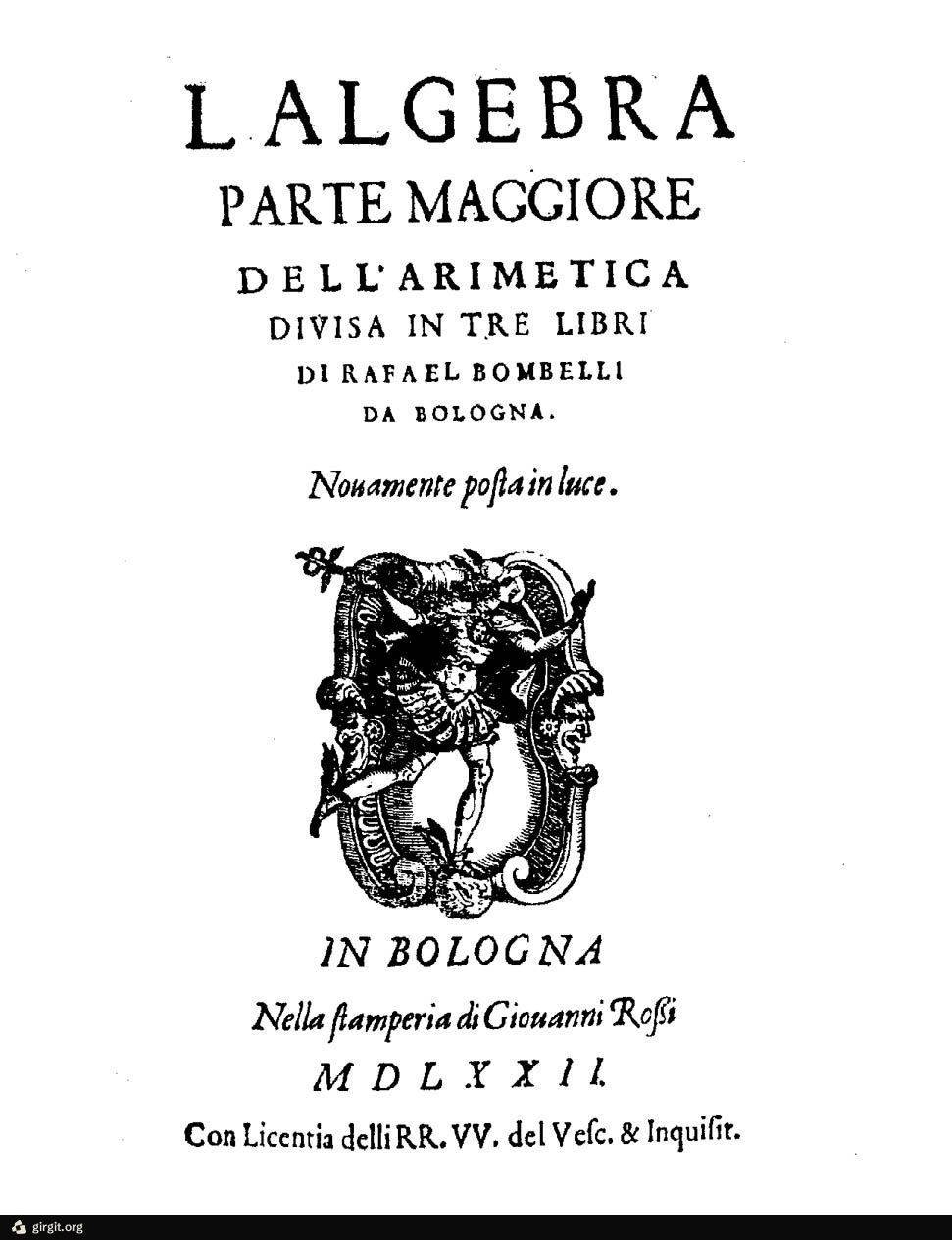 Algebrain three booksprinted in Bologna= 1572
See it: the arrow between two numbers
Drag the two points. The bold arrow from \( z_2 \) to \( z_1 \) is \( z_1 - z_2 \); the dashed copy starts at O and ends at the point \( z_1 - z_2 \). Its two legs are the real gap and the imaginary gap. Then tap "Every point at this distance" to see all the whole-number points at the same distance from \( z_2 \), and a chart of how many there are for every distance.
Notice two things. Slide both points by the same step (add the same \( w \) to both) and the arrow between them does not change: adding moves things but never changes gaps. And the chart is full of zeros: no whole-number point is exactly \( \sqrt{3} \), \( \sqrt{6} \) or \( \sqrt{7} \) away from another, because 3, 6 and 7 are not sums of two squares. That fact comes back on page 9.
Solve it
Solve it
Three corners of a parallelogram ABCD, taken in order, are \( A = 1 + i \), \( B = 4 + 2i \) and \( C = 6 + 5i \). Find the fourth corner D.
Hint
Answer
Spot the error
A student finds the distance from \( 2 + 3i \) to \( -1 + 7i \) like this: \( \sqrt{(2 + 1)^2 + (3 + 7)^2} = \sqrt{109} \). What went wrong, and what is the distance?
Answer
Solve it (JEE style)
How many complex numbers \( z = x + iy \), with \( x \) and \( y \) whole numbers (integers), are at distance exactly 5 from \( 2 + i \)?
Hint
Answer
You add the same number \( w = 7 - 2i \) to both \( z_1 \) and \( z_2 \). What happens to the distance between them?
- It grows by the size of \( w \)
- It stays the same
- It depends on the direction of \( w \)
Connect it
Connect it
- Physics: adding vectors. The tip-to-tail walk and the parallelogram are the triangle and parallelogram laws for adding vectors; adding parts is adding with components.
- Relative velocity. "The arrow from \( z_2 \) to \( z_1 \)" is the same idea as relative velocity: the velocity of A seen from B is \( v_A - v_B \).
- Coordinate geometry. The distance \( \sqrt{(a - c)^2 + (b - d)^2} \) is the distance formula of the coordinate geometry recap.
- Class 12 vectors. "Head minus tail" for the vector from one point to another is this page's \( z_1 - z_2 \): head minus tail, and the section formula.
- Pages 9 and 10. The length of the arrow is the modulus \( |z_1 - z_2| \) (page 9), and the points live on the Argand plane.
Still confused?
Is \( z_1 - z_2 \) a point or an arrow?
Both, and that is the trick. As an arrow it can start anywhere: from \( z_2 \) it ends at \( z_1 \). Started at O, it ends at the point \( z_1 - z_2 \). A complex number is a step; the point is where that step lands if you start from O.
Do \( z_1 - z_2 \) and \( z_2 - z_1 \) give the same distance?
Yes. They are the same arrow pointing opposite ways: \( z_2 - z_1 = -(z_1 - z_2) \). Both parts change sign, and squaring removes the signs, so the length is the same. Only the direction differs, which is why subtraction is not commutative but distance is symmetric.
Sources
- Rafael Bombelli: Val di Chiana, the algebra book, "plus of minus", rules for multiplying then adding complex numbers, the "more sophistic than true" passage, MacTutor History of Mathematics, St Andrews.
- H. K. Strick, Rafael Bombelli (the cube root of 2 + √−121 is 2 + √−1, so the root is 4), MacTutor.
- Rafael Bombelli (L'Algebra, 1572; "plus of minus" and "minus of minus"), Wikipedia.
- Title page of L'Algebra (Bologna, Giovanni Rossi, 1572), Wikimedia Commons.
- Complex number: history (Bombelli developed the rules for addition, subtraction and multiplication), Wikipedia.

Picture and video credits