Complex Numbers and Quadratic Equations
- 1. Why do we need a new kind of number?
- 2. What is a complex number?
- 3. Adding and subtracting complex numbers
- 4. Multiplying complex numbers
- 5. Dividing one complex number by another
- 6. Why the powers of i go round in a circle
- 7. Square roots of negative numbers
- 8. Do the old algebra identities still work?
- 9. Modulus and conjugate
- 10. Complex numbers as points: the Argand plane
- Review
10 of 10·NCERT §4.5·5 min
Complex numbers as points: the Argand plane
The big ideaThe complex number \( x + iy \) is the point \( (x, y) \) on a plane; in this Argand plane the modulus is the distance from the origin and the conjugate is the mirror image in the horizontal axis.
In simple words
Plain numbers live on a line. These new two-part numbers need more room, so they live on a flat sheet, like graph paper. The plain part tells you how far to go right or left. The \( i \) part tells you how far to go up or down. So every such number is a dot on the sheet, and every dot is such a number. How big the number is turns into how far the dot is from the middle.
One number, one point
Every ordered pair of real numbers \( (x, y) \) gives exactly one point in the XY-plane, and every point gives exactly one pair. A complex number \( x + iy \) is also fixed by a pair, its real part \( x \) and imaginary part \( y \). So we match the complex number \( x + iy \) with the point \( P(x, y) \). This is the ordered-pair idea of W. R. Hamilton.
The plane in which every point stands for a complex number is called the complex plane or the Argand plane (after Jean-Robert Argand, who described it in 1806; a Danish surveyor, Caspar Wessel, had the same idea in 1797, as the deep dive tells).
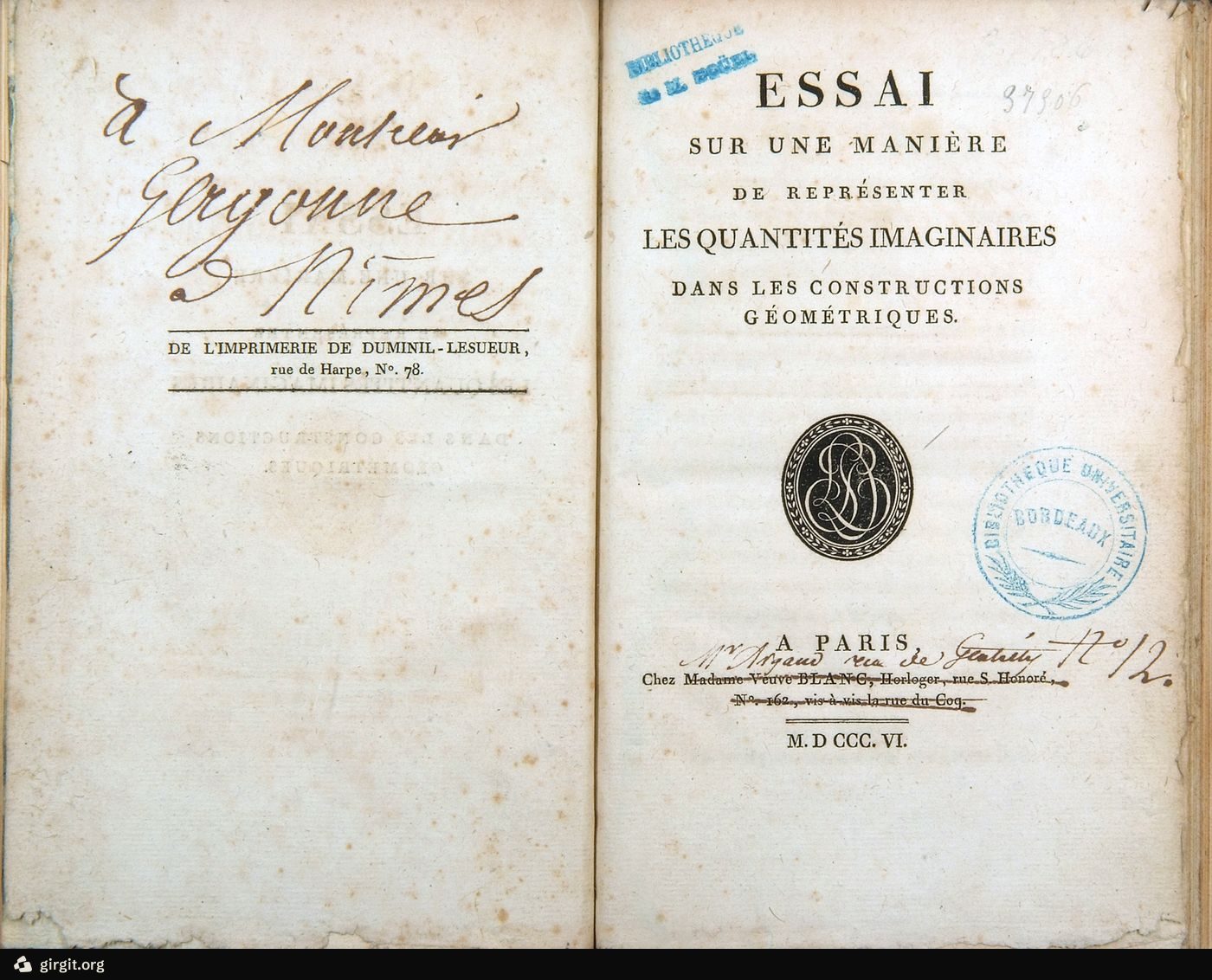 no author's name printed"Mr Argand" added by handM.DCCC.VI = 1806"to Monsieur Gergonne, Nîmes"
Try it: drag the point to any spot and read off its number.
Picture it
Imagine ordinary graph paper with the origin O at the centre. Mark these numbers:
- \( 3 + 2i \): go 3 to the right of O and 2 up. A point in the first quadrant.
- \( -1 + 4i \): 1 to the left and 4 up, high in the second quadrant.
- \( -4 - 3i \): 4 left and 3 down, in the third quadrant.
- \( 2 - i \): 2 right and 1 down, just below the horizontal axis in the fourth quadrant.
- \( 5 \) (that is \( 5 + 0i \)): 5 to the right, sitting on the horizontal axis.
- \( -2i \) (that is \( 0 - 2i \)): 2 down, sitting on the vertical axis.
The signs of Re z and Im z tell you the quadrant: both positive, first; Re negative and Im positive, second; both negative, third; Re positive and Im negative, fourth.
The two axes
- Points on the \( x \)-axis are numbers \( a + i0 \), the real numbers. So the \( x \)-axis is called the real axis.
- Points on the \( y \)-axis are numbers \( 0 + ib \), the purely imaginary numbers (and 0). So the \( y \)-axis is called the imaginary axis.
The old number line has not gone anywhere: it is the real axis, lying flat across the middle of the plane.
The modulus is a distance
Drop a perpendicular from \( P(x, y) \) to the real axis. You get a right triangle with legs \( |x| \) and \( |y| \), and its hypotenuse is OP. By Pythagoras,
\[ OP = \sqrt{x^2 + y^2} = |x + iy| \]So the modulus of \( z \) is the distance of its point from the origin. For \( 3 + 4i \) the point \( (3, 4) \) is 5 units from O, and \( |3 + 4i| = 5 \). All complex numbers with \( |z| = 5 \) lie on the circle of radius 5 centred at O: \( 5 \), \( 5i \), \( -3 + 4i \), \( 4 - 3i \) and infinitely many more.
The conjugate is a mirror image
The number \( z = x + iy \) is the point \( P(x, y) \), and its conjugate \( \bar{z} = x - iy \) is the point \( Q(x, -y) \). Q is directly below P (or above it, if P is below the axis), the same distance from the real axis on the other side. In other words, \( \bar{z} \) is the mirror image of \( z \) in the real axis. Fold the paper along the real axis and P lands on Q.
This explains two earlier facts at a glance: \( |\bar{z}| = |z| \) (a mirror keeps distances from O), and \( z = \bar{z} \) only for points on the real axis (only they are their own reflection).
Worked example
Describe the points of \( z = -2 + 3i \), \( \bar{z} \) and \( -z \), and find their distances from O.
- \( z \) is the point \( (-2, 3) \): 2 left, 3 up, in the second quadrant.
- \( \bar{z} = -2 - 3i \) is \( (-2, -3) \): its mirror image in the real axis, in the third quadrant.
- \( -z = 2 - 3i \) is \( (2, -3) \): the point on the opposite side of O, in the fourth quadrant.
- All three are \( \sqrt{4 + 9} = \sqrt{13} \) from O.
Don't mix these up
- The vertical axis is marked with the imaginary part \( y \), not \( iy \): the number \( 2 - 5i \) is the point \( (2, -5) \).
- The conjugate is the reflection in the real axis; \( -z \) is the reflection through the origin.
- Real numbers lie on the real axis; purely imaginary numbers lie on the imaginary axis; 0 is the origin and lies on both.
Remember
- \( x + iy \longleftrightarrow P(x, y) \).
- \( x \)-axis = real axis; \( y \)-axis = imaginary axis.
- \( |z| = OP \), the distance from the origin.
- \( \bar{z} = x - iy \) is \( (x, -y) \), the mirror image of \( P \) in the real axis.
Try it. (a) In which quadrant is \( -6 + i \), and what is its distance from O? (b) Which point is the conjugate of \( 4 + 7i \)? (c) Name four complex numbers whose points are 13 units from the origin.
Answer
Just remember
The plane itself is forced (see the deep dive), but which axis gets which job, and how the point is written, are conventions. Hooks below.
- Real part across (\( x \)-axis), imaginary part up (\( y \)-axis)
- "Real runs along the ground, imaginary floats up in the air." Same order as \( (x, y) \): the first number goes across.
- \( 2 - 5i \) is the point \( (2, -5) \), not \( (2, -5i) \)
- "The axis is labelled in \( i \)'s, the coordinate is a plain number." The \( i \) is already in the axis's name.
- \( \bar{z} \) is the mirror in the real axis; \( -z \) is the half turn through O
- "Bar = a bar of mirror lying flat on the real axis; minus = spin through the middle." Rebuild with \( z = 3 + i \): \( \bar{z} = 3 - i \) is just below it; \( -z = -3 - i \) is opposite.
- Argand plane
- The plane in which each point \( (x, y) \) stands for the complex number \( x + iy \).
- Complex plane
- Another name for the Argand plane.
- Real axis
- The \( x \)-axis: the numbers \( a + i0 \).
- Imaginary axis
- The \( y \)-axis: the numbers \( 0 + ib \).
- Modulus as distance
- \( |z| \) is the distance of the point from O.
- Mirror image
- \( \bar{z} \) is the reflection of \( z \) in the real axis.
Words to know
In the Argand plane, where is the point of \( 0 - 4i \)?
- On the real axis, 4 to the left of O
- On the imaginary axis, 4 below O
- On the imaginary axis, 4 above O
The point of \( z \) is \( (3, -1) \). Where is the point of \( \bar{z} \)?
- \( (-3, 1) \)
- \( (3, 1) \)
- \( (-3, -1) \)
Which complex number is farthest from the origin?
- \( 5 \)
- \( 4 + 4i \)
- \( -1 + 5i \)
Deep dive · optional
Who drew the plane first, and what can it draw?
Three people found the complex plane independently, and the one whose name it carries published it without his name. This goes into that story, into why the plane makes every rule of this chapter visible, and into the shapes a single equation in \( z \) can draw. The exam asks only how to plot a point; this is the bigger picture.
The roots: one picture, every rule
- Why does a complex number need a plane, not a line?Multiplying by \( -1 \) flips the number line, a half turn. Multiplying by \( i \) twice must do the same, so \( i \) is a quarter turn, and a quarter turn leaves the line. The second direction is forced (concept 6 has the full chain).
- Why does adding work so neatly on the plane?Adding real parts and imaginary parts separately is exactly adding \( x \)-steps and \( y \)-steps: walking one arrow, then the other (concept 3).
- Why is \( |z_1 - z_2| \) the distance between two points?\( z_1 - z_2 = (x_1 - x_2) + i(y_1 - y_2) \), so \( |z_1 - z_2| = \sqrt{(x_1 - x_2)^2 + (y_1 - y_2)^2} \): the distance formula of coordinate geometry, which is Pythagoras.
- So what does an equation in \( z \) describe?A set of points. \( |z - a| = r \) says "\( z \) is at distance \( r \) from \( a \)": a circle. \( |z - a| = |z - b| \) says "\( z \) is as far from \( a \) as from \( b \)": the perpendicular bisector of the segment \( ab \). One complex equation does the work of a coordinate-geometry equation in \( x \) and \( y \).
- And underneath?Pythagoras, and the choice to put \( i \) at right angles to 1. Everything else, from adding to multiplying to distances, follows from those two.
The story: the plane that had to be invented three times
Look at the copy of the 1806 essay above: no author on the title page, a handwritten "Mr Argand" with an address squeezed in above the printed seller (a horloger, a clock-maker), and a handwritten dedication to Monsieur Gergonne at Nîmes, the editor of the journal where the 1813 argument took place.
See it: one equation, one shape
Pick an equation, then drag the test point \( z \). The distances from \( z \) to \( a \) and \( b \) are drawn with their lengths, and \( z \) lights up when the equation holds. First find a few working points by hand, then press "Show every z that works" to see all of them at once.
The third chip, \( |z - a| + |z - b| = k \), draws an ellipse: the gardener's ellipse made with two pegs and a loop of string. It is a taste of Chapter 10, where the same shapes return as equations in \( x \) and \( y \).
Solve it
Solve it
Describe in words, and then by an equation in \( x \) and \( y \), the set of points \( z = x + iy \) with \( |z - 2i| = |z + 2| \).
Hint
Answer
Think it through
Without calculating, find the largest and smallest values of \( |z| \) for the points on the circle \( |z - (3 + 4i)| = 2 \).
Answer
Which set of points does \( |z - 1 - i| = 1 \) describe?
- the circle of radius 1 round O
- the circle of radius 1 round \( 1 + i \)
- the line through \( 1 \) and \( i \)
Connect it
Connect it
- Straight lines and conics, Ch 9 and 10. \( |z_1 - z_2| \) is the distance formula, and circles and ellipses come back as equations in \( x \) and \( y \): the circle.
- Trigonometry, Ch 3. A point of length 1 at angle \( \theta \) is \( \cos\theta + i\sin\theta \), the unit-circle point of Chapter 3 read as one number: sine and cosine on the unit circle.
- Electricity at home. Engineers draw India's 230 V, 50 Hz supply as an arrow spinning in this plane, and its shadow on the real axis is the voltage you get: phasors and what 230 V really means.
- Signals. Music, phone calls and images are split into waves of different frequencies, each stored as a complex number (its length is the loudness, its angle the timing): the Fourier transform.
- Quantum physics. The wave function of an electron in an atom takes complex values; only \( |\psi|^2 \), a modulus squared, gives a probability: wave function, and orbitals and quantum numbers.
Still confused?
Is the Argand plane just the ordinary \( xy \)-plane?
As a set of points, yes: the same sheet of graph paper. The difference is what you may do with the points. In the \( xy \)-plane you cannot multiply two points; in the Argand plane you can, and the product is again a point (turned and stretched). That one extra operation is what makes it a plane of numbers.
Why isn't it called the Wessel plane?
Because names go to whoever is read, not whoever is first. Argand's essay reached Legendre, the Français brothers and Gergonne's journal; Wessel's paper sat unread in Danish until 1895. By then "Argand diagram" had stuck.
Sources
- Jean Robert Argand (the anonymous 1806 essay; Legendre's letter of 2 November 1806; Jacques Français 1813; Gergonne's Annales; Schubring on his identity), MacTutor History of Mathematics, St Andrews.
- Jean-Robert Argand (i as a 90° rotation; the term modulus), Complex number: history (Wessel 1799, Argand 1806, Gauss 1831; Argand's "module", 1814) and Complex plane (also called the Gauss plane), Wikipedia.
- Caspar Wessel (1797 paper, noticed 1895), MacTutor.
- Argand, Essai sur une manière de représenter les quantités imaginaires (1806), copy in the Bibliothèque universitaire de Bordeaux, Wikimedia Commons.
- Mains electricity by country (India 230 V, 50 Hz); Phasor, Wikipedia.

Picture and video credits