Complex Numbers and Quadratic Equations
- 1. Why do we need a new kind of number?
- 2. What is a complex number?
- 3. Adding and subtracting complex numbers
- 4. Multiplying complex numbers
- 5. Dividing one complex number by another
- 6. Why the powers of i go round in a circle
- 7. Square roots of negative numbers
- 8. Do the old algebra identities still work?
- 9. Modulus and conjugate
- 10. Complex numbers as points: the Argand plane
- Review
8 of 10·NCERT §4.3.7·5 min
Do the old algebra identities still work?
The big ideaBecause complex numbers obey the same laws as real numbers, the algebra identities you already know, such as \( (z_1 + z_2)^2 = z_1^2 + 2z_1z_2 + z_2^2 \), are true for complex numbers too.
In simple words
The old shortcuts for squaring and cubing brackets were built only from a few rules: you may swap the order when you times, and you may spread a times over a plus. The new numbers follow the very same rules. So every shortcut built from those rules still works. You can square or cube a number with \( i \) in it the quick way, then tidy up using \( i \) times \( i \) is minus one.
Proving the square identity
We show that for all complex numbers \( z_1 \) and \( z_2 \),
\[ (z_1 + z_2)^2 = z_1^2 + 2z_1 z_2 + z_2^2 \]- \( (z_1 + z_2)^2 = (z_1 + z_2)(z_1 + z_2) \), by the meaning of a square.
- \( = (z_1 + z_2)z_1 + (z_1 + z_2)z_2 \), by the distributive law.
- \( = z_1^2 + z_2 z_1 + z_1 z_2 + z_2^2 \), by the distributive law again.
- \( = z_1^2 + z_1 z_2 + z_1 z_2 + z_2^2 \), by the commutative law of multiplication (\( z_2 z_1 = z_1 z_2 \)).
- \( = z_1^2 + 2z_1 z_2 + z_2^2 \).
Every step used only a law from concepts 3 and 4. That is the whole point: the identity is true because the laws are true.
The identities to know
In the same way one can prove, for all complex \( z_1, z_2 \):
\[ (z_1 - z_2)^2 = z_1^2 - 2z_1 z_2 + z_2^2 \] \[ (z_1 + z_2)^3 = z_1^3 + 3z_1^2 z_2 + 3z_1 z_2^2 + z_2^3 \] \[ (z_1 - z_2)^3 = z_1^3 - 3z_1^2 z_2 + 3z_1 z_2^2 - z_2^3 \] \[ z_1^2 - z_2^2 = (z_1 + z_2)(z_1 - z_2) \]The same goes for almost every algebra identity from earlier classes: if its proof uses only these laws, it stays true when the letters stand for complex numbers.
Try it: expand a power of a complex number and watch the powers of i sort themselves into real and imaginary.
Using them with \( i \)
Take \( z_1 \) as the real part and \( z_2 \) as the imaginary part, expand, then replace powers of \( i \): \( i^2 = -1 \), \( i^3 = -i \).
Worked example
- \( (1 - 2i)^2 = 1 - 2(1)(2i) + (2i)^2 = 1 - 4i - 4 = -3 - 4i \).
- \( (2 + i)^3 = 2^3 + 3(2^2)(i) + 3(2)(i^2) + i^3 = 8 + 12i - 6 - i = 2 + 11i \).
Check by multiplying: \( (2 + i)^2 = 3 + 4i \), and \( (3 + 4i)(2 + i) = 6 + 3i + 8i + 4i^2 = 2 + 11i \). Same. - \( (3 + 2i)^2 - (3 - 2i)^2 \): use \( z_1^2 - z_2^2 = (z_1 + z_2)(z_1 - z_2) \) with \( z_1 = 3 + 2i \), \( z_2 = 3 - 2i \). Sum \( = 6 \), difference \( = 4i \), so the answer is \( 24i \).
- \( (\sqrt{2} + \sqrt{-3})(\sqrt{2} - \sqrt{-3}) \): first \( \sqrt{-3} = \sqrt{3}\,i \). Then it is \( (\sqrt{2})^2 - (\sqrt{3}\,i)^2 = 2 - 3i^2 = 2 + 3 = 5 \).
- \( (1 + i)^4 = \left((1 + i)^2\right)^2 = (2i)^2 = -4 \). Squaring twice is faster than the fourth-power expansion.
Don't mix these up
- \( (bi)^2 = b^2 i^2 = -b^2 \). The square of the imaginary piece is negative: \( (3i)^2 = -9 \), not 9.
- \( (bi)^3 = b^3 i^3 = -b^3 i \): \( (2i)^3 = -8i \).
- \( (a + bi)^2 = (a^2 - b^2) + 2abi \), not \( a^2 + b^2 \).
Remember
- \( (z_1 \pm z_2)^2 = z_1^2 \pm 2z_1z_2 + z_2^2 \)
- \( (z_1 \pm z_2)^3 = z_1^3 \pm 3z_1^2z_2 + 3z_1z_2^2 \pm z_2^3 \)
- \( z_1^2 - z_2^2 = (z_1 + z_2)(z_1 - z_2) \)
- \( (1 + i)^2 = 2i \), \( (1 - i)^2 = -2i \).
Try it. Write in the form \( a + ib \): (a) \( (4 + 3i)^2 \) (b) \( (1 - i)^3 \) (c) \( (3 - \sqrt{-5})(3 + \sqrt{-5}) \) (d) \( (1 - i)^6 \).
Answer
Just remember
The identities themselves have a reason (the laws), but the signs inside them are where marks are lost. Hooks, each with a quick check.
- \( (z_1 - z_2)^3 = z_1^3 - 3z_1^2z_2 + 3z_1z_2^2 - z_2^3 \)
- "Plus, minus, plus, minus": the signs alternate, starting with plus, because each term has one more \( (-z_2) \). Check with \( z_1 = z_2 = 1 \): \( 1 - 3 + 3 - 1 = 0 = (1 - 1)^3 \).
- \( (a + bi)^2 = (a^2 - b^2) + 2abi \)
- "Square the parts and subtract; double the product for the \( i \) part." The minus is \( i^2 \). Check: \( (1 + i)^2 = 0 + 2i \).
- \( i^2 = -1 \) and \( i^3 = -i \): both carry a minus
- "Two and three both bite." So \( (bi)^2 = -b^2 \) and \( (bi)^3 = -b^3 i \); only \( i^4 \) is back to \( +1 \).
- Identity
- An equation true for every value of its letters.
- Distributive law
- \( z_1(z_2 + z_3) = z_1z_2 + z_1z_3 \).
- Commutative law
- \( z_1 z_2 = z_2 z_1 \): order of multiplying does not matter.
- Difference of squares
- \( z_1^2 - z_2^2 = (z_1 + z_2)(z_1 - z_2) \).
Words to know
What is \( (3 + i)^2 \)?
- \( 10 \)
- \( 8 + 6i \)
- \( 10 + 6i \)
Which law lets us write \( z_2 z_1 + z_1 z_2 = 2 z_1 z_2 \) in the proof?
- Distributive law
- Commutative law of multiplication
- Associative law of addition
What is \( (2i)^3 \)?
- \( 8i \)
- \( -8 \)
- \( -8i \)
Deep dive · optional
Why the old identities survive, and where they would die
The identities hold because complex numbers keep the laws of algebra. This looks at what happens in a number system that breaks one law, and at the most useful identity of all in this chapter: the cube of \( \cos\theta + i\sin\theta \), which hands you the triple-angle formulas of Chapter 3. Not for the exam; it shows what the laws are for.
The roots: an identity is only as good as its laws
- Why is \( (z_1 + z_2)^2 = z_1^2 + 2z_1z_2 + z_2^2 \) true?Because its proof (at the top of this page) uses only the distributive law and the commutative law of multiplication, and complex numbers obey both.
- Which step needs the commutative law?The one that turns \( z_2z_1 + z_1z_2 \) into \( 2z_1z_2 \). Without it, the square of a sum is \( z_1^2 + z_1z_2 + z_2z_1 + z_2^2 \), and the two middle terms need not be equal.
- Is there a number system where they are not equal?Yes: Hamilton's quaternions (the story is on concept 5), where \( ij = k \) but \( ji = -k \). There \( (i + j)^2 = i^2 + ij + ji + j^2 = -1 + k - k - 1 = -2 \), while the "identity" would give \( i^2 + 2ij + j^2 = -2 + 2k \). The old identity is simply false there. Matrices (Class 12) behave the same way.
- So what is special about the complex numbers?They keep every law of real arithmetic: closure, commutative, associative, identity and inverse for both adding and multiplying, and the distributive law. Mathematicians call a system with all of these a field. Every identity ever proved from those laws for real numbers is automatically true for complex numbers.
- And underneath?An identity is a chain of steps, and each step is one law. A chain holds wherever every link holds.
The payoff: put \( z = \cos\theta + i\sin\theta \), write \( c = \cos\theta \) and \( s = \sin\theta \), and expand the cube with the identity you already trust:
\[ (c + is)^3 = c^3 + 3c^2(is) + 3c(is)^2 + (is)^3 = (c^3 - 3cs^2) + i(3c^2s - s^3) \]But a number of length 1 at angle \( \theta \), cubed, is a number of length 1 at angle \( 3\theta \) (angles add, from the deep dive on multiplying). So the real part is \( \cos 3\theta \) and the imaginary part is \( \sin 3\theta \). With \( s^2 = 1 - c^2 \):
\[ \cos 3\theta = 4\cos^3\theta - 3\cos\theta, \qquad \sin 3\theta = 3\sin\theta - 4\sin^3\theta \]Exactly the triple-angle formulas of Chapter 3, with no triangles at all. The square gives \( \cos 2\theta = c^2 - s^2 \) and \( \sin 2\theta = 2cs \) the same way.
The story: a refugee in a coffee house
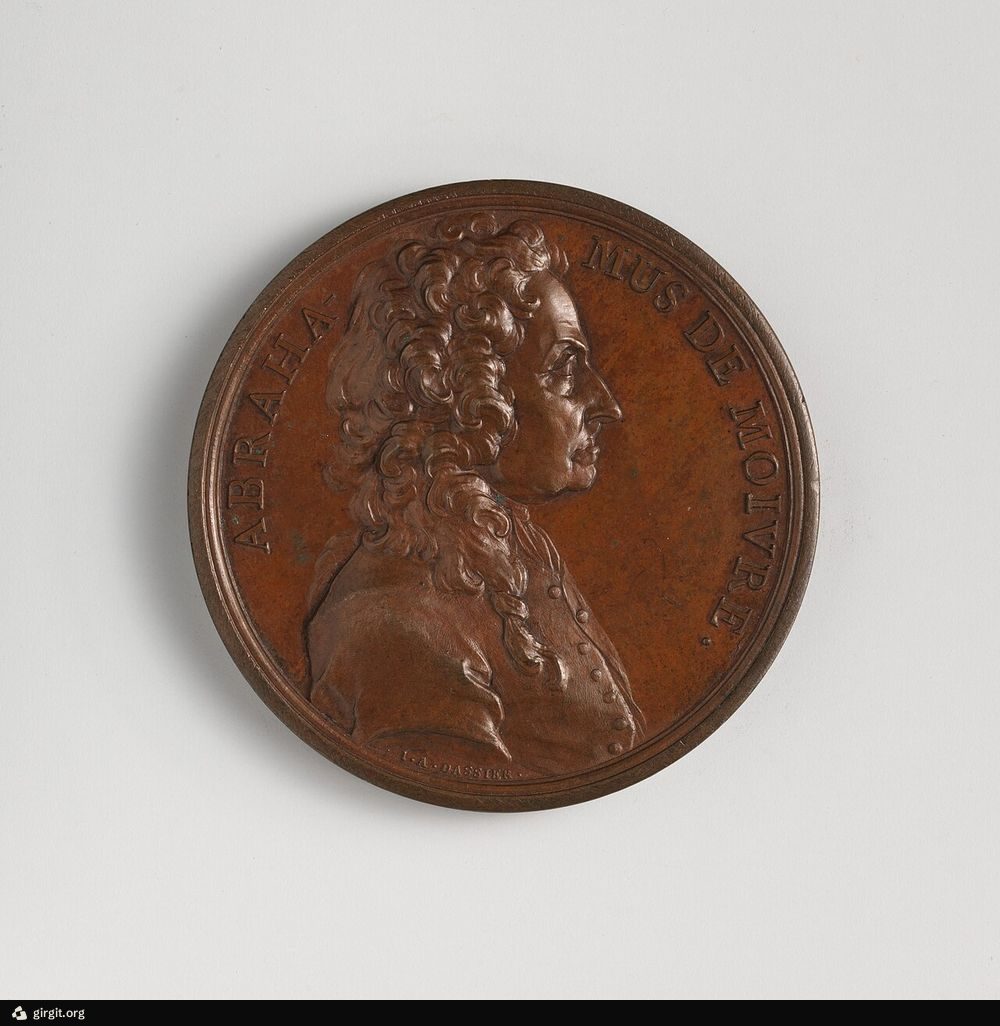 his name in Latinmaker: J. A. Dassier
See it: squaring doubles, cubing triples
Choose an angle \( \theta \) and a power \( n \). The widget expands \( (\cos\theta + i\sin\theta)^n \) with the binomial pattern of this page, works out both parts as numbers, and checks them against \( \cos n\theta \) and \( \sin n\theta \). On the circle you see the whole history: each power is the last one turned by another \( \theta \). Then switch on "Every θ at once": the expanded real part, drawn for every angle, lies exactly on the curve of \( \cos n\theta \).
Solve it
Solve it
Expand \( (c + is)^4 \) with the binomial pattern to find \( \cos 4\theta \) in terms of \( \cos\theta \) alone. Check your answer at \( \theta = 0 \) and \( \theta = 60^\circ \).
Hint
Answer
Spot the error
A student "proves" in a matrix-like system with \( AB \ne BA \) that \( (A + B)^2 = A^2 + 2AB + B^2 \). Which step fails, and what is the correct expansion?
Answer
What is \( (\cos 20^\circ + i\sin 20^\circ)^9 \)?
- \( \cos 29^\circ + i\sin 29^\circ \)
- \( -1 \)
- \( 9i \)
Connect it
Connect it
- Trigonometry, Ch 3. The triple-angle formulas, here from one cube: double and triple angles, and the rotation proof of the sum formulas: sine and cosine of a sum.
- Binomial theorem, Ch 7. \( (c + is)^n \) for any \( n \) uses the binomial coefficients of Pascal's triangle: the binomial theorem.
- Matrices, Class 12. A system where \( AB \ne BA \), so \( (A + B)^2 \) needs four terms: multiplication surprises.
- Concept 1: Bombelli's check. \( (2 + i)^3 = 2 + 11i \) is this page's cube identity in action: why a new number.
Still confused?
Is De Moivre's formula in my syllabus?
Not in the current NCERT chapter, and you will not be examined on it there. JEE uses it often, and it is just "angles add" applied \( n \) times. On this page it is shown only as a use of the cube identity.
Do all identities carry over, even ones with square roots?
All the ones built from adding, subtracting, multiplying and dividing do. Rules about square roots are a different matter: \( \sqrt{a}\sqrt{b} = \sqrt{ab} \) is not proved from the field laws, and it fails for two negative numbers (concept 7).
Sources
- Abraham de Moivre (1667-1754; imprisonment after 1685; tutoring; Newton's "Go to Mr De Moivre"; Slaughter's; the sleep story), MacTutor History of Mathematics, St Andrews.
- Abraham de Moivre (coffee houses, pages of the Principia, chess at Slaughter's Coffee House) and De Moivre's formula (1707, 1722, 1730) and Complex number: history (Euler's formula, 1748), Wikipedia.
- History of quaternions (ij = k, ji = −k), Wikipedia.
- Medal of Abraham de Moivre by Jacques-Antoine Dassier, 1741, Metropolitan Museum of Art, CC0.

Picture and video credits