Complex Numbers and Quadratic Equations
- 1. Why do we need a new kind of number?
- 2. What is a complex number?
- 3. Adding and subtracting complex numbers
- 4. Multiplying complex numbers
- 5. Dividing one complex number by another
- 6. Why the powers of i go round in a circle
- 7. Square roots of negative numbers
- 8. Do the old algebra identities still work?
- 9. Modulus and conjugate
- 10. Complex numbers as points: the Argand plane
- Review
7 of 10·NCERT §4.1 · §4.3.6·6 min
Square roots of negative numbers
The big ideaEvery negative number \( -a \) has two square roots, \( \sqrt{a}\,i \) and \( -\sqrt{a}\,i \); the symbol \( \sqrt{-a} \) means the first one, and the rule \( \sqrt{a}\sqrt{b} = \sqrt{ab} \) breaks when both numbers are negative.
In simple words
Minus nine had no square root before. Now it has two: three \( i \), and minus three \( i \). When we write the root sign, we agree to mean the first one. One old rule now needs care: you used to join two roots into one big root. That still works, except when both numbers inside are below zero. There it gives the wrong sign, so pull out the \( i \) first.
The square roots of \( -1 \)
Since \( i^2 = -1 \) and \( (-i)^2 = i^2 = -1 \), the number \( -1 \) has two square roots: \( i \) and \( -i \). Both solve \( x^2 + 1 = 0 \), that is \( x^2 = -1 \). But the symbol \( \sqrt{-1} \) is reserved for \( i \) only, just as \( \sqrt{9} \) means 3 and not \( -3 \).
Any negative number
Take \( -5 \). Then \( (\sqrt{5}\,i)^2 = 5i^2 = -5 \) and \( (-\sqrt{5}\,i)^2 = 5i^2 = -5 \). So the square roots of \( -5 \) are \( \sqrt{5}\,i \) and \( -\sqrt{5}\,i \), and the symbol \( \sqrt{-5} \) means \( \sqrt{5}\,i \).
In general, if \( a \) is a positive real number,
\[ \sqrt{-a} = \sqrt{a}\,\sqrt{-1} = \sqrt{a}\, i \]Examples: \( \sqrt{-16} = 4i \), \( \sqrt{-12} = \sqrt{12}\,i = 2\sqrt{3}\,i \), \( \sqrt{-\tfrac{1}{4}} = \tfrac{1}{2}i \).
Before the rule, test your instinct.
The trap: \( \sqrt{a} \times \sqrt{b} \)
For positive real numbers you know \( \sqrt{a} \times \sqrt{b} = \sqrt{ab} \). With the meaning of \( \sqrt{-a} \) fixed above, this rule still works when one of \( a, b \) is negative and the other positive, and when either one is zero (both sides are then 0). But it fails when both are negative. See what happens if we pretend it holds:
\[ i^2 = \sqrt{-1}\,\sqrt{-1} \overset{?}{=} \sqrt{(-1)(-1)} = \sqrt{1} = 1 \]That contradicts \( i^2 = -1 \). So
\[ \sqrt{a} \times \sqrt{b} \ne \sqrt{ab} \quad \text{when } a \lt 0 \text{ and } b \lt 0 \]The safe habit: change every \( \sqrt{\text{negative}} \) into \( \sqrt{\text{positive}}\; i \) before doing anything else.
Worked example
- \( \sqrt{-4} \times \sqrt{-9} = 2i \times 3i = 6i^2 = -6 \). (Joining the roots would wrongly give \( \sqrt{36} = 6 \).)
- \( \sqrt{-3} \times \sqrt{12} = \sqrt{3}\,i \times 2\sqrt{3} = 6i \). (Here one number is positive, and \( \sqrt{-36} = 6i \) agrees.)
- \( \sqrt{-25} + 3\sqrt{-4} - \sqrt{-49} = 5i + 6i - 7i = 4i \).
Back to quadratic equations
We started the chapter wanting to solve \( ax^2 + bx + c = 0 \) when \( D = b^2 - 4ac \lt 0 \). Now we can. The Class 10 formula
\[ x = \frac{-b \pm \sqrt{D}}{2a} \]still works, with \( \sqrt{D} = \sqrt{-D}\; i \) when \( D \) is negative. The two roots are then complex numbers.
Try it: raise c and follow the two roots as D turns negative.
Here is the same story in motion for \( x^2 + 2x + c \), with the parabola beside the roots. Watch what happens at the moment the curve lifts off the axis:
Worked example
Solve \( x^2 + 2x + 5 = 0 \).
- \( a = 1, b = 2, c = 5 \). \( D = 4 - 20 = -16 \), so \( \sqrt{D} = \sqrt{-16} = 4i \).
- \( x = \dfrac{-2 \pm 4i}{2} = -1 \pm 2i \).
- Check \( x = -1 + 2i \): \( x^2 = 1 - 4i + 4i^2 = -3 - 4i \); then \( x^2 + 2x + 5 = (-3 - 4i) + (-2 + 4i) + 5 = 0 \). Correct.
Notice the two roots \( -1 + 2i \) and \( -1 - 2i \) differ only in the sign of the imaginary part. That always happens when \( a, b, c \) are real and \( D \lt 0 \).
Don't mix these up
- \( \sqrt{-9} = 3i \), not \( -3 \). A negative sign under the root becomes an \( i \), not a minus outside.
- \( \sqrt{-2}\sqrt{-8} = -4 \), not \( 4 \). Both negative: pull out \( i \) first.
- \( -9 \) has two square roots, \( \pm 3i \); the symbol \( \sqrt{-9} \) names just one of them, \( 3i \).
Try it. (a) Simplify \( \sqrt{-18} \). (b) Find \( \sqrt{-6} \times \sqrt{-6} \). (c) Solve \( x^2 - 4x + 13 = 0 \). (d) Solve \( x^2 + x + 1 = 0 \).
Answer
Just remember
Two conventions here are choices, not facts of nature. Learn them as rules; the deep dive shows why the second one has to be there.
- \( \sqrt{-a} \) means \( \sqrt{a}\,i \) (for \( a \gt 0 \)), the root with the plus sign
- "The root sign always picks the friendly one": \( \sqrt{9} = 3 \), not \( -3 \), and \( \sqrt{-9} = 3i \), not \( -3i \). Both \( \pm 3i \) square to \( -9 \); the symbol just names one of them.
- \( \sqrt{a}\sqrt{b} = \sqrt{ab} \) fails only when both \( a \) and \( b \) are negative
- "Two minuses under two roots: take the \( i \)'s out first." Rebuild: \( \sqrt{-1}\sqrt{-1} = i^2 = -1 \), but \( \sqrt{(-1)(-1)} = 1 \).
- Real coefficients, \( D \lt 0 \): roots \( p \pm qi \)
- "Complex roots come as twins": same real part \( -\tfrac{b}{2a} \), opposite imaginary parts \( \pm\tfrac{\sqrt{-D}}{2a} \).
- Square root of \( -a \)
- Either of the two numbers \( \pm\sqrt{a}\,i \) whose square is \( -a \).
- \( \sqrt{-a} \)
- The symbol for \( \sqrt{a}\,i \) (for \( a \gt 0 \)).
- Discriminant \( D \)
- \( b^2 - 4ac \); if negative, the quadratic has two complex roots.
- Complex roots
- Roots of the form \( p \pm qi \) with \( q \ne 0 \).
Words to know
What is \( \sqrt{-9} \times \sqrt{-16} \)?
- \( 12 \)
- \( -12 \)
- \( 12i \)
What are the roots of \( x^2 + 9 = 0 \)?
- \( \pm 3 \)
- \( \pm 3i \)
- \( \pm 9i \)
A quadratic \( x^2 + bx + c = 0 \) with real \( b, c \) has a root \( 3 - i \). What is the other root?
- \( -3 - i \)
- \( 3 + i \)
- \( -3 + i \)
Deep dive · optional
Why does every quadratic have exactly two roots?
With \( i \) allowed, the quadratic formula never fails. This goes into why there are always two roots and never three, why they come in mirror pairs, why the \( \sqrt{a}\sqrt{b} \) rule breaks, and the 1,200-year road from Brahmagupta to Gauss. The exam asks only the formula; this is the reason behind it.
The roots: square roots, factors and mirrors
- Why does solving a quadratic come down to one square root?Complete the square. Multiply \( ax^2 + bx + c = 0 \) by \( 4a \) and add \( b^2 \) to both sides: \( 4a^2x^2 + 4abx + b^2 = b^2 - 4ac \), that is \( (2ax + b)^2 = D \). So \( 2ax + b \) must be a square root of \( D \).
- Why does that always work now?Every number has two square roots in the complex numbers: \( \pm\sqrt{D} \) if \( D \ge 0 \), and \( \pm\sqrt{-D}\,i \) if \( D \lt 0 \). So \( 2ax + b \) always has two values, and \( x = \tfrac{-b \pm \sqrt{D}}{2a} \) always gives two roots (the same one twice when \( D = 0 \)).
- Why not a third root?If \( r \) and \( s \) are the two roots, then \( ax^2 + bx + c = a(x - r)(x - s) \). A product of complex numbers is 0 only if one factor is 0 (lengths multiply, and a length is 0 only for 0 itself). So \( x \) must be \( r \) or \( s \); there is no room for a third.
- Why do the two complex roots mirror each other?Because conjugation passes through adding and multiplying (concept 9). If \( a, b, c \) are real and \( ar^2 + br + c = 0 \), take the conjugate of everything: \( a\bar{r}^2 + b\bar{r} + c = \bar{0} = 0 \). So \( \bar{r} \) is a root too.
- And underneath all polynomials?The fundamental theorem of algebra: every polynomial of degree \( n \) with complex coefficients has exactly \( n \) roots in the complex numbers, counting repeats. Quadratics are the case \( n = 2 \). With \( i \) added once, no polynomial ever needs another new kind of number.
The same picture explains the \( \sqrt{a}\sqrt{b} \) trap. A square root halves the angle on the plane: \( -4 \) sits at \( 180^\circ \), so \( \sqrt{-4} = 2i \) sits at \( 90^\circ \). Then \( \sqrt{-4}\sqrt{-9} \) points at \( 90^\circ + 90^\circ = 180^\circ \): it is \( -6 \). But \( (-4)(-9) = 36 \) sits at \( 360^\circ \), which is the same place as \( 0^\circ \), and the root sign takes half of \( 0^\circ \), not half of \( 360^\circ \). Halving a full turn gives a half turn, which flips the sign. That is the whole trap.
The story: from "the question is absurd" to "always two"
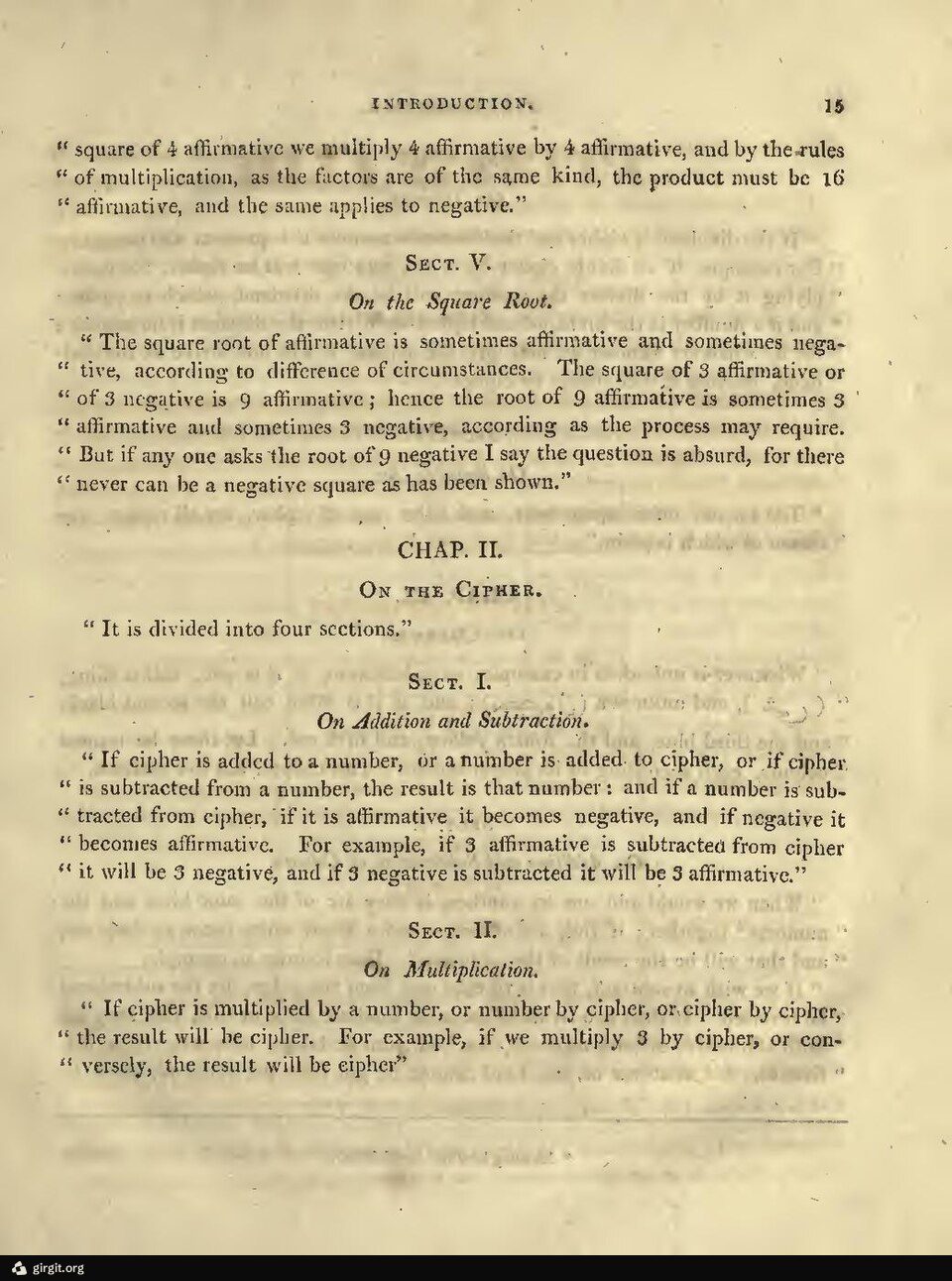 Bhāskara: no root for a negative
See it: shrink a circle until it catches a root
Here is a modern way to see the fundamental theorem for a quadratic. On the left, \( z \) goes once round a circle. On the right is where \( p(z) = z^2 + bz + c \) goes, in the same colours. For a huge circle \( z^2 \) dominates, and since squaring doubles angles, the image goes round 0 twice. For a tiny circle the image hardly moves away from \( c \) and goes round 0 no times. Shrink the circle slowly: the number of turns can only change when the image curve sweeps across 0, and that happens exactly when the circle passes through a root.
Switch on "Turns for every radius": the count of turns jumps at each root's distance from 0. A mirror pair sits at one distance, so the count jumps from 0 straight to 2; set \( b = -1 \), \( c = -6 \) (roots 3 and \( -2 \)) to see it step 0, 1, 2. Two steps, two roots. For a polynomial of degree \( n \) the big circle goes round \( n \) times, so there are \( n \) steps and \( n \) roots.
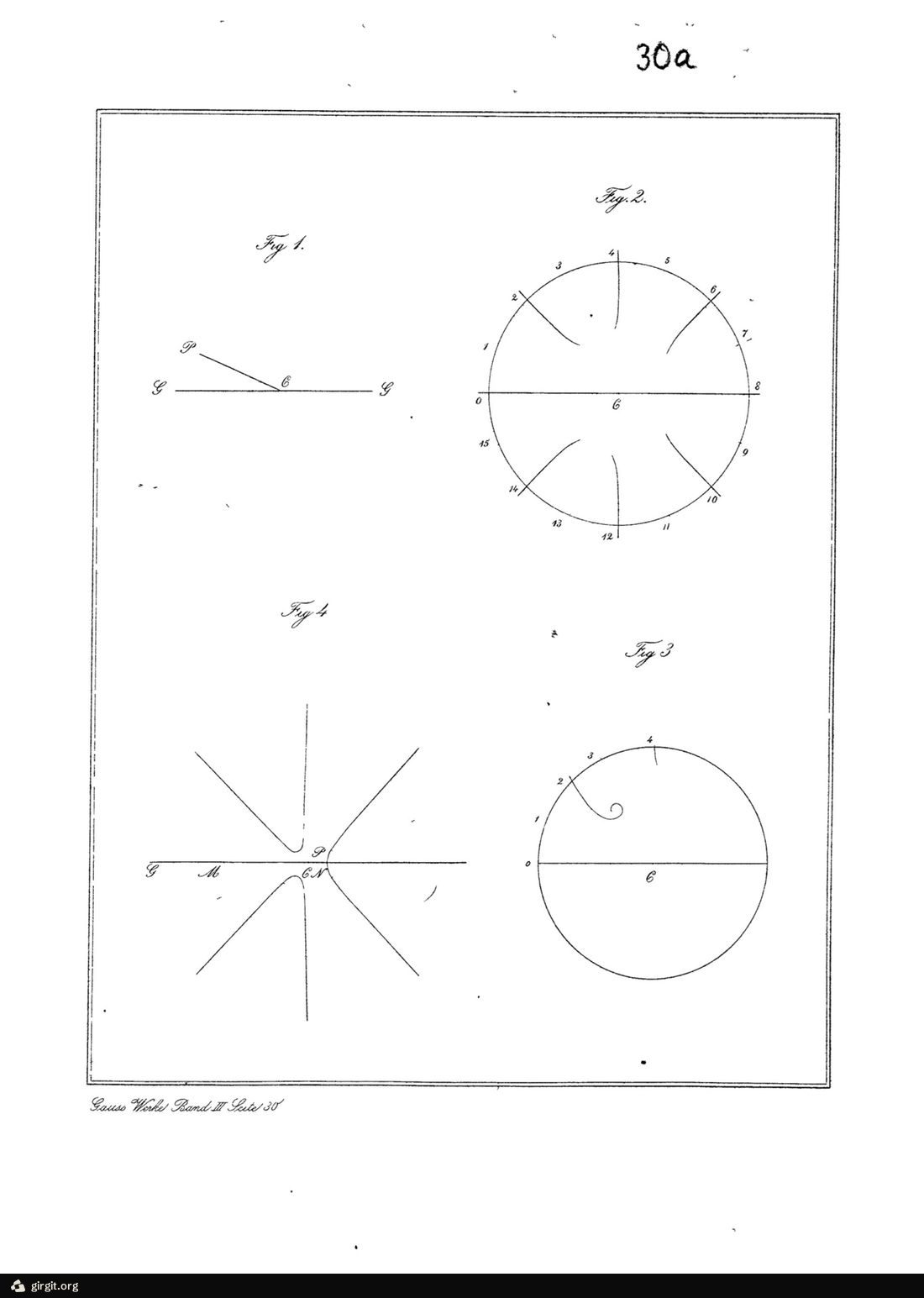 numbered points where curves meet the circle
Solve it
Solve it, Śrīdhara's way
Solve \( 2x^2 + 3x + 5 = 0 \) by completing the square exactly as Śrīdhara's rule says, without quoting the formula.
Hint
Answer
Work backwards
\( 2 + 3i \) is a root of \( x^2 + bx + c = 0 \), where \( b \) and \( c \) are real. Find \( b \) and \( c \).
Answer
How many complex numbers \( z \) satisfy \( z^3 = 8 \)?
- One: \( z = 2 \)
- Two: \( z = \pm 2 \)
- Three
Connect it
Connect it
- Concept 1: the cubic. A cubic with three real roots still needs \( i \) on the way: why a new number.
- Concept 9: conjugates. The rules \( \overline{z_1 + z_2} = \bar{z}_1 + \bar{z}_2 \) and \( \overline{z_1 z_2} = \bar{z}_1\bar{z}_2 \) are what force the mirror pairs: modulus and conjugate.
- Concept 6: turning. "A square root halves the angle" is "powers multiply the angle" run backwards: powers of any z.
- Physics: resonance. A tuned LCR circuit rings, like a struck bell, exactly when its quadratic has complex roots; how fast the ringing dies is the real part: how a radio picks one station.
Still confused?
Was Bhāskara wrong to call \( \sqrt{-9} \) absurd?
No. He was talking about the numbers he had, and among real numbers no square is negative, so the question has no answer there. What changed later was not the facts but the number system: once \( i \) is allowed, the question has two answers, \( \pm 3i \). Both statements are true, each in its own system.
Does "exactly two roots" hold when \( D = 0 \)?
Yes, if you count the repeated root twice: \( x^2 - 6x + 9 = (x - 3)^2 \) has the root 3 "twice". That is how the fundamental theorem counts, and it is why the winding picture still steps up by 2 in total.
Sources
- Brahmagupta (Brāhmasphuṭasiddhānta, 628, Bhillamala; verses 18.35, 18.44-45), Wikipedia; Brahmagupta, MacTutor.
- Śrīdhara (his rule for quadratics, quoted by Bhāskara II), MacTutor; Mahāvīra, Wikipedia.
- E. Strachey, Bija Ganita, or the Algebra of the Hindus (London, 1813), Introduction p. 15, "On the Square Root", Internet Archive; Bijaganita (first text to recognise two square roots), Wikipedia.
- Fundamental theorem of algebra (Gauss 1799, its gap filled by Ostrowski 1920; Argand 1806; the winding-number proof), Wikipedia; Gauss (dissertation, Helmstedt 1799), MacTutor.
- Complex number: history (√a√b and the symbol i), Wikipedia.
Picture and video credits