Complex Numbers and Quadratic Equations
- 1. Why do we need a new kind of number?
- 2. What is a complex number?
- 3. Adding and subtracting complex numbers
- 4. Multiplying complex numbers
- 5. Dividing one complex number by another
- 6. Why the powers of i go round in a circle
- 7. Square roots of negative numbers
- 8. Do the old algebra identities still work?
- 9. Modulus and conjugate
- 10. Complex numbers as points: the Argand plane
- Review
4 of 10·NCERT §4.3.3·5 min
Multiplying complex numbers
The big ideaMultiply complex numbers by opening the brackets as in ordinary algebra and replacing \( i^2 \) by \( -1 \); every non-zero complex number then has a reciprocal \( \tfrac{1}{z} \).
In simple words
To times two of these two-part numbers, times every piece of the first by every piece of the second, just like you learnt for brackets. You get four pieces. One of them has \( i \) times \( i \), and that is just minus one, so it jumps over and joins the plain part. Add up the plain pieces, add up the \( i \) pieces, and you are done.
The product rule
Let \( z_1 = a + ib \) and \( z_2 = c + id \). Open the brackets:
\[ (a + ib)(c + id) = ac + iad + ibc + i^2 bd \]Put \( i^2 = -1 \), then collect the real and imaginary parts:
\[ z_1 z_2 = (ac - bd) + i(ad + bc) \]This is the definition of the product. You do not need to memorise it: opening brackets always gets you there. Notice that the real part of the product is not just the product of the real parts; the term \( -bd \) comes from \( i \times i \).
Try it: change any number and watch the four pieces, especially the one that crosses over.
The rule is pure algebra, but it hides a picture. Put every number on a plane as a point (concept 10 does this properly) and watch what multiplying by one fixed number \( w \) does to all of them at once:
Worked example
- \( (2 + 3i)(4 - i) = 8 - 2i + 12i - 3i^2 = 8 + 10i + 3 = 11 + 10i \).
Check with the rule: \( a = 2, b = 3, c = 4, d = -1 \). Real: \( 8 - (3)(-1) = 11 \). Imaginary: \( 2(-1) + 3(4) = 10 \). - \( (1 + i)^2 = 1 + 2i + i^2 = 2i \). A neat result worth remembering.
- \( (3 + 4i)(3 - 4i) = 9 - 12i + 12i - 16i^2 = 9 + 16 = 25 \). The \( i \) terms cancel and the answer is real. You will see why in concept 9.
- \( 5i \times (2 - 7i) = 10i - 35i^2 = 35 + 10i \).
The laws of multiplication
For all complex numbers \( z_1, z_2, z_3 \) (NCERT states these without proof):
- Closure law: \( z_1 z_2 \) is a complex number.
- Commutative law: \( z_1 z_2 = z_2 z_1 \).
- Associative law: \( (z_1 z_2) z_3 = z_1 (z_2 z_3) \).
- Multiplicative identity: the number \( 1 + i0 \), written 1, satisfies \( z \cdot 1 = z \).
- Multiplicative inverse: every non-zero \( z = a + ib \) has an inverse, written \( \tfrac{1}{z} \) or \( z^{-1} \), with \( z \cdot \tfrac{1}{z} = 1 \). It is \[ \frac{1}{z} = \frac{a}{a^2 + b^2} + i\,\frac{-b}{a^2 + b^2} \]
- Distributive law: \( z_1(z_2 + z_3) = z_1 z_2 + z_1 z_3 \) and \( (z_1 + z_2) z_3 = z_1 z_3 + z_2 z_3 \).
"Non-zero" means \( a \) and \( b \) are not both 0, so that \( a^2 + b^2 \ne 0 \). One of them may be 0: the inverse of \( 3i \) (here \( a = 0 \), \( b = 3 \)) is \( \tfrac{0}{9} + i\tfrac{-3}{9} = -\tfrac{1}{3}i \). Check: \( 3i \times \left(-\tfrac{1}{3}i\right) = -i^2 = 1 \).
Where does the inverse formula come from?
Multiply \( a + ib \) by \( a - ib \): you get \( a^2 - (ib)^2 = a^2 + b^2 \), a real number. Dividing by that real number gives 1:
\[ (a + ib) \cdot \frac{a - ib}{a^2 + b^2} = \frac{a^2 + b^2}{a^2 + b^2} = 1 \]So \( \tfrac{a - ib}{a^2 + b^2} \) is the inverse. Split into parts, that is exactly the formula above.
Worked example
Find the multiplicative inverse of \( z = 3 + 4i \).
- \( a = 3 \), \( b = 4 \), \( a^2 + b^2 = 9 + 16 = 25 \).
- \( \dfrac{1}{z} = \dfrac{3}{25} - \dfrac{4}{25}i \).
- Check: \( (3 + 4i)(3 - 4i) = 25 \) from above, and \( \tfrac{25}{25} = 1 \).
Don't mix these up
- \( (a + ib)(c + id) \ne ac + ibd \). Multiply all four pairs, then use \( i^2 = -1 \).
- \( i^2 = -1 \) turns a product of two imaginary pieces into a real piece with the opposite sign: \( (2i)(3i) = -6 \).
- The inverse of \( a + ib \) is not \( \tfrac{1}{a} + \tfrac{1}{ib} \).
Try it. (a) \( (1 - 2i)(3 + i) \). (b) \( (2 + i)(2 - i) \). (c) The multiplicative inverse of \( 1 - i \).
Answer
Just remember
The product rule has a reason (open the brackets), but under exam pressure two small things go wrong. Hooks below; you can always rebuild by opening the brackets.
- \( (a + ib)(c + id) = (ac - bd) + i(ad + bc) \)
- Real part: "firsts minus lasts" (\( ac \) minus \( bd \)); the minus is the \( i^2 \). Imaginary part: "outers plus inners" (\( ad + bc \)). Check with \( i \times i \): \( a = 0, b = 1, c = 0, d = 1 \) gives \( (0 - 1) + i(0) = -1 \).
- \( (1 + i)^2 = 2i \) and \( (1 - i)^2 = -2i \)
- "One plus i, squared, stands up straight": 45° doubled is 90°, straight up the imaginary axis, and \( \sqrt{2} \times \sqrt{2} = 2 \). Rebuild: \( 1 + 2i + i^2 = 2i \).
- \( \dfrac{1}{a + ib} = \dfrac{a - ib}{a^2 + b^2} \)
- "Flip the sign, divide by the sum of squares." Rebuild: multiply \( a + ib \) by \( a - ib \) to get \( a^2 + b^2 \), then divide.
- Product
- \( (a + ib)(c + id) = (ac - bd) + i(ad + bc) \).
- Multiplicative identity
- The number \( 1 = 1 + i0 \); multiplying by it changes nothing.
- Multiplicative inverse
- The number \( \tfrac{1}{z} \) with \( z \cdot \tfrac{1}{z} = 1 \); exists for every \( z \ne 0 \).
- Distributive law
- \( z_1(z_2 + z_3) = z_1 z_2 + z_1 z_3 \): multiplying spreads over adding.
Words to know
What is \( (2 + i)(3 + 2i) \)?
- \( 6 + 2i \)
- \( 4 + 7i \)
- \( 8 + 7i \)
Which complex number has no multiplicative inverse?
- \( i \)
- \( 0 + 5i \)
- \( 0 + 0i \)
What is the multiplicative inverse of \( 2 + i \)?
- \( \tfrac{2}{5} - \tfrac{1}{5}i \)
- \( \tfrac{1}{2} - i \)
- \( 2 - i \)
Deep dive · optional
Why does multiplying turn things?
The rule \( (ac - bd) + i(ad + bc) \) was fixed by algebra alone. Yet on the plane it does something beautiful: it turns and stretches. Here is why, and how a Danish map-maker saw it first. Not for the exam; it is here so that the product rule has a picture.
The roots: lengths multiply, angles add
- What does multiplying by \( i \) do to a point?\( i(a + ib) = ia + i^2 b = -b + ia \). So the point \( (a, b) \) goes to \( (-b, a) \). Try it: \( (1, 0) \to (0, 1) \to (-1, 0) \to (0, -1) \). The new arrow has the same length \( \sqrt{a^2 + b^2} \) and is at right angles to the old one (their dot product \( a(-b) + b(a) \) is 0). Multiplying by \( i \) is a quarter turn anticlockwise.
- What does multiplying by \( w = c + id \) do?Split it: \( wz = c\,z + d\,(iz) \). That is \( c \) copies of the arrow \( z \), plus \( d \) copies of \( z \) turned a quarter turn. Those two pieces are at right angles, like the two legs of a right triangle.
- So how long is \( wz \), and which way does it point?The legs are \( c|z| \) and \( d|z| \), so by Pythagoras the result has length \( |z|\sqrt{c^2 + d^2} = |z|\,|w| \). And it is turned away from \( z \) by exactly the angle that \( (c, d) \) makes with the real axis: the angle of \( w \). Lengths multiply, angles add.
- Why does that match the trigonometry of Chapter 3?A number of length 1 at angle \( A \) is \( \cos A + i\sin A \). Multiply two of them with the product rule: \( (\cos A\cos B - \sin A\sin B) + i(\sin A\cos B + \cos A\sin B) \). That is \( \cos(A + B) + i\sin(A + B) \): the sum formulas are the product rule in disguise.
- And underneath?Only \( i^2 = -1 \) and the distributive law. Nobody designed the rule to turn things; the turning fell out of the algebra.
One consequence you can use straight away: the triangle with corners \( 0, 1, z \) and the triangle with corners \( 0, w, wz \) have the same shape. The second is the first, turned by the angle of \( w \) and stretched by \( |w| \). This is also why \( |z_1 z_2| = |z_1|\,|z_2| \) in concept 9 is true.
The story: a map-maker's paper
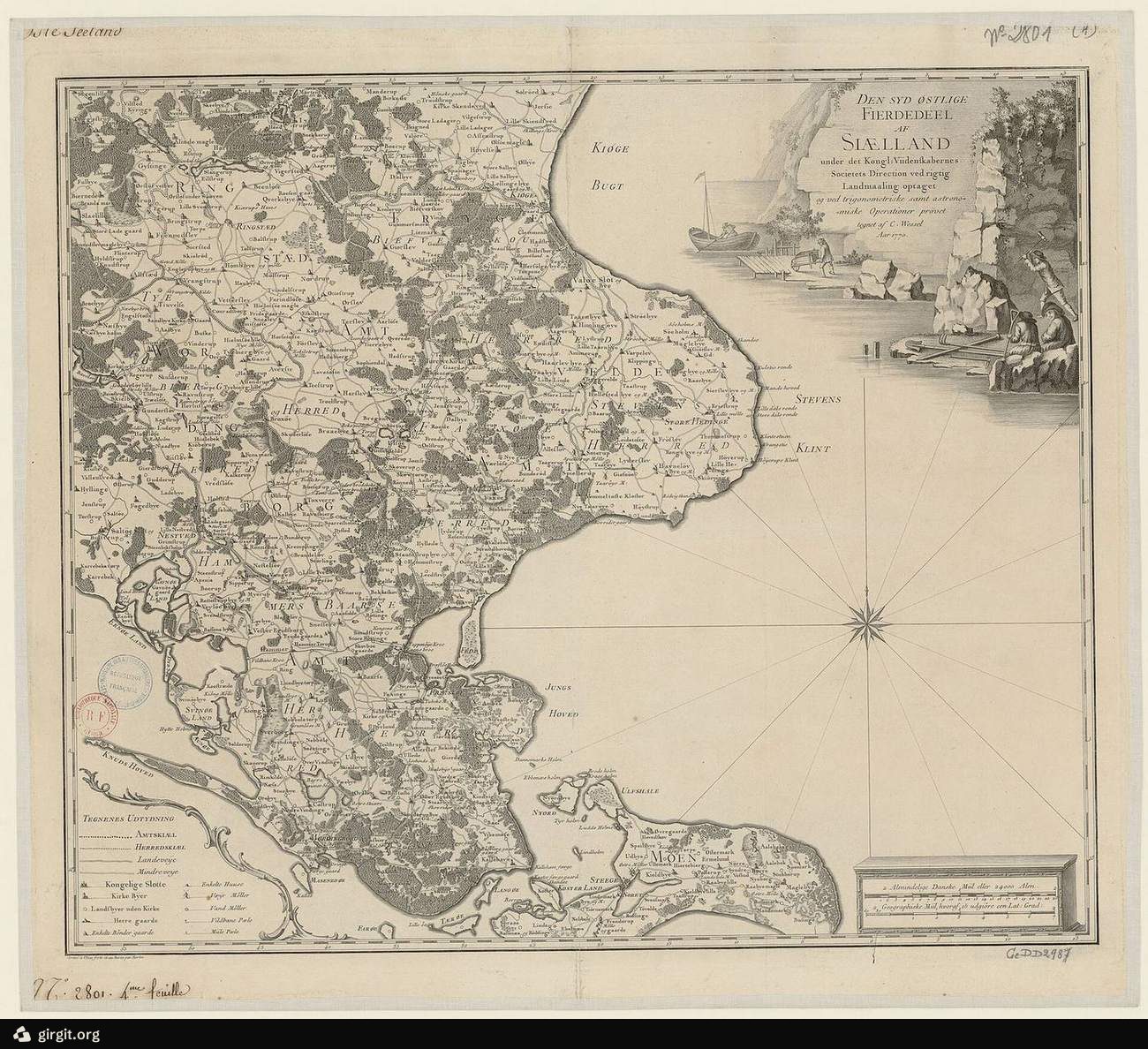 drawn by C. Wessel, 1770compass rose: directionsscale bar
See it: drag two numbers and multiply them
Drag \( z \) and \( w \). The product \( zw \) moves so that its length is always \( |z| \times |w| \) and its angle is always \( \theta + \varphi \); the line under the picture keeps the score. The two shaded triangles are Wessel's rule: the indigo one is always the amber one, turned and stretched by \( w \). Switch to "Times a whole shape" to see that \( w \) does the same to every point at once.
Two things to try: put \( w \) on the unit circle (say \( w = i \) or \( w = -1 \)): the length never changes, only the angle. Then put \( w \) on the positive real axis: only the length changes. Every other \( w \) does a bit of both.
Solve it
Solve it
Turn the point \( 3 + 4i \) by \( 90^\circ \) anticlockwise about the origin, then by another \( 45^\circ \), without drawing anything. Where does it land?
Hint
Answer
Proof step
Use "angles add" to explain, with no calculation, why \( (1 + i)^8 = 16 \).
Answer
\( |z| = 2 \) at angle \( 30^\circ \), and \( |w| = 3 \) at angle \( 60^\circ \). Where is \( zw \)?
- length 5 at \( 90^\circ \)
- length 6 at \( 90^\circ \), that is \( 6i \)
- length 6 at \( 1800^\circ \)
Connect it
Connect it
- Trigonometry, Ch 3. The rotation proof of \( \cos(x + y) \) and \( \sin(x + y) \) is this page's product rule seen from the other side: sine and cosine of a sum.
- Concept 6: powers of \( i \). Four quarter turns make a full turn, which is why \( i^4 = 1 \): powers of i.
- Concept 9: modulus. "Lengths multiply" is the rule \( |z_1 z_2| = |z_1|\,|z_2| \): modulus and conjugate.
- Concept 5: dividing. Dividing undoes the turn and the stretch: dividing is turning back.
- Physics: phasors. In an AC circuit an inductor turns the current's arrow a quarter turn behind the voltage: in the engineer's language, a factor of \( j \): phasors.
Still confused?
Why does multiplying by \( -1 \) turn a point half way round?
Because \( -1 \) sits at angle \( 180^\circ \) with length 1: "angles add" says the product is turned by \( 180^\circ \), which takes \( z \) to the opposite side of O. On the number line this is the old fact that \( -1 \times 3 = -3 \): a half turn of the line flips 3 to −3. And since \( i \times i = -1 \), two quarter turns make that half turn.
Is "angles add" an extra rule I have to learn for the exam?
No. The current syllabus only asks you to multiply with \( (ac - bd) + i(ad + bc) \). The turning picture is a way to check answers quickly (is \( (1 + i)^4 \) real? Four times \( 45^\circ \) is \( 180^\circ \), so yes, and negative: \( -4 \)).
Sources
- Caspar Wessel (survey work, maps, the paper read on 10 March 1797, noticed in 1895, French translation 1897), MacTutor History of Mathematics, St Andrews.
- Wessel, Caspar (his rule for the product: ratio to the unit, direction differing by the same amount), Complete Dictionary of Scientific Biography.
- Caspar Wessel, Wikipedia; Complex plane (multiplication: moduli multiply, arguments add), Wikipedia.
- Map of south-east Zealand, drawn by C. Wessel, Bibliothèque nationale de France via Wikimedia Commons.

Picture and video credits