Complex Numbers and Quadratic Equations
- 1. Why do we need a new kind of number?
- 2. What is a complex number?
- 3. Adding and subtracting complex numbers
- 4. Multiplying complex numbers
- 5. Dividing one complex number by another
- 6. Why the powers of i go round in a circle
- 7. Square roots of negative numbers
- 8. Do the old algebra identities still work?
- 9. Modulus and conjugate
- 10. Complex numbers as points: the Argand plane
- Review
9 of 10·NCERT §4.4·6 min
Modulus and conjugate
The big ideaThe modulus \( |z| = \sqrt{a^2 + b^2} \) measures the size of \( z = a + ib \), the conjugate \( \bar{z} = a - ib \) flips the sign of its imaginary part, and the two are tied together by \( z\bar{z} = |z|^2 \).
In simple words
Every one of these numbers has a size, a single plain number that says how big it is, never below zero. Every one also has a mirror twin: keep the plain part, turn round the sign of the \( i \) part. Times a number by its twin and the \( i \) parts cancel, leaving just its size, squared. That one fact is the key to dividing, and to finding sizes quickly.
The two definitions
Let \( z = a + ib \).
- The modulus of \( z \), written \( |z| \), is the non-negative real number \[ |z| = \sqrt{a^2 + b^2} \]
- The conjugate of \( z \), written \( \bar{z} \) ("z bar"), is the complex number \[ \bar{z} = a - ib \]
Examples: \( |6 + 8i| = \sqrt{36 + 64} = 10 \); \( |1 - i| = \sqrt{1 + 1} = \sqrt{2} \); \( |{-7}| = 7 \); \( |5i| = 5 \). And \( \overline{4 + 7i} = 4 - 7i \); \( \overline{-2 - i} = -2 + i \); \( \overline{5i} = -5i \); \( \overline{9} = 9 \).
For a real number the modulus is the usual absolute value, and the conjugate is the number itself.
Try it: drag z around and watch its size and its mirror twin.
The key fact: \( z\bar{z} = |z|^2 \)
\[ z\bar{z} = (a + ib)(a - ib) = a^2 - i^2 b^2 = a^2 + b^2 = |z|^2 \]So a number times its conjugate is always a non-negative real number. This explains the division trick of concept 5 and gives a short formula for the multiplicative inverse of a non-zero \( z \):
\[ z^{-1} = \frac{1}{a + ib} = \frac{a - ib}{a^2 + b^2} = \frac{\bar{z}}{|z|^2} \]Worked example
Find the multiplicative inverse of \( 1 + 3i \).
- \( \bar{z} = 1 - 3i \), \( |z|^2 = 1 + 9 = 10 \).
- \( z^{-1} = \dfrac{1 - 3i}{10} = \dfrac{1}{10} - \dfrac{3}{10}i \).
Rules for products, quotients and sums
For any complex numbers \( z_1 \) and \( z_2 \):
- \( |z_1 z_2| = |z_1|\,|z_2| \): the size of a product is the product of the sizes.
- \( \left|\dfrac{z_1}{z_2}\right| = \dfrac{|z_1|}{|z_2|} \), provided \( |z_2| \ne 0 \).
- \( \overline{z_1 z_2} = \overline{z_1}\,\overline{z_2} \): conjugate of a product is the product of conjugates.
- \( \overline{z_1 \pm z_2} = \overline{z_1} \pm \overline{z_2} \).
- \( \overline{\left(\dfrac{z_1}{z_2}\right)} = \dfrac{\overline{z_1}}{\overline{z_2}} \), provided \( z_2 \ne 0 \).
Two more facts that follow straight from the definitions: \( z + \bar{z} = 2a = 2\,\text{Re}\, z \) and \( z - \bar{z} = 2ib = 2i\,\text{Im}\, z \). Also \( |\bar{z}| = |z| \).
Try it: is the size of a sum the sum of the sizes?
Careful: there is no such rule for sums of moduli. In general \( |z_1 + z_2| \ne |z_1| + |z_2| \); for example \( |1 + (-1)| = 0 \) but \( |1| + |{-1}| = 2 \).
Worked example
- Find \( |(3 + 4i)(5 - 12i)| \) without multiplying out. \( |3 + 4i| = 5 \) and \( |5 - 12i| = 13 \), so the answer is \( 5 \times 13 = 65 \).
- Find \( \left|\dfrac{1 + i}{1 - i}\right| \). Both moduli are \( \sqrt{2} \), so the answer is 1. (Indeed the quotient is \( i \).)
- Find the conjugate of \( \dfrac{(2 + i)^2}{3 - i} \). Simplify first: \( (2 + i)^2 = 3 + 4i \), and \( \dfrac{3 + 4i}{3 - i} = \dfrac{(3 + 4i)(3 + i)}{10} = \dfrac{9 + 3i + 12i + 4i^2}{10} = \dfrac{5 + 15i}{10} = \dfrac{1}{2} + \dfrac{3}{2}i \). So the conjugate is \( \dfrac{1}{2} - \dfrac{3}{2}i \).
- If \( x + iy = \dfrac{3 + 4i}{4 - 3i} \), show \( x^2 + y^2 = 1 \). Take moduli: \( x^2 + y^2 = |x + iy|^2 = \left(\dfrac{|3 + 4i|}{|4 - 3i|}\right)^2 = \left(\dfrac{5}{5}\right)^2 = 1 \).
Don't mix these up
- \( |a + ib| = \sqrt{a^2 + b^2} \), not \( \sqrt{a^2 - b^2} \) and not \( a + b \). The modulus is never negative.
- The conjugate changes only the sign of the imaginary part: \( \overline{-3 + 2i} = -3 - 2i \). The negative \( -z \) changes both signs.
- \( z\bar{z} = |z|^2 \), not \( |z| \): \( (3 + 4i)(3 - 4i) = 25 = 5^2 \).
Try it. (a) Find \( |{-5 + 12i}| \) and the conjugate of \( -5 + 12i \). (b) Find the inverse of \( 4 - 3i \). (c) Find \( |(1 + i)^{8}| \). (d) For which \( z \) is \( z = \bar{z} \)?
Answer
Just remember
Each rule below has a one-line proof, but in an exam you want them as reflexes. The hooks sort them into "goes through" and "does not".
- The bar goes through everything: \( \overline{z_1 \pm z_2} = \bar{z}_1 \pm \bar{z}_2 \), \( \overline{z_1z_2} = \bar{z}_1\bar{z}_2 \), \( \overline{z_1/z_2} = \bar{z}_1/\bar{z}_2 \)
- "The bar is polite: it walks through every door." Reason: the bar only swaps \( i \) for \( -i \), and \( -i \) obeys the same rule \( (-i)^2 = -1 \).
- The modulus goes through \( \times \) and \( \div \), not \( + \)
- "Sizes multiply, they don't add." \( |z_1z_2| = |z_1||z_2| \), but \( |1 + (-1)| = 0 \ne 2 \). For sums you only get \( |z_1 + z_2| \le |z_1| + |z_2| \).
- \( z\bar{z} = |z|^2 \), \( z + \bar{z} = 2\,\text{Re}\,z \), \( z - \bar{z} = 2i\,\text{Im}\,z \)
- "A number times its twin is its size squared; plus its twin, twice the real part; minus its twin, twice the \( i \) part." Rebuild with \( z = 3 + 4i \): \( 25 \), \( 6 \), \( 8i \).
- Modulus \( |z| \)
- \( \sqrt{a^2 + b^2} \), the size of \( z \); never negative.
- Conjugate \( \bar{z} \)
- \( a - ib \): the imaginary part's sign flipped.
- \( z\bar{z} = |z|^2 \)
- A number times its conjugate is the square of its modulus.
- Inverse
- \( z^{-1} = \dfrac{\bar{z}}{|z|^2} \) for \( z \ne 0 \).
- Non-negative real
- A real number that is zero or positive.
Words to know
What is \( |{-8 + 6i}| \)?
- \( -10 \)
- \( 10 \)
- \( -2 \)
What is \( z\bar{z} \) for \( z = 2 - 5i \)?
- \( -21 \)
- \( 29 \)
- \( \sqrt{29} \)
\( |z_1| = 3 \) and \( |z_2| = 4 \). Which value must \( |z_1 z_2| \) have?
- \( 12 \)
- \( 5 \)
- \( 7 \)
Deep dive · optional
Why does the size of a product multiply?
The rule \( |z_1z_2| = |z_1|\,|z_2| \) has a two-line proof using the conjugate. Written out in real numbers, that proof is a 1,400-year-old identity about sums of squares, known to Diophantus and to Brahmagupta. Not for the exam; it shows how much the conjugate can do.
The roots: twins that algebra cannot tell apart
- Why is \( |zw| = |z|\,|w| \)?Square both sides and use \( z\bar{z} = |z|^2 \): \( |zw|^2 = (zw)\overline{(zw)} = zw\,\bar{z}\bar{w} = (z\bar{z})(w\bar{w}) = |z|^2|w|^2 \). Take square roots (both sides are non-negative). The only steps are \( \overline{zw} = \bar{z}\bar{w} \) and swapping the order of a product.
- Why is \( \overline{zw} = \bar{z}\bar{w} \)?Conjugating means writing \( -i \) wherever \( i \) appears. Now \( -i \) is also a square root of \( -1 \): \( (-i)^2 = -1 \). Every calculation that is true with \( i \) stays true with \( -i \) in its place, because the only rule we ever used about \( i \) was \( i^2 = -1 \). So it does not matter whether you conjugate before or after multiplying.
- What does this look like in real numbers?Put \( z = a + bi \), \( w = c + di \). Then \( zw = (ac - bd) + i(ad + bc) \), and \( |zw|^2 = |z|^2|w|^2 \) says \[ (a^2 + b^2)(c^2 + d^2) = (ac - bd)^2 + (ad + bc)^2 . \] A product of two sums of two squares is again a sum of two squares. Using \( \bar{z}w \) instead gives a second way: \( (ac + bd)^2 + (ad - bc)^2 \).
- Why is that surprising?Because nothing about whole numbers suggests it. \( 5 = 1^2 + 2^2 \) and \( 13 = 2^2 + 3^2 \), and so \( 65 \) must be a sum of two squares: \( 1^2 + 8^2 \), and also \( 4^2 + 7^2 \). The complex numbers explain a fact about ordinary integers.
- And underneath?\( i \) and \( -i \) are perfect twins: no equation built from real numbers can tell them apart. The conjugate is the swap of the twins, and swapping cannot break any true equation.
On the plane it is the same fact you met on concept 4: multiplying stretches lengths by \( |w| \). The algebra proves it without drawing anything.
The story: one identity, three civilisations
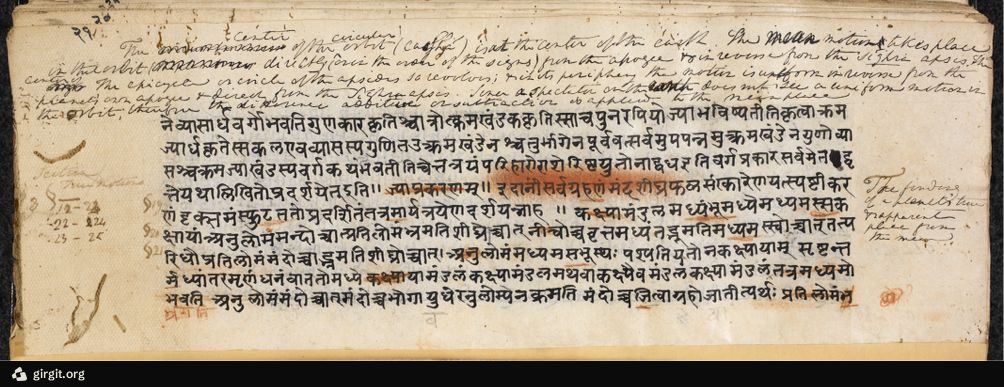 Sanskrit, in DevanagariEnglish notes by a later reader
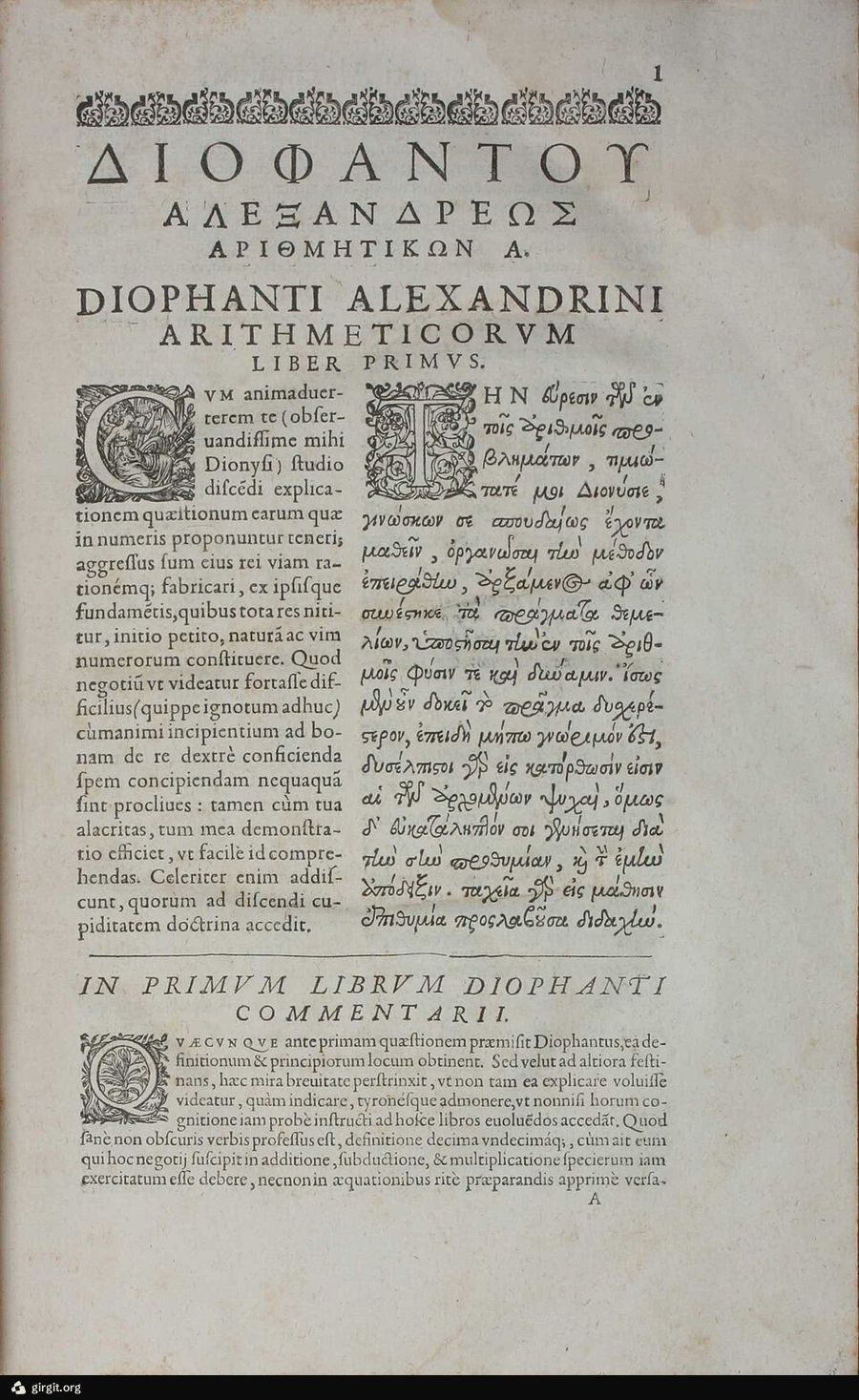 Arithmetic, Book 1
See it: two squares times two squares
Set \( z \) and \( w \) to whole numbers. The plane shows \( zw \) and \( \bar{z}w \): both lie on the same circle, because both have squared length \( |z|^2|w|^2 \). The line above the picture writes the identity with your numbers in. Then switch on "Every number up to 100": the sums of two squares light up, and the product of any two lit numbers is always lit.
Solve it
Solve it
Write \( 221 = 13 \times 17 \) as a sum of two squares in two different ways, using complex numbers.
Hint
Answer
Proof step
Show that a number equal to its own conjugate is real, and a non-zero number equal to minus its conjugate is purely imaginary. Then decide: if \( \dfrac{z - 1}{z + 1} \) is purely imaginary, what is \( |z| \)?
Answer
What is \( |(1 + i)^{10}| \)?
- \( 20 \)
- \( 32 \)
- \( 1024 \)
Connect it
Connect it
- Concept 4: multiplying. "Lengths multiply" seen as a turn and a stretch: multiplying.
- Concept 7: quadratics. "The bar goes through everything" is why complex roots of real quadratics come in mirror pairs: square roots of negatives.
- Concept 10: the plane. \( |z| \) is a distance, and \( |z_1 - z_2| \) is the distance between two points: the Argand plane.
- Concept 5: dividing. Brahmagupta's \( N \) in place of 1 is the same game Hamilton played with more square roots of \( -1 \): dividing.
- Physics: AC circuits. The size of the current is the size of the voltage divided by the size of the impedance, \( |I| = \tfrac{|V|}{|Z|} \): moduli divide, just as here: the series LCR circuit.
Still confused?
Why is \( z\bar{z} \) real but \( z^2 \) usually not?
In \( z\bar{z} = (a + ib)(a - ib) \) the two cross terms \( -iab \) and \( +iab \) cancel. In \( z^2 = (a + ib)^2 \) they add up to \( 2iab \) instead. On the plane: \( z \) and \( \bar{z} \) have opposite angles, which add to 0, so the product points along the real axis; \( z \) and \( z \) have the same angle, which doubles.
Is \( |z|^2 \) the same as \( z^2 \)?
Only for real \( z \). For \( z = i \): \( |z|^2 = 1 \) but \( z^2 = -1 \). The modulus squared is always \( z\bar{z} \), a non-negative real number.
Sources
- Brahmagupta–Fibonacci identity (Diophantus, Arithmetica III.19; Brahmagupta's generalisation and Pell's equation; al-Fazari; Fibonacci 1225), Wikipedia.
- Brahmagupta (Brāhmasphuṭasiddhānta, 628; equations Nx² + 1 = y²), MacTutor History of Mathematics, St Andrews; Brahmagupta, Wikipedia.
- Annotated copy of Pṛthūdhaka's commentary on the Brāhmasphuṭasiddhānta, British Library IOSAN 1304, Wikimedia Commons.
- Diophantus, Arithmetica, Bachet's Greek-Latin edition (1621), Wikimedia Commons.


Picture and video credits