- 1. How fast is a falling stone at one instant?
- 2. What is a limit?
- 3. Left-hand and right-hand limits: when does a limit exist?
- 4. The algebra of limits and limits of polynomials
- 5. Limits of rational functions and the 0/0 puzzle
- 6. The standard limit (xⁿ − aⁿ)/(x − a) = naⁿ⁻¹
- 7. Why sin x / x tends to 1: the sandwich theorem
- 8. Solving limits of trigonometric functions
- 9. What is a derivative? From chord to tangent
- 10. Derivatives from first principles
- 11. Algebra of derivatives: sum, product and quotient rules
- 12. Derivatives of polynomials and trigonometric functions
- Review
2 of 12·NCERT §12.3·4 min
What is a limit?
The big ideaThe limit of \( f(x) \) as \( x \) tends to \( a \) is the value \( f(x) \) gets closer and closer to as \( x \) comes closer and closer to \( a \), whatever happens exactly at \( a \).
In simple words
Walk towards a door, one small step at a time. Even if you never touch the door, anyone watching can tell where you are heading. A limit is like that. We feed a rule numbers that come closer and closer to one number, and watch what comes out. If the answers settle down near one value, that value is where the rule is heading.
In the falling-stone problem we never put the gap equal to 0; we watched where the answers were going. That habit has a name and a symbol.
Reading the symbol
If \( f(x) \) gets as close as we like to a number \( l \) whenever \( x \) is close enough to \( a \) (but not equal to it), we write
\[ \lim_{x \to a} f(x) = l \]and read it "the limit of \( f(x) \) as \( x \) tends to \( a \) is \( l \)". The arrow \( x \to a \) means "\( x \) gets nearer and nearer to \( a \)". You can think of \( l \) as the value that \( f \) ought to have at \( a \), judging only by its neighbours.
Finding a limit with a table
Take \( f(x) = 2x + 1 \) and let \( x \) come close to 4 from both sides:
| \( x \) | 3.9 | 3.99 | 4.01 | 4.1 |
|---|---|---|---|---|
| \( f(x) \) | 8.8 | 8.98 | 9.02 | 9.2 |
The outputs crowd round 9, so \( \lim_{x \to 4} (2x + 1) = 9 \). Here \( f(4) = 9 \) as well: for simple, smooth functions the limit is just the value. A few more you can check the same way:
- \( \lim_{x \to 0} x^2 = 0 \): squares of tiny numbers are even tinier.
- A constant function such as \( f(x) = 3 \) is 3 everywhere, so its limit at any point is 3.
- \( \lim_{x \to \pi/6} \sin x = \frac{1}{2} \), with angles in radians: within 0.002 of \( \frac{\pi}{6} \) the sine stays between 0.498 and 0.502.
- \( \lim_{x \to \pi} (x + \cos x) = \pi - 1 \), which is \( \pi + \cos \pi \).
A limit where the function has no value
Now take \( g(x) = |x| \) with the point \( x = 0 \) left out of its domain. \( g(0) \) does not exist, yet as \( x \) gets near 0 from either side, \( |x| \) gets near 0. So \( \lim_{x \to 0} g(x) = 0 \). The limit doesn't care about the point itself.
A sharper example: \( h(x) = \dfrac{x^2 - 9}{x - 3} \) for \( x \ne 3 \). At \( x = 3 \) it would be \( \frac{0}{0} \), so \( h(3) \) is undefined. But look nearby:
| \( x \) | 2.9 | 2.99 | 2.999 | 3.001 | 3.01 | 3.1 |
|---|---|---|---|---|---|---|
| \( h(x) \) | 5.9 | 5.99 | 5.999 | 6.001 | 6.01 | 6.1 |
The answer is clearly heading for 6. Factorising shows why: \( x^2 - 9 = (x - 3)(x + 3) \), and for \( x \ne 3 \) we may cancel to get \( h(x) = x + 3 \). Its graph is the straight line \( y = x + 3 \) with a single hole at \( (3, 6) \). So \( \lim_{x \to 3} h(x) = 6 \).
Guess first: what is 0/0?
At \( x = 3 \), \( h(x) = \frac{x^2 - 9}{x - 3} \) looks like \( \frac{0}{0} \). Guess: is the limit 0 (top is zero), "infinity" (bottom is zero), 1 (same over same) or "no answer"?
Commit to a guess, then walk \( x \) in towards 3 from both sides and see where the values go.
See what happens
Don't mix these up
- \( f(a) \) is what the function is at \( a \). \( \lim_{x \to a} f(x) \) is what it is heading for near \( a \).
- One can exist without the other, and both can exist yet differ (next page).
- When finding a limit, \( x \) is close to \( a \) but never equal to it. That is why cancelling \( (x - 3) \) is allowed.
Try it. Use a few values of \( x \) close to 0 (such as \( \pm 0.1 \) and \( \pm 0.01 \)) to guess \( \lim_{x \to 0} \dfrac{x^2 + x}{x} \). Then check by cancelling.
Answer
Just remember
The way a limit is written and read is a convention: someone chose it, and everyone now uses it. Learn the reading; the picture of walking towards a door rebuilds the meaning.
- \( \lim_{x \to a} f(x) = l \)
- Read it aloud as "the limit of \( f(x) \) as \( x \) tends to \( a \) is \( l \)". Hook: a road sign. "lim" is the sign, \( x \to a \) underneath is the road you walk along, and \( l \) is the town it points to. The arrow sits under "lim", never beside it.
- \( x \to a \) means near \( a \), never at \( a \)
- Hook: "tends to, never touches". Rebuild: the floor with one missing tile. You judge the missing tile's colour from the tiles around it; the hole itself is never looked at.
- Limit
- The value \( f(x) \) approaches as \( x \) approaches a given number.
- \( x \to a \)
- "\( x \) tends to \( a \)": \( x \) gets as close as we like to \( a \) without being \( a \).
- Constant function
- A function with the same output for every input, like \( f(x) = 3 \).
- Indeterminate form
- A shape like \( \frac{0}{0} \) that hides the answer; you must simplify to find the limit.
Words to know
\( h(x) = \dfrac{x^2 - 9}{x - 3} \) is not defined at 3. What is \( \lim_{x \to 3} h(x) \)?
- It does not exist, because \( h(3) \) is undefined
- 0
- 6
When we work out \( \lim_{x \to a} f(x) \), what do we look at?
- Only the value \( f(a) \)
- The values of \( f(x) \) for \( x \) close to \( a \), but not at \( a \)
- The values of \( f(x) \) for all \( x \) in the domain
Deep dive · optional
What does "as close as we like" really mean?
"Gets closer and closer" sounds clear, but it is not good enough, and it took mathematicians about 170 years after Newton to say exactly what a limit is. Here is the problem, the picture that solved it, and the people. The exam needs none of this; it makes the word "limit" solid.
The roots: why "closer and closer" is not enough
- Isn't a limit just the number \( f(x) \) gets closer and closer to?Try it on \( x^2 \) as \( x \) climbs towards 2: 3.61, 3.96, 3.996, … These values get closer and closer to 4. But they also get closer and closer to 5, and to 100, at every step. "Closer and closer" picks out no single number.
- So what makes 4 special?The values get as close as we like to 4: within 0.1, within 0.001, within any gap you name. Their distance from 5 never drops below 1. Only one number can be approached that well.
- How do we say "as close as we like" exactly?Turn it into a challenge. Someone names a tolerance, a small positive number called \( \varepsilon \) (epsilon). You must then name a window \( \delta \) (delta) round \( a \) such that for every \( x \) in that window (except \( a \) itself), \( f(x) \) is within \( \varepsilon \) of \( l \).
- When is the limit \( l \)?When you can win this challenge for every \( \varepsilon \), however tiny. A smaller \( \varepsilon \) usually needs a smaller \( \delta \), but some \( \delta \) must always exist.
- And underneath?Only distance on the number line: \( |f(x) - l| \) is how far the output is from \( l \), and \( |x - a| \) is how far the input is from \( a \). The whole definition is two distances and the words "for every" and "there is".
Written in symbols (you will not be examined on this): \( \lim_{x \to a} f(x) = l \) means that for every \( \varepsilon \gt 0 \) there is a \( \delta \gt 0 \) such that \( 0 \lt |x - a| \lt \delta \) makes \( |f(x) - l| \lt \varepsilon \). The "\( 0 \lt \)" on the left is the rule "near \( a \), never at \( a \)". Read it as a picture: a horizontal band round \( l \), a vertical window round \( a \), and the curve inside the window must stay inside the band.
The story: from "ultimate ratios" to a schoolteacher's ε
See it: Cauchy's page, and the game
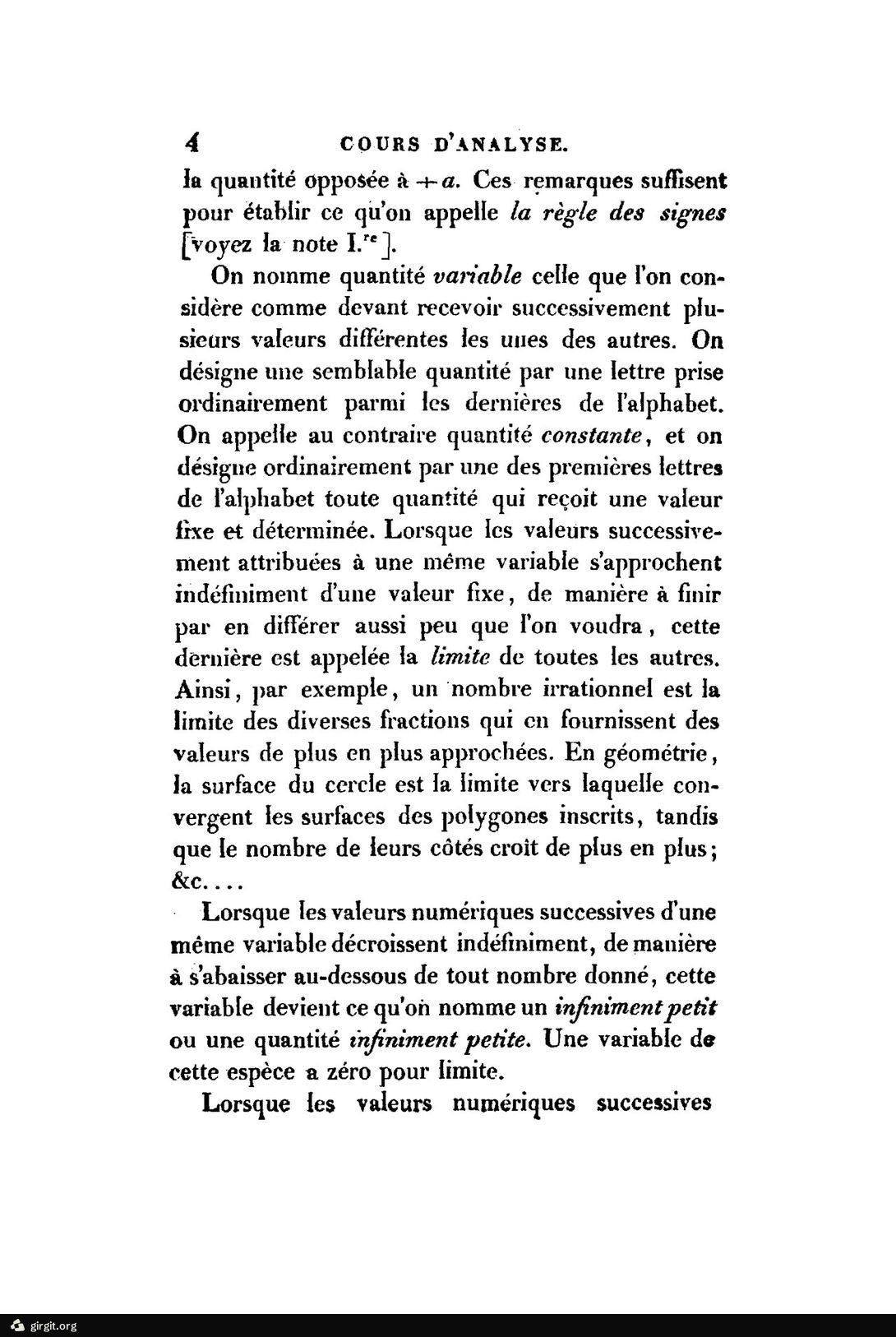 limite: "as little as one wishes"circle = limit of polygons
Now play the challenge. Your opponent sets \( \varepsilon \), the half-height of the amber band. You set \( \delta \), the half-width of the teal window. Every bit of curve inside your window turns green if it stays in the band and red if it escapes. A limit exists when you can always win; for the jump you will find challenges no window can meet.
Notice the shapes in "Every ε". For a straight line the best window is a fixed fraction of the band: the steeper the line, the narrower the window. For a curve the best window depends on which side is steeper. For a jump the chart is stuck at zero: below a certain \( \varepsilon \) there is no answer at all, whatever \( l \) you claim. That is what "the limit does not exist" means.
Solve it
Solve it
For \( \lim_{x \to 4} (2x + 1) = 9 \), the challenger says \( \varepsilon = 0.01 \). Find a \( \delta \) that wins, and then a formula for \( \delta \) that wins for every \( \varepsilon \).
Answer
Solve it (harder)
For \( \lim_{x \to 2} x^2 = 4 \) with \( \varepsilon = 0.1 \), find the widest window \( \delta \) that wins. Why is it not the same on both sides of 2?
Hint
Answer
Spot the error
A student writes: "As \( x \to 0 \), the values of \( x^2 + 1 \) get closer and closer to 0.5, so \( \lim_{x \to 0} (x^2 + 1) = 0.5 \)." What is wrong?
Answer
Connect it
Connect it
- One-sided limits, page 3. The jump in the game is the function of left-hand and right-hand limits: each side wins on its own, but not together.
- The sandwich theorem, page 7. Two bread curves inside the band force the filling inside too: the squeeze is an \( \varepsilon \) argument in disguise.
- Endless sums, Ch 8. \( 1 + \frac{1}{2} + \frac{1}{4} + \dots = 2 \) means the running totals get within any \( \varepsilon \) of 2: endless G.P. sums.
- Physics, errors. An engineer's tolerance is an \( \varepsilon \): "the shaft must be 20 mm within 0.01 mm". The question "how precisely must I set the machine?" is the \( \delta \): errors in results.
- Class 12, continuity. A function is continuous at \( a \) when the limit equals the value \( f(a) \): continuity at a point.
Still confused?
Does \( f(x) \) ever actually reach the limit?
It may or may not, and it does not matter. \( 2x + 1 \) reaches 9 at \( x = 4 \); \( \frac{x^2 - 9}{x - 3} \) never reaches 6 because it is undefined at 3. The definition only asks that \( f(x) \) can be kept within any \( \varepsilon \) of \( l \) near \( a \).
Why the letters \( \varepsilon \) and \( \delta \)?
Think of \( \varepsilon \) as the "error" you are allowed in the output and \( \delta \) as the "distance" allowed in the input. Cauchy himself used \( \varepsilon \) as a short form for error in some of his work, and the habit stuck.
Isn't this just a fancy way of saying what the table of values already showed?
A table shows a few values and invites a guess. The \( \varepsilon \)–\( \delta \) challenge has to be won for every \( \varepsilon \), which a table can never check. That is the difference between "it looks like 6" and "it is 6".
Sources
- I. Newton, The Mathematical Principles of Natural Philosophy, tr. A. Motte (1729), Book I, Section I, Lemma I, Wikisource.
- Limit of a function: history (Bolzano 1817; Cauchy 1821; Weierstrass 1861 and the notation; Hardy 1908 and the arrow; ε as "error"), Wikipedia.
- Cours d'analyse (1821; the limit defined on the first pages; "Lim." from L'Huilier 1787), Wikipedia; scan of the 1821 edition, Cauchy, Analyse algébrique, Wikimedia Commons, p. 4.
- Karl Weierstrass (school teaching at Deutsch Krone 1842 and Braunsberg 1848; subjects taught; 1854 paper; Berlin 1856; lectures 1859/60), MacTutor History of Mathematics, St Andrews.
- Augustin-Louis Cauchy (1789 to 1857), MacTutor History of Mathematics, St Andrews.
Picture and video credits