- 1. How fast is a falling stone at one instant?
- 2. What is a limit?
- 3. Left-hand and right-hand limits: when does a limit exist?
- 4. The algebra of limits and limits of polynomials
- 5. Limits of rational functions and the 0/0 puzzle
- 6. The standard limit (xⁿ − aⁿ)/(x − a) = naⁿ⁻¹
- 7. Why sin x / x tends to 1: the sandwich theorem
- 8. Solving limits of trigonometric functions
- 9. What is a derivative? From chord to tangent
- 10. Derivatives from first principles
- 11. Algebra of derivatives: sum, product and quotient rules
- 12. Derivatives of polynomials and trigonometric functions
- Review
11 of 12·NCERT §12.5.1·6 min
Algebra of derivatives: sum, product and quotient rules
The big ideaDerivatives of sums and differences split up neatly, but products and quotients have their own rules, \( (uv)' = u'v + uv' \) and \( \left(\frac{u}{v}\right)' = \frac{u'v - uv'}{v^2} \); with them, \( \frac{d}{dx} x^n = n x^{n-1} \).
In simple words
If two things are each changing, their total changes by the sum of the two changes. Easy. But when you multiply two changing things, each one's change gets multiplied by the other one, so the rule is a little longer. Learn these few rules once, and you can find the steepness of almost any formula without starting from scratch.
The rules (Theorem 5 of §12.5.1)
Let \( f \) and \( g \) be functions whose derivatives exist on a common domain. Then:
- Sum: \( \dfrac{d}{dx}[f(x) + g(x)] = \dfrac{d}{dx} f(x) + \dfrac{d}{dx} g(x) \)
- Difference: \( \dfrac{d}{dx}[f(x) - g(x)] = \dfrac{d}{dx} f(x) - \dfrac{d}{dx} g(x) \)
- Product rule: \( \dfrac{d}{dx}[f(x) \cdot g(x)] = \dfrac{d}{dx} f(x) \cdot g(x) + f(x) \cdot \dfrac{d}{dx} g(x) \)
- Quotient rule (where \( g(x) \ne 0 \)): \( \dfrac{d}{dx}\left[\dfrac{f(x)}{g(x)}\right] = \dfrac{\frac{d}{dx} f(x) \cdot g(x) - f(x) \cdot \frac{d}{dx} g(x)}{(g(x))^2} \)
They follow from the matching rules for limits; the textbook does not prove them. Writing \( u = f(x) \) and \( v = g(x) \) makes them easier to remember:
\[ (u \pm v)' = u' \pm v' \qquad (uv)' = u'v + uv' \qquad \left(\frac{u}{v}\right)' = \frac{u'v - uv'}{v^2} \]The product rule is also called the Leibniz rule, after Gottfried Wilhelm Leibniz, who invented calculus at about the same time as Isaac Newton, each on his own.
Building up to xⁿ
First, \( f(x) = x \): \( \frac{(x + h) - x}{h} = 1 \), so \( \frac{d}{dx} x = 1 \). And any constant has derivative 0.
- By the sum rule: \( 4x = x + x + x + x \), so its derivative is \( 1 + 1 + 1 + 1 = 4 \).
- By the product rule: \( 4x = u v \) with \( u = 4 \), \( v = x \): \( (uv)' = 0 \cdot x + 4 \cdot 1 = 4 \). The same answer.
- \( x^2 = x \cdot x \): \( \frac{d}{dx} x^2 = 1 \cdot x + x \cdot 1 = 2x \).
Theorem 6: the power rule
- \( \dfrac{d}{dx} x^n = n x^{n-1} \) for every positive integer \( n \).
- It is in fact true for every real power \( n \) (not proved here), so \( \frac{d}{dx} x^{-1} = -x^{-2} \) and \( \frac{d}{dx} x^{1/2} = \frac{1}{2} x^{-1/2} \), matching what first principles gave.
Proof 1, by the binomial theorem. \( (x + h)^n = x^n + {}^nC_1 x^{n-1} h + {}^nC_2 x^{n-2} h^2 + \dots + h^n \), so \( (x + h)^n - x^n = h\left(n x^{n-1} + (\text{terms with } h)\right) \). Divide by \( h \) and let \( h \to 0 \): every term with \( h \) vanishes, leaving \( n x^{n-1} \). (This is Theorem 2 from the limits pages in disguise.)
Proof 2, by induction and the product rule. True for \( n = 1 \). If \( \frac{d}{dx} x^{n-1} = (n - 1)x^{n-2} \), then writing \( x^n = x \cdot x^{n-1} \),
\[ \frac{d}{dx} x^n = 1 \cdot x^{n-1} + x \cdot (n - 1)x^{n-2} = x^{n-1} + (n - 1)x^{n-1} = n x^{n-1} \]Worked examples
Worked example 1: product rule
Differentiate \( (x^2 + 1)(x^3 - 2) \).
- \( u = x^2 + 1 \), \( u' = 2x \); \( v = x^3 - 2 \), \( v' = 3x^2 \).
- \( u'v + uv' = 2x(x^3 - 2) + (x^2 + 1)3x^2 = 2x^4 - 4x + 3x^4 + 3x^2 = 5x^4 + 3x^2 - 4x \).
- Check by expanding first: \( x^5 + x^3 - 2x^2 - 2 \) has derivative \( 5x^4 + 3x^2 - 4x \). It agrees.
Worked example 2: quotient rule
Differentiate \( \dfrac{x^2 + 1}{x - 3} \), \( x \ne 3 \).
- \( u = x^2 + 1 \), \( u' = 2x \); \( v = x - 3 \), \( v' = 1 \).
- \( \dfrac{u'v - uv'}{v^2} = \dfrac{2x(x - 3) - (x^2 + 1)}{(x - 3)^2} = \dfrac{x^2 - 6x - 1}{(x - 3)^2} \).
Guess first: is the product rule just "multiply the derivatives"?
It would be tidy if \( (uv)' = u' v' \). Guess: test it on \( x^2 = x \cdot x \). What does "multiply the derivatives" give, and is it right?
Commit to an answer, then grow the plot and see where the new area really comes from.
See what happens
Don't mix these up
- Quotient rule order: \( u'v \) minus \( uv' \), top-derivative first. Swapping them flips the sign of the answer.
- The bottom is \( v^2 \), not \( v \).
- A constant factor just rides along: \( (cu)' = cu' \). No product rule needed (though it gives the same answer).
Try it. Differentiate (a) \( \dfrac{x}{x + 1} \), (b) \( x^7 \), (c) \( \dfrac{1}{x^3} \).
Answer
Just remember
The rules have reasons (the land plot and the rectangle in the deep dive), but the order of the quotient rule is easy to scramble, because swapping it only flips a sign. Learn the chant, then check it in two seconds.
- \( \left(\dfrac{u}{v}\right)' = \dfrac{u'v - uv'}{v^2} \)
- "Lo d-hi minus hi d-lo, over lo lo": the bottom (lo) times the derivative of the top (hi), minus the top times the derivative of the bottom, over the bottom squared. Two-second check: \( \frac{1}{x} \) must give \( -\frac{1}{x^2} \). With \( u = 1 \), \( v = x \): \( \frac{0 \cdot x - 1 \cdot 1}{x^2} = -\frac{1}{x^2} \). The other order gives a plus: wrong.
- \( (uv)' = u'v + uv' \)
- "Each one takes a turn being differentiated." Order does not matter here (it is a sum). Rebuild: the two strips of the growing land plot.
- \( \dfrac{d}{dx}x^n = nx^{n-1} \)
- "Bring the power down, then take one off it." Check with \( x^2 \): \( 2x \), the slope that is 0 at the bottom of the bowl and grows on either side.
- Product rule (Leibniz rule)
- \( (uv)' = u'v + uv' \).
- Quotient rule
- \( \left(\frac{u}{v}\right)' = \frac{u'v - uv'}{v^2} \), where \( v \ne 0 \).
- Power rule
- \( \frac{d}{dx} x^n = n x^{n-1} \).
- Induction
- Prove for \( n = 1 \), then show "true for \( n - 1 \)" makes it true for \( n \).
Words to know
What is \( \dfrac{d}{dx}\left[x^2 \cdot x^3\right] \)?
- \( 6x^3 \)
- \( 5x^4 \)
- \( 6x^5 \)
For \( \dfrac{u}{v} \) with \( u = x^2 \) and \( v = x + 1 \), which is the top of the quotient-rule answer?
- \( 2x(x + 1) - x^2 \)
- \( x^2 - 2x(x + 1) \)
- \( 2x(x + 1) + x^2 \)
Deep dive · optional
Leibniz's wrong guess, and where the minus sign comes from
The inventor of this notation first guessed that the derivative of a product is the product of the derivatives. Here is why it cannot be, why the product rule has two pieces, and how the quotient rule falls out of it. Not needed for the exam, but after this the rules stop being things to memorise.
The roots: two strips, a vanishing corner, and a rectangle
- Why can't \( (uv)' \) be \( u'v' \)?Check the units. Let \( u \) and \( v \) be the sides of a plot in metres and \( x \) the time in days. Then \( uv \) is in m², and its rate \( (uv)' \) is in m² per day. But \( u'v' \) is (m per day) × (m per day) = m² per day². Wrong units, so it cannot be the rule.
- Then what is the change in \( uv \)?Grow \( u \) by \( \Delta u \) and \( v \) by \( \Delta v \): \( (u + \Delta u)(v + \Delta v) - uv = v\,\Delta u + u\,\Delta v + \Delta u\,\Delta v \). Two long strips and one small corner, exactly the land plot above.
- Why does the corner drop out?Divide by the step \( h \): the corner gives \( \frac{\Delta u}{h} \cdot \Delta v \). The first factor heads for \( u' \), but \( \Delta v \) heads for 0 (a function with a derivative has no jumps). So the corner's share is \( u' \times 0 = 0 \), by the algebra of limits (page 4). The strips give \( u'v + uv' \). Nothing is thrown away by hand: the limit removes it.
- Where does the quotient rule come from?From the product rule, in one line. If \( q = \frac{u}{v} \) then \( u = qv \), so \( u' = q'v + qv' \). Solve for \( q' \): \( q' = \frac{u' - qv'}{v} = \frac{u'v - uv'}{v^2} \). The minus sign is the side strip \( qv' \) being taken away: when the width grows, some of the new area is used up there, and only what is left can raise the height.
- And underneath?The distributive law, \( (a + b)(c + d) = ac + ad + bc + bd \), and the algebra of limits. Nothing else.
Divide the product rule by \( uv \) and it says \( \frac{(uv)'}{uv} = \frac{u'}{u} + \frac{v'}{v} \): the percentage rates add. If a plot's length grows by 2% a year and its width by 3%, its area grows by about 5%. It is the same reason that, in physics, the relative errors of two measured lengths add up when you multiply them.
The story: "This is a difficult point"
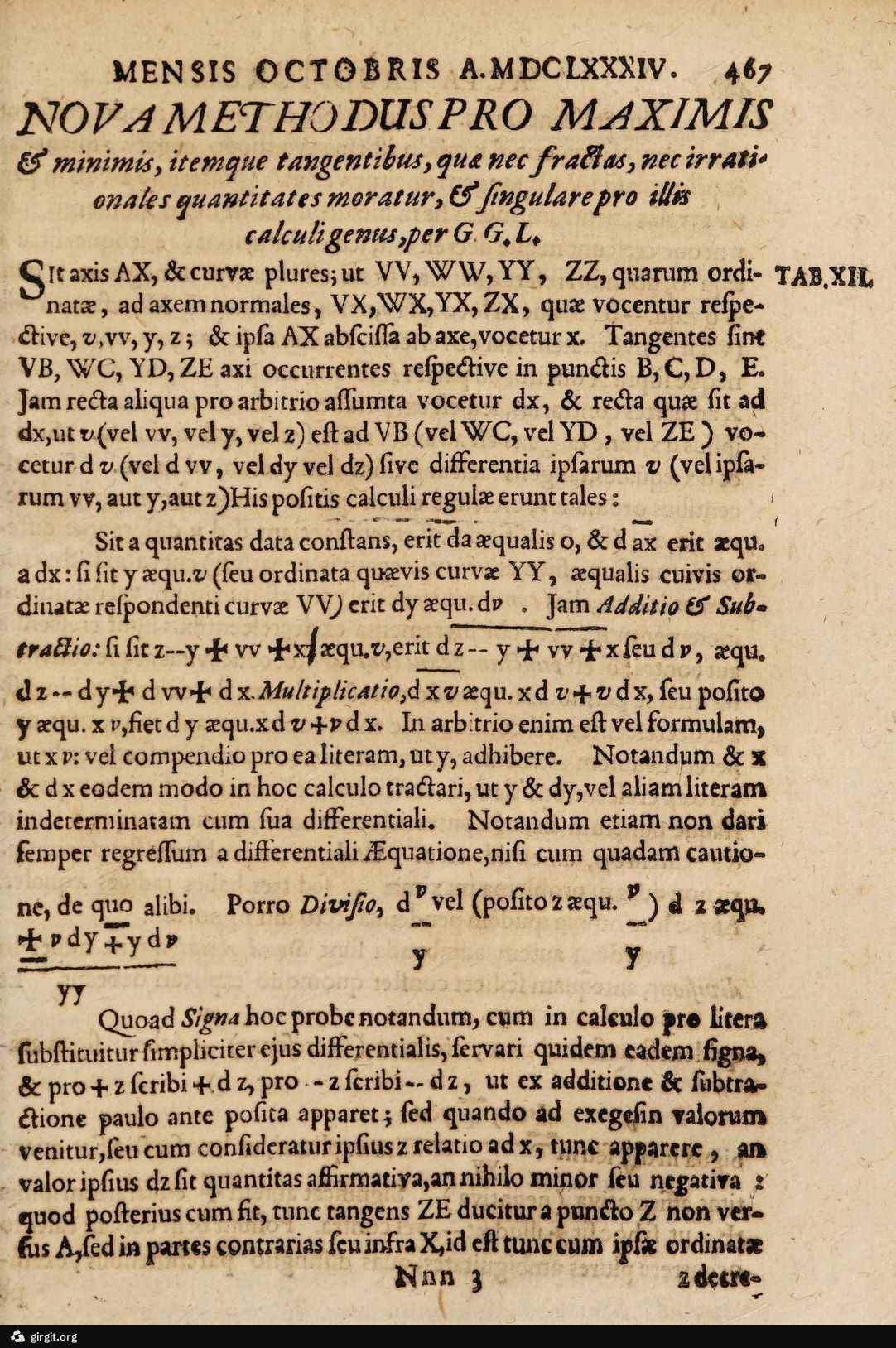 dx: Leibniz's dMultiplicatio: d(xv) = x dv + v dxDivisio: the quotient rule
See it: the rectangle that must keep its area rule
Here \( q = \frac{u}{v} \) is the height of a rectangle whose width is \( v \) and whose area is \( u \). Step \( x \): the new area \( \Delta u \) has to pay for the extra width first (green strip). Whatever is left raises the height (amber); if there is not enough, the height must drop (pink). Try the second pair, \( \frac{1}{x} \): the area never changes, so every bit of widening comes out of the height, and the slope is negative.
Solve it
Spot the error
A student writes \( \left(\frac{u}{v}\right)' = \frac{uv' - u'v}{v^2} \) and tests it on \( \frac{x}{x} \): both sides give 0, "so the formula is right". What is wrong with the test, and what is the right one?
Answer
Solve it: a plot that grows both ways
A rectangular field is 40 m long and 25 m wide. The farmer extends the length by 0.5 m a day and the width by 0.2 m a day. How fast is the area growing today? Check with the percentage rule.
Answer
Solve it (JEE style): three factors
Use the product rule twice to find \( (uvw)' \). Then find the derivative of \( x(x + 1)(x + 2) \) at \( x = 1 \) and check by expanding.
Hint
Answer
At some \( x \), \( u = 6 \), \( v = 2 \), \( u' = 4 \), \( v' = 1 \). What is \( \left(\frac{u}{v}\right)' \) there?
- 4
- \( \frac{1}{2} \)
- \( -\frac{1}{2} \)
- 1
Connect it
Connect it
- Algebra of limits, page 4. "The limit of a product is the product of the limits" is what kills the corner \( \Delta u \, \Delta v \): the rules for limits.
- Trig derivatives, page 12. \( \tan x = \frac{\sin x}{\cos x} \) and \( \sec x = \frac{1}{\cos x} \) are differentiated with the quotient rule: the six trig derivatives.
- Physics: errors. When you multiply two measurements, their relative errors add, the percentage form of the product rule: errors in results.
- Class 12: logarithmic differentiation. Taking logs turns a long product into a sum, so the percentage rates simply add: the derivative of xˣ.
- Notation, page 10. Leibniz's \( d \) and the 1684 paper this rule first appeared in: two inventors.
Still confused?
Why does the quotient rule have a minus but the product rule does not?
In a product, both factors growing makes the product grow, so both strips add. In a quotient, the bottom growing makes the fraction smaller (dividing by more), so its share is subtracted. The minus belongs to \( v' \), the bottom's change.
Do I need the quotient rule for \( \frac{5}{x^2} \)?
No. Write it as \( 5x^{-2} \): the constant rides along and the power rule gives \( -10x^{-3} \). The quotient rule gives the same answer, more slowly. Use it when the bottom is a real expression, like \( x^2 + 1 \) or \( \cos x \).
Sources
- J. M. Child (tr.), The Early Mathematical Manuscripts of Leibniz (Chicago: Open Court, 1920): manuscript of 11 November 1675, pp. 100 to 102, with Child's note 89; undated manuscript of about 1680, "Simple Multiplication", p. 143, Internet Archive.
- G. W. Leibniz, Nova Methodus pro Maximis et Minimis, Acta Eruditorum, October 1684, p. 467, Wikimedia Commons.
- Gottfried Leibniz (the November 1675 manuscripts; the 1684 paper with the rules for products and quotients), MacTutor History of Mathematics, St Andrews.

Picture and video credits