- 1. How fast is a falling stone at one instant?
- 2. What is a limit?
- 3. Left-hand and right-hand limits: when does a limit exist?
- 4. The algebra of limits and limits of polynomials
- 5. Limits of rational functions and the 0/0 puzzle
- 6. The standard limit (xⁿ − aⁿ)/(x − a) = naⁿ⁻¹
- 7. Why sin x / x tends to 1: the sandwich theorem
- 8. Solving limits of trigonometric functions
- 9. What is a derivative? From chord to tangent
- 10. Derivatives from first principles
- 11. Algebra of derivatives: sum, product and quotient rules
- 12. Derivatives of polynomials and trigonometric functions
- Review
3 of 12·NCERT §12.3·5 min
Left-hand and right-hand limits: when does a limit exist?
The big ideaYou can come up to a point from the left or from the right; the limit exists only when both ways lead to the same value.
In simple words
Two roads lead to a river, one from each bank, and a bridge is to join them. If both roads arrive at the same height, the bridge fits. If one road arrives high and the other low, no straight bridge can join them. A limit is the bridge: it is there only when the left road and the right road meet at the same height.
Two ways to approach a number
On the number line, \( x \) can come close to \( a \) through numbers smaller than \( a \) (from the left) or through numbers bigger than \( a \) (from the right). Each way gives its own limit:
- The left hand limit, \( \lim_{x \to a^-} f(x) \): the value \( f \) is heading for, judged only by \( x \) just below \( a \).
- The right hand limit, \( \lim_{x \to a^+} f(x) \): the value \( f \) is heading for, judged only by \( x \) just above \( a \).
The little minus or plus sign on \( a \) tells you which side you come from. If the two agree, their common value is the limit:
\[ \lim_{x \to a} f(x) = l \quad \text{exactly when} \quad \lim_{x \to a^-} f(x) = \lim_{x \to a^+} f(x) = l \]For \( 2x + 1 \) at 4, the left values 8.8, 8.98 and the right values 9.2, 9.02 both head for 9, so the limit is 9. For smooth graphs the two sides always agree. The interesting cases are graphs with a jump.
A jump: no limit
Let \( f(x) = x - 3 \) for \( x \lt 0 \), \( f(0) = 0 \), and \( f(x) = x + 3 \) for \( x \gt 0 \).
| \( x \) | −0.1 | −0.01 | −0.001 | 0.001 | 0.01 | 0.1 |
|---|---|---|---|---|---|---|
| \( f(x) \) | −3.1 | −3.01 | −3.001 | 3.001 | 3.01 | 3.1 |
From the left the values head for −3; from the right, for 3. So \( \lim_{x \to 0^-} f(x) = -3 \) and \( \lim_{x \to 0^+} f(x) = 3 \). They differ, so \( \lim_{x \to 0} f(x) \) does not exist, even though \( f(0) = 0 \) is perfectly well defined. The graph has a jump of 6 at 0.
The same happens with \( \dfrac{|x|}{x} \): it is −1 for every negative \( x \) and 1 for every positive \( x \), so its left and right hand limits at 0 are −1 and 1, and there is no limit.
A hole filled in the wrong place
Now let \( f(x) = x^2 \) for \( x \ne 2 \), but define \( f(2) = 0 \). Near 2, from both sides, \( x^2 \) is close to 4, so both one-sided limits are 4 and \( \lim_{x \to 2} f(x) = 4 \). Yet \( f(2) = 0 \). The limit exists, the value exists, and they are different.
Only one side, and limits that run off
Sometimes only one side makes sense. If \( f(x) = \frac{1}{x^2} \) is given only for \( x \gt 0 \), there are no points to the left of 0, so we look only from the right. There the values grow without end: 100 at \( x = 0.1 \), 10000 at \( x = 0.01 \), \( 10^{2n} \) at \( x = 10^{-n} \). We write \( \lim_{x \to 0^+} f(x) = +\infty \), meaning \( f(x) \) beats any number you name. This is not a real number, so the limit does not exist in the usual sense; such limits are outside this course.
Guess first: defined means limit?
Guess: if \( f(a) \) is a perfectly good number, must \( \lim_{x \to a} f(x) \) exist and equal \( f(a) \)?
Commit to an answer, then walk in from each side on five different graphs.
See what happens
Checklist for a limit at \( a \)
- Find the left hand limit using the rule that applies just left of \( a \).
- Find the right hand limit using the rule that applies just right of \( a \).
- Equal: that is the limit. Different: the limit does not exist. The value \( f(a) \) plays no part.
Try it. (a) \( f(x) = 2x + 1 \) for \( x \lt 1 \) and \( f(x) = 4 - x \) for \( x \ge 1 \). Does \( \lim_{x \to 1} f(x) \) exist? (b) Find \( \lim_{x \to 5} |x - 5| \).
Answer
Just remember
The little signs on \( a \) are a convention, and easy to mix up under exam pressure. Two hooks, and the number line rebuilds both.
- \( x \to a^- \) is from the left, \( x \to a^+ \) from the right
- Hook: "minus, less, left": numbers a little less than \( a \), like \( a - 0.001 \), sit to the left of it. "Plus, more, right" is the other one. Rebuild: draw the number line, put \( a - 0.01 \) and \( a + 0.01 \) on it.
- \( +\infty \) is not a number
- Writing \( \lim_{x \to 0^+} \frac{1}{x^2} = +\infty \) is shorthand for "grows past every number"; the limit still does not exist. Hook: "infinity is a direction, not a destination".
- Left hand limit
- \( \lim_{x \to a^-} f(x) \): where \( f \) heads as \( x \) comes up to \( a \) from below.
- Right hand limit
- \( \lim_{x \to a^+} f(x) \): where \( f \) heads as \( x \) comes down to \( a \) from above.
- Limit exists
- Both one-sided limits are the same real number.
- Limit does not exist
- The two sides disagree, or the values run off without end.
- \( +\infty \)
- Not a number: shorthand for "grows bigger than any number".
Words to know
For a function, \( \lim_{x \to 2^-} f(x) = 5 \), \( \lim_{x \to 2^+} f(x) = 5 \) and \( f(2) = 7 \). What is \( \lim_{x \to 2} f(x) \)?
- 7
- 5
- It does not exist
What is \( \lim_{x \to 0} \dfrac{|x|}{x} \)?
- 1
- 0
- It does not exist
\( f(x) = x + 2 \) for \( x \lt 1 \) and \( f(x) = kx \) for \( x \ge 1 \). For which \( k \) does \( \lim_{x \to 1} f(x) \) exist?
- \( k = 3 \)
- \( k = 1 \)
- Any \( k \)
Deep dive · optional
Which value belongs at a jump?
Why one road from each side is the whole test, what nature does at a jump, and a machine from 1898 that drew it. The exam does not need any of this; it makes one-sided limits feel like something real.
The roots: why two sides decide everything
- Why must the left and right limits agree?Because "\( x \) close to \( a \)" means close on either side. A single limit \( l \) has to be near the values of \( f \) on the left and on the right at the same time.
- At a jump from −3 to 3, why not settle on the middle, 0?Because every value just left of the jump is about 3 below 0, and every value just right is about 3 above it. Getting closer to the jump never shrinks that gap. In the \( \varepsilon \) game of page 2, a band of half-height 1 round 0 can never be met.
- Then why bother with each side on its own?Because each side still has an honest answer. Many functions live on one side only (\( \sqrt{x} \) at 0, time after a switch is pressed), or follow different rules on the two sides (a fare that rises in slabs). The one-sided limits say exactly what happens on each side, even when the two-sided limit fails.
- And the value \( f(a) \) at the jump itself?It is whatever the person defining the function chose. The limit never looks at it, so it cannot help or spoil the limit.
- And underneath?The number line. You can walk up to a point from exactly two directions, and nothing else.
So a limit is two questions asked at once: where is \( f \) heading from the left, and from the right? One answer to both means a limit. Two answers mean a jump, and the size of the jump is the right-hand limit minus the left-hand one.
The story: adding waves to make a jump
See it: waves closing in on a jump
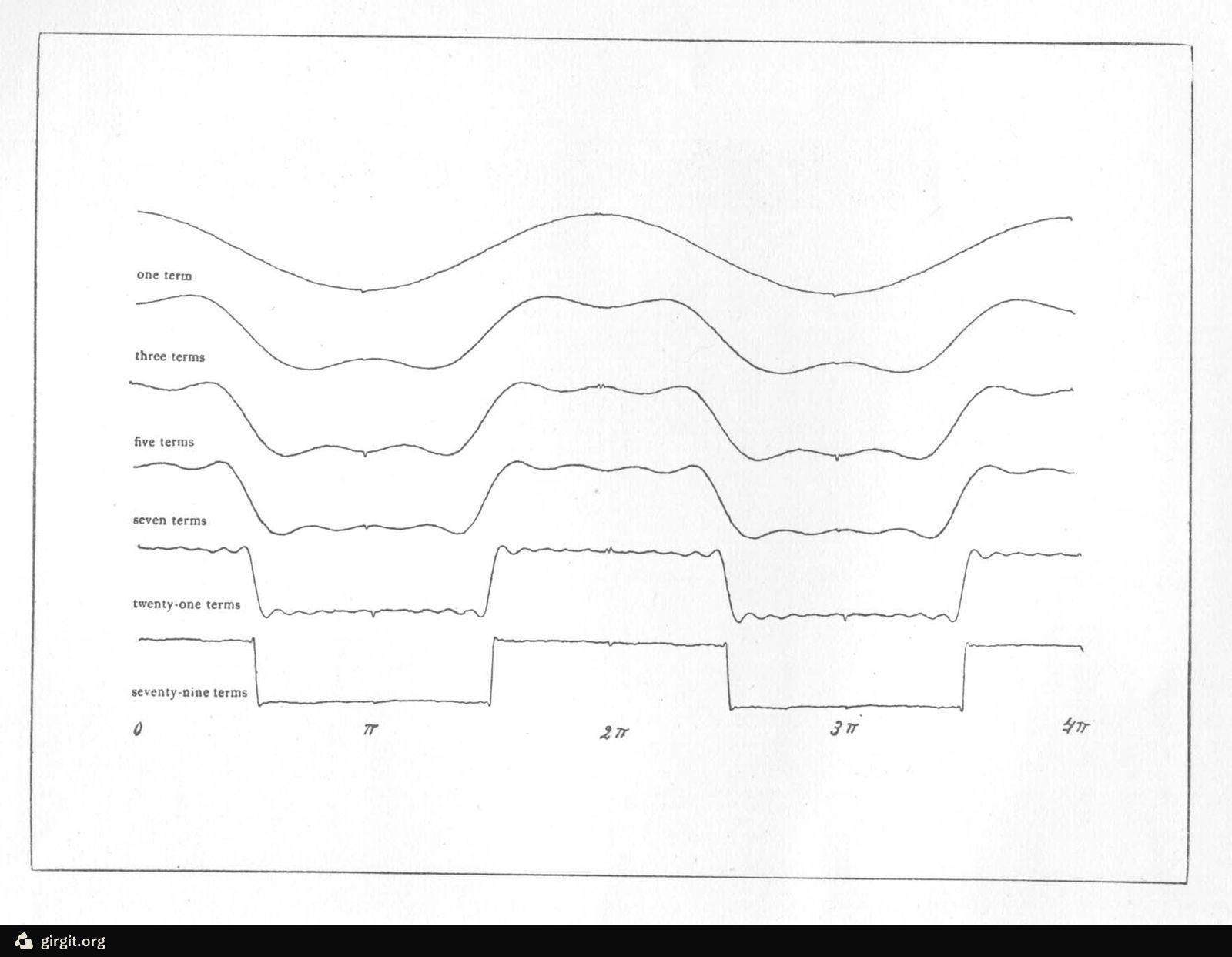 a small horn at each jump79 waves: almost a clean jump
Now add the waves yourself. The grey steps are a square wave: −1 to the left of 0, 1 to the right. Its left-hand limit at 0 is −1 and its right-hand limit is 1. Add more sine waves and watch the blue sum hug each step more closely, pass through 0 at the jump every single time, and keep its little horn near the top.
Solve it
Solve it
\( f(x) = kx + 1 \) for \( x \lt 2 \) and \( f(x) = x^2 - 1 \) for \( x \ge 2 \). Find \( k \) so that \( \lim_{x \to 2} f(x) \) exists. Then say how big the jump is when \( k = 3 \).
Answer
Solve it (JEE style)
\( [x] \) is the greatest integer function. Find the left-hand and right-hand limits of \( [x] \) at \( x = 2 \), and the limit of \( [x] \) at \( x = 2.5 \). Then find \( \lim_{x \to 2^-} \left(x - [x]\right) \) and \( \lim_{x \to 2^+} \left(x - [x]\right) \).
Hint
Answer
Predict, then check
A signal is 2 volts for a moment, then switches to 0 volts, again and again (a square wave between 0 and 2). If it is built from sine waves, what value will the sum give exactly at a switch?
Answer
Connect it
Connect it
- Signum and greatest integer, Ch 2. The two standard jump functions: signum and [x]. Signum is \( \frac{|x|}{x} \) with a value chosen at 0.
- The ε game, page 2. Why a jump defeats every claimed limit: the ε–δ game.
- A corner, page 9. At the corner of \( |x| \) the slopes from the left and right are −1 and 1: one-sided limits again, this time of a difference quotient: what is a derivative?
- Class 12, continuity. A function is continuous at \( a \) when left limit = right limit = \( f(a) \): jumps and the 1/x surprise.
- Daily life. Anything charged in slabs, like parking by the hour or parcels by weight, jumps at each slab edge: just below the edge you pay one amount, just above it the next.
Still confused?
At a jump, isn't the limit just \( f(a) \), since that is where the function actually is?
No. \( f(a) \) is one chosen point; the limit is about the crowd of points around it. In the jump example \( f(0) = 0 \) sits exactly between −3 and 3, yet no value near 0 is close to 0. The limit is decided by the neighbours, and here the neighbours disagree.
If the left-hand limit is \( +\infty \) and the right-hand limit is \( +\infty \), does the limit exist?
Not as a real number. Both sides agree that \( f \) grows without end, which is worth saying (\( \lim_{x \to 0} \frac{1}{x^2} = +\infty \) is common shorthand), but \( +\infty \) is not a value \( f \) can be close to. In this course, "the limit exists" means a real number.
Sources
- Dirichlet conditions (Dirichlet 1829; at a jump the series gives the midpoint), Wikipedia; Lejeune Dirichlet (1805 to 1859), founder of the theory of Fourier series, MacTutor History of Mathematics.
- Dirichlet function (1 on the rationals, 0 elsewhere; continuous nowhere), Wikipedia.
- Gibbs phenomenon (Wilbraham 1848; Michelson's analyser 1898 and the anecdote; Gibbs in Nature 1898 and 27 April 1899; Bôcher 1906; overshoot about 9% of the jump), Wikipedia.
- Albert A. Michelson (Chicago from 1892; Nobel prize 1907, the first American in a science; the harmonic analyzer paper with Stratton, 1898), Wikipedia.
- Curves from A. A. Michelson and S. W. Stratton, "A new harmonic analyzer" (1898), Wikimedia Commons.

Picture and video credits