- 1. How fast is a falling stone at one instant?
- 2. What is a limit?
- 3. Left-hand and right-hand limits: when does a limit exist?
- 4. The algebra of limits and limits of polynomials
- 5. Limits of rational functions and the 0/0 puzzle
- 6. The standard limit (xⁿ − aⁿ)/(x − a) = naⁿ⁻¹
- 7. Why sin x / x tends to 1: the sandwich theorem
- 8. Solving limits of trigonometric functions
- 9. What is a derivative? From chord to tangent
- 10. Derivatives from first principles
- 11. Algebra of derivatives: sum, product and quotient rules
- 12. Derivatives of polynomials and trigonometric functions
- Review
7 of 12·NCERT §12.4·6 min
Why sin x / x tends to 1: the sandwich theorem
The big ideaIf a function is trapped between two others that head for the same limit, it is forced to that limit too; trapping \( \frac{\sin x}{x} \) between \( \cos x \) and 1 proves that \( \lim_{x \to 0} \frac{\sin x}{x} = 1 \).
In simple words
You walk between two friends down a narrow lane. Both friends are heading to the same tea stall, and you stay between them the whole way. Where do you end up? At the same tea stall. You don't need to know your own path. Being stuck between two people who arrive at the same place is enough.
Trigonometric limits can't be done by factorising. Instead we use two facts about functions that sit above or below one another.
Order survives limits (Theorem 3)
Let \( f \) and \( g \) have the same domain with \( f(x) \le g(x) \) for every \( x \) in it. If both \( \lim_{x \to a} f(x) \) and \( \lim_{x \to a} g(x) \) exist, then
\[ \lim_{x \to a} f(x) \le \lim_{x \to a} g(x) \]A curve that stays below another can't end up heading for a higher value.
The sandwich theorem (Theorem 4)
Let \( f \), \( g \) and \( h \) be real functions with \( f(x) \le g(x) \le h(x) \) for all \( x \) in their common domain. If, for some real number \( a \),
\[ \lim_{x \to a} f(x) = l = \lim_{x \to a} h(x) \quad \text{then} \quad \lim_{x \to a} g(x) = l \]This is the sandwich theorem (also called the squeeze theorem). The outer two are the bread, \( g \) is the filling. Squeeze the bread to one point and the filling has nowhere else to go.
A quick use: \( x^2 \sin\frac{1}{x} \) wiggles wildly near 0, but since \( -1 \le \sin\frac{1}{x} \le 1 \), it stays between \( -x^2 \) and \( x^2 \). Both of those head for 0, so \( \lim_{x \to 0} x^2 \sin\frac{1}{x} = 0 \).
Trapping sin x / x
The key fact, with \( x \) in radians:
\[ \cos x \lt \frac{\sin x}{x} \lt 1 \qquad \text{for } 0 \lt |x| \lt \frac{\pi}{2} \]Since \( \sin(-x) = -\sin x \) and \( \cos(-x) = \cos x \), changing \( x \) to \( -x \) leaves both \( \frac{\sin x}{x} \) and \( \cos x \) unchanged. So it is enough to prove it for \( 0 \lt x \lt \frac{\pi}{2} \). Here is the geometric proof.
Draw a circle of radius 1 with centre O. Mark A on the circle, and C on the circle so that angle AOC is \( x \) radians. Drop a perpendicular CD from C to OA. At A, draw the tangent to the circle, which is perpendicular to OA, and let it meet OC extended at B. Now compare three areas, each fitting inside the next:
\[ \text{area of } \triangle OAC \;\lt\; \text{area of sector } OAC \;\lt\; \text{area of } \triangle OAB \]- \( \triangle OAC \) has base OA and height \( CD = OA \sin x \): area \( \frac{1}{2} OA \cdot CD \).
- The sector is the fraction \( \frac{x}{2\pi} \) of the whole circle: area \( \frac{x}{2\pi} \cdot \pi (OA)^2 \).
- \( \triangle OAB \) has base OA and height \( AB = OA \tan x \): area \( \frac{1}{2} OA \cdot AB \).
Multiply through by \( \frac{2}{OA} \) to get \( CD \lt x \cdot OA \lt AB \), that is \( OA \sin x \lt OA \cdot x \lt OA \tan x \). OA is positive, so
\[ \sin x \lt x \lt \tan x \]For \( 0 \lt x \lt \frac{\pi}{2} \), \( \sin x \gt 0 \), so divide by it: \( 1 \lt \frac{x}{\sin x} \lt \frac{1}{\cos x} \). Turning all three upside down flips the inequalities: \( \cos x \lt \frac{\sin x}{x} \lt 1 \). Done.
Try it: drag C round the circle and watch the three areas keep their order, all the way down to a thin slice.
The two trig limits (Theorem 5)
\[ \text{(i)}\; \lim_{x \to 0} \frac{\sin x}{x} = 1 \qquad \text{(ii)}\; \lim_{x \to 0} \frac{1 - \cos x}{x} = 0 \](i) \( \frac{\sin x}{x} \) is sandwiched between \( \cos x \) and the constant 1. As \( x \to 0 \), \( \cos x \to 1 \), and 1 stays 1. By the sandwich theorem, \( \frac{\sin x}{x} \to 1 \).
(ii) Use \( 1 - \cos x = 2 \sin^2 \frac{x}{2} \):
\[ \frac{1 - \cos x}{x} = \frac{2\sin^2 \frac{x}{2}}{x} = \frac{\sin \frac{x}{2}}{\frac{x}{2}} \cdot \sin \frac{x}{2} \;\to\; 1 \cdot 0 = 0 \]Here we used that \( x \to 0 \) is the same as \( \frac{x}{2} \to 0 \) (put \( y = \frac{x}{2} \)), so the first factor is the limit in (i).
Guess first: degrees or radians?
Set a calculator to degrees and work out \( \frac{\sin 0.01}{0.01} \). Guess: do you get about 1?
Commit to a guess, then squeeze the window in on 0, in radians and in degrees.
See what happens
Just remember
These two limits are proved above, but you will use them so often that they must come without thinking. Learn them by heart, with a picture to fall back on.
- \( \lim_{x \to 0} \dfrac{\sin x}{x} = 1 \), with \( x \) in radians
- "For a thin slice, the string is as long as the bow." The half-chord \( \sin x \) and the arc \( x \) are almost the same length when the angle is small. Rebuild: draw the unit circle and a thin slice; the vertical half-chord and the arc nearly coincide.
- \( \lim_{x \to 0} \dfrac{1 - \cos x}{x} = 0 \)
- "Cosine is flat on top." At \( x = 0 \) the cosine curve sits at its peak, so it hardly drops at first: \( 1 - \cos x \) is about \( \tfrac{x^2}{2} \), far smaller than \( x \). Rebuild: picture the cos graph's flat hilltop at 0.
- \( \sin x \lt x \lt \tan x \) for \( 0 \lt x \lt \tfrac{\pi}{2} \)
- "Inside, on, outside." The half-chord is inside the circle, the arc is on it, the tangent piece is outside: shortest to longest. Rebuild from the three nested areas in the proof.
- In degrees the limit is \( \tfrac{\pi}{180} \), not 1
- "Calculus speaks radians." Rebuild: \( \sin x^\circ = \sin\left(\tfrac{\pi x}{180}\right) \approx \tfrac{\pi x}{180} \).
- Sandwich (squeeze) theorem
- If \( f \le g \le h \) and \( f, h \to l \), then \( g \to l \).
- Radian
- The angle at the centre of a circle made by an arc as long as the radius; \( \pi \) radians \( = 180^\circ \).
- Sector
- The slice of a circle between two radii and the arc joining them.
- \( \sin x \lt x \lt \tan x \)
- True for \( 0 \lt x \lt \frac{\pi}{2} \) in radians; the heart of the proof.
Words to know
In the proof that \( \frac{\sin x}{x} \to 1 \), which two functions form the "bread" of the sandwich?
- \( \sin x \) and \( \tan x \)
- \( \cos x \) and the constant 1
- \( 1 \) and \( \frac{1}{\cos x} \)
\( f(x) \le g(x) \le h(x) \) near 2, \( \lim_{x \to 2} f(x) = 5 \) and \( \lim_{x \to 2} h(x) = 7 \). What do we know about \( \lim_{x \to 2} g(x) \)?
- It is 6
- It may not exist; if it does, it lies between 5 and 7
- It is 5
What is \( \lim_{x \to 0} \dfrac{1 - \cos x}{x} \)?
- 1
- 0
- It does not exist
Deep dive · optional
The oldest sandwich: Archimedes and π
The squeeze \( \sin x \lt x \lt \tan x \) is more than 2,200 years old. Archimedes used it, in polygon form, to trap π. This section shows that the page's proof and his are the same idea. Not for the exam; for understanding where the theorem comes from.
The roots: polygons around a circle
- Why does the proof compare areas and not lengths?Because areas of triangles are easy and the area of a sector is known, \( \tfrac{x}{2} \) for radius 1. The length of a curved arc is itself a limit, so starting from it would go round in a circle.
- Why is the sector's area \( \tfrac{x}{2} \)?The sector is the fraction \( \tfrac{x}{2\pi} \) of the whole circle, whose area is \( \pi \). And why is a circle's area \( \pi r^2 \)? Archimedes showed that a circle has the same area as a right triangle whose two short sides are the radius and the circumference: \( \tfrac{1}{2} \times r \times 2\pi r \).
- Where does \( \sin x \lt x \lt \tan x \) turn into polygons?Put \( x = \tfrac{\pi}{n} \). A regular \( n \)-sided polygon inside a circle of radius 1 has sides \( 2\sin\tfrac{\pi}{n} \); one drawn outside has sides \( 2\tan\tfrac{\pi}{n} \). Multiply the squeeze by \( 2n \): \[ 2n\sin\tfrac{\pi}{n} \;\lt\; 2\pi \;\lt\; 2n\tan\tfrac{\pi}{n} \] inside perimeter < circumference < outside perimeter.
- Why do the two polygons close in on the circle?Because \( n\sin\tfrac{\pi}{n} = \pi \cdot \dfrac{\sin x}{x} \) with \( x = \tfrac{\pi}{n} \). As \( n \) grows, \( x \to 0 \), and \( \tfrac{\sin x}{x} \to 1 \). "sin x over x tends to 1" says exactly this: polygons with many sides have almost the circle's perimeter.
- And underneath?A straight line is the shortest way between two points, and a shape inside another has the smaller area.
One warning that JEE students meet: you cannot get \( \lim_{x \to 0} \frac{\sin x}{x} = 1 \) from L'Hôpital's rule (page 5's deep dive), because that rule needs the derivative of \( \sin x \) at 0, and that derivative is this limit. The squeeze is the honest proof.
The story: 96 sides in Syracuse
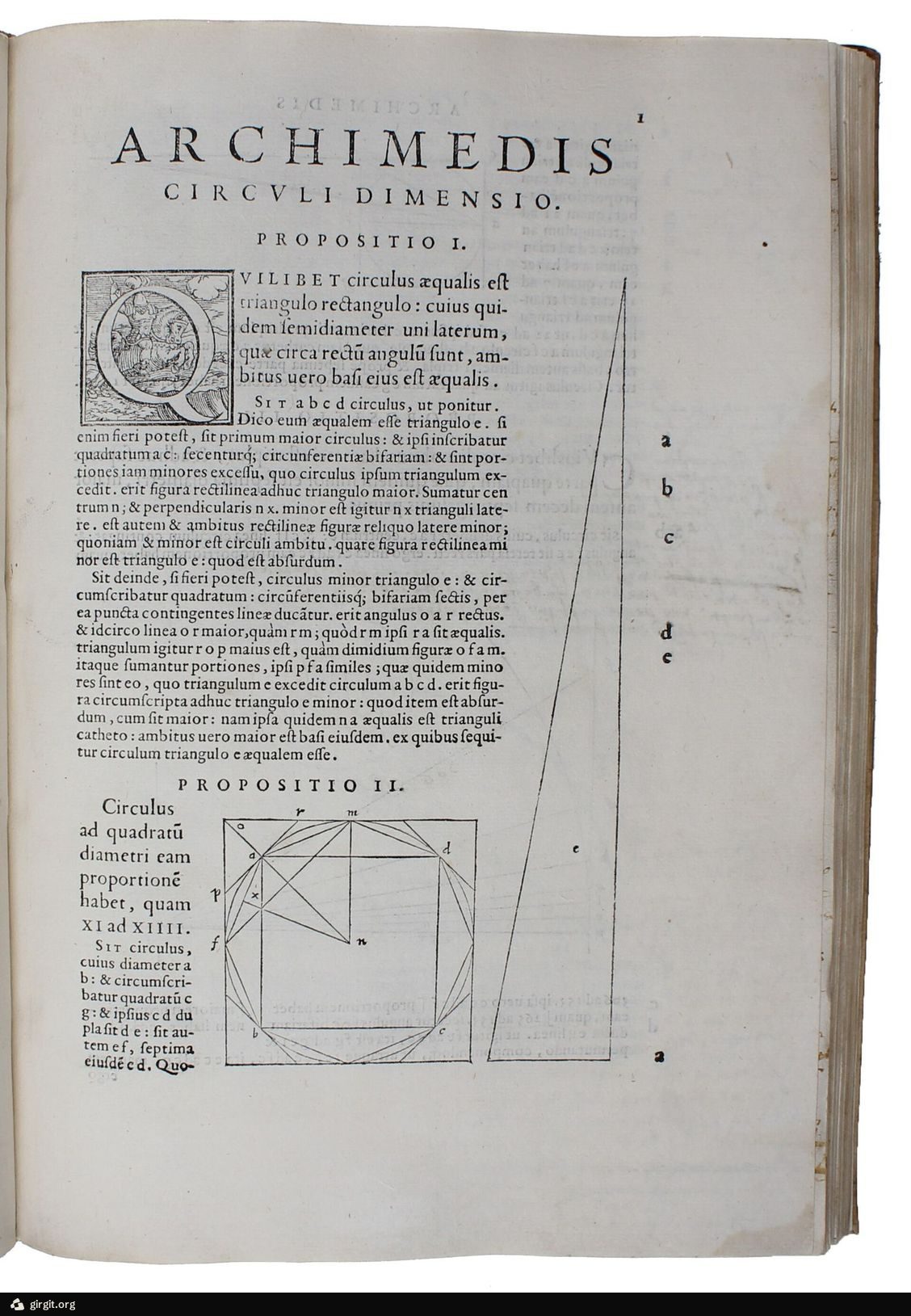 this leg = the circumferencepolygons inside and outsidethis leg = the radius
See it: the squeeze on π
First, Archimedes' own steps: scrub the number of doublings and watch both polygons close on the circle (this is the widget from the trigonometry chapter).
Now every \( n \) at once. The blue curve is the inside perimeter over 2, \( n\sin\tfrac{\pi}{n} \); the amber one the outside, \( n\tan\tfrac{\pi}{n} \); π sits between them. Drag the point along \( n \), and read \( \tfrac{\sin x}{x} \) for \( x = \tfrac{\pi}{n} \).
Solve it
Solve it
Do Archimedes' first step yourself: use a regular hexagon inside and one outside a circle of radius 1 to show \( 3 \lt \pi \lt 2\sqrt{3} \).
Hint
Answer
Spot the error
A student writes: "\( \lim_{x \to 0} \frac{\sin x}{x} = \lim_{x \to 0} \frac{\cos x}{1} = 1 \) by differentiating top and bottom." The answer is right. Why is this not a proof?
Answer
Solve it (JEE style)
Find \( \lim_{n \to \infty} n\sin\dfrac{\pi}{n} \) and \( \lim_{n \to \infty} n\tan\dfrac{\pi}{n} \), and say what they mean.
Answer
For a regular 96-gon inside a circle of radius 1, which is \( 96\sin\tfrac{\pi}{96} \) closest to?
- 3.1410
- exactly π
- 0.0327
Connect it
Connect it
- Archimedes again, Trigonometry. How the 96-gon numbers come from the half-angle formulas: double and triple angles.
- Why radians, Trigonometry. The same three-area picture appears where the radian is defined: what is a radian?
- The derivative of sine, page 12. \( \frac{d}{dx}\sin x = \cos x \) rests entirely on this limit: derivatives of trig functions.
- The pendulum, Physics Ch 13. \( \sin\theta \approx \theta \) for small swings is what makes a pendulum's period independent of its swing: the simple pendulum.
- Integration, Class 12. Squeezing an area between inside and outside rectangles is exactly how the definite integral is built: the definite integral.
Still confused?
The sandwich needs \( \cos x \) and 1 to have the same limit. Why does that force \( \frac{\sin x}{x} \)?
Pick any small band around 1, say from 0.999 to 1.001. Close enough to 0, \( \cos x \) is inside the band, and 1 always is. \( \frac{\sin x}{x} \) sits between them, so it is inside the band too. Make the band as thin as you like and the same happens: that is what "tends to 1" means.
Is \( \sin x \lt x \) only true below \( \tfrac{\pi}{2} \)?
No, it holds for every \( x \gt 0 \): for \( x \gt 1 \) it is obvious, as \( \sin x \le 1 \lt x \). The proof here stops at \( \tfrac{\pi}{2} \) because the tangent part, \( x \lt \tan x \), and the triangle picture only work in the first quadrant.
Sources
- Measurement of a Circle (the three propositions; 96-gons; 3 10/71 < π < 3 1/7; the √3 bounds), Wikipedia.
- Archimedes of Syracuse (287–212 BCE; the method of exhaustion; Plutarch's three accounts of his death), MacTutor History of Mathematics, St Andrews.
- Method of exhaustion (Antiphon, Eudoxus, Archimedes), Wikipedia.
- L'Hôpital's rule (why it cannot prove sin x / x → 1), Wikipedia.
- A page of Measurement of a Circle, Commandino's Latin edition, Venice 1558, Wikimedia Commons.

Picture and video credits