- 1. How fast is a falling stone at one instant?
- 2. What is a limit?
- 3. Left-hand and right-hand limits: when does a limit exist?
- 4. The algebra of limits and limits of polynomials
- 5. Limits of rational functions and the 0/0 puzzle
- 6. The standard limit (xⁿ − aⁿ)/(x − a) = naⁿ⁻¹
- 7. Why sin x / x tends to 1: the sandwich theorem
- 8. Solving limits of trigonometric functions
- 9. What is a derivative? From chord to tangent
- 10. Derivatives from first principles
- 11. Algebra of derivatives: sum, product and quotient rules
- 12. Derivatives of polynomials and trigonometric functions
- Review
8 of 12·NCERT §12.4·5 min
Solving limits of trigonometric functions
The big ideaTo find a trigonometric limit at 0, reshape the expression until every sine sits over its own angle, \( \frac{\sin \square}{\square} \), which tends to 1, and every leftover piece can simply be substituted.
In simple words
You have one key that opens one lock: a sine of a small angle divided by that same small angle is very nearly 1. Most problems hand you a lock that doesn't quite fit. So you multiply and divide by the right number to make it fit the key, then use the key.
The toolkit
- \( \lim_{x \to 0} \frac{\sin x}{x} = 1 \), and so \( \lim_{x \to 0} \frac{x}{\sin x} = 1 \).
- The angle can be anything that tends to 0: \( \lim_{x \to 0} \frac{\sin kx}{kx} = 1 \), because \( kx \to 0 \) when \( x \to 0 \).
- \( \lim_{x \to 0} \frac{1 - \cos x}{x} = 0 \), and \( \lim_{x \to 0} \cos x = 1 \).
- \( \tan x = \frac{\sin x}{\cos x} \), \( 1 - \cos 2x = 2\sin^2 x \), and the algebra of limits.
Worked examples
Worked example 1: match the angle
\( \lim_{x \to 0} \dfrac{\sin 5x}{x} = \lim_{x \to 0} 5 \cdot \dfrac{\sin 5x}{5x} = 5 \cdot 1 = 5 \).
Worked example 2: sine over sine
Find \( \lim_{x \to 0} \dfrac{\sin 3x}{\sin 7x} \).
- Give each sine its own angle underneath: \( \dfrac{\sin 3x}{\sin 7x} = \dfrac{\sin 3x}{3x} \cdot \dfrac{7x}{\sin 7x} \cdot \dfrac{3x}{7x} \).
- The first two factors head for 1 each; the last is \( \frac{3}{7} \) for every \( x \ne 0 \).
- The limit is \( \frac{3}{7} \).
Worked example 3: tangent
\( \lim_{x \to 0} \dfrac{\tan 2x}{x} = \lim_{x \to 0} 2 \cdot \dfrac{\sin 2x}{2x} \cdot \dfrac{1}{\cos 2x} = 2 \cdot 1 \cdot 1 = 2 \). In particular \( \lim_{x \to 0} \frac{\tan x}{x} = 1 \).
Worked example 4: one minus cosine over x squared
Find \( \lim_{x \to 0} \dfrac{1 - \cos 2x}{x^2} \).
- Use \( 1 - \cos 2x = 2\sin^2 x \): the expression is \( 2 \left( \dfrac{\sin x}{x} \right)^2 \).
- Product rule: \( 2 \cdot 1^2 = 2 \).
Note the contrast: over \( x \), \( 1 - \cos \) gives 0; over \( x^2 \), it gives a non-zero number.
Worked example 5: a limit not at 0
Find \( \lim_{x \to \pi} \dfrac{\sin (\pi - x)}{\pi - x} \). Put \( y = \pi - x \); as \( x \to \pi \), \( y \to 0 \). The limit is \( \lim_{y \to 0} \frac{\sin y}{y} = 1 \).
The general rule for 0/0
For any limit \( \lim_{x \to a} \frac{f(x)}{g(x)} \), first check \( f(a) \) and \( g(a) \). If both are 0, look for the factor that is making them vanish: write \( f(x) = f_1(x) f_2(x) \) with \( f_1(a) = 0 \) and \( f_2(a) \ne 0 \), and similarly \( g(x) = g_1(x) g_2(x) \). Cancel the common troublemaker (if possible) to get \( \frac{f(x)}{g(x)} = \frac{p(x)}{q(x)} \) with \( q(a) \ne 0 \). Then the limit is \( \frac{p(a)}{q(a)} \). With polynomials the troublemaker is \( (x - a) \); with trig limits at 0 it is a small angle, handled through \( \frac{\sin x}{x} \to 1 \).
Guess first: can you cancel the x?
Guess: is \( \lim_{x \to 0} \dfrac{\sin 4x}{\sin 2x} \) equal to \( \frac{\sin 4}{\sin 2} \) (cancelling the \( x \)s), or to something else?
Commit to a guess, then try five forms and watch each factor head for 1.
See what happens
Not in the current textbook, but JEE asks it: three more standard limits used alongside these, proved in Class 12 and beyond: \( \lim_{x \to 0} \frac{e^x - 1}{x} = 1 \), \( \lim_{x \to 0} \frac{\log_e(1 + x)}{x} = 1 \) and \( \lim_{x \to 0} (1 + x)^{1/x} = e \). JEE papers often mix them with the sine limit, so learn them as a set.
Try it. Find (a) \( \lim_{x \to 0} \dfrac{x}{\tan 3x} \), (b) \( \lim_{x \to 0} \dfrac{1 - \cos 4x}{x^2} \).
Answer
Just remember
These are the standard limits JEE expects you to know cold. The first three follow from page 7 in a line or two; the last three are proved in Class 12, so for now they are simply facts to learn as a set.
- \( \lim_{x \to 0} \dfrac{\sin kx}{kx} = 1 \) for any \( k \ne 0 \)
- "Match the hook." The angle under the sine must sit underneath it too. Rebuild: \( kx \) is just another small angle, so page 7's picture applies to it.
- \( \lim_{x \to 0} \dfrac{\tan x}{x} = 1 \)
- "Near 0, tan and sin are twins." Rebuild: \( \tan x = \frac{\sin x}{x} \cdot \frac{x}{\cos x} \), and \( \cos 0 = 1 \).
- \( \lim_{x \to 0} \dfrac{1 - \cos x}{x^2} = \dfrac{1}{2} \)
- "Half the square." \( 1 - \cos x \) is about \( \tfrac{x^2}{2} \). Rebuild: \( 1 - \cos x = 2\sin^2\tfrac{x}{2} \approx 2\left(\tfrac{x}{2}\right)^2 = \tfrac{x^2}{2} \). Over \( x \) (not \( x^2 \)) the same top gives 0.
- \( \lim_{x \to 0} \dfrac{e^x - 1}{x} = 1 \) and \( \lim_{x \to 0} \dfrac{\log_e(1 + x)}{x} = 1 \)
- "e and log are mirror twins." One undoes the other, so near 0 both behave like \( x \). Rebuild: the graphs of \( e^x - 1 \) and \( \log_e(1 + x) \) both pass through the origin with slope 1, mirror images in the line \( y = x \).
- \( \lim_{x \to 0} (1 + x)^{1/x} = e \)
- "A tiny growth, many times." Interest of 1% compounded 100 times gives \( 1.01^{100} \approx 2.705 \), already close to \( e \approx 2.718 \). Rebuild by trying \( x = 0.01 \) on a calculator.
- Standard trig limits
- \( \frac{\sin x}{x} \to 1 \), \( \frac{\tan x}{x} \to 1 \), \( \frac{1 - \cos x}{x} \to 0 \) as \( x \to 0 \).
- Matching the angle
- Multiplying and dividing so that \( \sin kx \) sits over \( kx \).
- Half-angle identity
- \( 1 - \cos x = 2\sin^2 \frac{x}{2} \); turns cosine limits into sine limits.
- Change of variable
- Renaming a quantity that tends to 0 (like \( \pi - x \)) to reach a standard form.
Words to know
What is \( \lim_{x \to 0} \dfrac{\sin 6x}{2x} \)?
- 1
- 3
- \( \frac{1}{3} \)
Why does the calculation of \( \lim_{x \to 0} \frac{\sin x}{x} \) only give 1 when \( x \) is in radians?
- Because calculators can't handle degrees
- Because the proof's sector area \( \frac{x}{2} \cdot r^2 \) holds only for radians
- Because sine isn't defined in degrees
Deep dive · optional
How good is sin x ≈ x? Madhava's answer
The limit says that for small angles \( \sin x \) is almost \( x \). But how almost? The size of the error is what turns the limits on this page into tools, and a Kerala astronomer had the answer six centuries ago. The exam asks only the limits; this shows where the numbers \( \tfrac{1}{2} \) and \( \tfrac{1}{6} \) come from.
The roots: the error has a size
- What does \( \frac{\sin x}{x} \to 1 \) really promise?Only that the ratio gets close to 1. It says nothing about how big the gap \( x - \sin x \) is, except that it is small compared with \( x \).
- How small is the gap?Much smaller than \( x \), and even than \( x^2 \): it shrinks like \( x^3 \). Halve the angle and the gap drops to about one eighth. In fact \( \dfrac{x - \sin x}{x^3} \to \dfrac{1}{6} \).
- Why \( \tfrac{1}{6} \)?Because the sine is an endless sum, \( \sin x = x - \dfrac{x^3}{6} + \dfrac{x^5}{120} - \cdots \) (radians), the series found in Kerala around 1400. The first term is the limit you know; the second is the size of the error. The 6 is \( 3! = 1 \times 2 \times 3 \).
- And the \( \tfrac{1}{2} \) in \( \frac{1 - \cos x}{x^2} \)?That one needs nothing new: \( 1 - \cos x = 2\sin^2\tfrac{x}{2} \), and \( \sin\tfrac{x}{2} \approx \tfrac{x}{2} \), so \( 1 - \cos x \approx 2 \cdot \tfrac{x^2}{4} = \tfrac{x^2}{2} \). The cosine series \( \cos x = 1 - \tfrac{x^2}{2} + \tfrac{x^4}{24} - \cdots \) agrees.
- And underneath?Page 7's squeeze: every one of these is \( \frac{\sin x}{x} \to 1 \) used cleverly, plus, for the \( x^3 \) terms, the Kerala series.
Knowing the error tells you when the shortcut is safe. The gap as a fraction of \( \sin x \) is about \( \tfrac{x^2}{6} \). It reaches 1% when \( x^2 = 0.06 \), that is \( x \approx 0.245 \) radian, about 14°. For \( \tan x \approx x \) the error is about \( \tfrac{x^2}{3} \), so it reaches 1% sooner, near 10°. Physicists use \( \sin\theta \approx \theta \) for a pendulum swinging a few degrees for exactly this reason.
The story: palm leaves in a London library
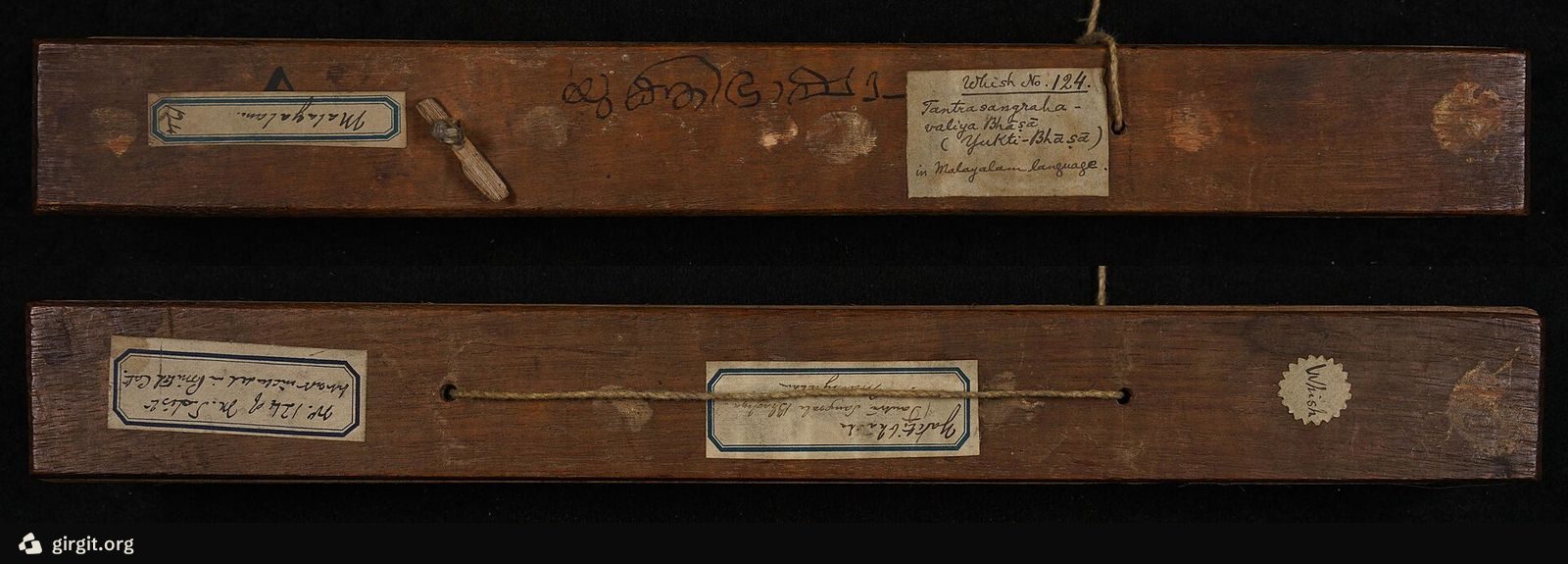 Whish No. 124: Yukti-Bhāṣā
See it: the error, term by term
First the Kerala series itself (from the trigonometry chapter): add terms one at a time and watch each sum hug the sine further out.
Now the three "second-order" limits as curves. Each ratio is undefined at 0, yet its curve heads for a definite height there: \( \tfrac{1}{6} \), \( \tfrac{1}{2} \) and \( \tfrac{1}{3} \). Drag the point in towards 0.
Solve it
Spot the error
"For small \( x \), \( \sin x \approx x \). So \( \lim_{x \to 0} \dfrac{x - \sin x}{x^3} = \lim_{x \to 0} \dfrac{x - x}{x^3} = 0 \)." The true answer is \( \tfrac{1}{6} \). What went wrong?
Answer
Solve it (JEE style)
Find \( \lim_{x \to 0} \dfrac{\tan x - \sin x}{x^3} \) using only this chapter's limits.
Hint
Answer
Estimate it
Up to roughly what angle, in degrees, is \( \sin x \approx x \) correct to within 1%? And within 0.1%?
Answer
What is \( \lim_{x \to 0} \dfrac{1 - \cos 3x}{x^2} \)?
- \( \frac{1}{2} \)
- \( \frac{3}{2} \)
- \( \frac{9}{2} \)
Connect it
Connect it
- Madhava and radians, Trigonometry. The sine series only works with the angle measured as arc ÷ radius: what is a radian?
- The squeeze, page 7. Every limit here is \( \frac{\sin x}{x} \to 1 \) in disguise: sin x over x.
- The pendulum, Physics. \( T = 2\pi\sqrt{L/g} \) holds because \( \sin\theta \approx \theta \) for small swings; at 14° the error is already 1%: the simple pendulum.
- Lenses, Class 12 Physics. The thin lens formula is built on rays close to the axis, where \( \sin\theta \approx \tan\theta \approx \theta \): the thin lens formula.
- e and log, Class 12. The limits \( \frac{e^x - 1}{x} \to 1 \) and \( \frac{\log(1 + x)}{x} \to 1 \) are proved where \( e^x \) is differentiated: derivatives of eˣ and log x.
Still confused?
When can I replace \( \sin x \) by \( x \) and when not?
Safe: when \( \sin x \) is a factor of a product or a quotient, because then you are really using \( \frac{\sin x}{x} \to 1 \). Unsafe: when it is added to or subtracted from something of the same size that cancels it, like \( x - \sin x \) or \( \tan x - \sin x \). Then the leftover is the error term, which the replacement throws away.
Is the series on the syllabus?
No. Class 11 needs only the limits on this page; the series come with Taylor's theorem in higher studies. JEE students often use the first two terms anyway, as a quick check, which is fine as long as you can also do it with the standard limits.
Sources
- Madhava of Sangamagrama (series for sin, cos and arctan about 1400; writings lost; π to 11 places; Yukti-Bhasa), MacTutor History of Mathematics, St Andrews.
- Madhava of Sangamagrama (c. 1340–1425, Irinjalakuda; Yuktibhāṣā c. 1530), Wikipedia.
- Kerala school (Whish's 1835 paper and his "complete system of fluxions"; C. T. Rajagopal), Wikipedia.
- Yuktibhāṣā (the title means "rationale"; Malayalam, c. 1530; proofs of the series), Wikipedia.
- Yukti-bhāṣā, palm-leaf manuscript, Whish collection, Royal Asiatic Society (Whish's note; given July 1836), Internet Archive.
- Yuktibhasa cover boards, Wikimedia Commons.

Picture and video credits