Morphology of Flowering Plants
- 1. Roots: what holds a plant in the ground?
- 2. The stem: how is it different from a root?
- 3. The leaf: base, stalk and blade
- 4. How are leaves and flowers arranged?
- 5. What is a flower?
- 6. Sepals, petals and aestivation
- 7. Stamens, carpels and placentation
- 8. The fruit: what does an ovary become?
- 9. Inside a seed: gram and maize
- 10. How to read a floral formula
- 11. Three families: Solanaceae, Fabaceae, Liliaceae
- Review
11 of 11·NCERT §5.9·pp. 68–69·10 min
Three families: Solanaceae, Fabaceae, Liliaceae
The big ideaPlants in the same family share the same kind of flower, so one semi-technical description and one floral formula can stand for hundreds of species.
In simple words
Potato, tomato, brinjal and chilli look and taste different, but their flowers are built almost the same way: five joined green flaps, five joined petals in a star, five pollen stalks stuck to the petals, and a two-part seed box in the middle. Because their flowers match, botanists put them in one family. Pea and gram have a different flower, shaped like a little boat with a sail, so they belong to another family.
Flowers change much less than leaves or stems from one habitat to another, so floral characters are the main basis for classifying and identifying flowering plants. Here is one family in full, the way the textbook lays it out, then two more that NEET asks about.
Solanaceae: the potato family
A large family, found across the tropics, subtropics and even temperate regions. The textbook's example plant is Solanum nigrum, makoi, a small weed with white flowers and tiny black berries.
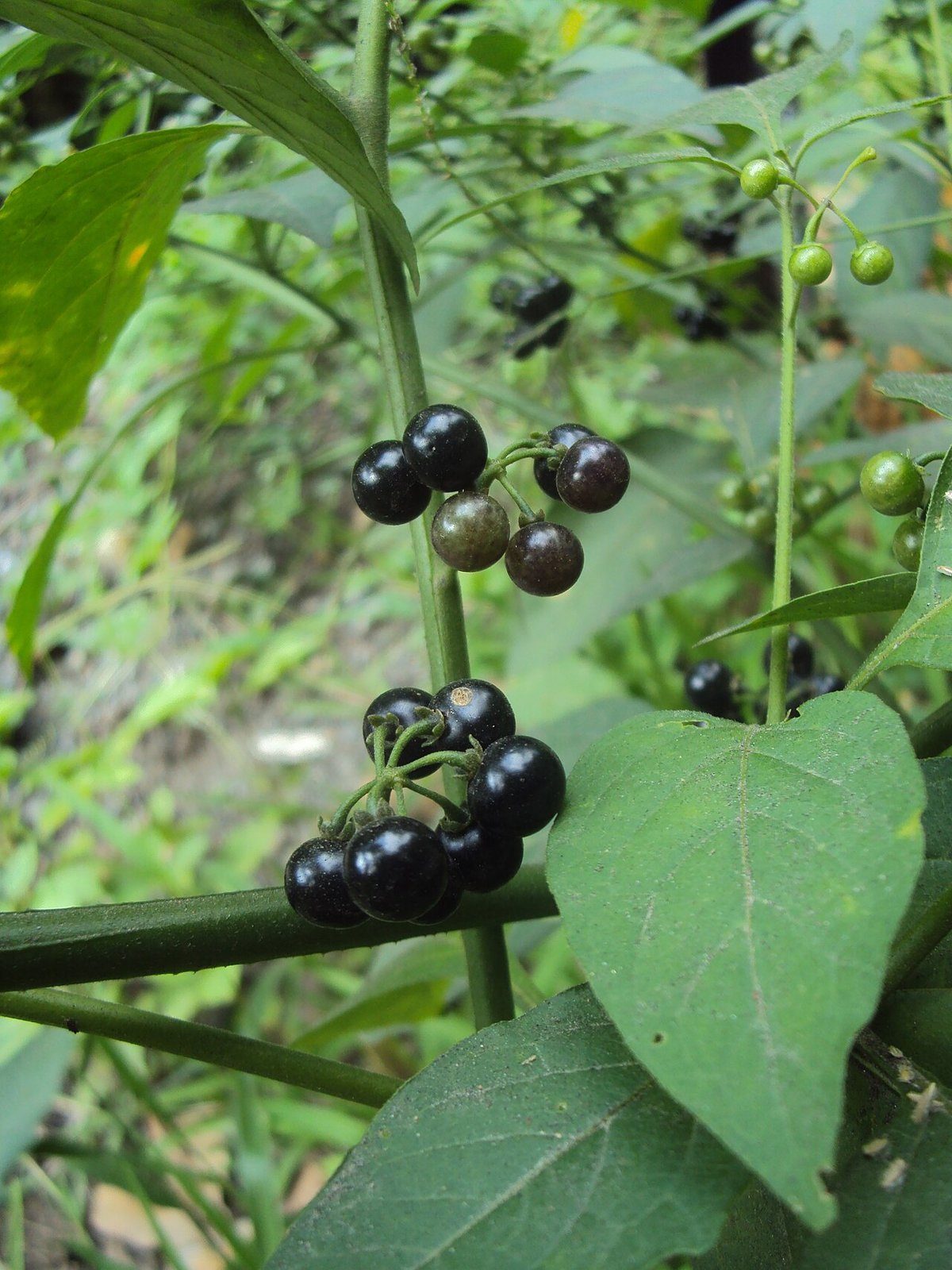 ripe berriesunripe berriessimple leaf
| Character | Solanaceae |
|---|---|
| Habit | Mostly herbs and shrubs; small trees are rare |
| Stem | Aerial, upright, round in section and branched; herbaceous (only rarely woody); may be hollow or solid, and hairy or glabrous (smooth). In potato (Solanum tuberosum) part of the stem is underground |
| Leaves | Simple and alternate (only rarely pinnately compound); exstipulate (no stipules); net (reticulate) venation |
| Inflorescence | Flowers solitary and axillary, or in cymes (as in Solanum) |
| Flower | Bisexual, actinomorphic |
| Calyx | Five sepals, united, persistent (stays on the fruit, like the green cap on a brinjal); valvate |
| Corolla | Five petals, united; valvate |
| Androecium | Five stamens, epipetalous |
| Gynoecium | Bicarpellary (two carpels), obliquely placed, syncarpous; ovary superior, bilocular (two chambers); swollen placenta with many ovules; axile placentation |
| Fruit | Berry (tomato, brinjal) or capsule |
| Seeds | Numerous, with endosperm (endospermous) |
Floral formula:
\[ \oplus\ \text{⚥}\ \mathrm{K}_{(5)}\ \overgroup{\mathrm{C}_{(5)}\ \mathrm{A}_{5}}\ \underline{\mathrm{G}}_{(2)} \]
Four members, one plan. Look for the same things in each: a star of five joined petals, the five stamens crowded in the middle (their stalks are fixed to the petals), and the green calyx underneath.
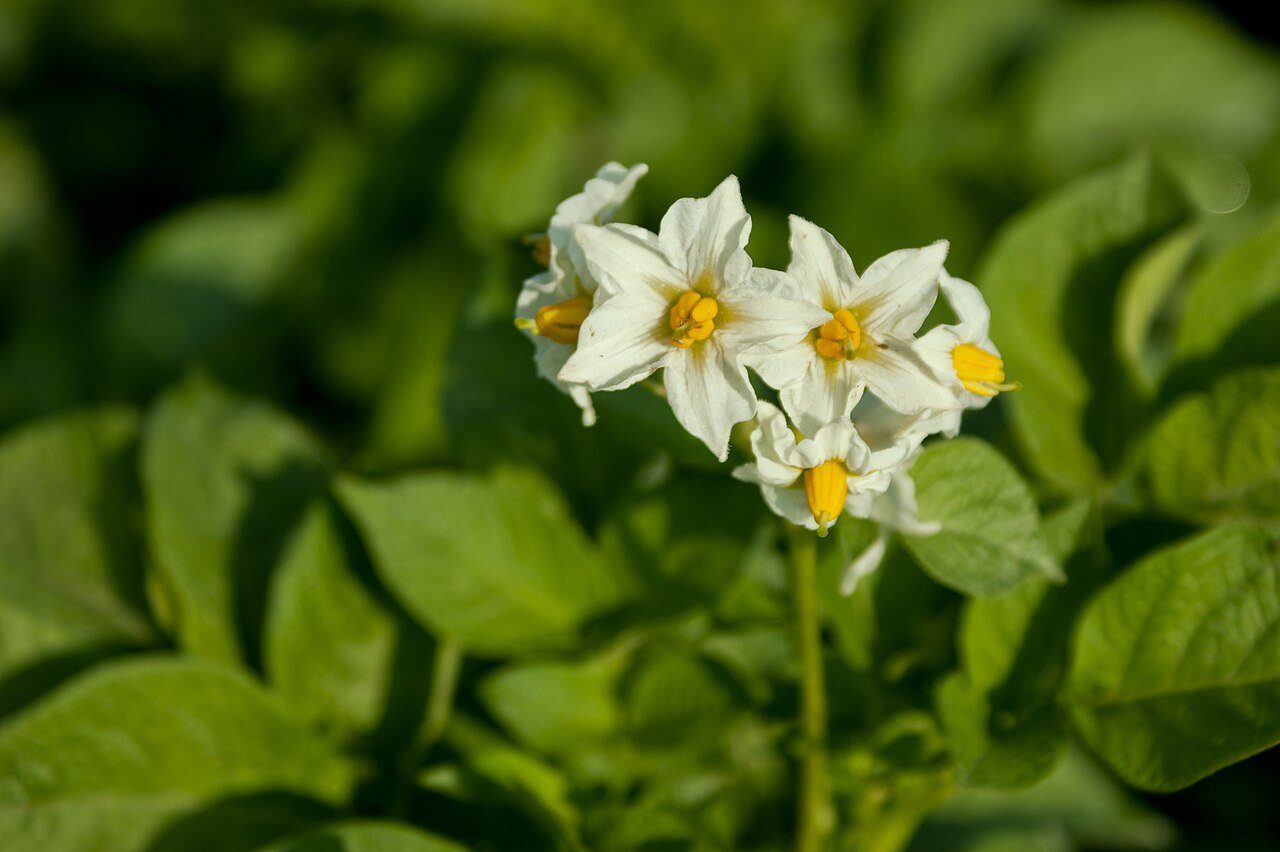 5 joined petalsanther cone
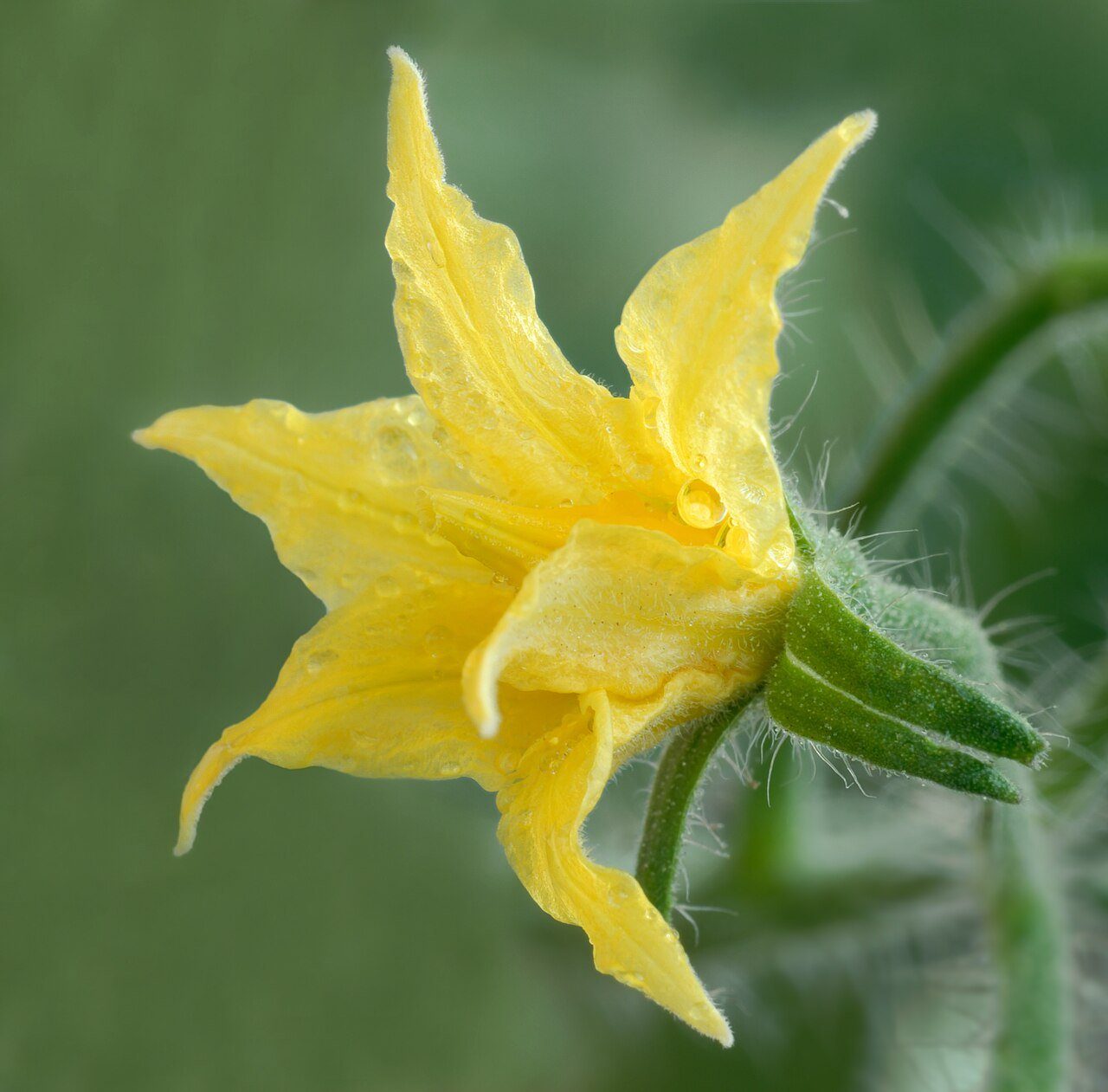 anther conesepalspetal
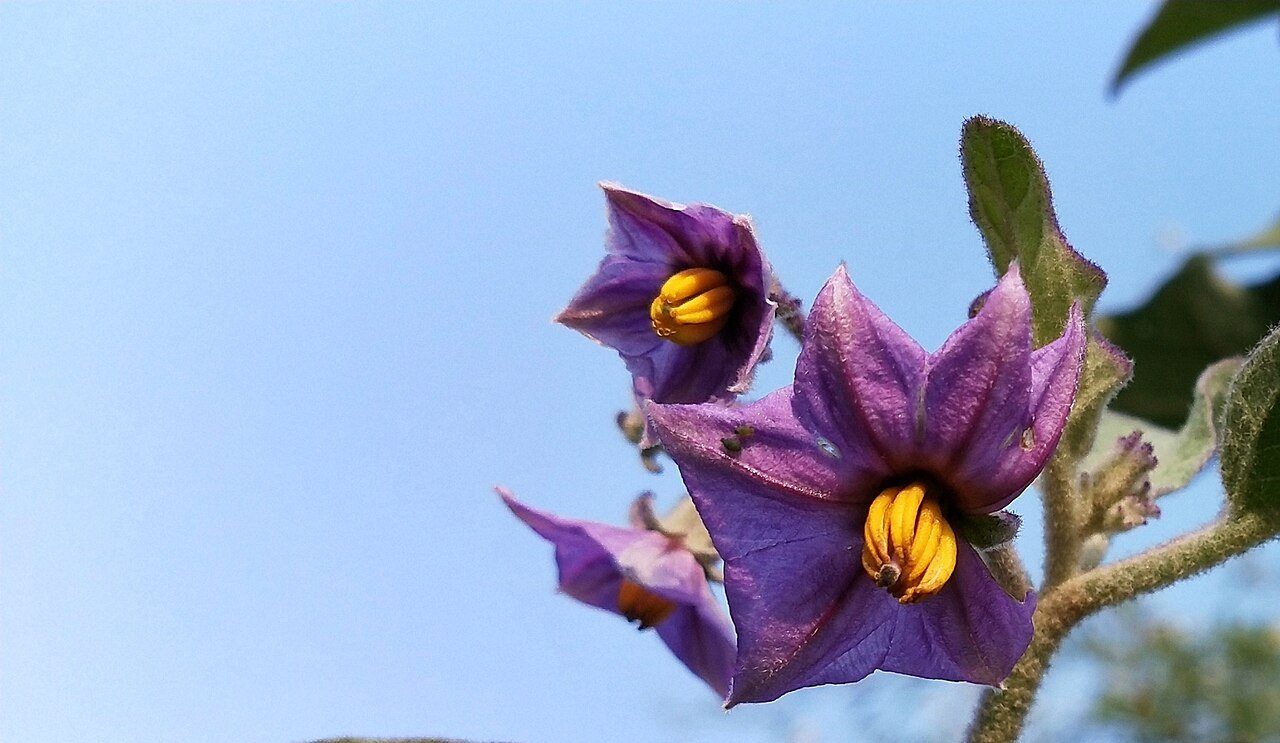 anther cone5 joined petals
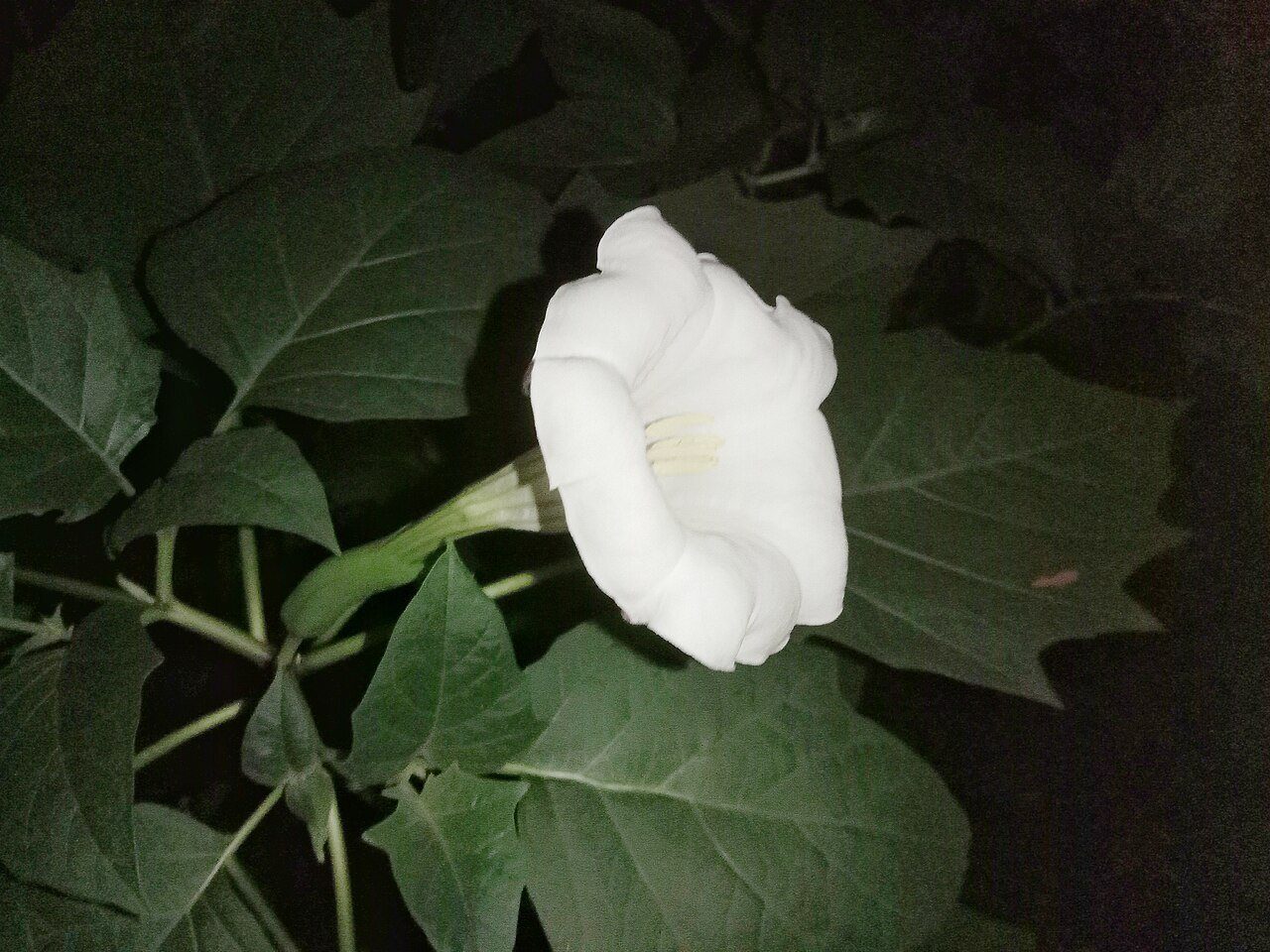 trumpet of 5 joined petals
Uses: potato, tomato and brinjal feed us; chilli is a spice; belladonna and ashwagandha are medicines; tobacco is a fumigatory (burnt for its smoke); petunia is grown for its flowers.
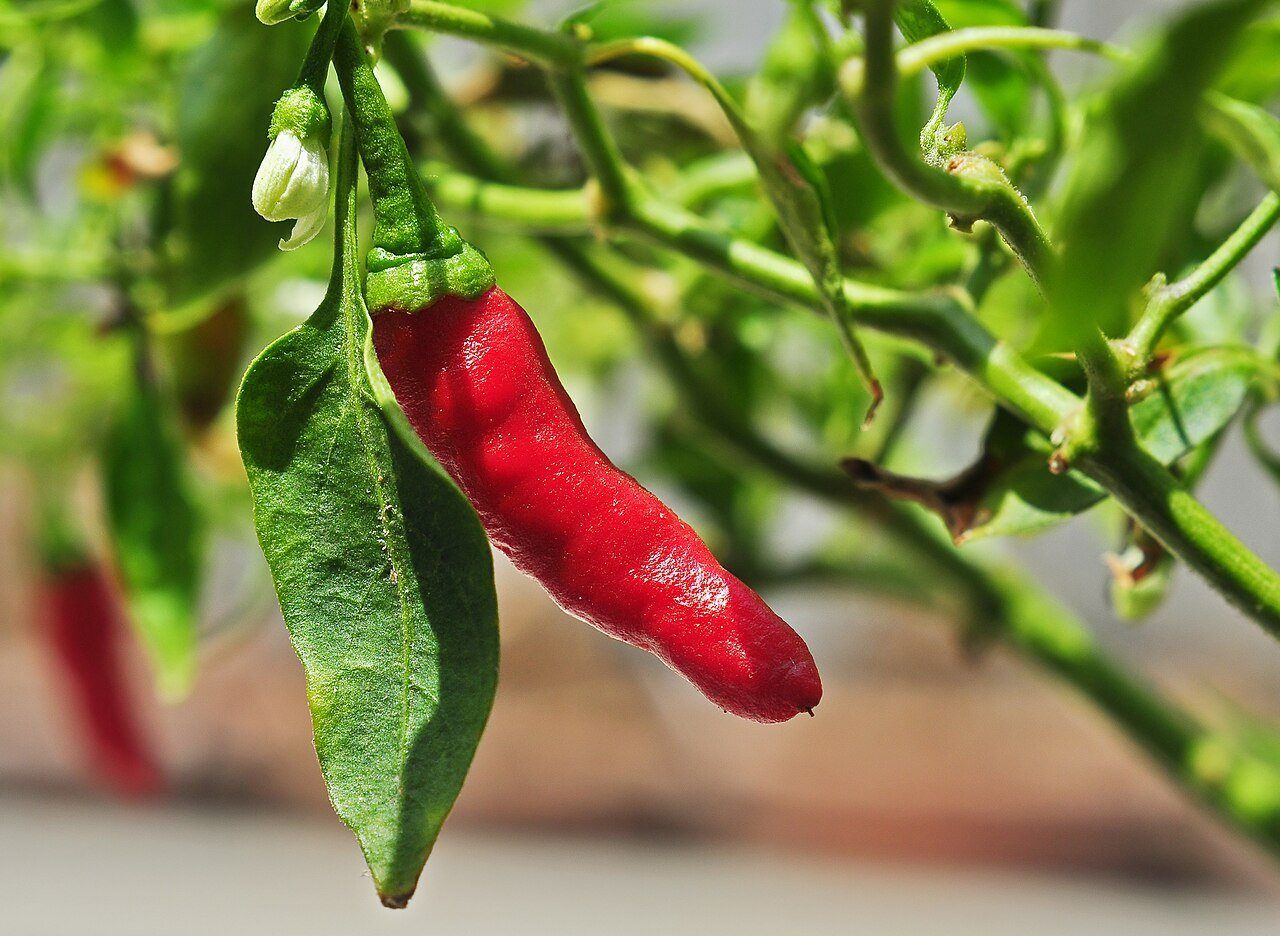 calyx stays onberry
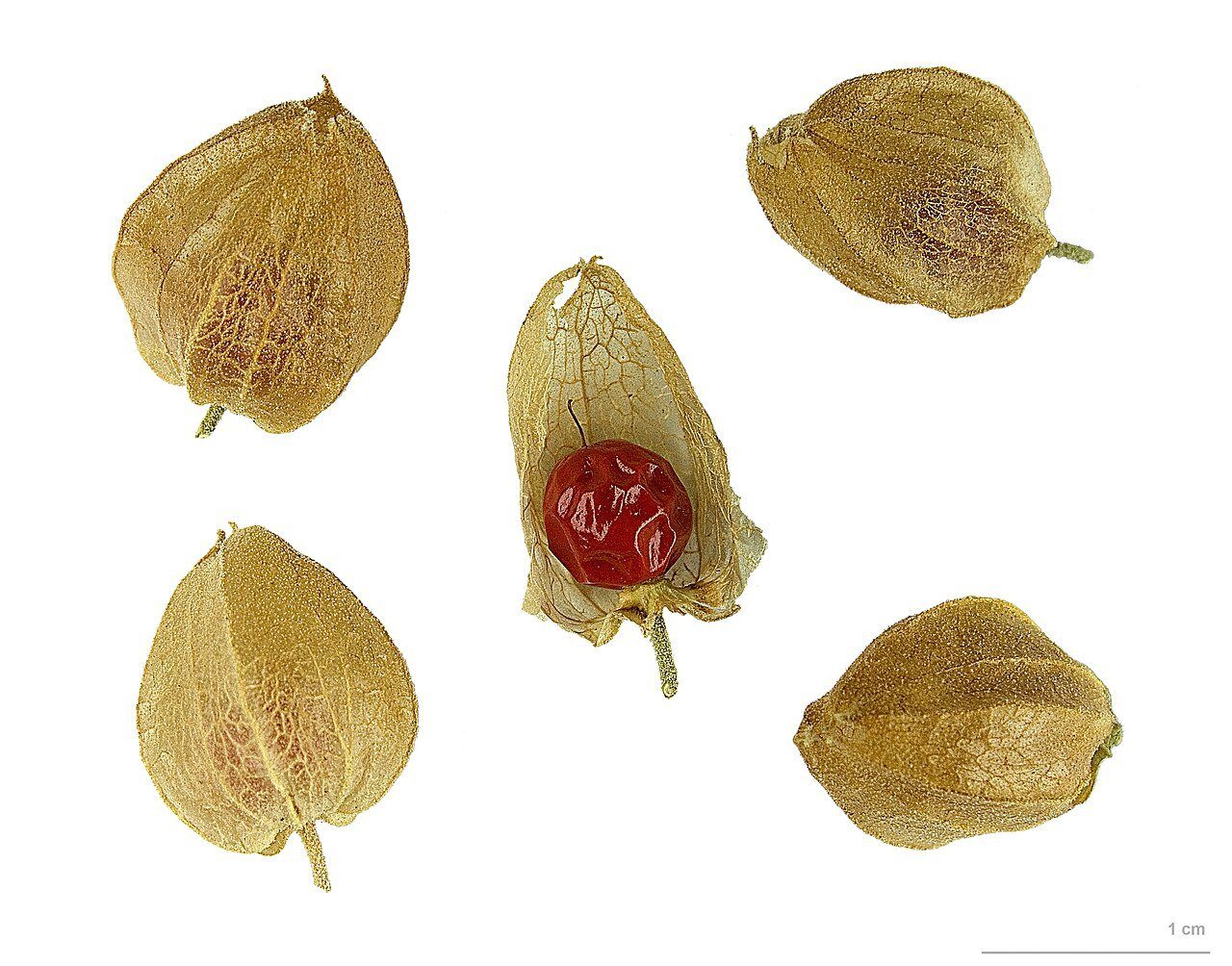 calyx, grown into a papery bagberry inside
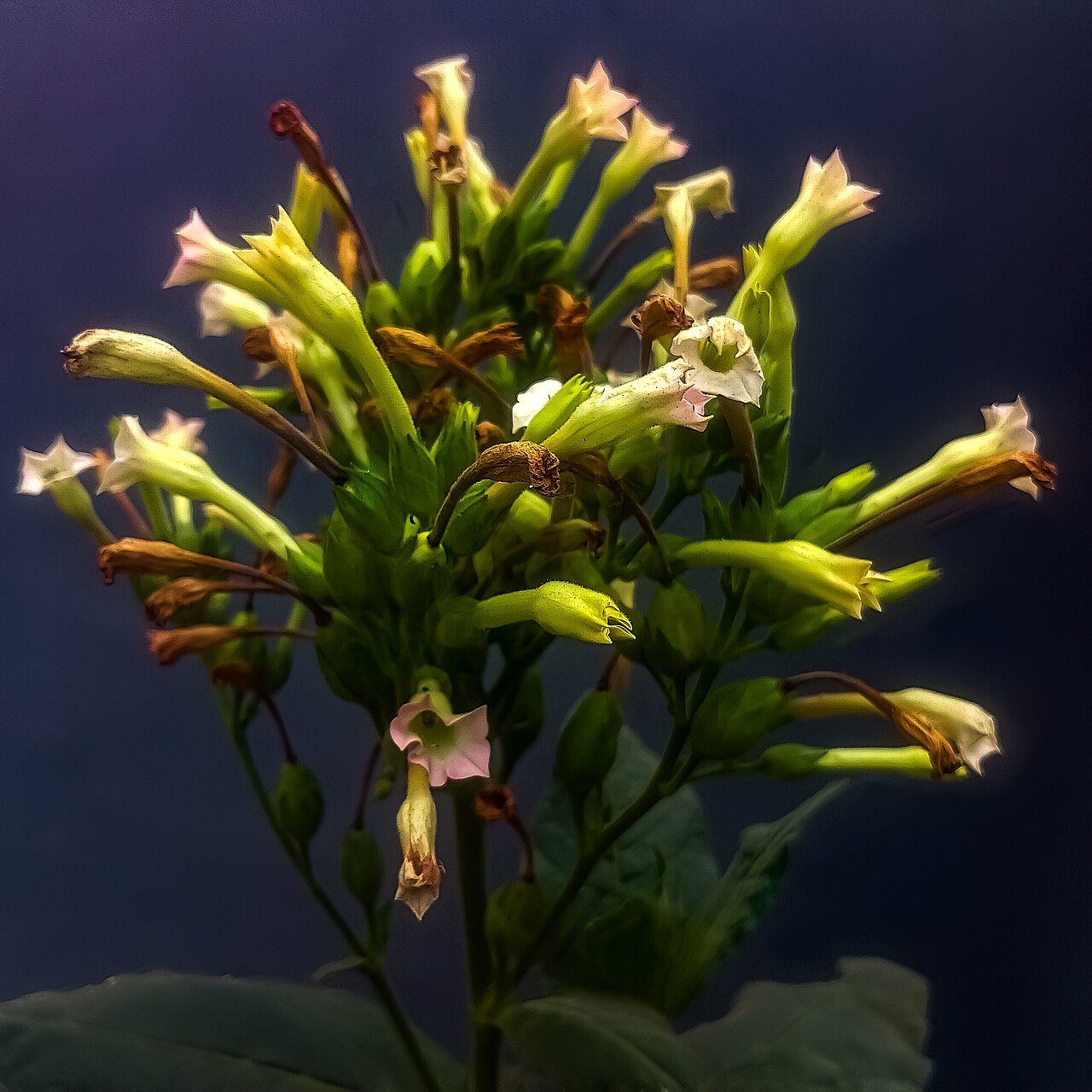 tube of 5 joined petals
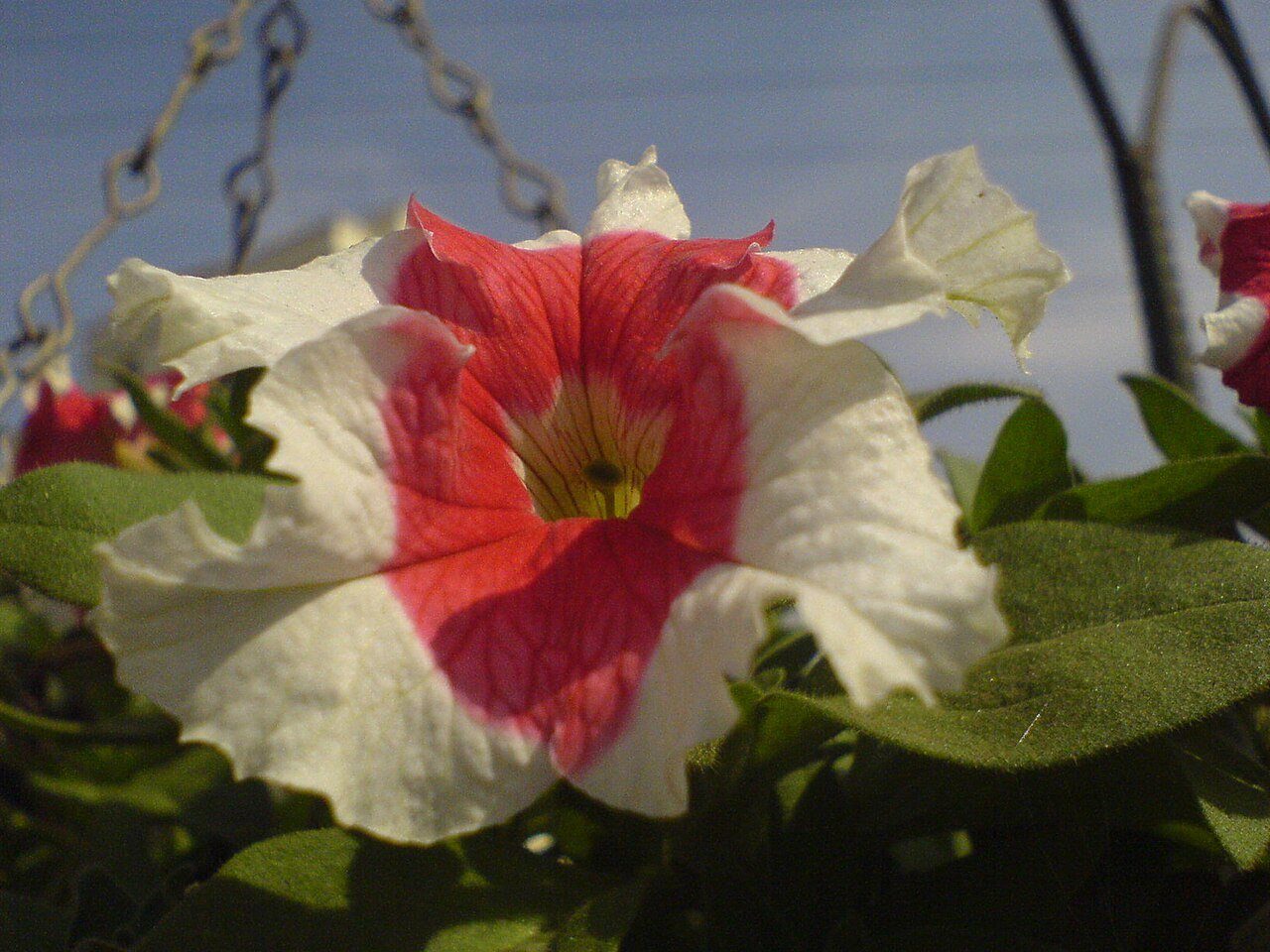 funnel of 5 joined petals
Fabaceae and Liliaceae
Not in the current textbook, but NEET has asked it: older editions also described the pea family and the lily family, and NEET questions still compare all three. Learn them side by side.
| Character | Fabaceae (pea family) | Liliaceae (lily family) |
|---|---|---|
| Group | Dicot; once a subfamily (Papilionoideae) of Leguminosae | Monocot |
| Habit | Trees, shrubs, herbs; roots with root nodules | Perennial herbs with underground bulbs, corms or rhizomes |
| Leaves | Alternate, pinnately compound or simple; leaf base pulvinate; stipulate; reticulate venation | Mostly basal, alternate, linear; exstipulate; parallel venation |
| Inflorescence | Racemose | Solitary or cymose; often umbellate clusters |
| Flower | Bisexual, zygomorphic | Bisexual, actinomorphic |
| Calyx and corolla | Five sepals, gamosepalous, imbricate; five petals, polypetalous, papilionaceous (standard, two wings, two keel petals joined), vexillary | Perianth of six tepals (3 + 3), often united into a tube; valvate |
| Androecium | Ten stamens, diadelphous (9 + 1); anthers dithecous (two-lobed) | Six stamens (3 + 3), epiphyllous |
| Gynoecium | Monocarpellary; ovary superior, unilocular with many ovules; marginal placentation | Tricarpellary, syncarpous; ovary superior, trilocular with many ovules; axile placentation |
| Fruit, seed | Legume (pod); seeds one to many, non-endospermous | Capsule, rarely berry; seeds endospermous |
| Floral formula | \( \%\ \text{⚥}\ \mathrm{K}_{(5)}\ \mathrm{C}_{1+2+(2)}\ \mathrm{A}_{(9)+1}\ \underline{\mathrm{G}}_{1} \) | \( \mathrm{Br}\ \oplus\ \text{⚥}\ \overgroup{\mathrm{P}_{(3+3)}\ \mathrm{A}_{3+3}}\ \underline{\mathrm{G}}_{(3)} \) |
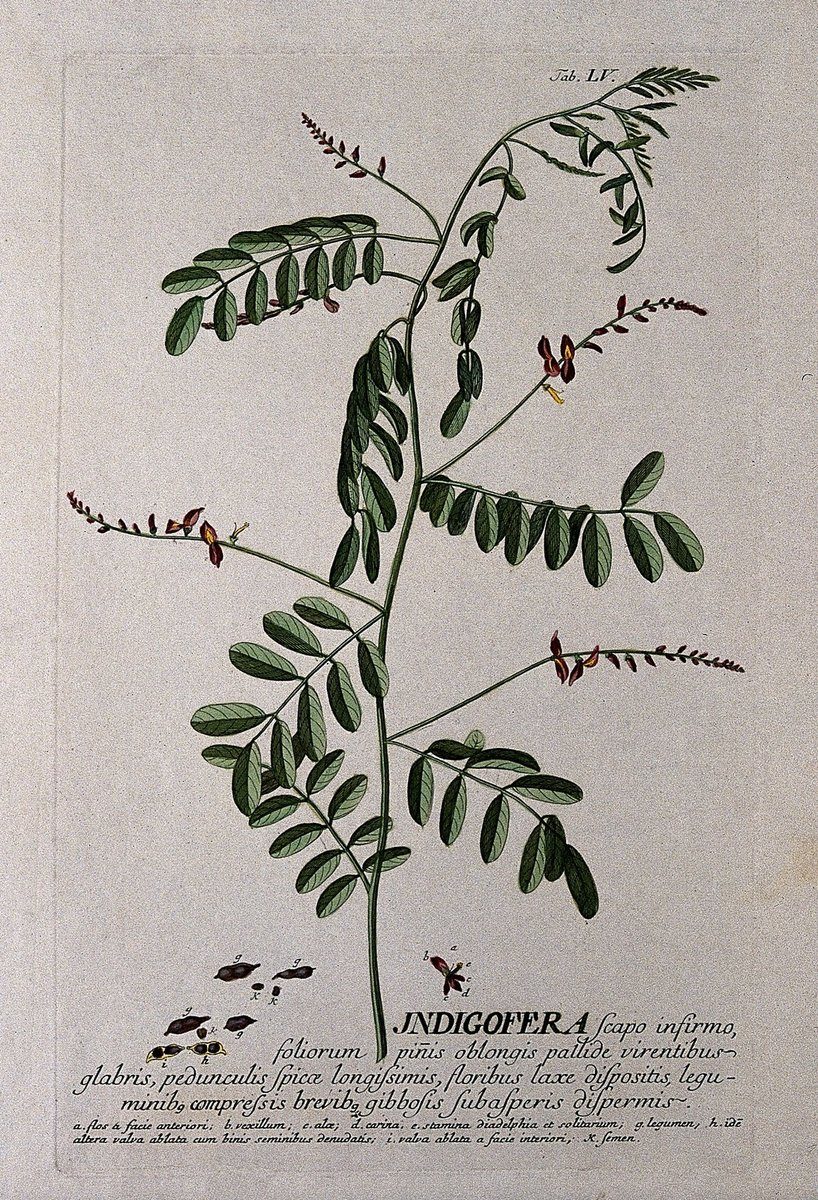
| Uses | Pulses (gram, arhar, moong, sem, soybean); edible oil (soybean, groundnut); dye (Indigofera); fibre (sunn hemp); fodder (Sesbania, Trifolium); ornamentals (lupin, sweet pea); medicine (muliathi) | Ornamentals (tulip, Gloriosa); medicine (Aloe); vegetable (asparagus); colchicine from Colchicum autumnale |
The pea flower is the one to know by sight. One big petal stands up at the back like a sail (the standard), two side petals spread like wings (the wings), and the two lowest petals are joined along their lower edge into a little boat (the keel) that hides the stamens and the carpel. Open a pea pod and the seeds sit in one row along a single seam: marginal placentation.
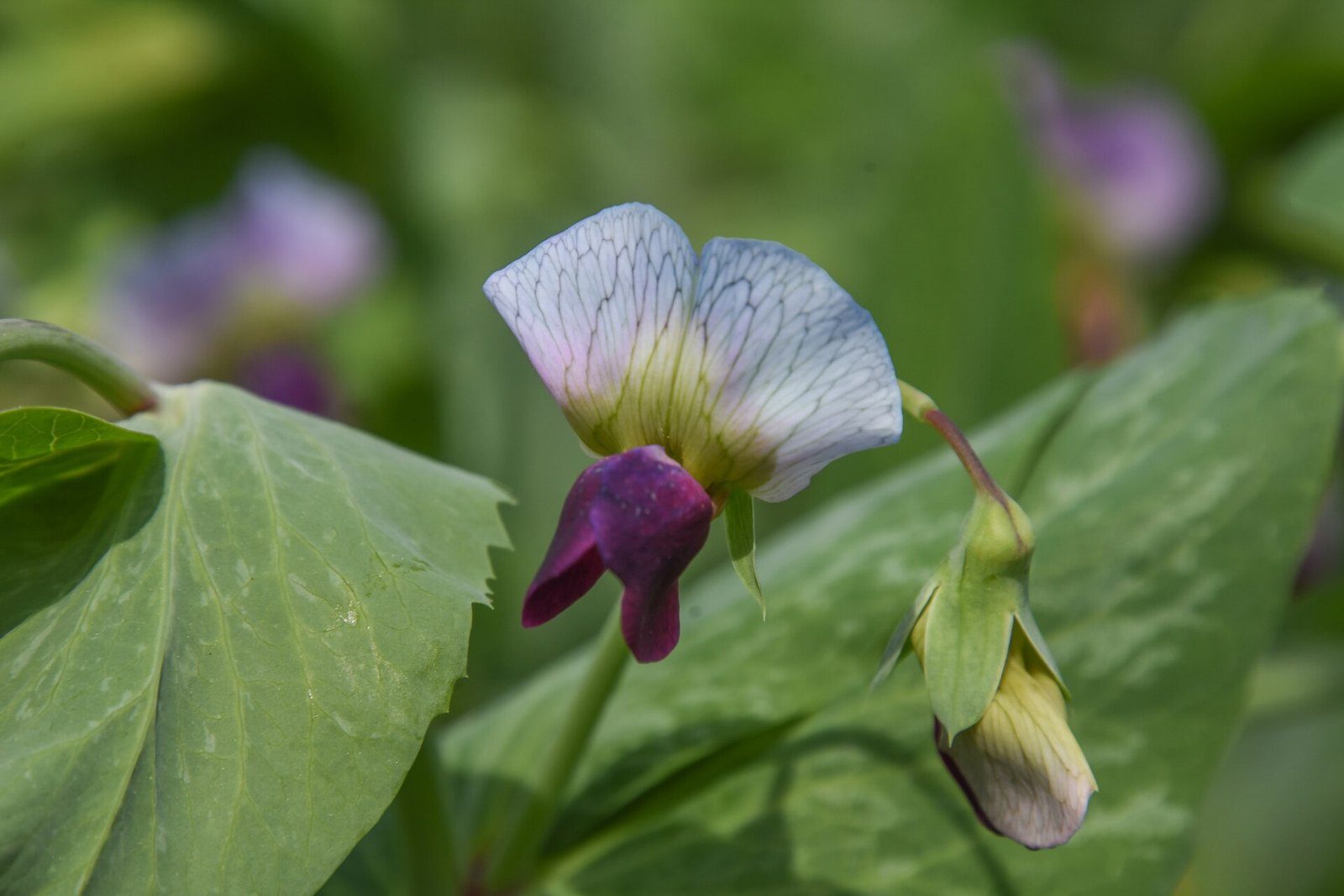 standardwingsflower bud
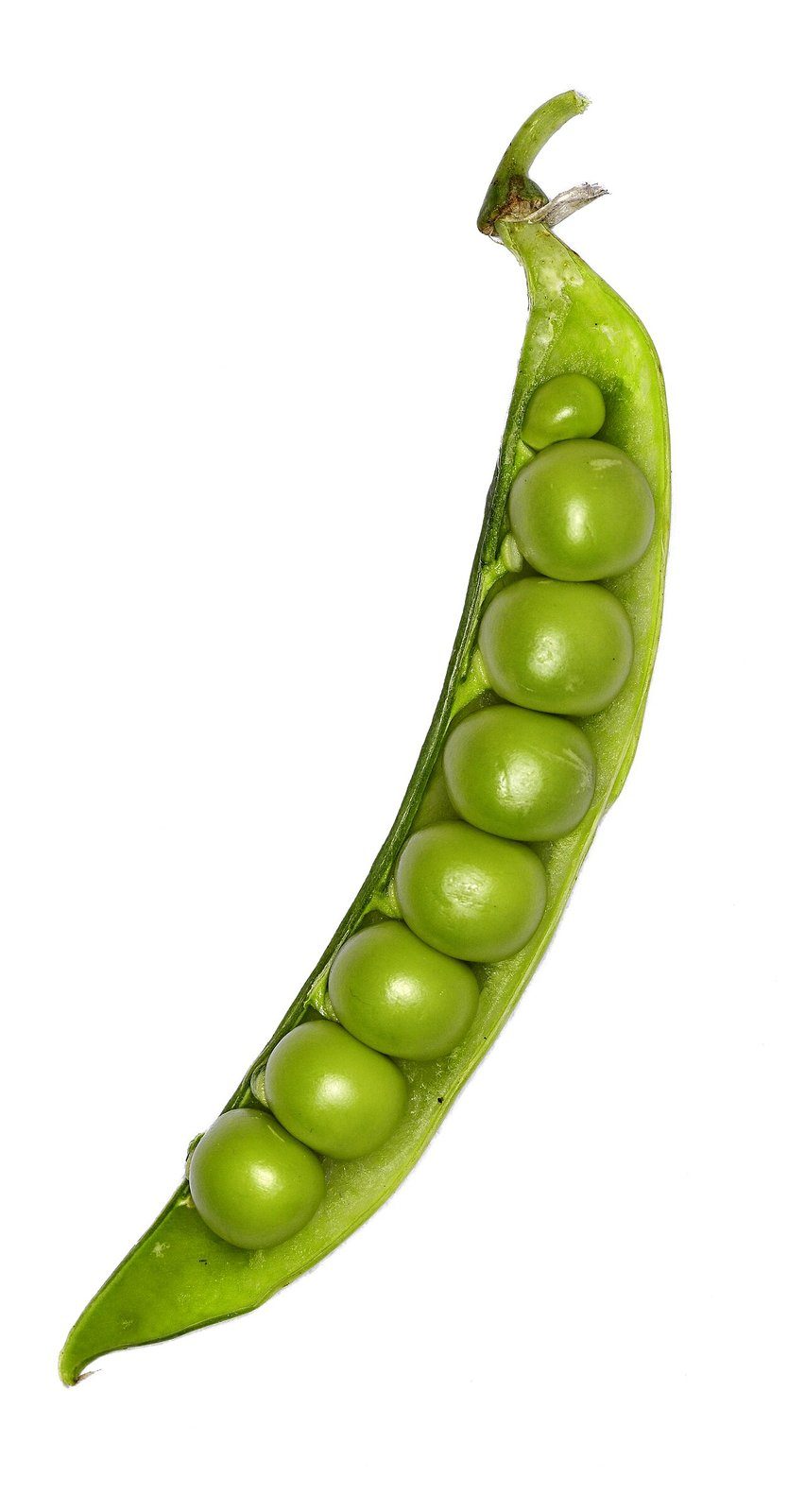 peas fixed along one seampod: 1 carpel
Dig up a gram, pea or groundnut plant and look at the roots: small round lumps, the root nodules. Bacteria living inside them turn nitrogen from the air into a form the plant can use.
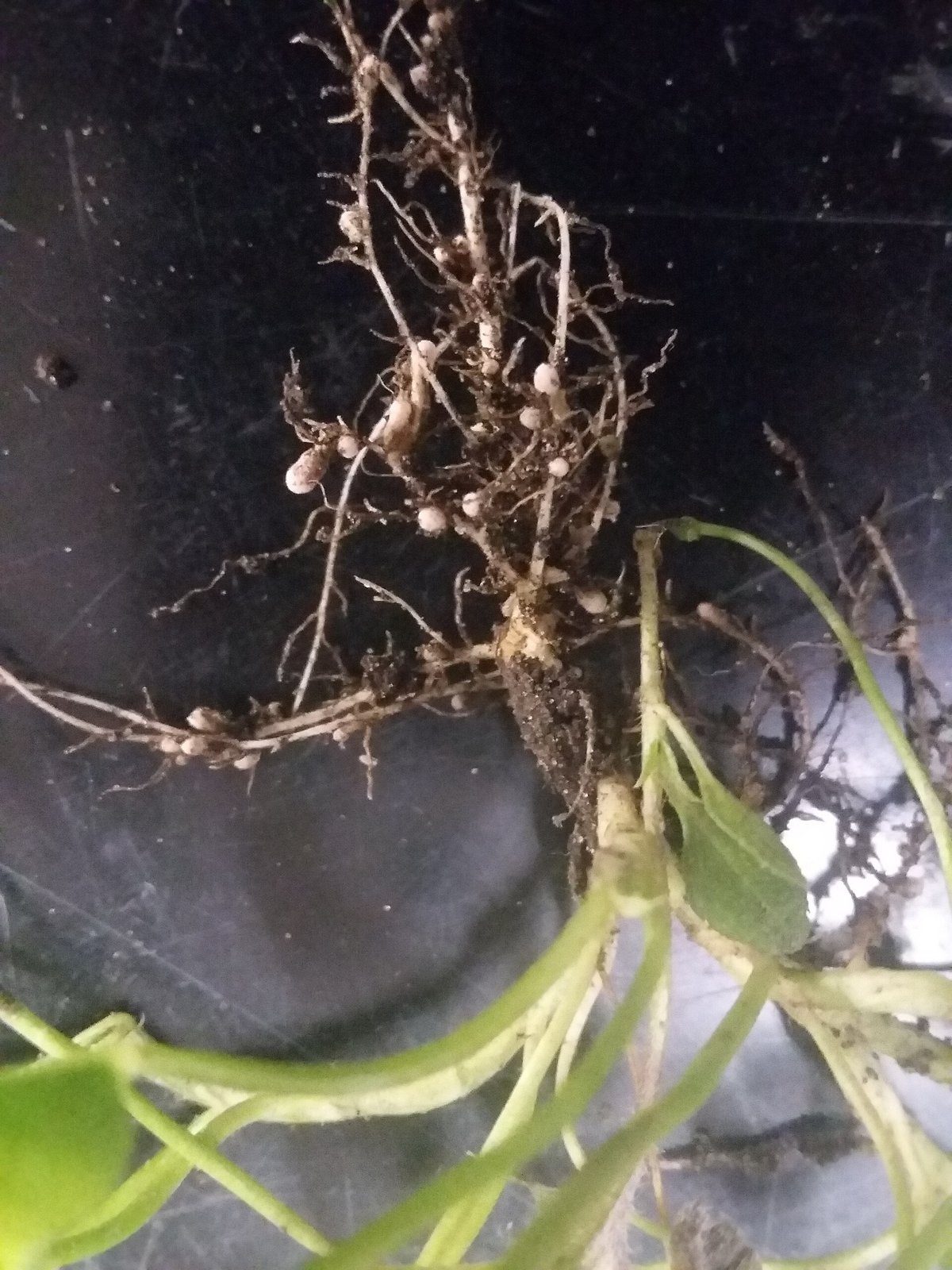 root nodules
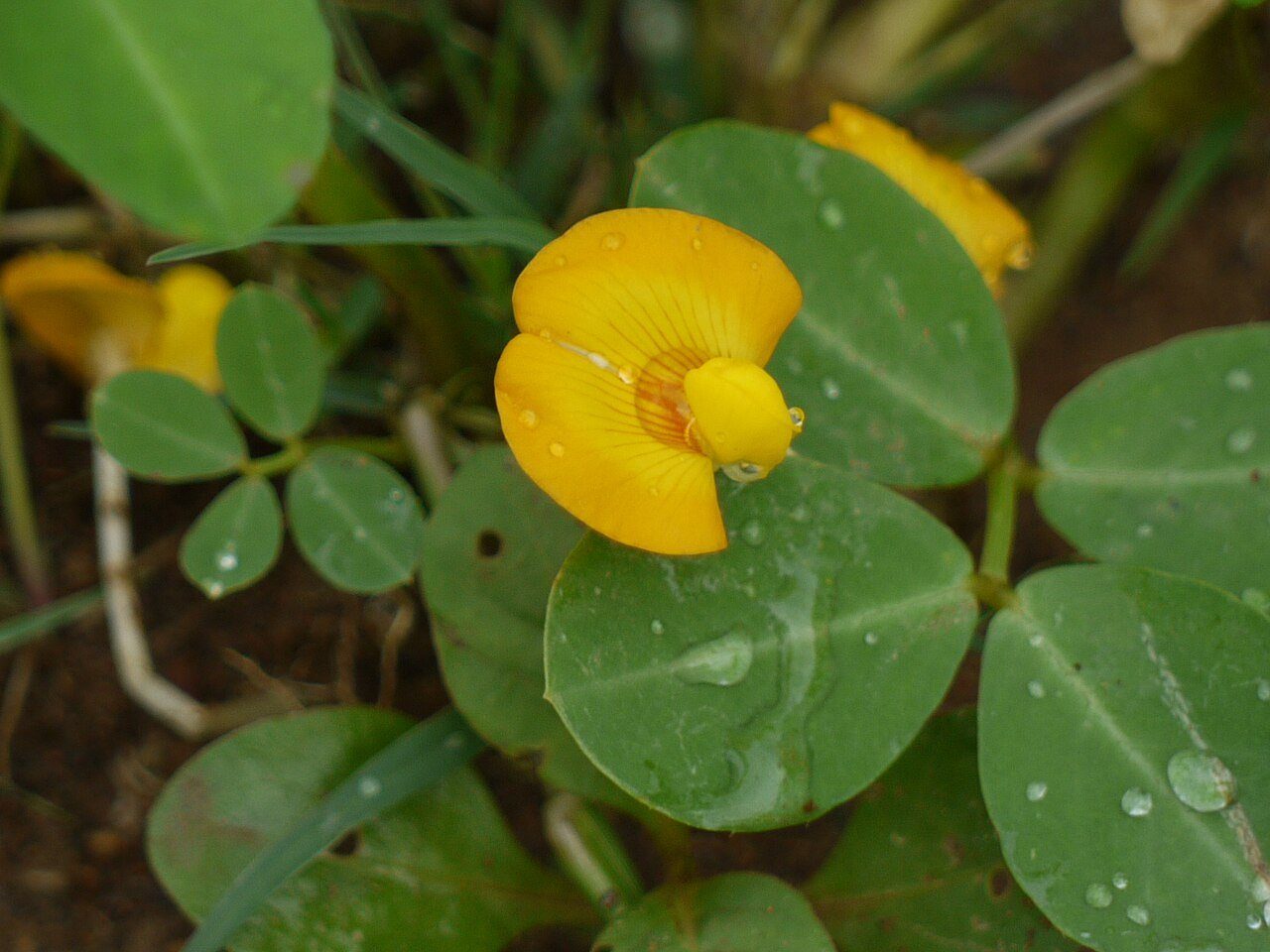 standardwings and keelleaf of 4 leaflets
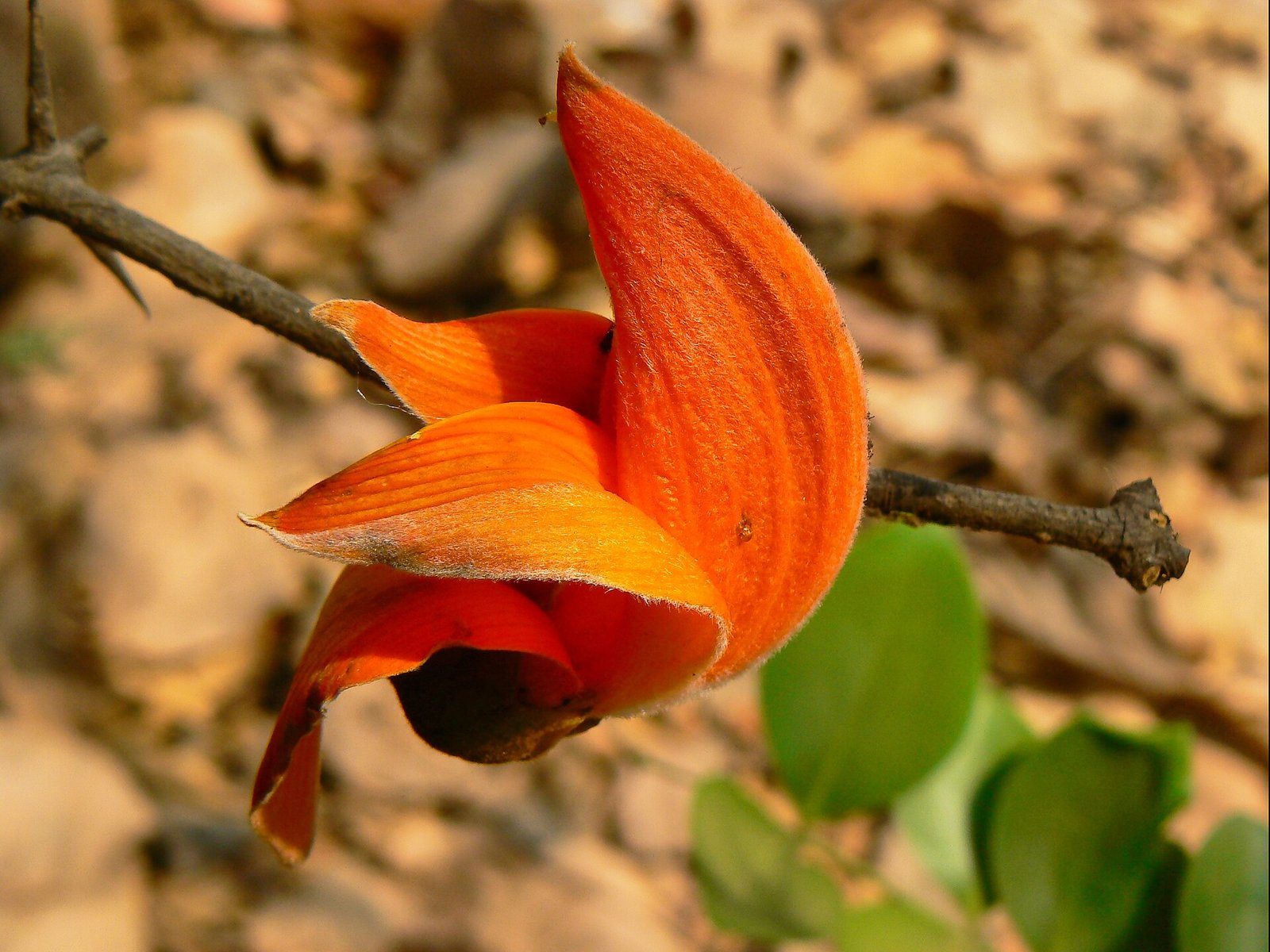 standardwingkeel
The lily flower has no separate green calyx: all six parts look like petals (tepals), three in an outer ring and three in an inner ring, with six stamens in front of them and a three-lobed stigma in the middle. Gloriosa, the glory lily, grows wild in India (it is the state flower of Tamil Nadu) and climbs with tendrils at the tips of its leaves.
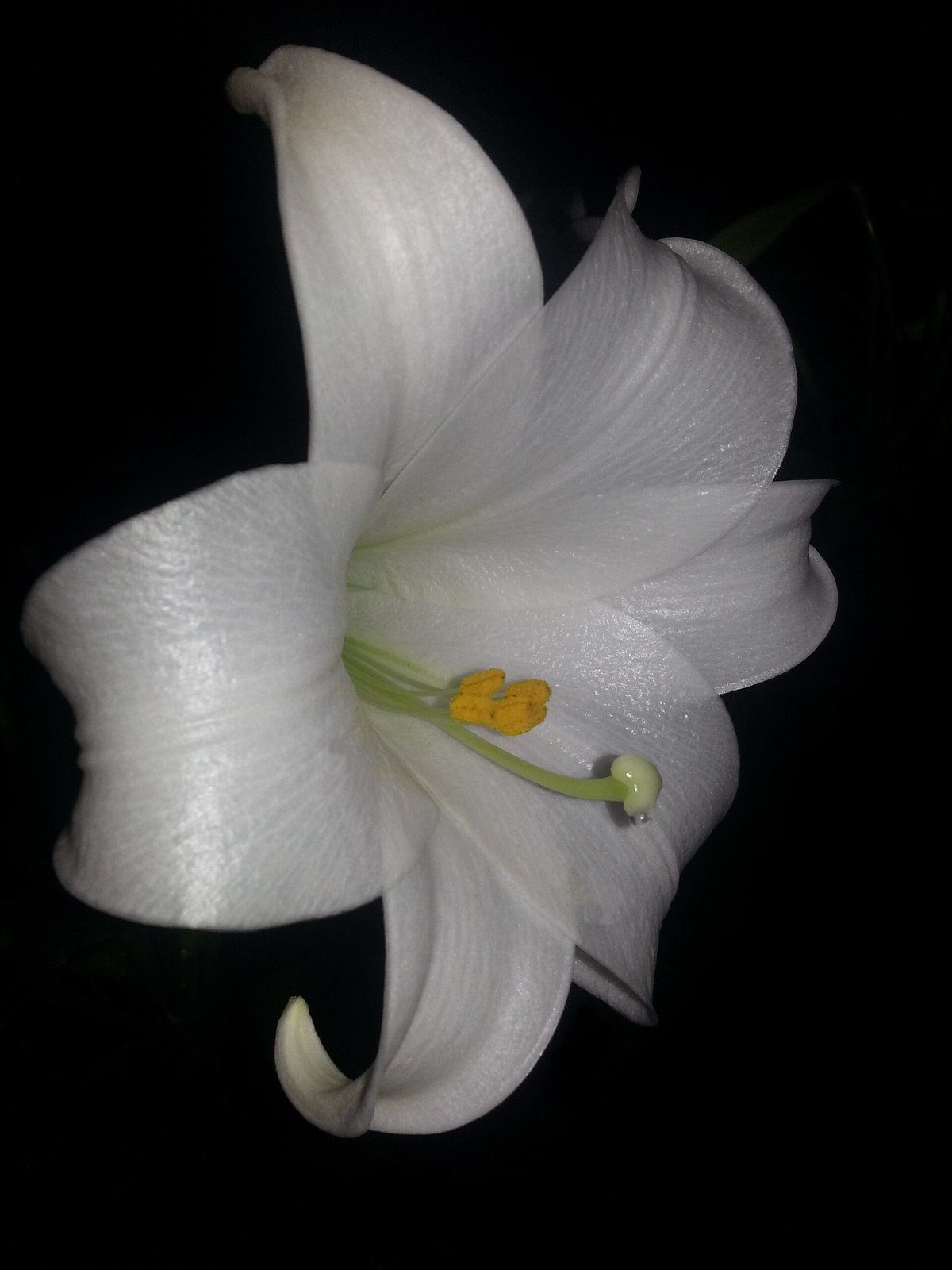 tepalstamens3-lobed stigma
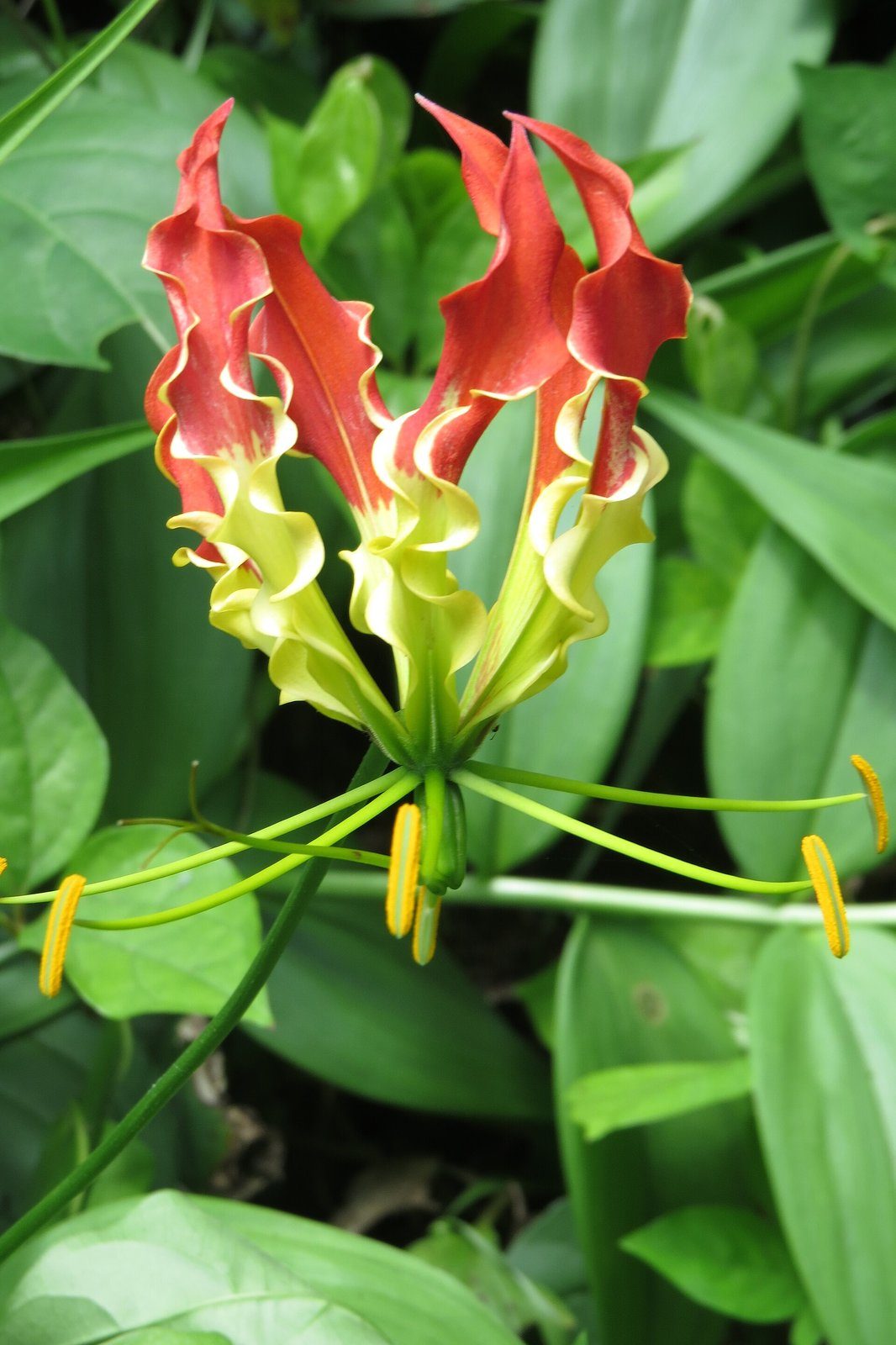 wavy tepal, bent back6 stamens
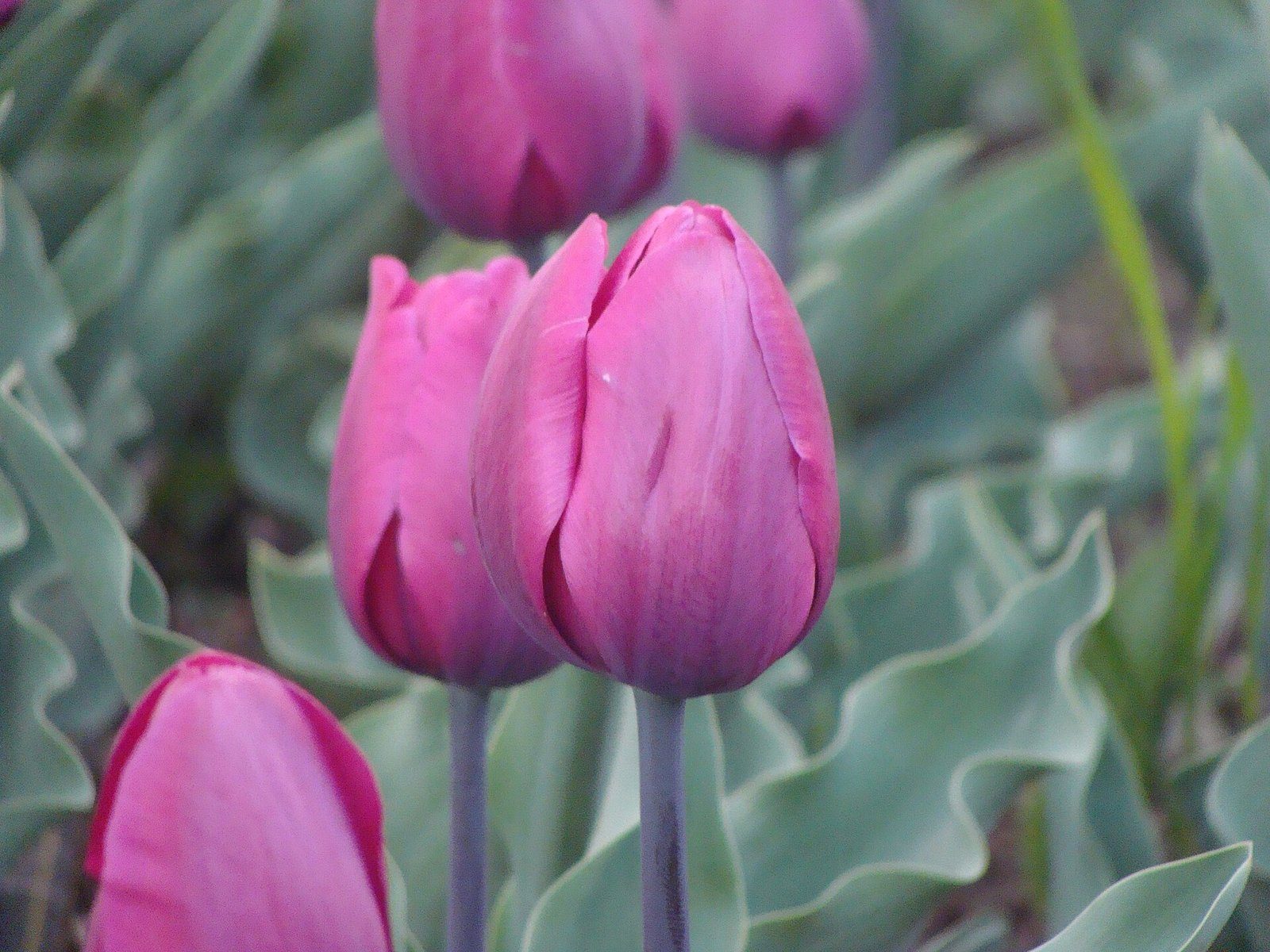 tepals, 3 + 3
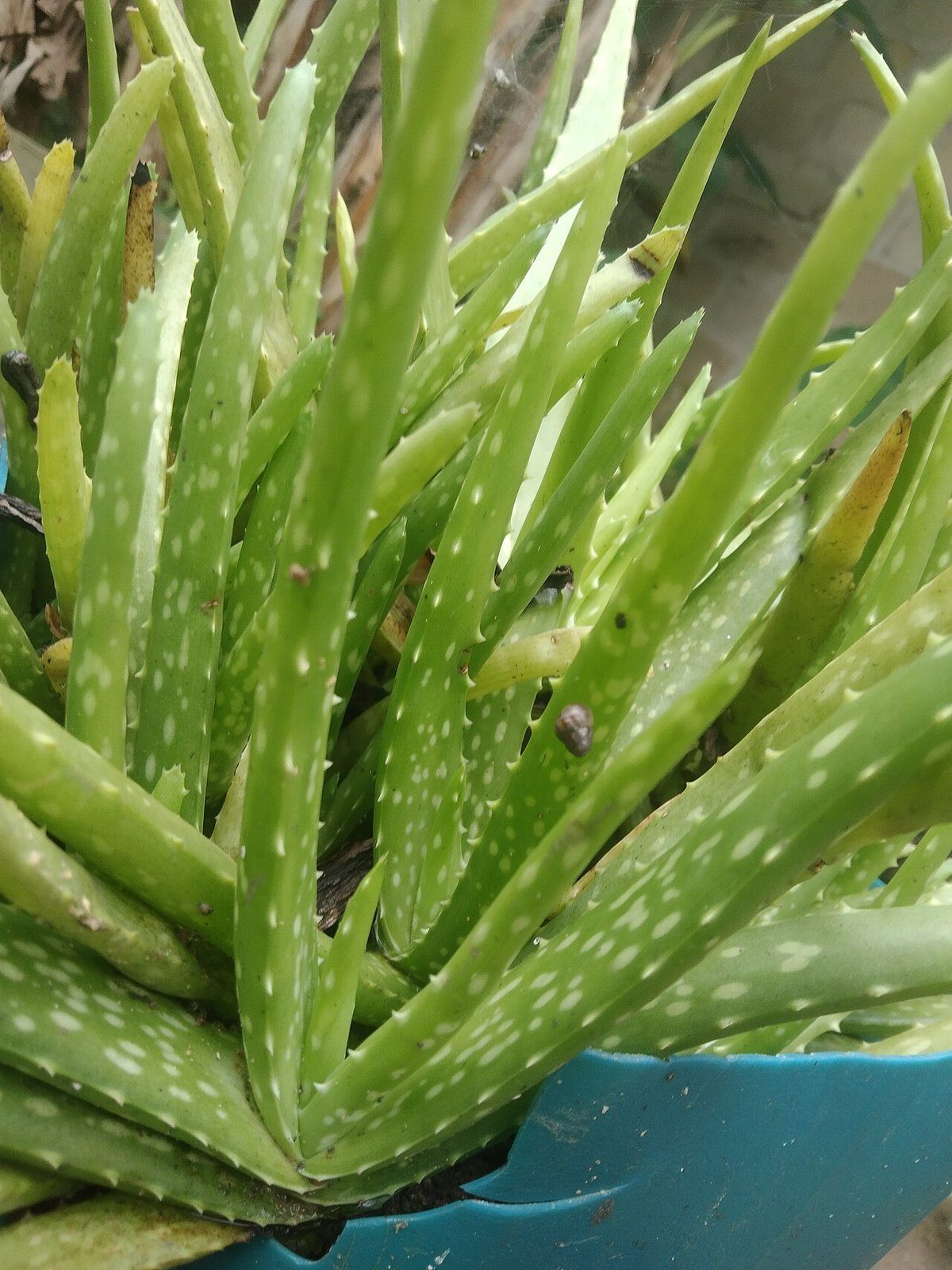 thick, fleshy leaf
Sort the family features.
Now read whole flowers. Each card shows a real plant's formula and floral diagram; name its family.
Don't mix these up
- Epipetalous stamens: Solanaceae. Epiphyllous: Liliaceae. Diadelphous: Fabaceae.
- Ovary is superior in all three families.
- Gynoecium: two fused carpels (Solanaceae), one carpel (Fabaceae), three fused carpels (Liliaceae).
- Placentation: axile (Solanaceae, Liliaceae), marginal (Fabaceae).
Just remember
The family features have a reason (the next section), but which crop sits in which family, and the uses, are lists to learn. Hooks:
- Solanaceae: potato, tomato, brinjal, chilli; belladonna and ashwagandha (medicine); tobacco (fumigatory); petunia (ornamental); makoi, Solanum nigrum (the textbook's example)
- "Po-To-Bri-Chi" for the four vegetables. Then look at the top of a brinjal, tomato or chilli: the green cap that stays on is the persistent calyx, the family's badge.
- Fabaceae uses: pulses (gram, arhar, moong, sem, soybean), oil (soybean, groundnut), dye (Indigofera), fibre (sunn hemp), fodder (Sesbania, Trifolium), ornamental (lupin, sweet pea), medicine (muliathi)
- Walk through an Indian kitchen and field: dal in the pot, oil in the pan, neel (indigo) in the wash (the word indigo comes from Greek for "from India"), rope of sunn hemp, chara for the cattle (Tri-folium = three leaflets, clover), muliathi in the cough syrup.
- Liliaceae uses: tulip and Gloriosa (ornamental), Aloe (medicine), asparagus (vegetable), colchicine (from Colchicum autumnale)
- "TAG-AC": Tulip and Gloriosa for the garden, Aloe for the skin, Asparagus for the plate, Colchicine for the lab.
- Epipetalous (Solanaceae), epiphyllous (Liliaceae), diadelphous (Fabaceae)
- The words carry the clue. Potato family has petals, so its stamens are epipetalous. Lilies have only tepals, perianth "leaves" (phyllon = leaf), so epiphyllous. Fabaceae's stamens form two brotherhoods (adelphos = brother): di-adelphous, nine together and one alone.
- Pea: \( \%\ \text{⚥}\ \mathrm{K}_{(5)}\ \mathrm{C}_{1+2+(2)}\ \mathrm{A}_{(9)+1}\ \underline{\mathrm{G}}_{1} \)
- Draw the boat: 1 sail (standard) + 2 wings + (2) keel petals glued into the hull. Nine stamens in a tube and one on its own.
- Lily: \( \mathrm{Br}\ \oplus\ \text{⚥}\ \overgroup{\mathrm{P}_{(3+3)}\ \mathrm{A}_{3+3}}\ \underline{\mathrm{G}}_{(3)} \)
- A monocot does everything in threes: 3 + 3 tepals, 3 + 3 stamens, 3 carpels.
- Placentation: axile in Solanaceae and Liliaceae, marginal in Fabaceae
- Peas sit in a row along the pod's margin (its seam). A tomato cut across shows seeds on a central pillar: axile.
- Exstipulate
- Leaves without stipules.
- Persistent calyx
- Sepals that stay on the fruit (brinjal's green cap).
- Bicarpellary
- Gynoecium with two carpels.
- Bilocular
- Ovary with two chambers.
- Dithecous
- Anther with two lobes.
- Legume
- The pod fruit of the pea family.
Words to know
Which feature is NOT true of the Solanaceae flower?
- Bisexual and actinomorphic
- Five epipetalous stamens
- Inferior ovary
- Bicarpellary, syncarpous, axile placentation
A flower has ten stamens, nine joined and one free, and a single carpel. It belongs to
- Solanaceae
- Fabaceae
- Liliaceae
Ashwagandha and belladonna, both medicinal plants, belong to the same family as
- potato
- gram
- tulip
Deep dive · optional
Why does a potato flower look like a brinjal flower?
Why families are read from flowers and not leaves, why Mendel picked the pea, how a family of plants from the Americas took over the Indian kitchen, and why the lily family of the textbook has since been split up. Not for the exam, but it ties the whole chapter together.
The roots: a family is a branch of one family tree
- Why are potato and brinjal put in the same family?Because their flowers are built on one plan, down to small details: five joined sepals that stay on the fruit, five joined petals, five stamens fixed to the petals, and two joined carpels set at a slant. One formula describes the typical flower of a family of about 2,700 species.
- Why should a shared flower plan mean anything?Because flowers are inherited. A detailed plan shared by many species is most likely a plan they all got from one ancestor. A family is meant to be one branch of the family tree of plants: cousins, not look-alikes.
- Then why not sort plants by their leaves? Leaves are easier to see.Because leaves change easily, even inside one family. Potato and tomato have leaves cut into leaflets; brinjal and chilli have simple leaves. A plant in shade grows bigger, thinner leaves than the same plant in sun. Leaves are solar panels, and their shape follows the light and water where each species lives.
- Why does the flower plan change more slowly?The usual explanation: every part of a flower must work with the other parts and with the pollinator at the same moment, so most big changes to the plan mean fewer seeds and do not last. Leaves can change shape much more freely without ruining reproduction. So the flower keeps the family resemblance, generation after generation.
- How do we know the flower-based families are real?Since the 1990s botanists have compared the DNA of plants directly. Many of the old flower-based families held together. Some did not: the old lily family turned out to be a "catch-all" of plants that only looked alike, and it was split (the next story).
The bedrock is the plainest fact of biology: children look like their parents, and changes that cost a plant its seeds do not get passed on. Put those together and you get families of plants that share a flower.
Try it with eleven real plants. Guess first.
The stories
See it
Inside a root nodule, under an electron microscope: the root's cells are packed with bacteria (the dark oval bodies), each one turning nitrogen from the air into ammonia the plant can use. This is why pulses enrich the soil they grow in.
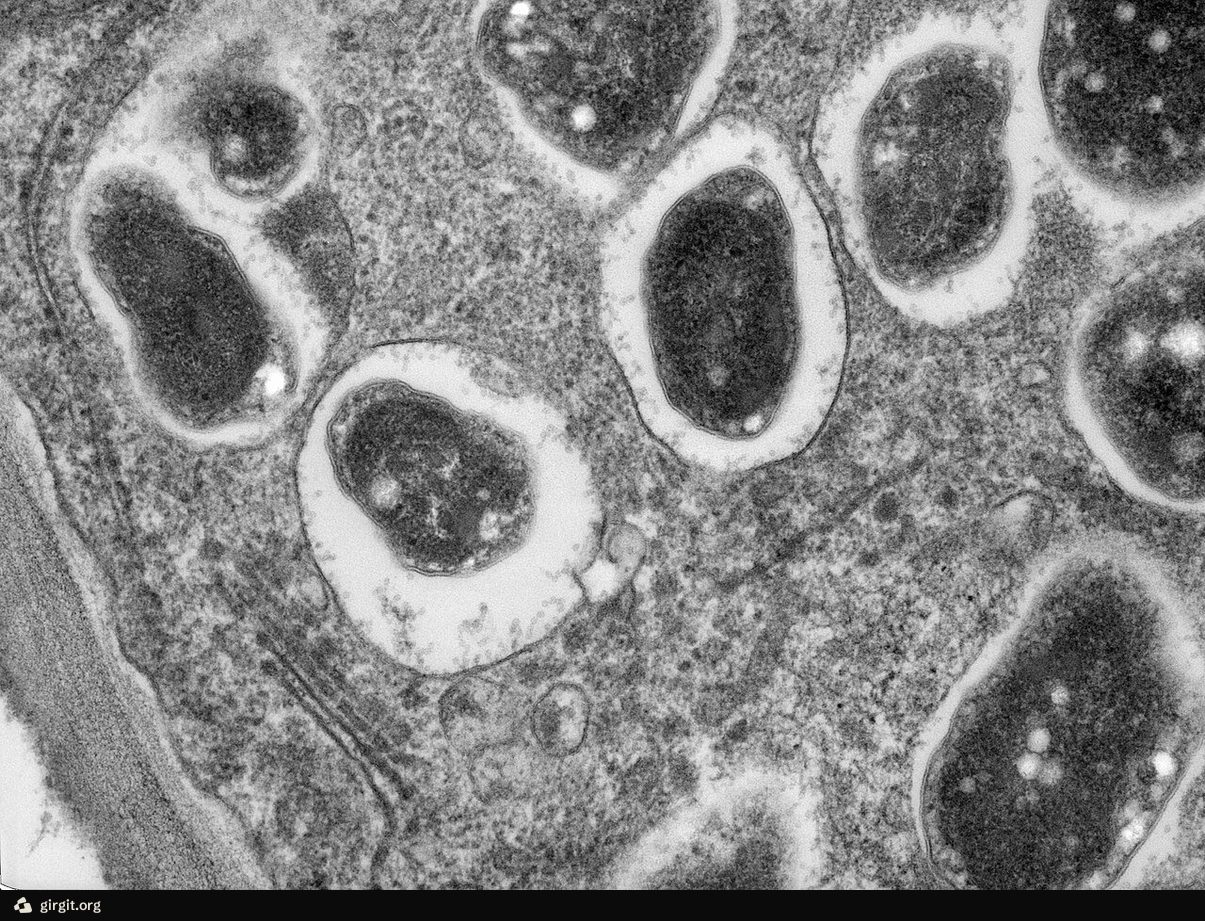 one bacterium
Solve it
Solve it
Agathi (Sesbania grandiflora) is a small tree of Indian gardens; in many parts of India its flowers are fried or cooked in curries, and its leaves are fed to cattle. Each flower has one large upright petal at the back, two side petals and two lower petals joined into a boat; ten stamens, nine joined and one free; one carpel that becomes a long pod. Name its family and write its floral formula. What would you expect to find on its roots?
Answer
Fabaceae (standard, wings and keel; diadelphous stamens; one carpel; a legume). Formula: \( \%\ \text{⚥}\ \mathrm{K}_{(5)}\ \mathrm{C}_{1+2+(2)}\ \mathrm{A}_{(9)+1}\ \underline{\mathrm{G}}_{1} \). Expect root nodules, as in other Fabaceae. That is one reason legumes such as Sesbania make good fodder: the nitrogen they fix ends up in protein-rich leaves.
Solve it
A farmer in Madhya Pradesh grows wheat after a crop of gram and finds the wheat needs less nitrogen fertiliser than wheat grown after wheat. Explain, step by step, using what this page says about Fabaceae.
Hint
Answer
Why was the pea's keel useful to Mendel?
- It made the flowers easy to tell apart by colour
- It keeps out stray pollen, so the flower pollinates itself unless opened by hand
- It protects the seeds from insects
- It makes the flower actinomorphic
Connect it
Connect it
- What is a family? Class 11 Ch 1. Family is one rank in the taxonomic hierarchy, between genus and order; potato and brinjal share even the genus Solanum.
- Reading the code, concept 10. Every family here is summed up in a floral formula.
- Mendel's peas, Class 12 Ch 4. The self-pollinating keel flower made the monohybrid cross possible.
- Colchicine and the spindle, Class 11 Ch 10. Colchicine stops the spindle forming, so the doubled chromosomes of prophase and metaphase never separate.
- Shared plans and shared ancestors, Class 12 Ch 6. Families built on shared structures are the same idea as homologous organs in evidences for evolution.
- Bees and keels, Class 12 Ch 1. How insects open zygomorphic flowers is part of agents of pollination.
Still confused?
Fabaceae, Leguminosae, Papilionaceae: are these the same?
Nearly. Leguminosae is the old name for the whole pea family and Fabaceae is the modern name for the same family. Papilionaceae (now subfamily Papilionoideae) is the part of it with butterfly-like flowers: standard, wings and keel. The pea, gram and groundnut flowers on this page are all papilionaceous. NCERT's description of Fabaceae is really the description of this subfamily.
Is onion in Liliaceae?
Older books, including the older NCERT edition, put onion and garlic in Liliaceae. Botanists have since moved them out (they also have the onion smell true lilies lack), and they are now grouped with the amaryllis family. If an exam question follows the old book, answer as the book does; just know the family has moved.
If leaves are so variable, why do we still learn leaf characters for each family?
Because they still help, as long as you use them together with the flower. Parallel veins tell you at once that a plant is probably a monocot, and a swollen leaf base (pulvinus) plus stipules strongly suggests Fabaceae. The flower is the deciding vote, the leaves are supporting evidence.
Sources
- Mendel (1865), Experiments in Plant Hybridization, English translation on MendelWeb; Wikipedia: Experiments on Plant Hybridization
- Wikipedia: Solanaceae and Fabaceae
- Wikipedia: Chili pepper (domestication, Chanca 1493, Portuguese spread, production 2024)
- Wikipedia: History of the potato
- Blakeslee and Avery (1937), Methods of inducing doubling of chromosomes in plants by treatment with colchicine, Journal of Heredity 28: 393 to 411
- Wikipedia: Liliaceae (the catch-all family and its narrowing) and Colchicaceae
- Wikipedia: Gloriosa superba
- Wikipedia: Root nodule
- Wikipedia: Indigo dye (the name)
Picture and video credits
Show 20 picture and video credits
- makoi-solanum-nigrum-berries-kerala.jpg: Vinayaraj, CC BY-SA 3.0
- potato-flowers-field.jpg: Ezhuttukari, CC BY-SA 3.0
- tomato-flower-anther-cone.jpg: André Karwath aka Aka, CC BY-SA 2.5
- brinjal-flowers-purple-sky.jpg: Baby Devi 26, CC BY-SA 4.0
- datura-metel-flower-night.jpg: Billjones94, CC BY-SA 4.0
- chilli-fruit-persistent-calyx-burdwan.jpg: Joydeep, CC BY-SA 3.0
- ashwagandha-withania-fruits-calyx.jpg: Roger Culos, CC BY-SA 3.0
- tobacco-flowers-nicotiana.jpg: Colowokanga, CC BY-SA 4.0
- petunia-red-white-thane.jpg: Dinesh Valke from Thane, India, CC BY-SA 2.0
- garden-pea-flower-keel.jpg: Georgios Liakopoulos, CC BY-SA 3.0
- green-pea-pod-open.jpg: Amada44, CC BY-SA 4.0
- clover-root-nodules.jpg: Bwiltz, CC BY-SA 4.0
- groundnut-flower-leaves-thane.jpg: Dinesh Valke from Thane, India, CC BY-SA 2.0
- palash-butea-monosperma-flower.jpg: Dinesh Valke from Thane, India, CC BY-SA 2.0
- indigofera-tinctoria-wellcome-plate.jpg: Wellcome Collection, CC BY 4.0
- lilium-candidum-flower.jpg: Gabriel Sozzi, CC BY-SA 4.0
- gloriosa-superba-thrissur.jpg: Baluperoth, CC BY-SA 4.0
- tulip-purple-srinagar.jpg: Abdars, CC BY-SA 3.0
- aloe-vera-pot.jpg: Andikan Efiok Eduok, CC BY-SA 4.0
- colchicum-autumnale-flowers.jpg: Steffen Bauer (saatpilot.de), CC BY 4.0


