- 1. What is a cell?
- 2. Cell theory
- 3. What is inside a cell?
- 4. How big is a cell?
- 5. Bacteria: prokaryotic cells
- 6. Plant and animal cells
- 7. The cell membrane and cell wall
- 8. The endomembrane system
- 9. Mitochondria and plastids
- 10. Ribosomes, cytoskeleton, cilia and centrioles
- 11. The nucleus
- Review
7 of 11·NCERT §8.5.1 · §8.5.2·pp. 93–94·6 min
The cell membrane and cell wall
The big ideaThe cell membrane is a fluid skin that chooses what gets in and out. Plant cells add a stiff wall outside it.
In simple words
The skin of a cell is made of two thin layers of fat, with proteins floating in it like boats on a pond. Everything in it slides about. Some small things slip straight through, some need a gate to be opened, and some have to be pushed in using energy.
The membrane is only about 7 to 10 nanometres thick, far too thin for a light microscope. Chemists first worked out what it is made of, using human red blood cells, which have no other membranes inside. It is mainly lipids (fats) and proteins.
- The main lipids are phospholipids, arranged in two layers: a lipid bilayer. Each has a head that likes water (polar) and two tails that hate it (non-polar). Heads face the water on both sides; tails hide in the middle.
- There is also cholesterol, plus proteins and carbohydrates. A red blood cell membrane is about 52% protein and 40% lipid.
- Peripheral proteins sit on the surface. Integral proteins are buried in it, often right through.
This ability to flow is the membrane's fluidity. Cells need it to grow, join to neighbours, release things (secretion), swallow things (endocytosis) and divide.
Getting things across
The membrane is selectively permeable: it lets some things through and not others.
- Passive transport: no energy needed, things flow from crowded to less crowded. Small neutral things cross by simple diffusion. Water crossing a membrane this way is osmosis.
- Polar molecules can't pass through the fatty middle, so a carrier protein helps them across.
- Active transport: moving things uphill, from less crowded to more crowded. That costs energy, paid in ATP. Example: the Na⁺/K⁺ pump.
Textbook check · §8.5.1Most water crosses through aquaporins
- The textbook says
- Water may also move across the membrane from higher to lower concentration by diffusion.
- What we know now
- Some water does slip through the lipid bilayer, but in many cells most of it flows through dedicated water-channel proteins, the aquaporins, discovered by Peter Agre around 1991. They explain why water crosses some membranes, like those of red blood cells and kidney tubules, so fast. He shared the 2003 Nobel Prize in Chemistry for it.Source: The Nobel Prize in Chemistry 2003
- In the exam
- Osmosis is the diffusion of water across a selectively permeable membrane: the definition is unchanged.
You can watch osmosis with a school microscope. Put a piece of red onion skin in salty water. Water leaves each cell, through its membrane, towards the saltier side. The coloured inside shrinks and pulls away from the wall, while the stiff wall keeps its shape. This shrinking is called plasmolysis. Put the skin back in plain water and the cells fill up again.
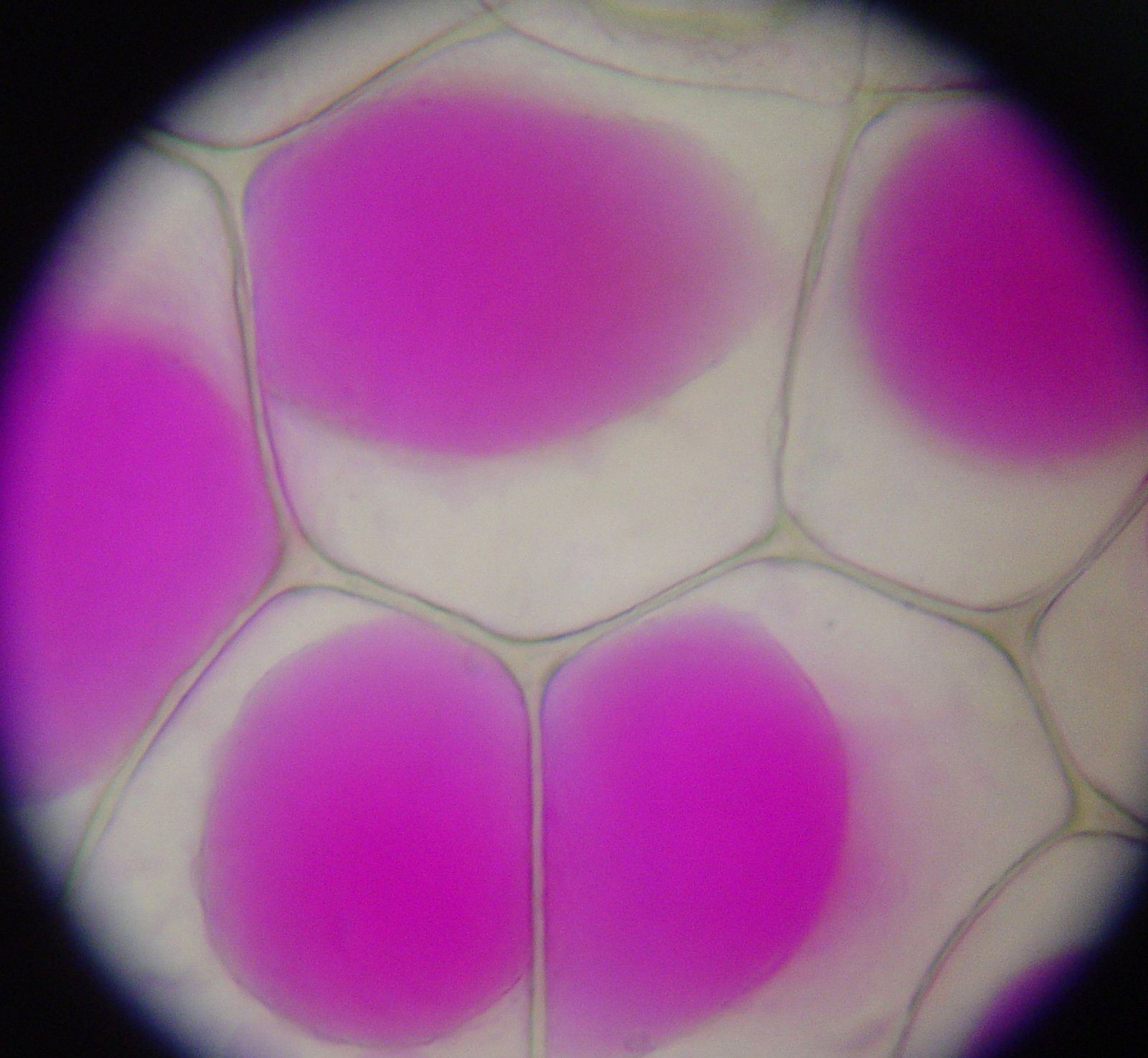 cell wallshrunken protoplastgap: salt waterpink sap in vacuole
The cell wall
Plants and fungi have a stiff, non-living cell wall outside the membrane. It gives shape, protects, helps cells talk to each other and keeps out unwanted big molecules.
- In algae: cellulose, galactans, mannans and minerals like calcium carbonate.
- In other plants: cellulose, hemicellulose, pectins and proteins.
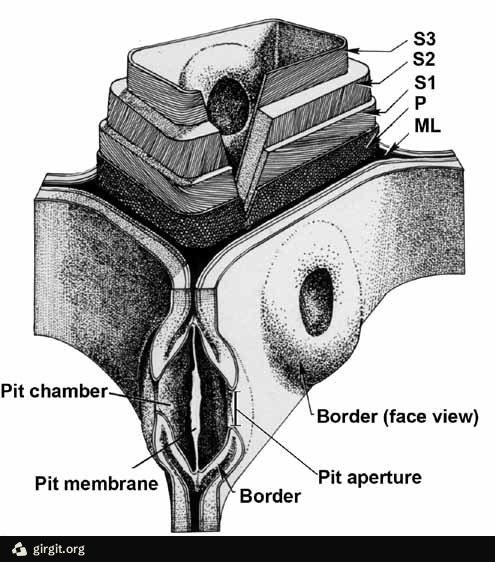
- A young cell has a thin, stretchy primary wall; later a secondary wall is laid down inside it.
- Neighbouring cells are glued by the middle lamella, mostly calcium pectate.
- Tiny channels, plasmodesmata, pass through walls and connect the cytoplasm of neighbouring cells.
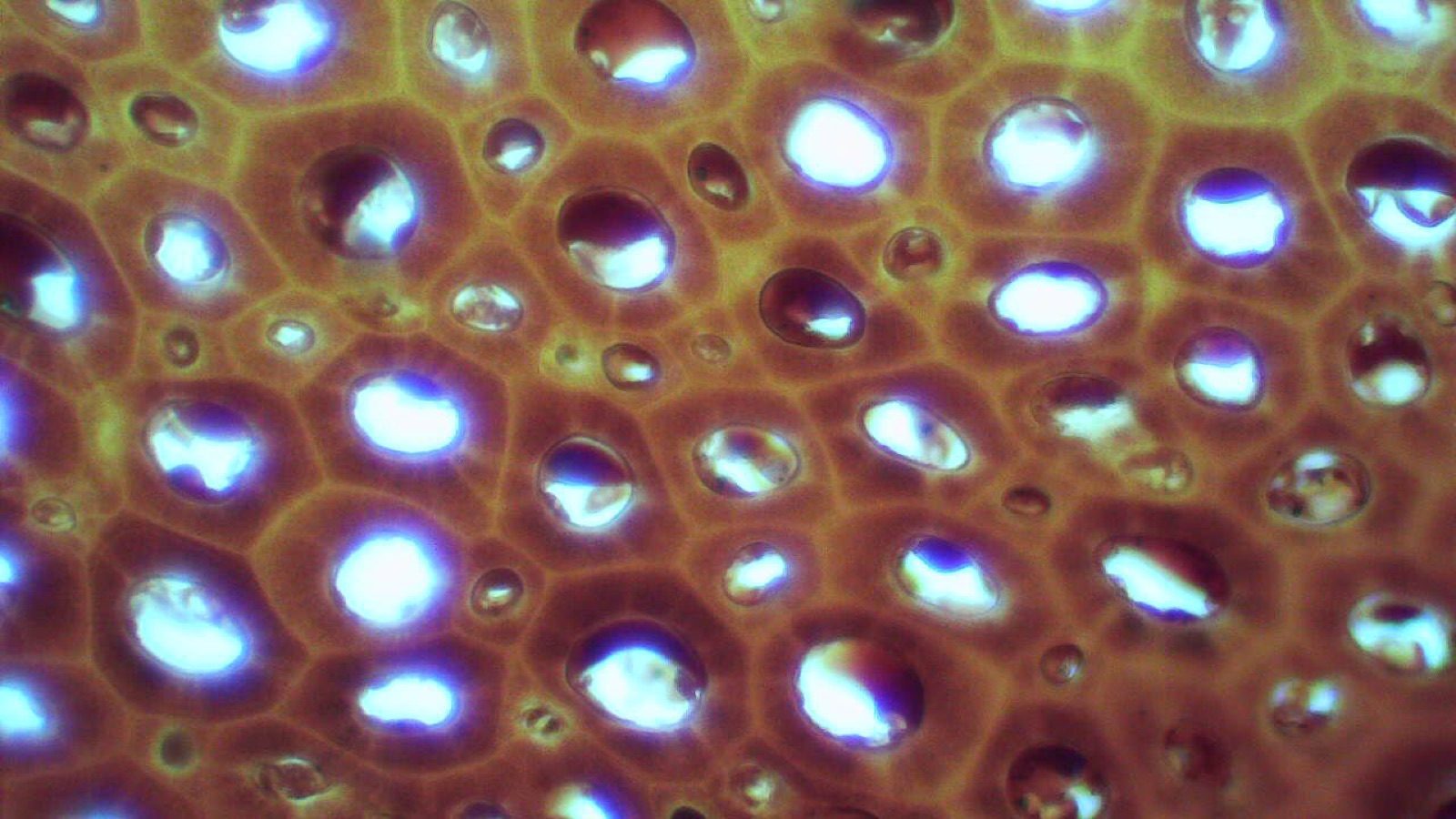 thick cell wallcell
In wood, the walls are so thick that you can see their layers: the glue between two cells, a thin primary wall, and a secondary wall built in three layers, each with its cellulose threads running a different way, like plywood.
Just remember
No deeper reason for these: they are names, dates and recipes. Use the hooks.
- Fluid mosaic model: Singer and Nicolson, 1972
- Singer and Nicolson made the membrane a Soap film with Naavs on it (naav: Hindi for boat). Seventy-two: the year the mosaic started to flow.
- Red blood cell membrane: about 52% protein, 40% lipid
- Protein takes the bigger share: 52 is the cards in a full pack, 40 is the fat left over. Protein wins the deal.
- Middle lamella: calcium pectate
- Pectin is what makes mango jam and guava jelly set. Calcium plus pectin is the jam that glues plant cells together.
- Algal wall: cellulose, galactans, mannans, calcium carbonate
- "Cell-Gal-Man with chalk": calcium carbonate is the stuff of chalk. Other plants: cellulose, hemicellulose, pectins, proteins ("C H P P").
- Plasmodesmata
- Desmos is Greek for a bond or tie: threads of cytoplasm that tie neighbouring cells together through the wall.
- Active transport example: the Na⁺/K⁺ pump
- A pump has to be paid: it runs on ATP. Uphill costs money.
- Lipid bilayer
- Two layers of phospholipids, tails inward.
- Fluid mosaic model
- Singer and Nicolson, 1972: a fluid bilayer with floating proteins.
- Osmosis
- Diffusion of water across a membrane.
- Active transport
- Moving against the gradient, using ATP (e.g. Na⁺/K⁺ pump).
- Middle lamella
- Calcium pectate glue between plant cells.
- Plasmodesmata
- Channels linking the cytoplasm of neighbouring plant cells.
Words to know
The middle lamella is made mainly of
- cellulose
- calcium pectate
- chitin
Deep dive · optional
How do we know the cell's skin is two layers of fat?
Why a skin made of fat forms by itself, the 1925 experiment that measured its thickness with a tray of water, the 1970 experiment that caught it flowing, and why a plant cell needs a wall stronger than a car tyre. The exam won't ask, but it makes the page stick.
The roots: oil and water don't mix
- Why is the cell's skin made of fat?Because a boundary must stop the cell's watery inside from mixing with the watery outside. Water, and everything dissolved in it, does not pass easily through an oily layer. So a thin sheet of fat makes a natural wall between two watery places.
- Why two layers, with the tails inside?A phospholipid has a head that likes water and two oily tails that don't. A cell has water on both sides of its skin. The only way to keep every head in water and every tail away from it, on both sides at once, is two layers back to back: heads out, tails in, the bilayer.
- Does the cell have to build it, piece by piece?No. Shake phospholipids in water and they arrange themselves into bilayers, and the sheets close up into hollow balls, because an open edge would leave tails touching water. Nobody has to put them in place: the water pushes them there.
- Why does the bilayer flow instead of being stiff?The lipids are not joined to each other by chemical bonds. They are only crowded together, like people sheltering under one roof in the rain. They can slide past their neighbours millions of times a second, and proteins drift among them. What they almost never do is flip to the other layer, because the water-loving head would have to cross the oily middle.
- And why don't oil and water mix in the first place?Because water molecules stick to each other much more strongly than they stick to oil. Water closes ranks and squeezes the oil out into drops, the way oil floats in round drops on top of dal. That is the bedrock: everything above follows from it.
This explains the things the main page listed. Small, uncharged molecules (oxygen, carbon dioxide) can dissolve in the oily middle and slip straight through. Charged or strongly polar things, like sodium ions or glucose, cannot, so they need a protein door (a carrier or a channel) or a pump. The fluid skin can also heal a small tear, bend round a swallowed particle, and fuse with a vesicle, all because nothing in it is fixed in place.
A plant cell has the same fluid skin, so why the wall? A plant cell keeps more dissolved stuff inside than outside, so water flows in by osmosis and the cell swells, pressing its membrane against the wall. This inward push of water builds up a pressure, turgor. In a growing root cell it can reach about 0.6 MPa, over three times the air pressure in a car tyre. A bare membrane would burst; the wall takes the strain, and the pressure in turn makes soft leaves and stems stand up. Animal cells have no wall, so they must keep the water inside and outside balanced instead. And the dead cork that Robert Hooke looked at in 1665 was nothing but these walls, with the living cells long gone.
The stories
See it
Gorter and Grendel's instrument, in its modern form: a tray of water, barriers that slide along the surface, and a balance that feels the film push back.
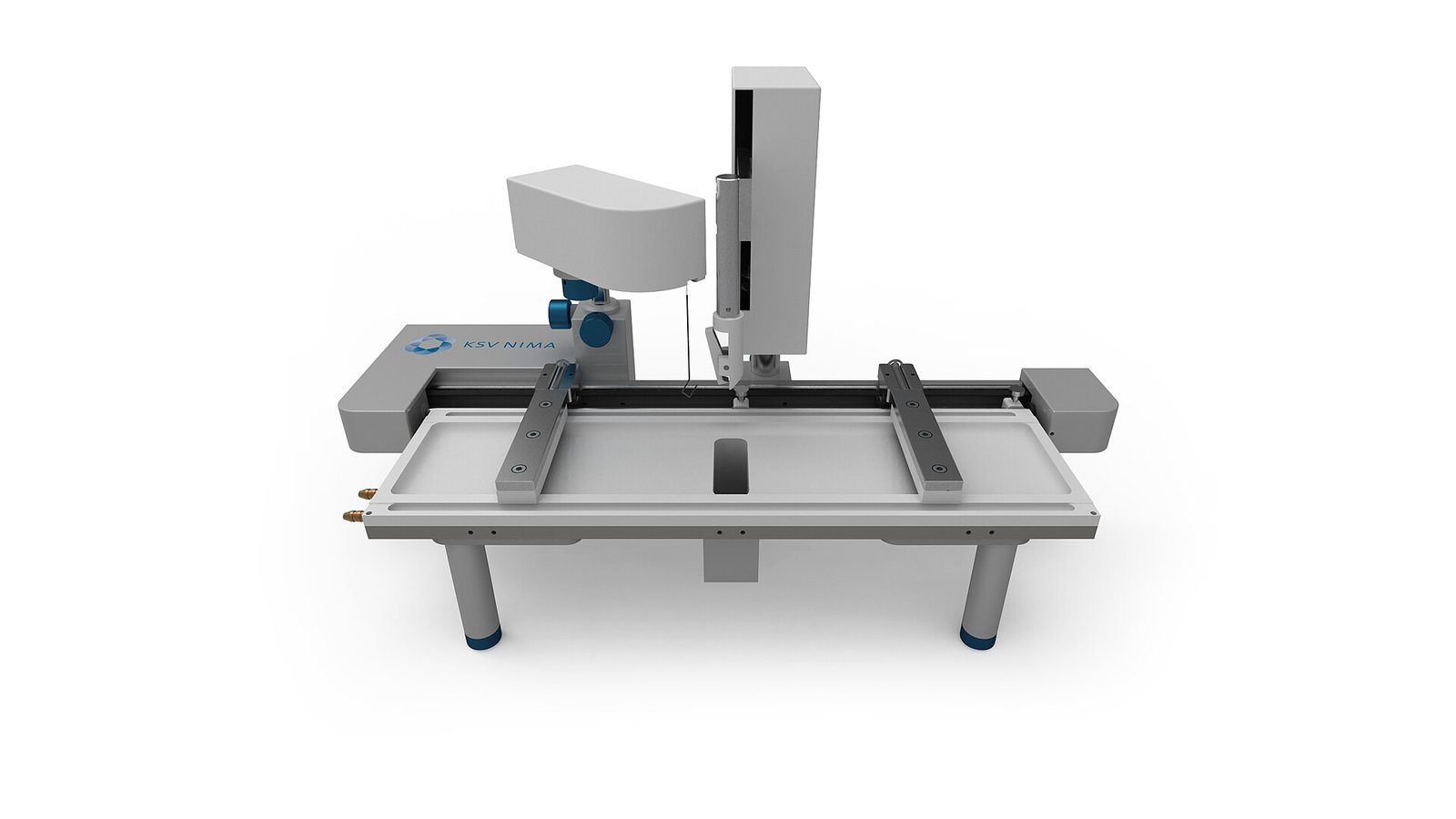 tray of watermoving barrierbalance
Now do their experiment. Squeeze the film, find where it packs, and then try their two mistakes: change how much fat the acetone pulled out, and how big they thought a cell was.
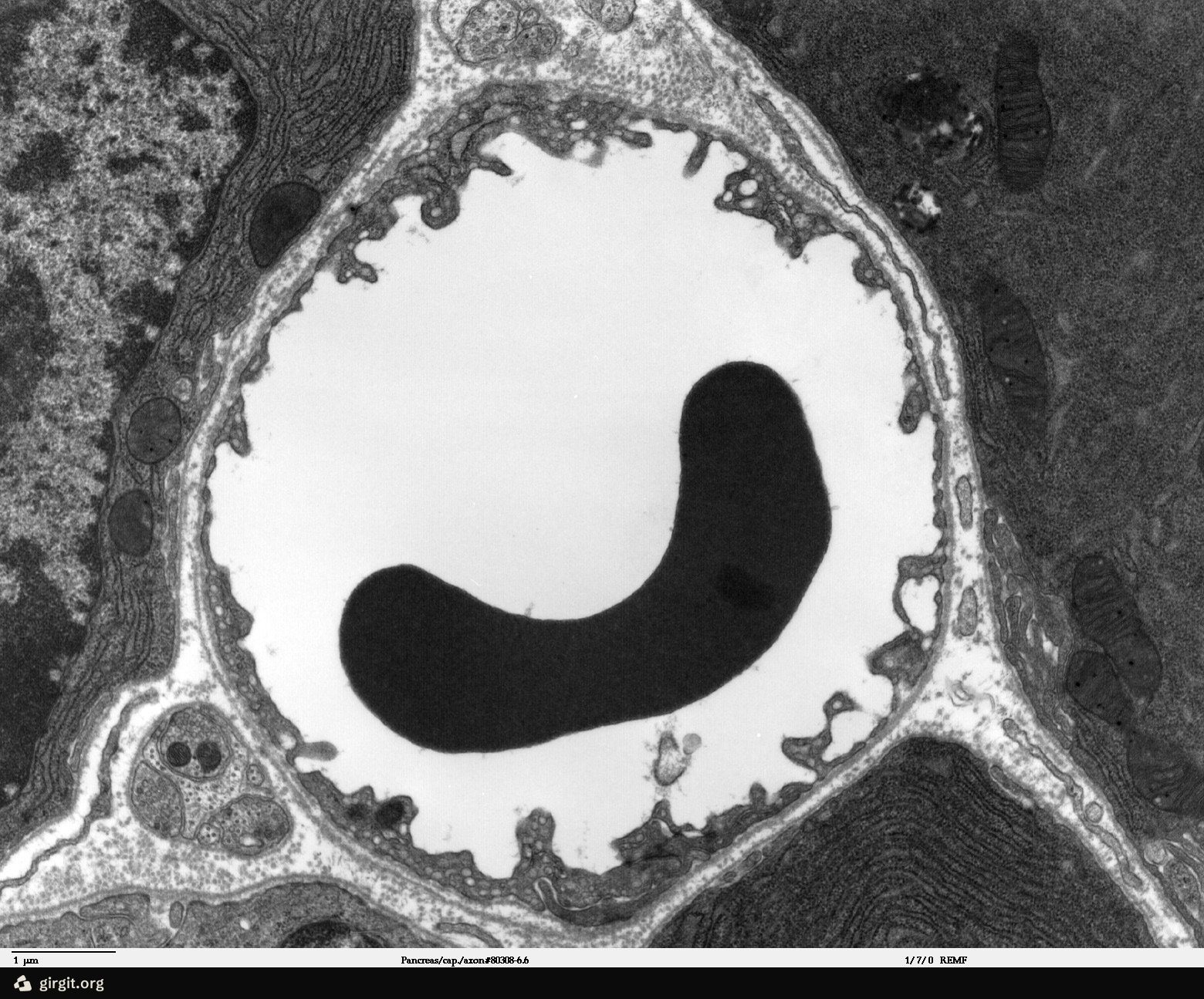
Their raw material: a red blood cell, seen here inside a tiny blood vessel with the electron microscope. Its whole outline is one membrane, and inside there is nothing else with a membrane at all.
 red blood cellcapillary wallblood plasma
Solve it
Solve it
Gorter and Grendel used acetone, which pulls out only about 75% of the fat, and took a human red cell's surface as 99 µm². Today we know it is about 138 µm². Suppose the membrane really is exactly two molecules thick. What ratio of film area to cell area would they have measured? What would they have got with all the fat and the right area?
Hint
Answer
Solve it
A growing root cell can have a turgor pressure of about 0.6 MPa (0.6 million newtons on every square metre). If a patch of its wall the size of your fingernail, 1 cm², carried that pressure, how heavy a load would that be? Why can a cheek cell never hold such a pressure?
Answer
Frye and Edidin repeated their mouse-human experiment with the cells kept cold. What did they see?
- The colours mixed faster
- The colours stayed on their own halves
- The hybrid cells split apart again
Connect it
Connect it
- Hooke's cork, concept 1. The "cells" Hooke named in 1665 were empty walls: see seeing cells for the first time.
- Lipids, Chapter 9. What a phospholipid is made of, a glycerol with two fatty acids and a phosphate head: lipids and nucleotides.
- Polar and non-polar, Chemistry. Why the head likes water and the tail doesn't is polarity and dipole moment.
- Surface tension, Physics. The trough works because a film of fat lowers the water's surface tension; the balance measures that change: surface tension.
- Fusing membranes, next page. Vesicles can merge with the Golgi and with the cell's skin only because membranes are fluid: the endomembrane system.
- In your kitchen. Salting cut cucumber or raw mango for achaar draws water out of the cells by osmosis, as in the onion video above. Soap works like a phospholipid too: one end loves water, the other loves oil, so it carries grease away.
Still confused?
If the membrane is a liquid, why doesn't the cell leak or fall apart?
Because it is a liquid in only two directions. The lipids can slide sideways freely, but leaving the sheet would put their oily tails in water, which costs far more energy than they have. So the sheet holds together the way a soap bubble does, even though everything in it moves. A small hole closes by itself for the same reason.
Which one chooses what enters a plant cell: the wall or the membrane?
The membrane. The wall is a mesh of cellulose threads with gaps far bigger than water, salts or sugars, so it lets them through freely. It only keeps out very large molecules and gives strength. The selectively permeable layer, the one that decides, is the plasma membrane just inside it. That is why, in plasmolysis, salt water fills the space between the wall and the shrunken cell.
Is osmosis just diffusion?
It is diffusion of water across a membrane that lets water through but holds back what is dissolved in it. Water moves from where it is more plentiful (a weaker solution) to where it is less plentiful (a stronger solution). Without the membrane, the dissolved stuff would simply spread out too, and you would just call it mixing.
Sources
- Gorter, E. and Grendel, F. (1925), On bimolecular layers of lipoids on the chromocytes of the blood, Journal of Experimental Medicine 41: 439–443
- Middlebury College: approximations in the Gorter–Grendel experiment (acetone extraction, cell area)
- History of cell membrane theory
- Frye, L. D. and Edidin, M. (1970), The rapid intermixing of cell surface antigens after formation of mouse-human heterokaryons, Journal of Cell Science 7: 319–335
- Singer, S. J. and Nicolson, G. L. (1972), The fluid mosaic model of the structure of cell membranes, Science 175: 720–731
- Lipid bilayer: self-assembly, lateral diffusion, slow flip-flop, permeability
- Turgor pressure: values in root and leaf cells
Picture and video credits
Show 3 picture and video credits
- rhoeo-plasmolysis.jpg: Mnolf, CC BY-SA 3.0
- plasmodesmata.jpg: 乌拉跨氪, CC BY-SA 4.0
- langmuir-trough-modern.jpg: Jyrkorpela, CC BY-SA 4.0


