- 1. Does a moving thing need a push to keep going?
- 2. Inertia and Newton's first law
- 3. Momentum and Newton's second law
- 4. Why does a fielder pull his hands back?
- 5. Newton's third law: every push has a partner
- 6. Conservation of momentum
- 7. Equilibrium of a particle
- 8. The common forces in mechanics
- 9. Friction: static and kinetic
- 10. Rolling friction, and why we need friction
- 11. What keeps a car on a curve?
- 12. Solving problems with free-body diagrams
- Review
3 of 12·NCERT §4.5·pp. 53–56·6 min
Momentum and Newton's second law
The big ideaThe net force on a body equals the rate at which its momentum changes; for a body of fixed mass that is \( \vec F = m\vec a \).
In simple words
A heavy thing moving fast is hard to stop. How hard depends on how heavy it is and how fast it goes, so we multiply the two and call that its "oomph". A push changes the oomph. A bigger push changes it faster. And the change always points the way the push points.
Momentum
The momentum of a body is its mass times its velocity:
\[ \vec p = m\vec v \]Here \( \vec p \) is momentum, \( m \) is mass in kg and \( \vec v \) is velocity in m s−1. Its unit is kg m s−1. Because velocity has a direction, momentum is a vector: it points the way the body is moving.
Why multiply mass by velocity? Everyday life gives the clues:
- Mass matters. Pushing a loaded truck up to walking speed in ten seconds takes far more force than pushing a small car. Catching a falling brick is harder than catching a falling tennis ball.
- Speed matters. A pebble flicked gently does no harm; the same pebble shot from a catapult can break a window. For the same mass, the faster it goes, the bigger the force needed to stop it in a given time.
- The product is what counts. Apply the same force for the same time to a light body and a heavy one, both starting at rest. The light one ends up faster, but both end up with the same momentum. Same force, same time, same change in momentum. This is the key clue.
- Direction counts too. Whirl a stone on a string in a circle at a steady speed. The size of its momentum stays the same, but its direction keeps turning, and your hand must keep pulling to make that happen. Whirl faster, or in a smaller circle, and you must pull harder.
 load: big m, small amotorbike: small m
Here is the key clue as a film: the same push for the same time, on a light cart and a heavy one.
The second law
Newton put these clues into his second law of motion: how fast a body's momentum changes is proportional to the force applied, and the change is in the direction of that force.
Try it: keep the mass the same and add trolleymen, one at a time.
If a force \( \vec F \) acts for a short time \( \Delta t \) and changes the momentum by \( \Delta\vec p \), then \( \vec F \propto \Delta\vec p/\Delta t \). Making \( \Delta t \) shrink to zero turns this into a derivative, and with a constant \( k \),
\[ \vec F = k\,\frac{d\vec p}{dt} \]For a body whose mass stays the same, \( d\vec p/dt = m\,d\vec v/dt = m\vec a \). We are free to choose the unit of force so that \( k = 1 \). Then
\[ \vec F = \frac{d\vec p}{dt} = m\vec a \]This defines the SI unit of force, the newton (N): one newton is the force that gives a 1 kg mass an acceleration of 1 m s−2. So 1 N = 1 kg m s−2. An apple's weight is about 1 N.
Now the other way round: keep the push the same and add load.
Four things to notice
- It agrees with the first law. If \( \vec F = 0 \), then \( \vec a = 0 \).
- It is a vector law. It is really three equations, one for each direction: \[ F_x = \frac{dp_x}{dt} = ma_x, \quad F_y = \frac{dp_y}{dt} = ma_y, \quad F_z = \frac{dp_z}{dt} = ma_z \] A force changes only the part of the velocity along the force. The part at right angles to it stays the same. For a ball thrown at an angle, gravity is vertical, so the horizontal part of its velocity never changes (air ignored).
- F is the net external force. For a single particle, \( \vec F \) is the total of all outside forces and \( \vec a \) is its acceleration. The same law works for a rigid body or any group of particles, with \( \vec F \) the total external force and \( \vec a \) the acceleration of the group as a whole (more exactly, of its centre of mass, met in Chapter 6). Forces between parts of the group are internal and are left out.
- It is a local law. The force here and now fixes the acceleration here and now. A body has no memory of forces it felt earlier. Drop a stone from the window of a train that is speeding up: the instant it leaves your hand it has no horizontal force on it and no horizontal acceleration (air ignored), even though a moment ago it was accelerating with the train. It keeps the horizontal velocity it had, and gravity alone acts.
The ball thrown up
This is where intuition misleads almost everyone. You throw a ball straight up. On its way up, what forces act on it? Most people say "the upward force of my throw, and gravity". Wrong. Your hand pushed it only while touching it. Once it leaves your hand there is no upward force at all. The only force (ignoring air) is its weight \( mg \), downward, the whole time: going up, at the top, and coming down.
So why does it keep rising? Because it already has upward velocity, and a body does not need a force to keep moving. The downward force just shrinks that velocity, second by second, until it is zero at the top, and then makes it grow downward. At the top \( v = 0 \), but the force is still \( mg \) and the acceleration is still \( g \), downward.
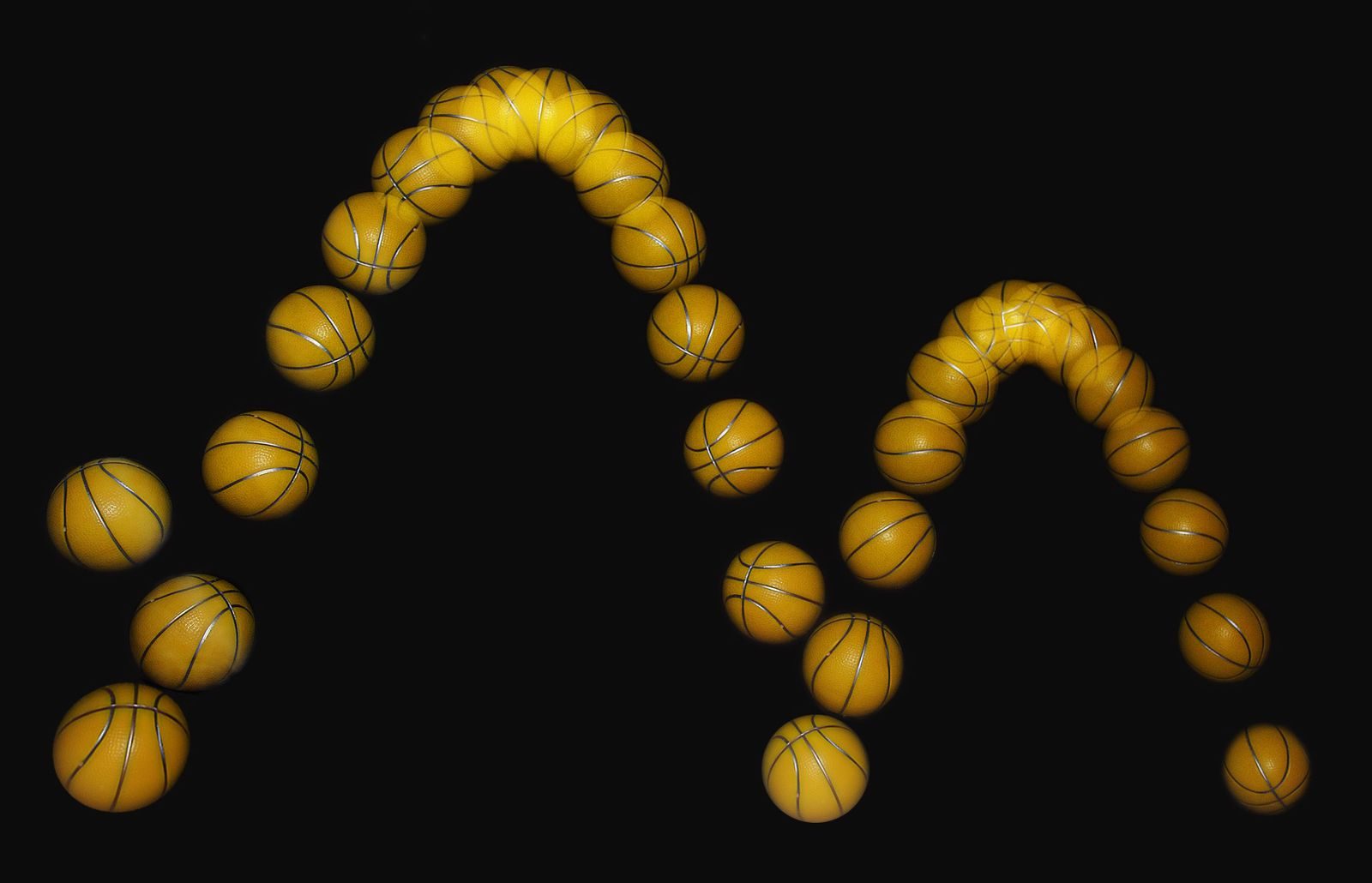 top: v = 0, force still mglower: faster, spread out
Try it: guess first, then throw the ball and watch the two arrows.
Don't mix these up
- Force points along the acceleration, not necessarily along the velocity. It can point along \( \vec v \), against it, at right angles to it, or at any angle.
- \( m\vec a \) is not an extra force to add to the others. It is the effect of the net force.
- \( v = 0 \) at an instant does not mean \( F = 0 \) at that instant.
Worked example
A 10 g bullet moving at 200 m s−1 hits a thick wooden plank and stops after going 10 cm into it. Find the average force of the wood on the bullet.
- Take the deceleration as constant. From \( v^2 = u^2 + 2as \) with \( v = 0 \), \( u = 200 \) m s−1, \( s = 0.10 \) m: \( a = -\dfrac{u^2}{2s} = -\dfrac{200^2}{0.2} = -2.0 \times 10^5 \) m s−2.
- Force: \( F = ma = 0.010 \times (-2.0 \times 10^5) = -2000 \) N.
- So the wood pushes back on the bullet with about 2000 N, opposite to its motion. The real force changes during the stop, so this is only the average.
Worked example
A 2 kg body moves along a line with \( x = 3t^2 + 4t \) (x in metres, t in seconds). What force acts on it?
- \( v = dx/dt = 6t + 4 \).
- \( a = dv/dt = 6 \) m s−2, the same at every instant.
- \( F = ma = 2 \times 6 = \) 12 N, constant, along +x.
Try it
An auto-rickshaw of mass 300 kg (with driver) speeds up from rest to 10 m s−1 in 5 s on a straight road. What net force acts on it?
Answer
Remember
- \( \vec p = m\vec v \), a vector, unit kg m s−1.
- \( \vec F = d\vec p/dt = m\vec a \); 1 N = 1 kg m s−2.
- F is the net external force; it acts along \( \vec a \).
- Acceleration now depends on force now, not on the past.
- A ball in flight has no "force of the throw" on it: only gravity.
Just remember
Names, symbols and units: conventions, not physics.
- Momentum is written \( p \)
- \( m \) was already taken by mass, so momentum got another letter. Hook: p for the punch a moving body carries. The word is Latin for movement, from movere, to move.
- Unit of momentum: kg m s−1, the same as N s
- Mass times velocity; or force times time, because a force acting for a time is what changes momentum.
- 1 N = 1 kg m s−2; an apple weighs about 1 N
- "Newton's apple weighs one newton": a 100 g apple, \( 0.1 \times 9.8 \approx 1 \) N.
- Momentum
- Mass times velocity, \( \vec p = m\vec v \); a vector.
- Newton's second law
- The rate of change of momentum equals the net force and points along it.
- Newton (N)
- The force that gives 1 kg an acceleration of 1 m s⁻².
- Vector law
- A law that holds separately along x, y and z.
- Local law
- Force at a place and instant fixes the acceleration at that place and instant.
- Internal force
- A force between two parts of the system you are studying; it is left out of F.
Words to know
A stone thrown straight up is still rising. Ignoring air, which force or forces act on it?
- Its weight down and the force of the throw up
- Only its weight, downward
- No force at all
A train is speeding up at 1 m s−2. A passenger lets a stone drop from the window. Just after it is released, its horizontal acceleration (air ignored) is
- 1 m s⁻², like the train
- zero
- 1 m s⁻² backward
The same force acts for the same time on a 1 kg ball and a 4 kg ball, both starting at rest. Afterwards,
- they have the same speed
- they have the same momentum
- the 4 kg ball has four times the momentum
Deep dive · optional
Why "change of momentum", and not just F = ma?
What Newton actually wrote, why the product of mass and velocity is the thing a force changes, when \( F = ma \) quietly fails, and how astronauts find their mass where nothing has weight. The exam doesn't need this; it makes the page stick.
The roots: what a force really changes
- Why does the law talk about a change, and not about velocity itself?Because by the first law a velocity needs no cause. Only a change in motion needs a force.
- Why is the change measured in mass times velocity?Push a 1 kg cart and a 4 kg cart with the same force for the same time. The light one ends up four times as fast, but both carry the same \( mv \). Whatever the body, the same push for the same time hands over the same momentum. Mass is what decides how that momentum is shared out as speed.
- Then why do we usually write \( F = ma \)?Because for a body whose mass stays fixed, \( \frac{d}{dt}(mv) = m\frac{dv}{dt} = ma \). But in general \( \frac{d}{dt}(mv) = m\frac{dv}{dt} + v\frac{dm}{dt} \). When mass is being added or lost, the second part matters.
- Where does the second part show up?A wagon filling with rain slows down with no backward force on it: its momentum stays the same while its mass grows. A conveyor belt that keeps receiving sand needs a steady push even though its speed never changes. A rocket gets its push by throwing mass out of the back (two pages on).
- And the bedrock?Part of the law is a definition: it tells us what we mean by force and by its unit, the newton. The rest is a fact of nature that experiments keep confirming: a body's mass found from one push is the same for every other push; masses add (two 1 kg blocks tied together behave as 2 kg); and forces add as vectors.
That last point gives a way to measure mass with no gravity at all. Push a body with a known force, measure its acceleration, and divide: \( m = F/a \). A bathroom scale cannot do this in orbit, because a scale reads how hard you press on it, and in a falling space station you press on nothing. But a known push still produces an acceleration, and that acceleration depends on your mass, in orbit or on the ground.
The story
See it
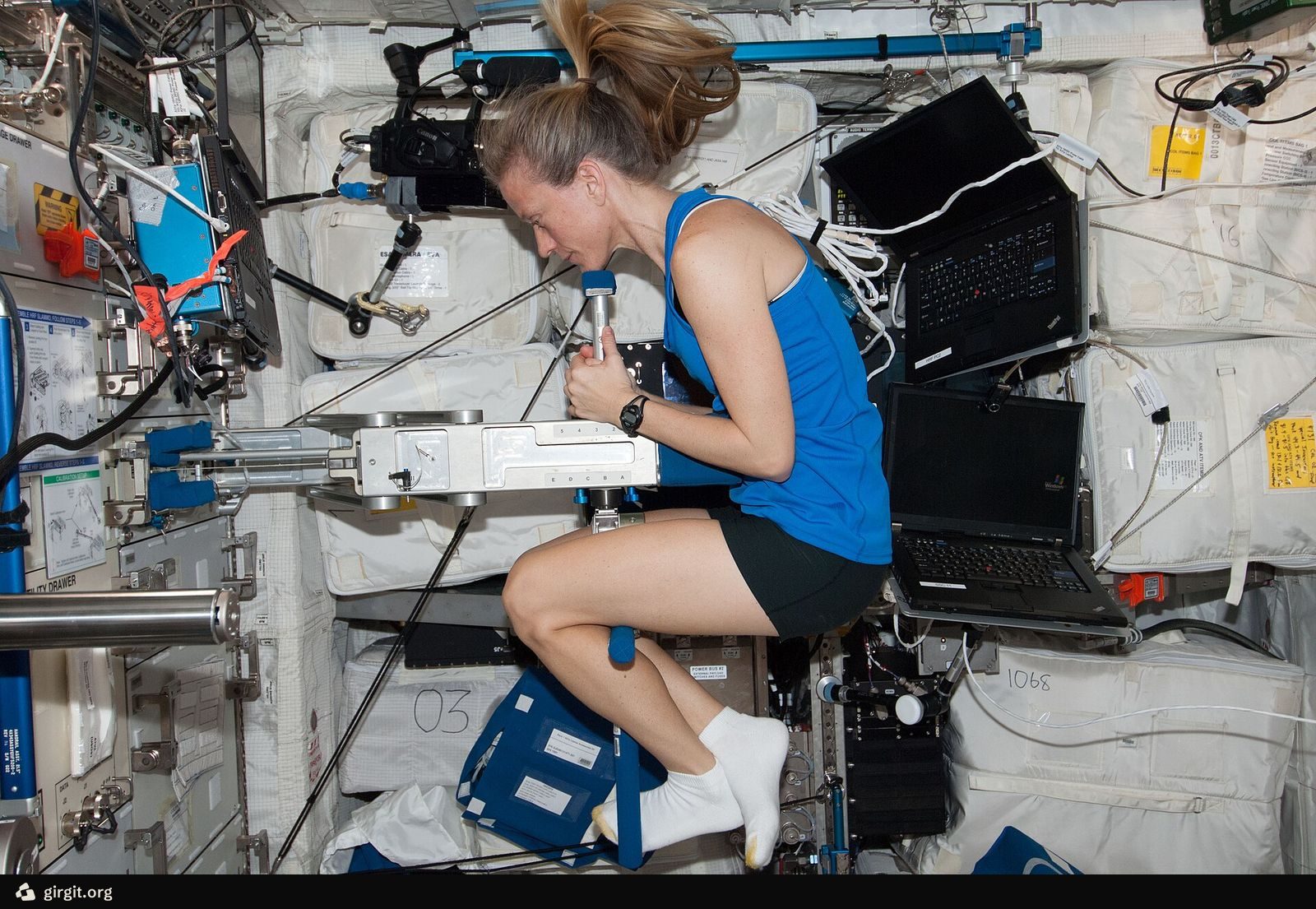 springs: a known push Fmeasure a; m = F/a
Guess first, then let rain pour into a coasting wagon. Watch the speed and the momentum on the same clock.
Solve it
Solve it
Sand falls straight down onto a conveyor belt at 5 kg every second. The belt runs at a steady 2 m s−1. What extra force must the motor supply to keep the belt's speed constant?
Hint
Answer
Solve it
Predict, then check with the wagon above. A 1000 kg wagon coasts at 4 m s−1 and catches 600 kg of rain. (a) How fast is it going now? (b) Then a hole opens in its floor and the water drains out, falling straight down relative to the wagon. Does the wagon speed back up?
Answer
Solve it
A mass-measuring device in orbit pushes an astronaut with a steady 60 N and measures an acceleration of 0.80 m s−2. What is her mass? If the same device were used on the ground, on a smooth horizontal track, would it give a different answer?
Answer
Connect it
Connect it
- Impulse, next page. Newton's own "change of motion": force multiplied by time equals the change in momentum: impulse.
- Rockets and recoil, this chapter. Throwing mass backwards pushes you forwards: conservation of momentum.
- Acceleration, Chapter 2. The \( a \) in \( F = ma \) is the same rate of change of velocity: acceleration.
- Many particles, Chapter 6. The same law for a whole body: the net external force equals the rate of change of total momentum: momentum of a system.
- Kinetic energy, Chapter 5. Momentum is \( mv \); kinetic energy is \( \tfrac12 mv^2 \): two different measures of motion, one changed by force times time, the other by force times distance: kinetic energy.
- Daily life. An overloaded auto-rickshaw crawls away from a signal: same engine, more mass, less acceleration.
Still confused?
A heavier stone has a bigger weight. Why doesn't it fall faster?
Because it also has more mass to speed up. Its weight is \( mg \), and its acceleration is weight divided by mass, \( mg/m = g \), the same for every stone. Twice the pull, twice the inertia, the same acceleration (air aside).
If \( F = ma \) works almost always, why learn \( F = dp/dt \)?
Because it is the form that never fails in Newton's mechanics: it covers bodies that gain or lose mass, it leads straight to impulse and to conservation of momentum, and it is the form that survives into relativity, where \( ma \) does not.
Is mass the same as weight?
No. Mass is how much a body resists a change in its motion, in kg, the same everywhere. Weight is the force of gravity on it, \( mg \), in newtons, and it changes from place to place: about a sixth on the Moon. The space station's SLAMMD measures mass precisely because there is nothing to weigh.
Sources
- Newton, Principia (1687), Lex II, Latin Wikisource; Definitio II, quantitas motus; Motte's English translation.
- Wikipedia, "Newton's laws of motion": no \( F = ma \) in the Principia; Hermann 1716; Euler in the 1740s.
- Space.com, "How do astronauts weigh themselves in space?": SLAMMD's springs, optical sensors and 0.2 kg accuracy.
- NASA, "How do you weigh things in space?" (2019 video) and NASA photograph, Expedition 37.

Picture and video credits
Show 2 picture and video credits
- overloaded-auto-rickshaw-hyderabad.jpg: Linda N., CC BY 2.0
- bouncing-ball-strobe.jpg: MichaelMaggs Edit by Richard Bartz, CC BY-SA 3.0

