Motion in a Straight LineFull experience
- 1. What does it mean to move?
- 2. How fast, on average?
- 3. How fast right now?
- 4. What is acceleration?
- 5. Reading velocity-time graphs
- 6. The three equations of motion
- 7. Why does a ball fall faster and faster?
- 8. Stopping distance and reaction time
- 9. Relative velocity
- Review
4 of 9·NCERT §2.3·pp. 15–17·5 min
What is acceleration?
The big ideaAcceleration is how fast the velocity changes with time.
In simple words
When a bus pulls away from a stop, you feel pushed back in your seat. When it brakes, you lurch forward. In both cases the bus is changing how fast it goes. How quickly it makes that change, each second, is what we call acceleration.
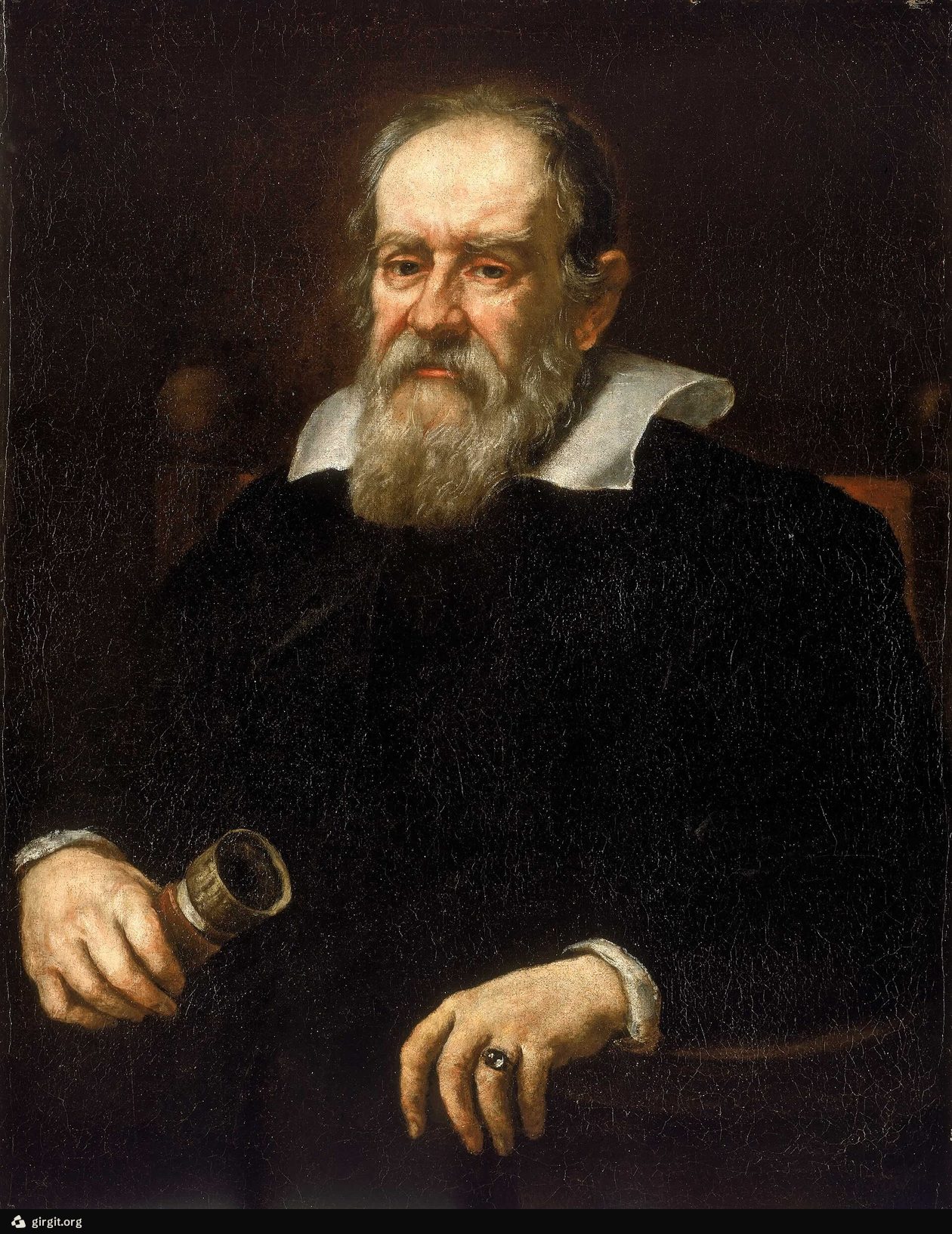
First, try the question Galileo asked, before reading on.
Change per second, not per metre
How should we measure a change in velocity: per metre travelled, or per second? People once thought per metre was natural. Galileo, by studying balls rolling down slopes and objects falling freely, found that for a falling body the change of velocity per second stays the same all the way down, while the change per metre keeps getting smaller as it falls. Time was the right thing to divide by. That gave us the idea of acceleration: the rate of change of velocity with time.
Average acceleration
The average acceleration over a time interval is the change in velocity divided by the time taken:
\[ \bar a = \frac{v_2 - v_1}{t_2 - t_1} = \frac{\Delta v}{\Delta t} \]Here \( v_1 \) and \( v_2 \) are the velocities at times \( t_1 \) and \( t_2 \). The SI unit is (m s−1) per second, written m s−2. An acceleration of 2 m s−2 means the velocity changes by 2 m s−1 every second.
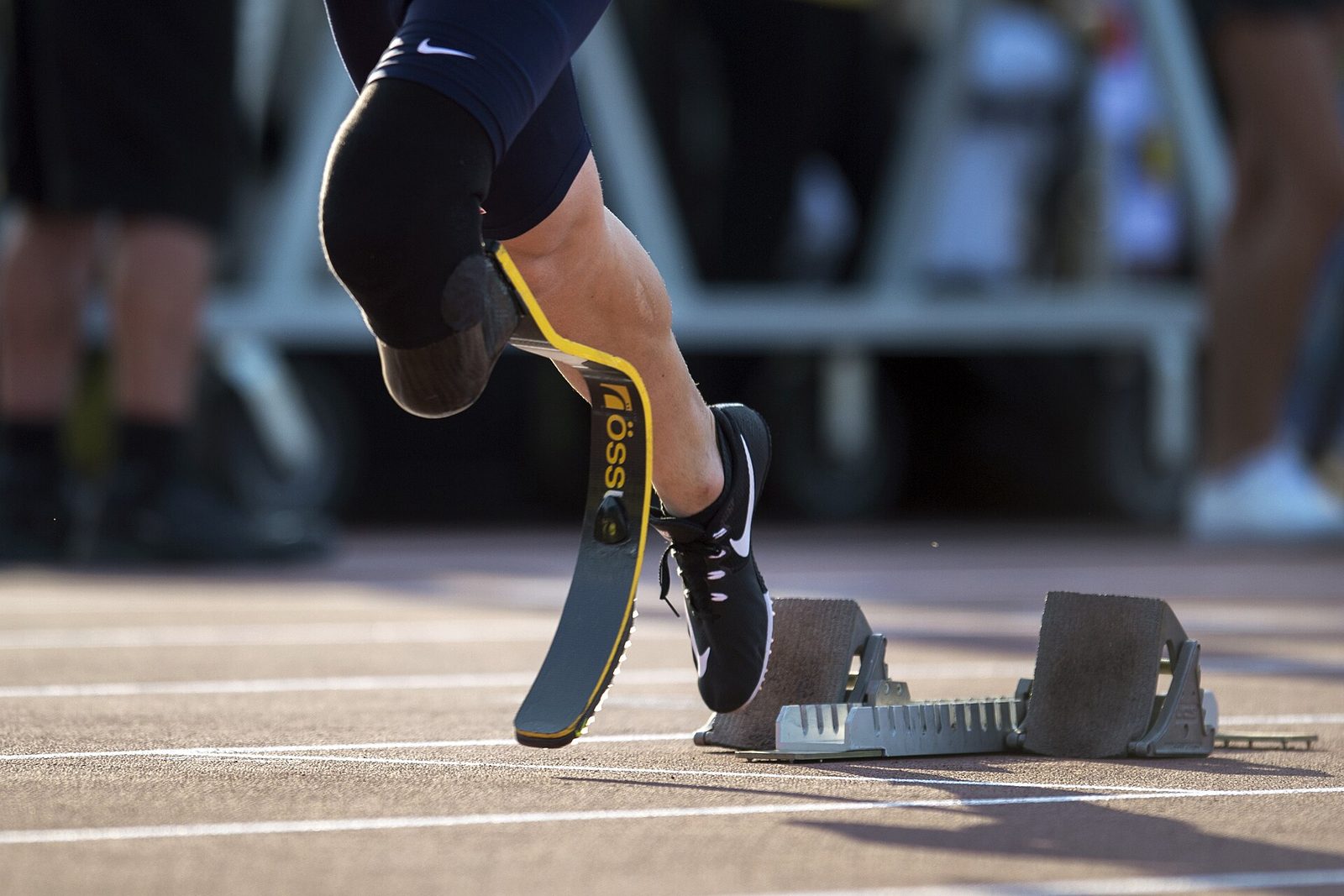 starting blockspushing off from rest
On a velocity-time graph (v-t graph), the average acceleration is the slope of the straight line joining the two points \( (t_1, v_1) \) and \( (t_2, v_2) \).
Instantaneous acceleration
Just as for velocity, shrink the interval to zero:
\[ a = \lim_{\Delta t \to 0} \frac{\Delta v}{\Delta t} = \frac{dv}{dt} \]The instantaneous acceleration is the slope of the tangent to the v-t curve at that instant. Since \( v = dx/dt \), acceleration is also the second derivative of position, \( a = d^2x/dt^2 \).
Worked example
A particle moves with \( x = t^3 - 6t^2 \) (metres, seconds). When is its acceleration zero, and what is its velocity then?
- \( v = \dfrac{dx}{dt} = 3t^2 - 12t \).
- \( a = \dfrac{dv}{dt} = 6t - 12 \). This is zero when \( t = 2 \) s.
- At \( t = 2 \) s: \( v = 12 - 24 = -12 \) m s−1. Zero acceleration does not mean zero velocity.
What the sign means
Velocity has a size and a direction, so it can change by changing its size (speed), its direction, or both. On a straight line, "direction" is just the sign. Acceleration can be positive, negative or zero.
A common mistake is to think "negative acceleration" always means slowing down. It does not. The rule is:
- Same sign for \( v \) and \( a \): the object is speeding up.
- Opposite signs: the object is slowing down. This is often called retardation or deceleration.
Worked example
- A metro train starts from rest and reaches 20 m s−1 in 25 s. \( a = (20 - 0)/25 = +0.8 \) m s−2. Positive \( v \), positive \( a \): speeding up.
- A car moving at +15 m s−1 brakes to +5 m s−1 in 4 s. \( a = (5 - 15)/4 = -2.5 \) m s−2. Signs opposite: slowing down.
- A car reversing at −10 m s−1 speeds up to −16 m s−1 in 3 s. \( a = (-16 - (-10))/3 = -2 \) m s−2. Negative acceleration, yet the car is speeding up, because \( v \) is negative too.
Try it: four ways a car can move on a ramp.
The shape of the x-t graph
Acceleration shows up as the bend of a position-time graph:
- Positive acceleration: the x-t graph curves upward (like a bowl, getting steeper).
- Negative acceleration: it curves downward (like a hill top).
- Zero acceleration: it is a straight line.
In this chapter we mostly study uniformly accelerated motion, where the acceleration stays constant. Then the average acceleration equals that constant value. If the velocity is \( v_0 \) at \( t = 0 \) and \( v \) at time \( t \):
\[ a = \frac{v - v_0}{t} \quad\Longrightarrow\quad v = v_0 + at \]A trick NEET likes: sometimes the motion is given as \( t \) in terms of \( x \), or \( v \) in terms of \( x \). Use the chain rule: \( a = \dfrac{dv}{dt} = \dfrac{dv}{dx}\cdot\dfrac{dx}{dt} = v\,\dfrac{dv}{dx} \). For example, if \( v = 4x \) then \( a = 4x \times 4 = 16x \). And if you are given \( t(x) \), first find \( v = 1 \big/ (dt/dx) \).
Try it
A body has \( x = 2t^3 \) (metres, seconds). Find its acceleration at \( t = 1 \) s.
Answer
Remember
- \( \bar a = \Delta v/\Delta t \); \( a = dv/dt = d^2x/dt^2 \); unit m s−2.
- Acceleration = slope of the v-t graph.
- Same signs: speeding up. Opposite signs: slowing down.
- x-t curves up for a > 0, down for a < 0, straight for a = 0.
Just remember
Names and notation, nothing to derive. Use the hooks.
- m s−2 is "metre per second squared"
- Say it the long way once: metres per second, every second. Two "per seconds", so two in the power.
- Retardation (deceleration) = slowing down
- From Latin retardare, to hold back; in music, ritardando means "slowing". It describes slowing, not a minus sign.
- \( \dfrac{d^2x}{dt^2} \) is read "d two x by d t squared"
- Differentiate twice: the 2 sits on the d at the top and on the t at the bottom.
- Acceleration
- Rate of change of velocity with time.
- Average acceleration
- Change in velocity divided by the time it took.
- Instantaneous acceleration
- Acceleration at one moment; dv/dt.
- Retardation
- Acceleration opposite to the velocity, so the object slows down.
- Uniformly accelerated motion
- Motion with constant acceleration.
Words to know
A ball has velocity −4 m/s and acceleration −3 m/s². It is
- slowing down
- speeding up
- moving at constant speed
The x-t graph of an object is a curve that bends upward and gets steeper. Its acceleration is
- positive
- negative
- zero
Deep dive · optional
Galileo's wrong turn, and a real race
Galileo first measured acceleration the wrong way, per metre, and still got the right law. Why "per metre" cannot work, and what acceleration looks like in the fastest 100 m ever run. The exam doesn't need this; it makes the page stick.
The roots: why we divide by time
- Why is acceleration a change per second and not per metre?Because nature keeps the per-second change simple. For a falling stone it is the same every second; per metre it keeps shrinking.
- Could a fall work "per metre" instead?Try it. Suppose the speed grew in step with the distance fallen, \( v = kx \). At the start, \( x = 0 \), so \( v = 0 \): the stone isn't moving, so x stays 0, so v stays 0. It would hang in the air for ever. A fall from rest could never begin.
- Why does "per second" not have that problem?Time passes whether or not the stone moves. If gravity adds the same speed each second, it adds speed from the very first moment, and the motion starts.
- Why would gravity add the same speed each second?Because its pull on the stone is the same at every height near the ground, and (as the next chapter shows) a steady force gives a steady rate of change of velocity with time.
- And the bedrock?Experiment. Galileo's rolling balls covered distances in proportion to the square of the time, and that only happens if the velocity grows evenly with time.
Real motions are rarely so tidy. A sprinter's legs can only push so hard, and the faster he already runs, the less extra speed each stride can add. So a sprinter's acceleration is huge out of the blocks, fades through the middle of the race and is slightly negative at the end, when tired legs can no longer hold top speed. Constant acceleration is a model; real data shows when it holds and when it doesn't.
The story
See it
Here are the real timings from Bolt's world record. Find where he was fastest, then see his acceleration fade. (The splits are rounded to 0.01 s, so each 10 m speed is only good to about ±0.15 m s−1: the small late changes are within that.)
Solve it
Solve it
Bolt reached 10 m at 1.89 s after the gun, and his reaction time was 0.146 s. Suppose he had accelerated uniformly from rest over those 10 m. Find that acceleration and his speed at 10 m. Then compare with his measured average of 10.1 m s−1 over the next 10 m. Was his acceleration really constant?
Hint
Answer
Solve it
A particle moves with \( x = t^3 - 6t^2 + 9t \) (metres, seconds). During which times is it slowing down?
Hint
Answer
Solve it
Show that "speed grows with distance" would make any fall from rest impossible, using a ball that starts at x = 0.001 m instead of 0. With \( v = kx \), how does x grow?
Answer
Connect it
Connect it
- Laws of motion, Chapter 4. Why acceleration is the thing forces control: momentum and the second law.
- Free fall, this chapter. The one place where acceleration is truly constant in daily life: why does a ball fall faster and faster?
- Maths: the second derivative. The sign of \( d^2x/dt^2 \) is the bend of the curve, exactly the "bowl or hill-top" rule on this page: the second derivative test.
- Oscillations. A swing's acceleration is largest where its velocity is zero, at the ends: velocity and acceleration in SHM.
Still confused?
Is deceleration the same as negative acceleration?
No. Deceleration means slowing down: acceleration opposite to the velocity. If the velocity is negative, slowing down needs a positive acceleration. The sign alone tells you only the direction of the acceleration.
Bolt's acceleration was nearly zero at 60 m. Was he not trying?
He was running his fastest. Zero acceleration means constant velocity, not zero velocity. At top speed every stride's push only just makes up for what each landing and the air take away.
Sources
- Renn, Damerow, Rieger and Camerota, "Hunting the White Elephant", MPIWG Preprint 97 (1998): Galileo's letter to Sarpi of 16 October 1604.
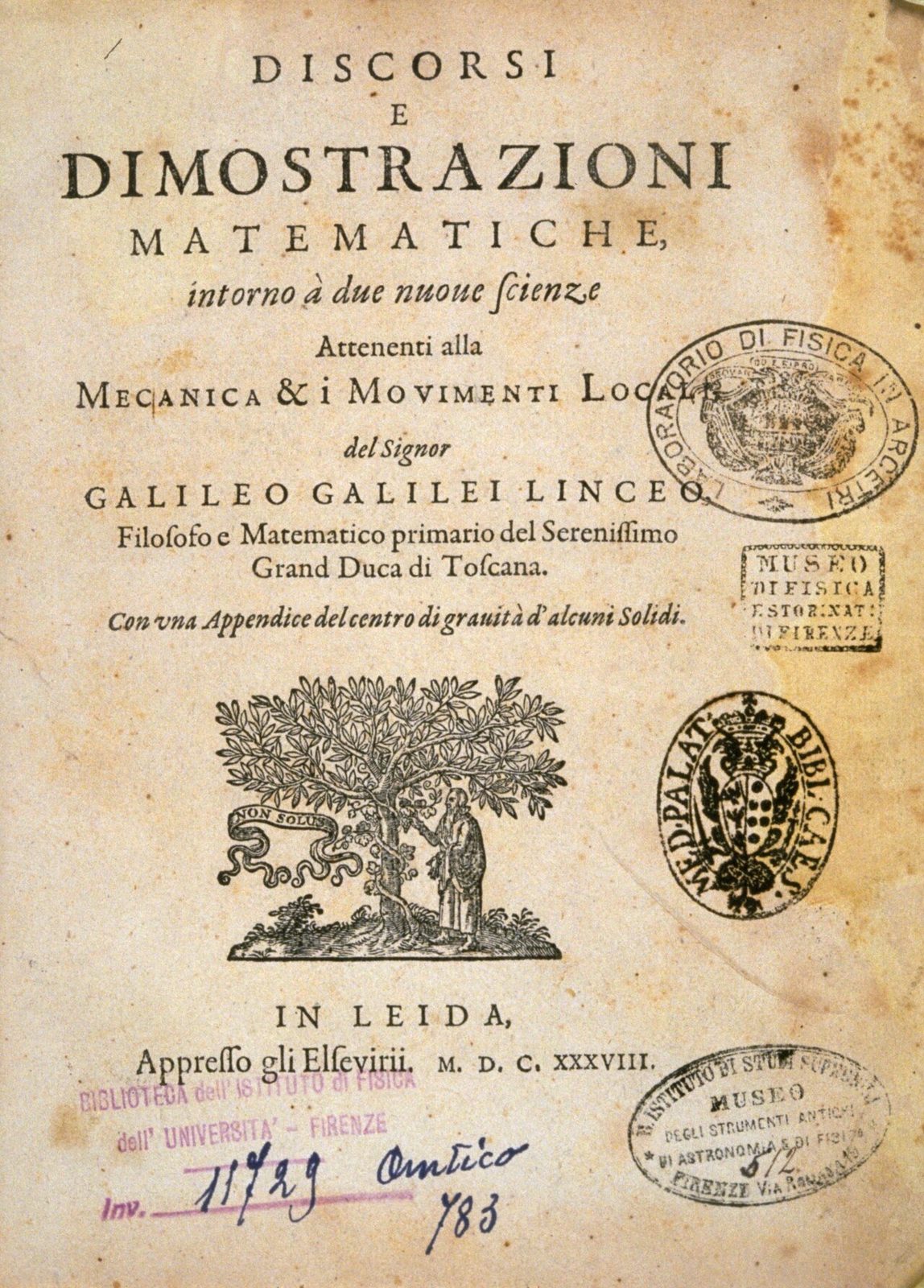
- Galileo, Two New Sciences (1638), Third Day, Crew and de Salvio translation: the definition of uniform acceleration.
- Helene and Yamashita, "The force, power and energy of the 100 meter sprint", Am. J. Phys. 78, 307 (2010): Bolt's Berlin 10 m splits (IAAF data).
- World Athletics, Berlin 2009 men's 100 m final result: 9.58 s, reaction 0.146 s.
Picture and video credits
Show 3 picture and video credits
- sprint-start-blocks.jpg: DoD News, CC BY 2.0
- local-train-braking.mp4: Anita Paliwal, CC BY 3.0
- two-new-sciences-1638-title.jpg: Museo Galileo - Istituto e Museo di Storia della Scienza, CC BY-SA 4.0
