- 1. Does a moving thing need a push to keep going?
- 2. Inertia and Newton's first law
- 3. Momentum and Newton's second law
- 4. Why does a fielder pull his hands back?
- 5. Newton's third law: every push has a partner
- 6. Conservation of momentum
- 7. Equilibrium of a particle
- 8. The common forces in mechanics
- 9. Friction: static and kinetic
- 10. Rolling friction, and why we need friction
- 11. What keeps a car on a curve?
- 12. Solving problems with free-body diagrams
- Review
2 of 12·NCERT §4.3 · §4.4·pp. 50–53·6 min
Inertia and Newton's first law
The big ideaA body stays at rest, or keeps moving in a straight line at a steady speed, unless a net external force makes it change. This laziness about changing is called inertia.
In simple words
Things are lazy about changing what they are doing. A thing that is still wants to stay still. A thing that is moving wants to keep going the same way at the same speed. Only a push or a pull from outside can make it start, stop, speed up, slow down or turn.
Galileo's ramps
Galileo Galilei studied balls rolling on sloping planks, called inclined planes. He noticed three things:
- a ball rolling down a slope speeds up;
- a ball rolling up a slope slows down;
- a ball on a flat plane is the case in between, so on a perfectly smooth flat plane it should neither speed up nor slow down. It should keep a constant velocity.
His second experiment used a double inclined plane: two ramps facing each other, like a V. A ball let go on one ramp rolls down and climbs the other. On smooth ramps it climbs back to almost the same height it started from, never higher. With no friction it would reach exactly the same height.
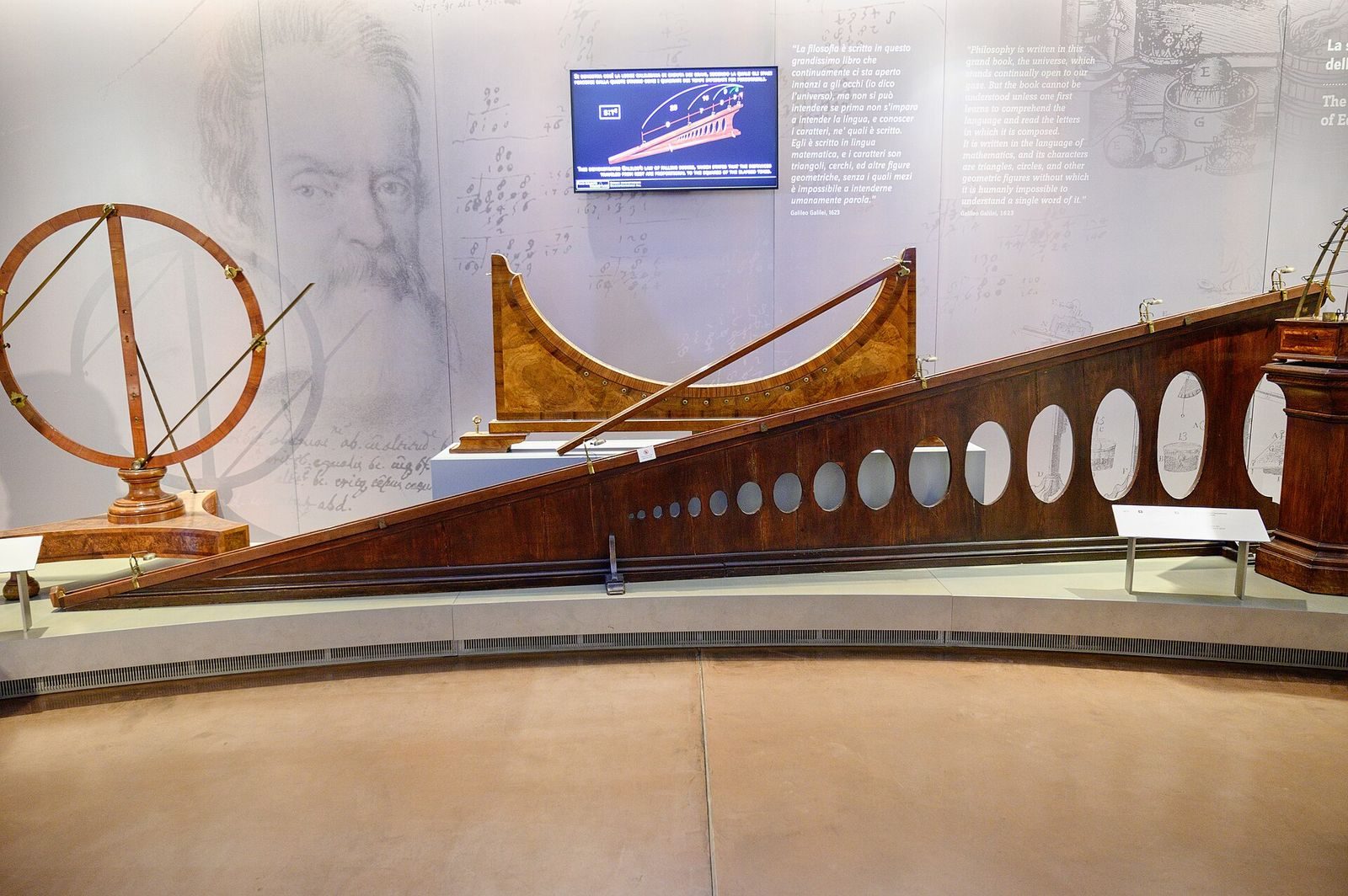 high end: let the ball gogroove: the ball rolls down, faster and faster
Now make the second ramp less steep. The ball still climbs to the same height, but it has to roll further to get there. Make the second ramp flatter and flatter. In the end, when it is completely flat, the ball can never reach its starting height, so it rolls on for ever. In real life it stops after a while, but only because friction can never be removed completely.
From this Galileo drew a new idea that Aristotle had missed: being at rest and moving at a constant velocity are the same kind of state. In both, the net external force is zero. A net force is not needed to keep a body moving uniformly; a push is needed only to cancel friction so that the total comes to zero.
Put together: with no net outside force, a still body stays still and a moving body carries on with the same velocity. This property of matter is called inertia, meaning resistance to change. Left alone, a body keeps whatever state it is in, rest or steady motion; only an outside force can change it.
Newton's first law
Isaac Newton took Galileo's law of inertia as the starting point of mechanics and wrote it as his first law of motion:
Newton's first law
- Every body stays in its state of rest, or of uniform motion in a straight line, unless an external force compels it to change that state.
Rest and uniform straight-line motion both mean zero acceleration. So the first law can be put very simply:
\[ \vec F_{\text{net}} = 0 \iff \vec a = 0 \]Here \( \vec F_{\text{net}} \) is the net external force and \( \vec a \) is the acceleration. In words: no net outside force, no acceleration. And the other way round: whenever a body accelerates, some net outside force must be acting.
Play it in Girgit RunOne push on a smooth floor: does Girgit ever stop?Two ways to use it
1. You know the forces, so you find the motion. A space probe far out between the stars, with its engines off, has almost no force on it. So its acceleration is zero: if it is moving, it keeps moving in a straight line at a steady speed, with no fuel used. Voyager 1, launched in 1977, is doing exactly this: it left the Sun's bubble of gas in 2012 and still moves outward at about 17 km/s, with no engine pushing it along.
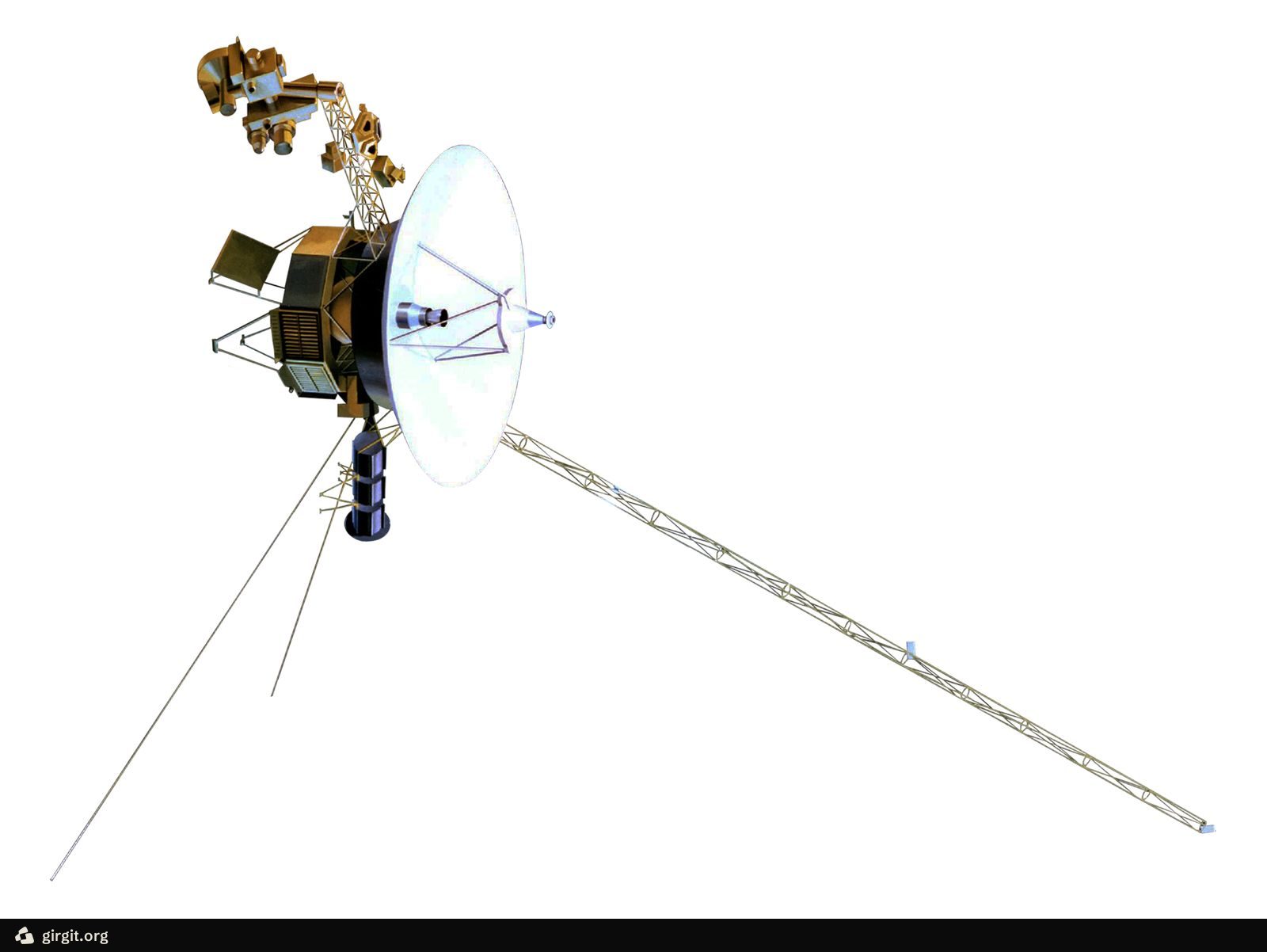 dish: still radios Earthno engine pushes it along
2. You know the motion, so you find the forces. This is more common on earth, because gravity is everywhere and friction and air drag are nearly always there too. So when something on earth sits still or moves uniformly, forces are still acting on it; they simply cancel, adding up to zero.
Take a school bag resting on a desk. Two forces act on it: its weight \( W \), the earth's pull downward, and the normal force \( R \), the desk's push upward. The desk's push is self-adjusting: it becomes as big as it needs to be. Watch the reasoning here, because it is often said backwards.
Don't mix these up
- Wrong: "Since \( W = R \), the forces cancel, so the bag is at rest."
- Right: "The bag is seen to be at rest, so by the first law the net force on it is zero, so \( R \) must be equal and opposite to \( W \)."
A car that starts from rest and picks up speed must have a net external force on it. Its engine is inside the car, and internal forces cannot accelerate a body as a whole. The only outside force along the road is friction from the road on the tyres. The engine turns the wheels, the tyres push back on the road, and the road's friction pushes the car forward. Once the car cruises at a constant velocity, the net force is zero again.
Lurching in a bus
Here is an intuition trap you have felt yourself. You are standing in a bus, and the driver brakes hard. You lurch forward. It feels as if something pushed you forward. Nothing did. There is no forward force on you at all.
What happens is this. Friction from the floor stops your feet along with the bus. But your body is not rigid: the top half is free to keep going, and by inertia it carries on moving forward at the old speed. Relative to the bus, which is slowing down, you tip forward. Then your muscles pull the rest of your body back to rest.
When the bus starts suddenly, the opposite happens. Friction drags your feet forward with the floor while your upper body, by inertia, stays where it was. Relative to the bus you are thrown backward. If the floor were perfectly slippery, the bus would simply slide forward under you and its back wall would arrive to meet you.
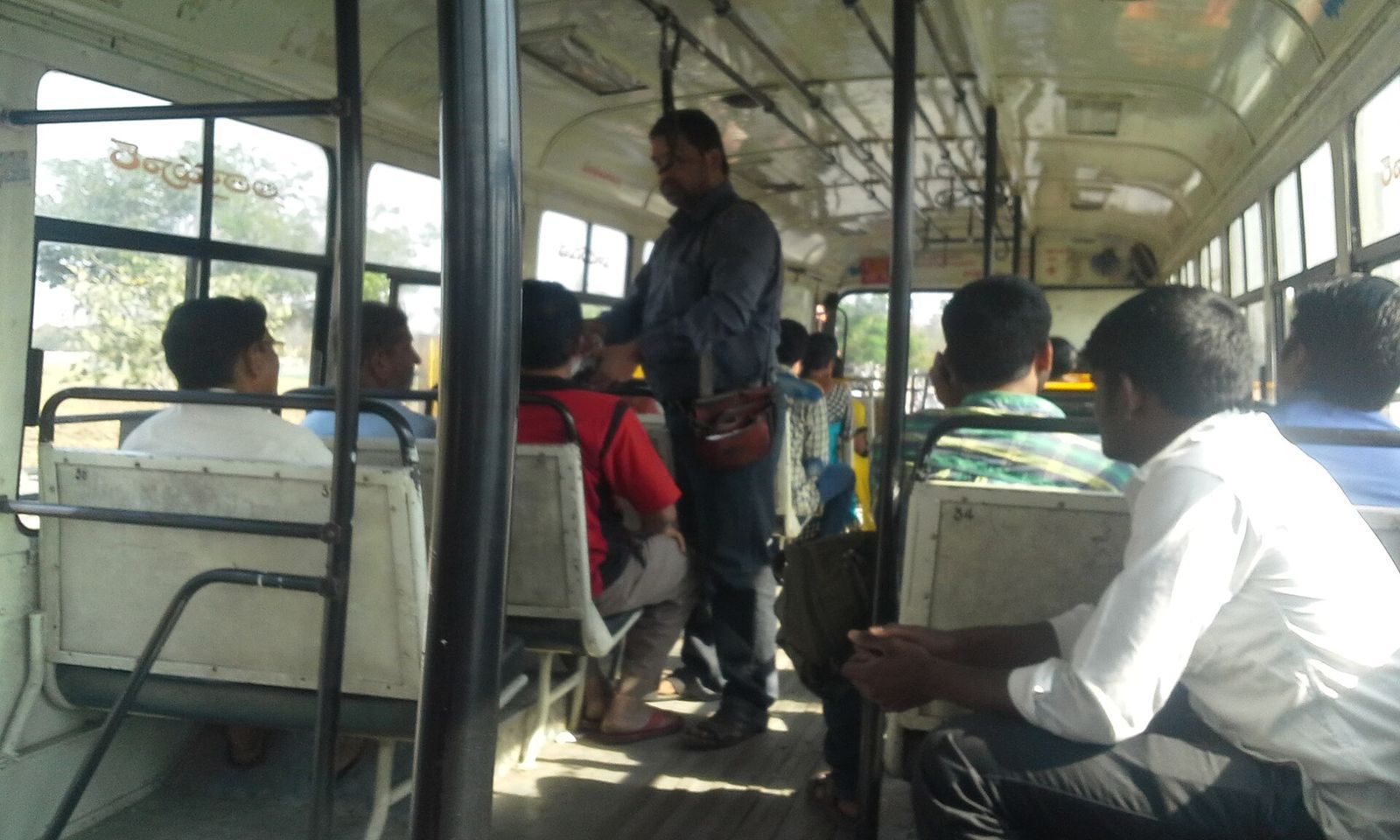 hand on the overhead railupper body keeps goingfeet: moved by the floor
Try it: guess first, then brake the bus and start it off again.
Try it: pull the cloth gently, then yank it, and watch what the thali does.
Worked example
A small robot is fixed to the outside of a spaceship that is speeding up at 50 m s−2, far from any star or planet. Its clamp breaks. What is the robot's acceleration just after it comes free?
- While clamped, the ship pushed it, so it accelerated with the ship.
- Once free, nothing touches it, and there are no nearby stars or planets to pull it. The ship's own gravity on it is tiny.
- So the net force on the robot is zero, and by the first law its acceleration is zero. It keeps the velocity it had at the instant it came free, while the ship pulls away ahead of it.
Ideas on motion in ancient India
Thinkers in ancient India also built a system of ideas about motion. They spoke of different kinds of force: steady pressure (nodan), like wind on a sail; a blow (abhighat), like a potter's stick hitting the wheel; and a lasting tendency (sanskara). In the Vaisesika school, vega, a body's urge to carry on along a straight path, comes closest to our idea of inertia; touching other things, the air included, was believed to wear it down, much like our friction and air resistance. Bhaskara (1150 AD) described "instantaneous motion" (tatkaliki gati), an early form of instantaneous velocity.
Just remember
Words and names with no physics reason behind them: use the hooks.
- Inertia
- Kepler's word, from Latin iners, idle or lazy. Hook: an inert, idle body. Inertia is laziness about changing, not about moving.
- First law: "rest, or uniform motion in a straight line"
- Both halves together, never just "at rest". Hook: "still or straight-and-steady", the two ways of doing nothing new.
- Vega (inertia-like urge), nodan (steady pressure), abhighat (a blow)
- Vega is the Hindi veg (वेग), speed: the urge to keep your speed. Abhighat sounds like aaghaat, a blow or shock.
- Bhaskara, 1150 AD: tatkaliki gati, instantaneous motion
- Tatkal is "this very moment", as in a Tatkal train ticket: motion at this very instant.
- Inertia
- A body's resistance to any change in its state of rest or uniform motion.
- Newton's first law
- With zero net external force, a body stays at rest or keeps a constant velocity.
- Uniform motion
- Motion in a straight line at a constant speed: constant velocity.
- Weight
- The earth's gravitational pull on a body, \( W = mg \), downward.
- Normal force
- The push of a surface on a body, at right angles to the surface.
- Vega
- In the Vaisesika theory, the tendency to move in a straight line, close to inertia.
Words to know
You are standing in a bus that brakes suddenly, and you lurch forward. What force pushed you forward?
- The force of inertia
- None: your body just kept moving while the bus slowed
- The force of the brakes
A raindrop falls at a constant speed near the ground. What is the net force on it?
- Its weight, mg, downward
- Zero
- A small force upward
Which force makes a car speed up on a level road?
- The engine's force
- Friction from the road on the tyres
- The normal force from the road
Deep dive · optional
Why does a moving thing not need a push?
Why a ball on Galileo's ramps climbs back to its starting height, why that means a ball on a flat floor would roll for ever, how Newton wrote it down in 1687, and what the first law quietly tells us about where we stand when we watch. The exam doesn't need this; it makes the page stick.
The roots: speed comes from height, not from a push
- Why does a ball speed up going down a slope and slow down going up?Because part of its weight points along the slope: forward on the way down, backward on the way up. On a flat floor no part of the weight points along it, so nothing speeds it up or slows it down, except friction.
- Why does it climb back to the height it started from?The speed it gains depends only on how far it drops in height, not on how steep the slope is. Going up, it loses speed in exactly the same way for each metre it rises. So, with no friction, it runs out of speed exactly at its starting height. Galileo showed the same thing with a pendulum whose string catches on a nail: the bob still swings back up to the height it was let go from.
- Why does a flatter second ramp make it roll further?To rise a height \( h \) along a slope of angle \( \theta \), it must travel \( h/\sin\theta \) along the slope. A 30° ramp needs twice the height in length; a 10° ramp almost six times; a 1° ramp about 57 times.
- And when the second ramp is completely flat?\( h/\sin 0^\circ \) has no end: the ball can never get back up to its starting height, so it never runs out of speed. It rolls on for ever, at the speed it had at the bottom.
- So what stops real things?Friction and air drag, both forces. Nothing is needed to keep a velocity; a force is needed only to change it. That is the first law.
There is one more thing hidden in the law. In a braking bus, a ball on the floor starts rolling forward although nothing pushes it. Seen from the road, nothing odd happened: the ball kept its speed and the bus slowed down under it. So the first law is not true from every point of view. It is true when we watch from a frame of reference that is not itself accelerating, called an inertial frame. That is why the first law is more than "the second law with zero force": it first tells us where to stand so that the laws of motion work.
The ground is almost, but not quite, an inertial frame. The Earth spins, so a point on the equator has a centripetal acceleration of about 0.034 m s−2, a third of a percent of g. For a cricket ball or a bus this is far too small to notice, so we treat the ground as inertial.
The story
See it
Newton's first law, in the first edition of the Principia. The laws take just two pages.
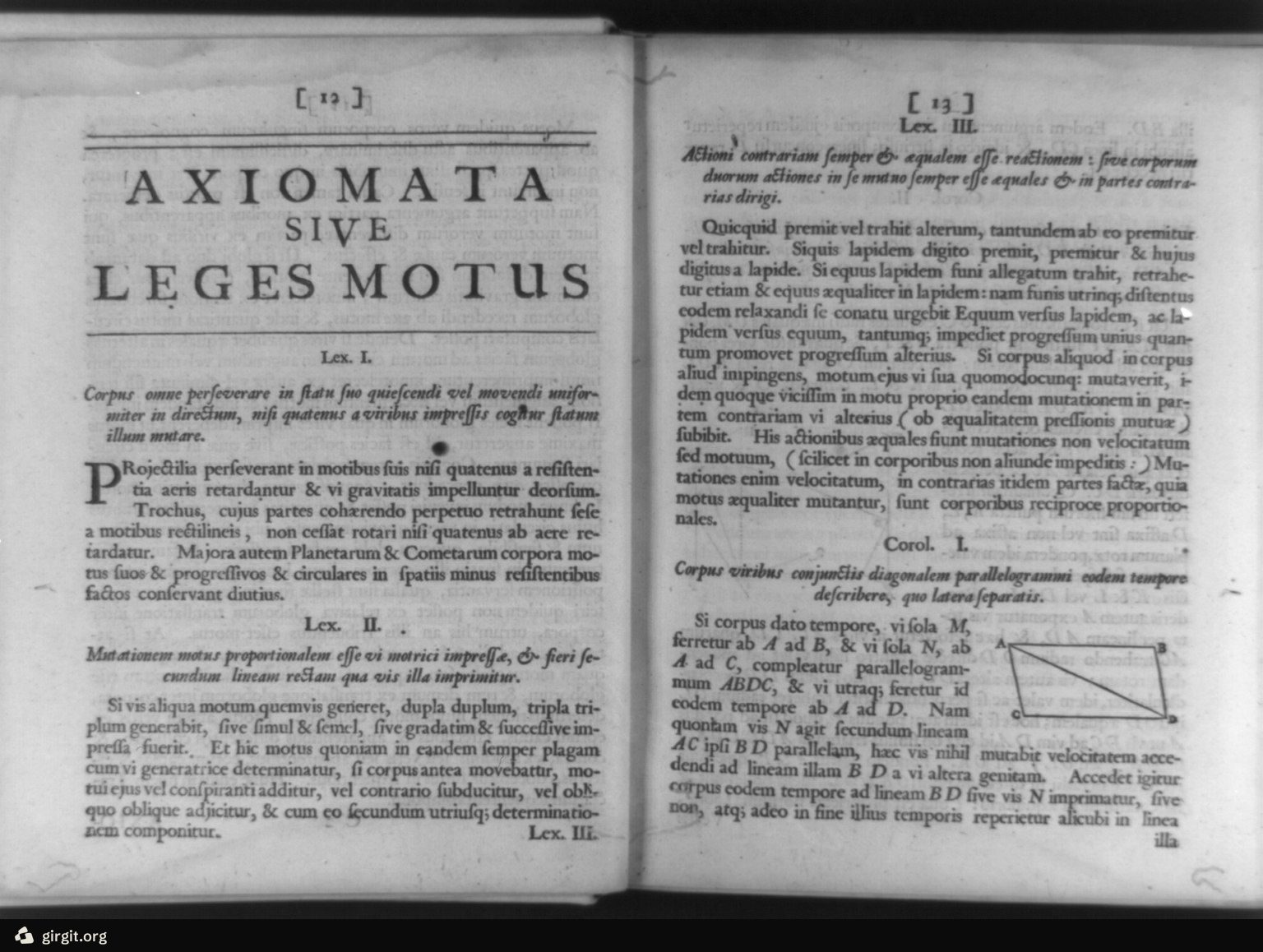 Lex I: the first lawTrochus: a spinning topplanets and comets keep going
Guess first, then flatten the second ramp all the way to 0°, and then add a little friction.
Solve it
Solve it
The tablecloth trick. A cloth is whipped out from under a steel plate in 0.10 s. While the cloth slides under it, friction drags the plate along with an acceleration of at most \( \mu g \), with \( \mu = 0.3 \). How far does the plate move while the cloth is leaving? Then it slides on the bare table (\( \mu = 0.3 \) again) and stops. How far in all? (g = 9.8 m s−2.)
Hint
Answer
Solve it
A bus at 10 m s−1 brakes steadily to a stop in 2.0 s. A ball lies on its smooth floor, 6 m from the front wall. Watching from the road, where is the ball when the bus stops? Watching from inside the bus, what does the ball seem to do, and what force seems to act on it?
Answer
Solve it
Galileo's nail. A pendulum bob is let go from 20 cm above its lowest point. Halfway down, a nail catches the string, so the bob swings up the other side on a shorter string. How high does it rise? What changes if the nail is placed lower?
Answer
Connect it
Connect it
- Mass is the measure of inertia, next page. The same push gives a heavier body less acceleration: momentum and the second law.
- Galileo's ship, Chapter 3. A stone dropped from the mast of a moving ship lands at the foot of the mast, because it keeps the ship's forward velocity: constant acceleration in a plane.
- Satellites, Chapter 7. A satellite needs no engine to keep going round; gravity only bends its path: Earth satellites.
- Turning has inertia too, Chapter 6. A spinning top keeps spinning, Newton's own example; its "laziness" about turning is the moment of inertia.
- Seat belts, this chapter. In a crash your body keeps the car's speed until something stops it; the belt makes that stop longer and gentler: impulse.
- Daily life. Luggage tied on a bus roof, a pot of water carried on a cycle, sugar sacks on a tempo: when the vehicle brakes, whatever is not tied down keeps going.
Still confused?
If nothing is needed to keep things moving, why does my cycle stop when I stop pedalling?
Because forces are acting on it all the time: friction in the hubs, the squashing of the tyres on the road and air drag, all pointing backwards. Pedalling only cancels them. Stop pedalling and they are the only forces left, so the net force points backwards and the cycle slows down. On ice or in space the same cycle would coast much further.
Is inertia a force?
No. Inertia is a property of a body, measured by its mass, not a push or pull from anything. "The force of inertia threw me forward" is a common way of speaking, but nothing pushed you: you kept moving while the bus slowed down.
Isn't the first law just the second law with F = 0?
As a formula, yes: if \( F = 0 \) then \( a = 0 \). But the first law does an extra job. It defines the frames in which "no force, no acceleration" is true, the inertial frames, and the second and third laws are written for those frames. In an accelerating bus, things accelerate with no force on them, so you must not use the laws from inside it without care.
Sources
- Newton, Principia (1687), "Axiomata, sive Leges Motus", Latin Wikisource and Motte's English translation: Lex I and its examples.
- Library of Congress photograph of the two pages, Wikimedia Commons.
- University of Virginia, "Galileo's acceleration experiment": the ramp, the water clock and the pendulum with a nail (Two New Sciences, p. 171).
- University of Virginia, Galileo on projectiles: the Fourth Day, "uniform and perpetual", and Simplicio's objection.
- Wikipedia, "Two New Sciences" and "Inertia": the 12-cubit ramp, Galileo's circular inertia, Kepler's word.
- Museo Galileo, Inclined plane (inv. 1041): the instrument in the picture.
- NASA, Voyager 1: launch 1977, interstellar space 2012, 17 km/s.

Picture and video credits
Show 3 picture and video credits
- galileo-inclined-plane-museo-galileo.jpg: Zde, CC BY-SA 4.0
- bus-standing-passenger-hyderabad.jpg: ReDHumus.Org Abonamos el cambio, CC BY-SA 2.0
- tablecloth-trick-slow-motion.mp4: Dan Spencer, CC BY 3.0

