- 1. Does a moving thing need a push to keep going?
- 2. Inertia and Newton's first law
- 3. Momentum and Newton's second law
- 4. Why does a fielder pull his hands back?
- 5. Newton's third law: every push has a partner
- 6. Conservation of momentum
- 7. Equilibrium of a particle
- 8. The common forces in mechanics
- 9. Friction: static and kinetic
- 10. Rolling friction, and why we need friction
- 11. What keeps a car on a curve?
- 12. Solving problems with free-body diagrams
- Review
9 of 12·NCERT §4.9.1·pp. 60–63·6 min
Friction: static and kinetic
The big ideaStatic friction grows to match a push, up to a limit \( \mu_s N \); once a body slides, kinetic friction \( \mu_k N \) takes over, and it is a little smaller.
In simple words
Push a heavy almirah gently and it does not move: the floor pushes back exactly as hard as you push. Push harder, and the floor pushes back harder too, but only up to a point. Beyond that the almirah gives way and slides. Once it is sliding, it is a bit easier to keep it going than it was to get it started.
Static friction
A box of mass \( m \) sits on a floor. Its weight \( mg \) is balanced by the normal force \( N \). Now push it sideways with a small force \( F \). It does not move. But if \( F \) were the only sideways force, the second law says it would have to accelerate at \( F/m \), however small \( F \) is. So another sideways force must have appeared, equal and opposite to your push. This is static friction, \( f_s \): friction between surfaces that are not sliding.
Three things about static friction:
- It does not exist on its own. With no push, there is no static friction at all. It switches on only when something tries to make the surfaces slide.
- It is self-adjusting. Push with 10 N and it is 10 N; push with 30 N and it is 30 N, always just enough to stop the sliding, up to a limit.
- It opposes impending motion. Impending motion means the motion that would happen if there were no friction, but does not actually happen.
Experiments show that the biggest value static friction can reach, the limiting friction, does not depend on the area of contact, and is roughly proportional to the normal force:
\[ (f_s)_{\max} = \mu_s N \qquad\text{so}\qquad f_s \le \mu_s N \]\( \mu_s \) is the coefficient of static friction. It depends only on the two surfaces (rubber on dry road is high, steel on ice is low). It is a ratio of two forces, so it has no unit and no dimensions.
 the road climbs at up to 19°parked: static friction holds it
Kinetic friction
Push harder than \( \mu_s N \) and the box starts to slide. As soon as it moves, the friction drops a little below the static maximum. Friction between surfaces that are sliding is kinetic friction (or sliding friction), \( f_k \):
\[ f_k = \mu_k N \]\( \mu_k \) is the coefficient of kinetic friction. Like static friction, kinetic friction does not depend on the area of contact, and it hardly depends on the speed. Experiments show \( \mu_k < \mu_s \): getting a body started is harder than keeping it sliding.
Once sliding, the box's acceleration is \( (F - f_k)/m \). If it slides at a constant velocity, \( F = f_k \). Take your push away and its acceleration is \( -f_k/m \): it slows down and stops.
Try it: push the trunk harder and harder, then ease off once it moves.
These friction laws are not fundamental laws of nature like the law of gravitation. They are empirical, found by experiment and only roughly true. But they work very well for real calculations.
Don't mix these up
- Static friction is up to \( \mu_s N \), not equal to it. Write \( f_s = \mu_s N \) only when the body is just about to slip.
- Kinetic friction is \( \mu_k N \) whenever the surfaces slide.
- Friction does not depend on the area of contact. A brick slides just as hard on its broad face as on its narrow face.
Friction opposes relative motion, not motion
This is a big intuition trap. People say "friction always opposes motion". Not quite: it opposes relative motion between the two surfaces, slipping of one over the other. Often friction is what causes motion.
A suitcase sits on the floor of a train that is speeding up. The suitcase stays put relative to the train, so it is speeding up too. What force does that? The only sideways force on it is friction from the floor, and it points forward, the same way the suitcase moves. Without it, the floor would slide away under the suitcase, which would stay behind by inertia and hit the back of the coach. Static friction stops that slipping and drags the suitcase along.
The largest acceleration static friction can give it is found from \( ma = f_s \le \mu_s mg \):
\[ a_{\max} = \mu_s g \]With \( \mu_s = 0.15 \) and \( g = 10 \) m s−2, the train can speed up (or brake) at up to 1.5 m s−2 before the suitcase starts to slide. The mass cancels.
Try it: work the motorman's lever and watch the friction on the suitcase.
The tilting-plank test
Put a block on a plank and slowly tilt it. On a slope at angle \( \theta \), split the weight into two parts: \( mg\sin\theta \) down the slope and \( mg\cos\theta \) into the slope. While the block is at rest,
\[ f_s = mg\sin\theta, \qquad N = mg\cos\theta \]As you tilt further, \( \theta \) grows and the friction needed grows with it, until it reaches its limit \( \mu_s N \) at some angle \( \theta_{\max} \). Then \( mg\sin\theta_{\max} = \mu_s\,mg\cos\theta_{\max} \), so
\[ \tan\theta_{\max} = \mu_s \]Tilt just a little more and the block slides. This angle (often called the angle of repose) depends only on \( \mu_s \), not on the block's mass. A block found to slip at 31° has \( \mu_s = \tan 31^\circ \approx 0.6 \). Once it slides, its acceleration down the slope is \( a = g(\sin\theta - \mu_k\cos\theta) \).
Try it: tip the truck's bed slowly and find the angle where the crate lets go.
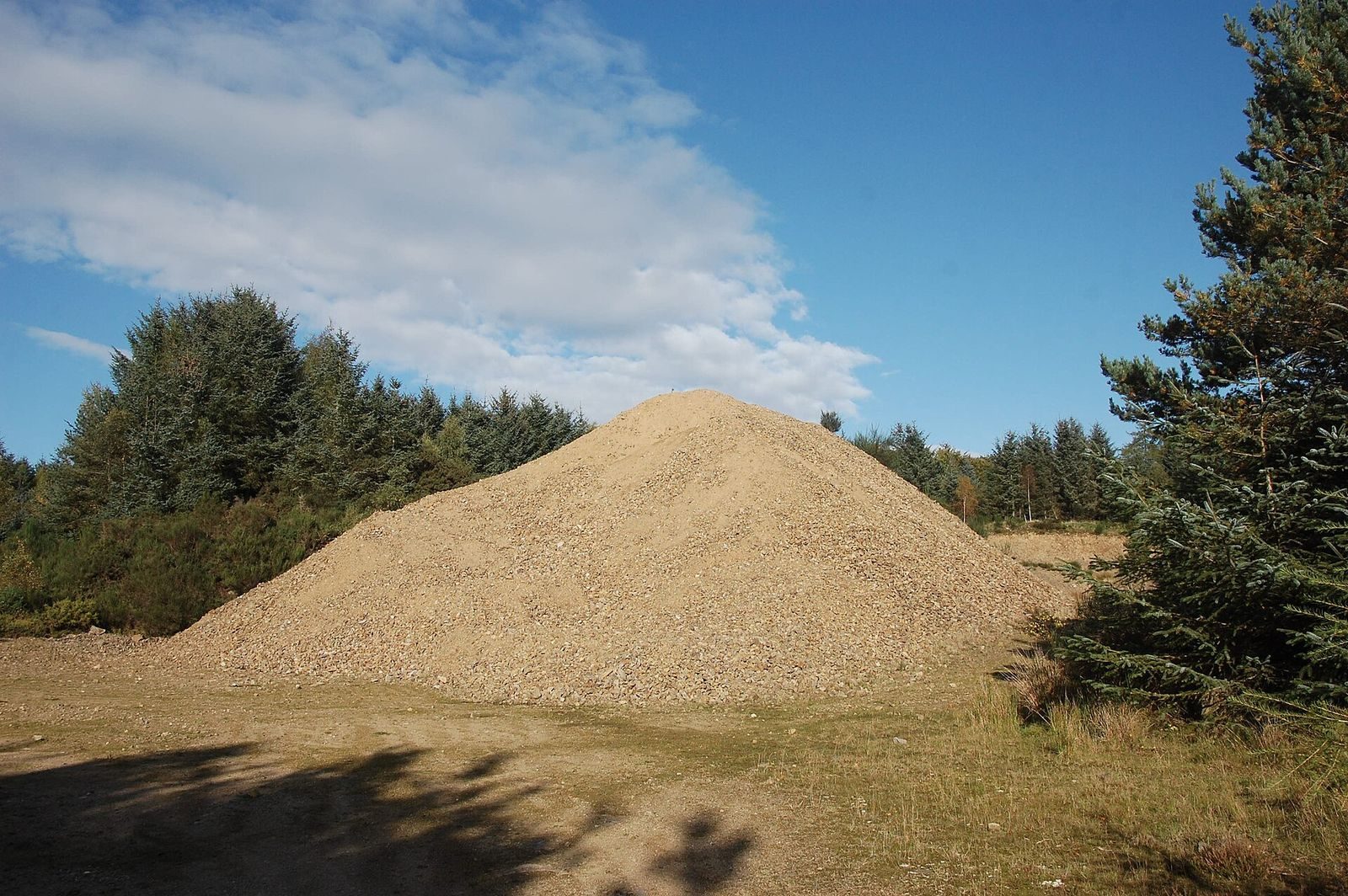 its slope: the angle of reposeadd more, and it slides down
Worked example
An 8 kg trolley on a table is tied by a light string, running over a smooth pulley at the table's edge, to a 2 kg block hanging below. The coefficient of kinetic friction between trolley and table is 0.05. Find the acceleration and the tension. (\( g = 10 \) m s−2.)
- The string does not stretch, so both move with the same acceleration \( a \).
- Hanging block (free-body diagram, in words: weight 20 N down, tension \( T \) up; it accelerates down): \( 20 - T = 2a \).
- Trolley (tension \( T \) towards the pulley, kinetic friction backward, weight 80 N down, normal force 80 N up): friction \( f_k = 0.05 \times 80 = 4 \) N, so \( T - 4 = 8a \).
- Add the two equations: \( 16 = 10a \), so \( a = \) 1.6 m s−2. Then \( T = 20 - 2 \times 1.6 = \) 16.8 N.
Notice the tension is less than the hanging block's weight. If it were equal, the block would not accelerate.
Try it
A 5 kg box rests on a floor with \( \mu_s = 0.4 \). You push it sideways with 12 N. What is the friction force? (\( g = 10 \) m s−2.)
Answer
Just remember
Friction's rules are experimental facts (the deep dive shows where they come from). These are the forms and symbols to learn as they are.
- \( f_s \le \mu_s N \) but \( f_k = \mu_k N \)
- "Static says as much as it needs; kinetic is fixed." The "less than or equal" belongs to static friction only.
- \( \mu_k < \mu_s \)
- "Starting is harder than going": the heavy almirah needs a big shove, then slides with less.
- µ has no unit
- It is newtons divided by newtons. Typical: rubber on dry concrete about 1, on wet concrete about 0.3; ice on ice a few hundredths.
- Angle of repose: \( \tan\theta = \mu_s \)
- Tilt till it travels: tan, not sin or cos. At 45°, µs = 1.
- Static friction
- Friction between surfaces that are not sliding; self-adjusting up to \( \mu_s N \).
- Impending motion
- The motion that would happen if there were no friction.
- Limiting friction
- The largest value of static friction, \( \mu_s N \).
- Coefficient of static friction
- \( \mu_s \), the ratio of limiting friction to normal force; no unit.
- Kinetic (sliding) friction
- Friction between sliding surfaces, \( f_k = \mu_k N \).
- Coefficient of kinetic friction
- \( \mu_k \), the ratio of kinetic friction to normal force; less than \( \mu_s \).
Words to know
A 10 kg crate sits on a floor where \( \mu_s = 0.5 \). You push it with 20 N and it does not move. The friction on it is (\( g = 10 \) m s−2)
- 50 N
- 20 N
- zero
A suitcase stays still on the floor of a train that is speeding up. The friction on the suitcase points
- forward, the way the train is moving
- backward, against the motion
- nowhere: there is no friction
A block just starts to slip when a plank is tilted to 45°. Its coefficient of static friction is
- 0.5
- 1
- 0.71
Deep dive · optional
Why doesn't friction care about the area of contact?
A brick needs the same push on its broad face as on its narrow side. That sounds wrong until you see how little of any surface really touches. The exam needs only the core page; this makes it stick.
The roots: surfaces touch only at their high spots
- Why doesn't a bigger face give more friction?Because the two surfaces do not really touch over the whole face. They touch only at a scatter of tiny high spots, and the total area of those spots is set by the load, not by the size of the face.
- Why only at high spots?Every surface is rough on a small enough scale. Even a mirror-polished steel block, seen under a microscope, is a landscape of hills and valleys. The hills are called asperities, from the Latin asper, "rough". Put two surfaces together and they meet only where hills happen to meet hills.
- Why does the real contact area depend on the load?The touching hills are squashed until they can carry the weight. In the simplest model the metal flows at the tips until the pressure there falls to the metal's hardness, so the real area is load ÷ hardness. Double the load, double the real area. Lay the block on a bigger face and the same load is spread over more hills, each squashed less: more spots, each smaller, the same total.
- Then where does the friction force come from?At each real contact the atoms of the two surfaces grip each other, by the same electric forces as on the last page. To slide, those tiny joints must be sheared apart, or hills must ride over hills. So friction is proportional to the real area, and hence to the load: \( f = \mu N \), with nothing about the face's size.
- Why is starting harder than keeping going?Coulomb found that the friction to start a sliding grows with how long the surfaces have rested together. Joints left at rest have time to settle and grip harder; once sliding, the surfaces never rest long enough. So \( \mu_s > \mu_k \).
- And the bedrock?Two facts you already believe: all surfaces are rough at small scales, and atoms that touch pull on each other electrically.
How small is the real contact? Take a 2 kg steel block on a steel plate. A rough figure for the hardness of ordinary steel is about 1 GPa (109 N m−2). The real area is then \( 19.6/10^9 \approx 2 \times 10^{-8} \) m2, about 0.02 mm2: a few parts in a million of a 50 cm2 face. The block is held up by a few dozen specks, each far thinner than a hair.
The laws are approximate because the model is. Very soft materials like rubber, very clean surfaces in a vacuum, or very high speeds can bend them. For wood, metal, stone and plastic in everyday conditions they hold well, which is why we use them.
The story
See it
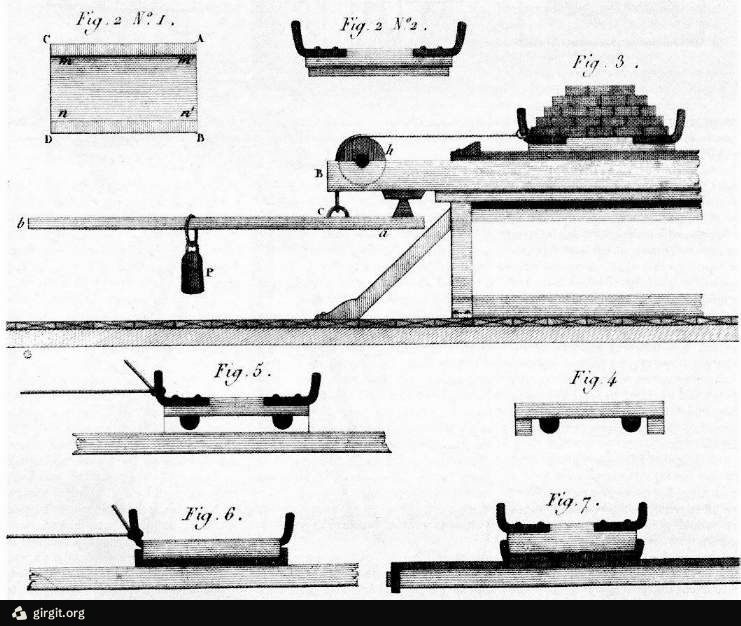 sledge loaded with weightsweight P pulls the cordpulley
Guess first, then flip the block from face to face and add load. Count the spots.
Solve it
Solve it
Measure µs with your phone. Lay the phone on a closed hardback book and slowly lift one end of the book. The phone just starts to slide when the cover makes 20° with the table. What is µs between phone and cover? Would a heavier phone in the same case slip at a different angle?
Answer
Solve it
You press a 2 kg book flat against a wall with a horizontal push F, and µs between book and wall is 0.5. What is the smallest F that holds it up? If you then push twice as hard, what is the friction on the book? (g = 9.8 m s−2)
Hint
Answer
Solve it
A 1 kg block sits on a 3 kg block on a smooth (frictionless) floor; µs between the blocks is 0.4. You pull the lower block sideways. What is the largest pull for which the two still move together? (g = 9.8 m s−2)
Hint
Answer
Connect it
Connect it
- Common forces, this chapter. Friction is the sideways half of the electric contact force: common forces.
- Rolling friction, next page. Why a wheel beats sliding by a huge factor: rolling friction.
- Curves, this chapter. On a flat road, static friction is the only thing that turns a car: circular motion.
- Work and energy, Chapter 5. Kinetic friction turns motion into heat; rub your palms: the work-energy theorem.
- Coulomb, Class 12. The same Coulomb measured the force between charges with a torsion balance: Coulomb's law.
- Daily life. A film of water or oil keeps the high spots of two surfaces apart: that is why a wet marble floor is slippery and why oil makes a sewing machine run smoothly.
Still confused?
If area doesn't matter, why do smooth tiles feel more slippery than a rough mat?
That is a change of surfaces, not of area. The coefficient µ depends on the two materials and their texture. A rubber sole on a rough mat has a much bigger µ than the same sole on wet, polished tile, whatever the size of your foot.
Which way does static friction point?
Against the slipping that would happen without it. On a slope it points up the slope; on a suitcase in a train speeding up it points forwards; on a book pressed to a wall it points up. Work out which way the surfaces would slide, then point friction the other way.
Does kinetic friction depend on speed?
Hardly, over everyday speeds: that is Coulomb's finding, and it is why we use one number, \( \mu_k \). At very low or very high speeds, or when surfaces heat up, it does change, which is one reason the laws are called empirical.
Sources
- University of Cambridge (2016), Leonardo's "irrelevant" scribbles and the laws of friction: the 1493 notebook, the sketches, the quote, Hutchings's study in Wear.
- Wikipedia, "Friction": Amontons 1699, Coulomb's factors, Bowden and Tabor, typical coefficients.
- Wikipedia, "Tribology": real area = load ÷ hardness, µ = shear strength ÷ hardness; Bowden and Tabor's book (1950).
- Wikipedia, "Asperity (materials science)": even mirror-polished surfaces touch only at a few high points; asper, "rough".
- Wikipedia, "Vickers hardness test": carbon steel about 55 to 120 HV, roughly 0.5 to 1.2 GPa.
- Coulomb's friction apparatus and Coulomb, Théorie des machines simples (1821 edition), chapter 1: starting friction after a time of rest versus the force for steady sliding.
- Wikipedia, "Baldwin Street": maximum gradient about 19° (35%).


Picture and video credits
Show 2 picture and video credits
- baldwin-street-parked-cars.jpg: Tony Hisgett from Birmingham, UK, CC BY 2.0
- gravel-pile-angle-of-repose.jpg: Bill Harrison, CC BY-SA 2.0

