Act 04NCERT §3.3 · pp. 49–505 min
Sine and cosine for any angle
The point P on the unit circle casts two shadows: across, on the x-axis, its cosine; up, on the y-axis, its sine. As P walks past the top, the cosine shadow flips to the left of the centre.
The cosine shadow slides left of the centre: negative.
From the textbookpp. 49–50
NCERT Mathematics, Class 11 · Reprint 2026-27
4.0The big idea
Sine and cosine are coordinates.
Walk a distance x anticlockwise round the unit circle from (1, 0). Where you stop is (cos x, sin x): a definition for every real number.
Full text
The big ideaWalk a distance \( x \) anticlockwise round the unit circle from \( (1, 0) \); the point you reach is \( (\cos x, \sin x) \), and this defines sine and cosine for every real number.
In simple words
Picture a round track with its centre at the middle of graph paper and a radius of 1. Start at the right-hand edge and walk round, against the clock. Wherever you stop, ask two questions: how far to the right of the centre am I, and how far above it? The first answer is the cosine. The second is the sine. Walk backwards and you get the answers for minus numbers.
4.1The definition
Across is cos, up is sin
- Unit circle: centre O at the origin, radius 1.
- From A(1, 0) go anticlockwise an arc x to P(a, b): ∠AOP = x radian.
- cos x = a, the x-coordinate; sin x = b, the y-coordinate.
- Negative x: go clockwise.
Full text
The definition
Draw a unit circle with its centre at the origin O. Let A be the point \( (1, 0) \). Go along the circle from A, anticlockwise, an arc of length \( x \), and call the point you reach \( P(a, b) \). Then \( \angle AOP = x \) radian, and we define
\[ \cos x = a, \qquad \sin x = b \]In words: cosine is the \( x \)-coordinate and sine is the \( y \)-coordinate of the point on the unit circle. For negative \( x \), go clockwise instead.
This matches what you learnt in Class 10. If \( P \) is in the first quadrant, drop a perpendicular PM to the \( x \)-axis. Triangle OMP is right-angled with hypotenuse \( OP = 1 \), adjacent side \( OM = a \) and opposite side \( MP = b \). So \( \cos x = \tfrac{a}{1} \) and \( \sin x = \tfrac{b}{1} \), exactly the old ratios. The new definition simply keeps working after the triangle runs out.
Try itWalk a distance x
Where you stop, read two numbers
4.2One point, two graphs
A quarter turn apart
As P goes round, its height draws sin x to the right and its run draws cos x downwards. Same circle, same moment: the same wave, shifted.
4.3Class 10, still true
Hypotenuse 1: no dividing
- Triangle OMP: OP = 1, OM = a, MP = b.
- So cos x = a/1, sin x = b/1: the old ratios.
- Past 90° only the definition works.
On a toy giant wheel, radius 1 m: height above the axle is the sine.
See itAll the way round
Past the first quadrant, and back
4.4The most used identity
Pythagoras, on the circle
OM² + MP² = OP², so a² + b² = 1.
P is always 1 from O, so it holds for every real x.
cos²x means (cos x)², not cos(x²).
CheckSquares, not sums
True for every x?
Full text
The most used identity
Since \( P(a, b) \) is on a circle of radius 1, its distance from O is 1. By Pythagoras, \( OM^2 + MP^2 = OP^2 \), so \( a^2 + b^2 = 1 \). Hence, for every real \( x \),
\[ \cos^2 x + \sin^2 x = 1 \](\( \cos^2 x \) means \( (\cos x)^2 \).) This holds for every angle, not only acute ones, because every point of the unit circle obeys \( a^2 + b^2 = 1 \).
Which statement is true for every real \( x \)?
- \( \sin x + \cos x = 1 \)
- \( \sin^2 x + \cos^2 x = 1 \)
- \( \sin x = \cos x \)
4.5Quadrantal angles
Quarter turns land on an axis
Integer multiples of π/2: P sits exactly on an axis, so cos and sin are 0, 1 or −1. A, B(0, 1), C(−1, 0), D(0, −1), then A again.
| Angle | Point P | cos | sin |
|---|---|---|---|
| \( 0 \) | \( (1, 0) \) | \( 1 \) | \( 0 \) |
| \( \tfrac{\pi}{2} \) | \( (0, 1) \) | \( 0 \) | \( 1 \) |
| \( \pi \) | \( (-1, 0) \) | \( -1 \) | \( 0 \) |
| \( \tfrac{3\pi}{2} \) | \( (0, -1) \) | \( 0 \) | \( -1 \) |
| \( 2\pi \) | \( (1, 0) \) | \( 1 \) | \( 0 \) |
Full text
Quadrantal angles
Angles that are integer multiples of \( \tfrac{\pi}{2} \) put P exactly on an axis. These are called quadrantal angles. A quarter turn takes you from A\( (1, 0) \) to B\( (0, 1) \), a half turn to C\( (-1, 0) \), three quarters to D\( (0, -1) \), and a full turn back to A.
| Angle | Point P | cos | sin |
|---|---|---|---|
| \( 0 \) | \( (1, 0) \) | \( 1 \) | \( 0 \) |
| \( \tfrac{\pi}{2} \) | \( (0, 1) \) | \( 0 \) | \( 1 \) |
| \( \pi \) | \( (-1, 0) \) | \( -1 \) | \( 0 \) |
| \( \tfrac{3\pi}{2} \) | \( (0, -1) \) | \( 0 \) | \( -1 \) |
| \( 2\pi \) | \( (1, 0) \) | \( 1 \) | \( 0 \) |
4.6A full turn, 2π, brings P back
Going round again changes nothing
Full text
Going round again changes nothing
After one full turn, \( 2\pi \), you are back at the same point P. After any whole number of turns, forwards or backwards, the same. So for every integer \( n \):
\[ \sin(2n\pi + x) = \sin x, \qquad \cos(2n\pi + x) = \cos x, \qquad n \in \mathbf{Z} \]4.7Where each one is 0
On an axis, one shadow vanishes
- sin x = 0 on the x-axis: x = 0, ±π, ±2π, ±3π … so x = nπ.
- cos x = 0 on the y-axis: ±π/2, ±3π/2, ±5π/2 … so x = (2n + 1)π/2.
Full text
Where sine and cosine are zero
- \( \sin x = 0 \) when P is on the \( x \)-axis: at \( x = 0, \pm\pi, \pm 2\pi, \pm 3\pi, \dots \) So \( \sin x = 0 \) exactly when \( x = n\pi \), \( n \) any integer.
- \( \cos x = 0 \) when P is on the \( y \)-axis: at \( x = \pm\tfrac{\pi}{2}, \pm\tfrac{3\pi}{2}, \pm\tfrac{5\pi}{2}, \dots \), the odd multiples of \( \tfrac{\pi}{2} \). So \( \cos x = 0 \) exactly when \( x = (2n + 1)\tfrac{\pi}{2} \), \( n \) any integer.
Worked example
- \( \sin \tfrac{5\pi}{2} = \sin\left(2\pi + \tfrac{\pi}{2}\right) = \sin \tfrac{\pi}{2} = 1 \).
- \( \cos(-3\pi) = \cos(-4\pi + \pi) = \cos \pi = -1 \). (Here \( n = -2 \).)
- \( \cos 7\pi \): \( 7\pi = 6\pi + \pi \), so \( \cos 7\pi = \cos \pi = -1 \).
- If \( \cos x = 0.6 \), what can \( \sin x \) be? \( \sin^2 x = 1 - 0.36 = 0.64 \), so \( \sin x = 0.8 \) or \( -0.8 \). Without knowing the quadrant, both are possible.
Remember
- On the unit circle, \( P = (\cos x, \sin x) \).
- \( \cos^2 x + \sin^2 x = 1 \) for every real \( x \).
- \( \sin x = 0 \iff x = n\pi \); \( \cos x = 0 \iff x = (2n+1)\tfrac{\pi}{2} \).
Answer
CheckOn the y-axis
When is cos x zero?
For which values of \( x \) is \( \cos x = 0 \)?
- \( x = n\pi \)
- \( x = (2n + 1)\tfrac{\pi}{2} \)
- \( x = 2n\pi \)
4.8Worked example
Strip the turns, then read
Worked example
- \( \sin \tfrac{5\pi}{2} = \sin\left(2\pi + \tfrac{\pi}{2}\right) = \sin \tfrac{\pi}{2} = 1 \).
- \( \cos(-3\pi) = \cos(-4\pi + \pi) = \cos \pi = -1 \). (Here \( n = -2 \).)
- \( \cos 7\pi \): \( 7\pi = 6\pi + \pi \), so \( \cos 7\pi = \cos \pi = -1 \).
- If \( \cos x = 0.6 \), what can \( \sin x \) be? \( \sin^2 x = 1 - 0.36 = 0.64 \), so \( \sin x = 0.8 \) or \( -0.8 \). Without knowing the quadrant, both are possible.
See itOne cosine, two points
cos x = 0.6: sin x is ±0.8
A vertical line meets the circle twice. Without the quadrant, both are possible.
CheckWhich coordinate?
The point is (−0.6, 0.8)
The point on the unit circle for angle \( x \) is \( (-0.6, 0.8) \). What is \( \sin x \)?
- \( -0.6 \)
- \( 0.8 \)
- \( -\tfrac{4}{3} \)
KeepThree lines
Point, identity, zeros
Remember
- On the unit circle, \( P = (\cos x, \sin x) \).
- \( \cos^2 x + \sin^2 x = 1 \) for every real \( x \).
- \( \sin x = 0 \iff x = n\pi \); \( \cos x = 0 \iff x = (2n+1)\tfrac{\pi}{2} \).
Try itThree quick ones
7π/2, 15π and 5/13
(a) sin 7π/2 and cos(−2π). (b) At x = 15 π, is sin x zero? Is cos x? (c) sin x = 5/13: both values of cos x.
Answer
KeepJust remember
Two conventions
Someone had to pick an order. Tap a card for its hook.
WordsTo know
Five words
- Unit circle
- Circle of radius 1 with centre at the origin.
- \( \cos x \)
- The \( x \)-coordinate of the point reached after an arc \( x \).
- \( \sin x \)
- The \( y \)-coordinate of that point.
- Quadrantal angle
- An integer multiple of \( \tfrac{\pi}{2} \); the point lies on an axis.
- \( n \in \mathbf{Z} \)
- \( n \) is any integer: \( \dots, -2, -1, 0, 1, 2, \dots \)
RootsWhy a coordinate, why radius 1
Half a chord
- Radius r: P is (r cos x, r sin x); radius 1, no dividing.
- Mirror P to P′ at −x: the axis halves chord PP′ at M.
- Hipparchus, second century BCE: chords. Indian astronomers: half.
So chord(2x) = 2 sin x. Underneath: Pythagoras.
Full text
The roots: why a coordinate, why radius 1
- Why is \( \sin x \) the \( y \)-coordinate of P?Because for an acute angle that is exactly the Class 10 ratio: opposite ÷ hypotenuse, with the hypotenuse OP equal to 1. The new definition agrees with the old one wherever the old one works.
- Why does it have to be a circle of radius 1?It does not have to be. On a circle of radius \( r \) the point is \( (r\cos x, r\sin x) \); dividing by \( r \) gives the same two numbers. Radius 1 just means there is nothing to divide by: the coordinates are the values.
- Why does \( \cos^2 x + \sin^2 x = 1 \) then hold for every angle?Because every point of the circle is at distance 1 from O, in every quadrant. The definition was chosen so that this, the most useful fact about the triangle, survives after the triangle is gone.
- Why is this "half a chord"?Reflect P in the \( x \)-axis to get P′, at angle \( -x \). The chord PP′ is cut in half by the axis at M, so \( MP = \sin x \) is half the chord of the arc \( 2x \). Old astronomers measured chords of circles; the half-chord is the piece that sits in a right triangle.
- And underneath?Pythagoras: a circle is just the set of points at one fixed distance from the centre, and distance is worked out with \( a^2 + b^2 \).
So "sine" is not a new invention of this chapter. Greek astronomers, from Hipparchus in the second century BCE, made tables of chords: the straight line across a circle for a given arc. Indian astronomers noticed that only half of that chord is needed, because the half-chord, the radius and a piece of the diameter make a right triangle. That half-chord is our sine. The chord itself is still useful: for an arc \( 2x \) on a unit circle,
\[ \text{chord}(2x) = 2\sin x . \]StoryA bowstring that became a fold
Sanskrit, Arabic, Latin, English
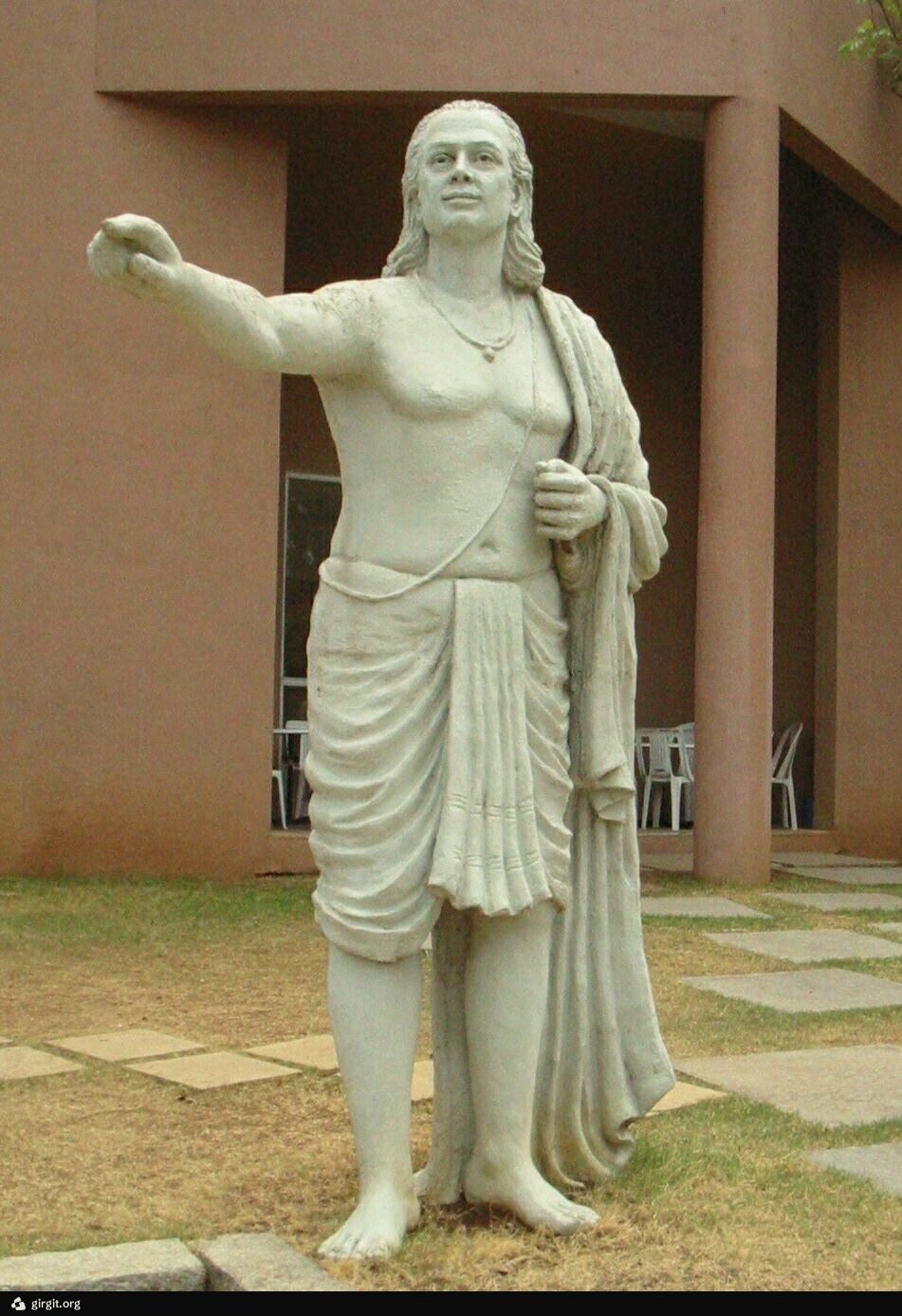
- 499 CEAryabhata, aged 23At 3,600 years of the Kali age. The Aryabhatiya uses ardha-jya; then jya, jiva; cosine: koti-jya.
- 9th–12th c.al-Khwarizmi, al-Battanijiba, a sound with no meaning; written jb, later read jayb: a pocket, a fold.
- 12th c.Translators in SpainGerard of Cremona (perhaps Robert of Chester first): sinus, a fold or bay.
- EnglishsineA translation of a misreading of a borrowing.
StoryOne ruler for arc and radius
3438
the radius of his circle, in minutes of arc
A circle has 360 × 60 = 21600 minutes; 21600/2π ≈ 3437.7. So his first jump, 225, equals the first arc, 225 minutes: the idea behind the radian.
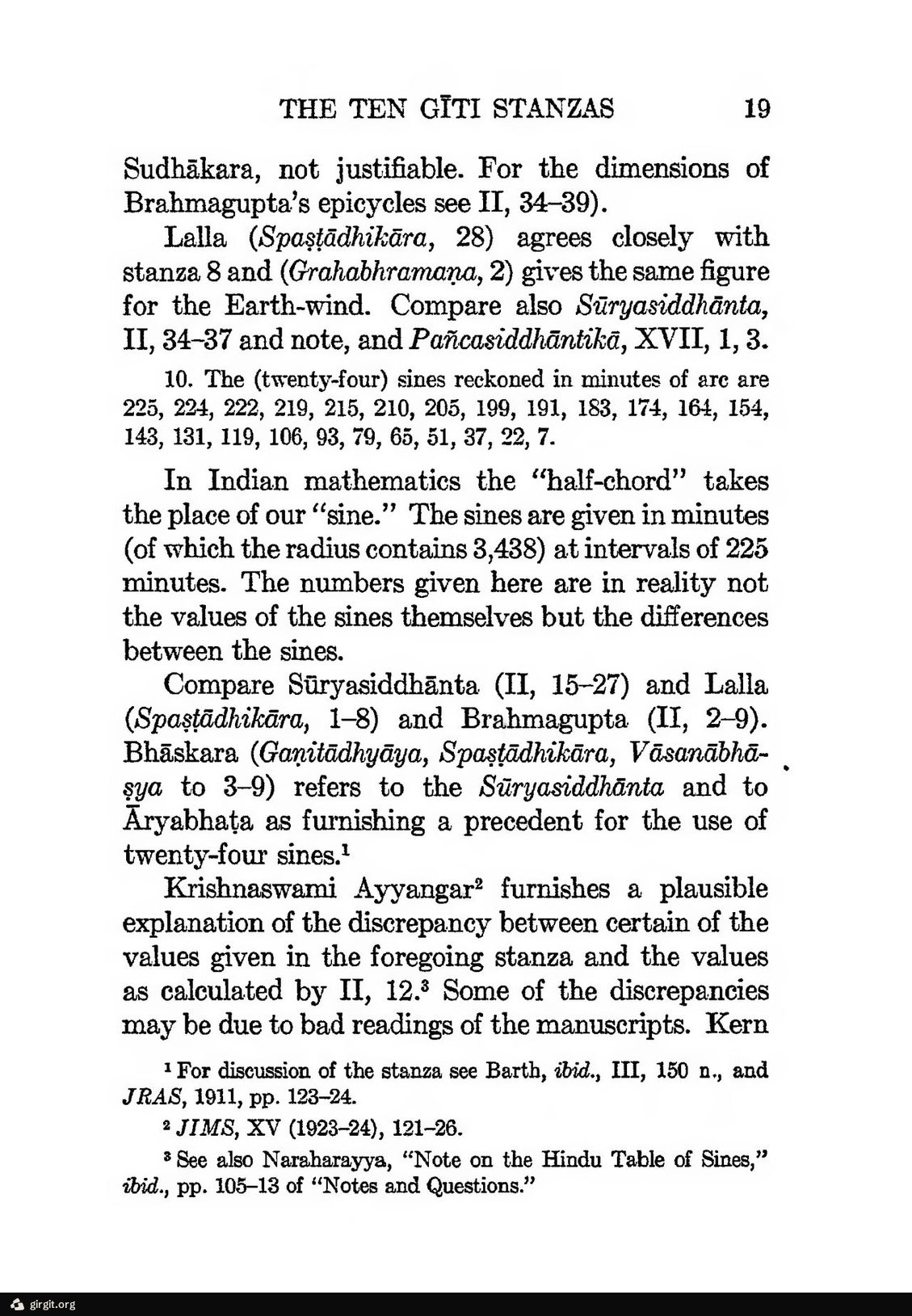 the 24 jumpsradius 3438
See itA whole table in one verse
24 jumps, every 3°45′
Letters stand for numbers: the first word, makhi, is 225. The numbers are the jumps between sines on a circle of radius 3438. Add them up and you get each sine.
See itBow, string, half-string
Why the jumps shrink
Near 0° P moves almost straight up; near 90°, sideways. Each jump follows the cosine, falling from 1 to 0. Tap a bar: a 1,500-year-old table, this close. (Class 12: the rate of change of sin x is cos x.)
Solve itThree problems
Your turn
Solve it
Aryabhata's first sine is 225 on a circle of radius 3438, for an arc of 225 minutes. Turn this into today's numbers and say what it tells you about \( \sin x \) for a small angle.
Hint
Answer
Spot the error
A student writes: "P = (3, 4) is on the terminal side of angle \( x \), and sine is the \( y \)-coordinate, so \( \sin x = 4 \)." What went wrong, and what is \( \sin x \)?
Answer
Solve it (JEE style)
A and B are the points of the unit circle for angles \( a \) and \( b \). Show that the chord AB has length \( 2\left|\sin \tfrac{a - b}{2}\right| \). Then find the side of a regular 12-sided polygon drawn inside a circle of radius 10 cm.
Hint
Answer
ConnectAnd still confused?
Where this goes next
Connect it
- Radians, page 2. Aryabhata's 3438 is a radius measured in arc-minutes: the same "measure the arc with the radius" idea as the radian.
- The sum formula, page 9. The proof of \( \cos(x + y) \) on page 9 compares two chords of the unit circle: chords again.
- Physics: SHM and circular motion. The shadow of a point going round a circle moves in simple harmonic motion, \( x = A\cos\omega t \): Oscillations.
- Limits, Ch 12. "The half-chord is almost the arc" becomes \( \lim_{x \to 0} \tfrac{\sin x}{x} = 1 \): sin x over x.
- The circle, Ch 10. Every point of \( x^2 + y^2 = r^2 \) can be written \( (r\cos\theta, r\sin\theta) \): the circle.
In Class 10 sine was a ratio. Now it is a coordinate. Which is it?
Both, and they agree. A ratio does not depend on the size of the triangle, so you may pick the triangle whose hypotenuse is 1. Then "opposite ÷ hypotenuse" is just "opposite", which is the \( y \)-coordinate of P. The coordinate version is the ratio version with the division already done, and it keeps working past 90°.
Is \( x \) an angle or a length here?
On the unit circle it is both at once. The arc walked from A has length \( x \), and the angle it makes at O is \( x \) radians, because on a circle of radius 1 arc length = angle in radians. That is why the definition can say "walk a distance \( x \)".
Why did old tables use a radius like 3438 or 60 instead of 1?
Before decimals were common, a fraction like 0.0654 was awkward to write. A big radius turned every sine into a whole number of units (225 instead of 0.0654). Radius 1 became the standard with Euler's book of 1748; see the story on page 6.
Sources
- Sine and cosine: etymology (jya, jiba, jayb, sinus; Gerard of Cremona, Robert of Chester), Wikipedia.
- Aryabhata's sine table (24 differences, radius 3438, interval 225′, the verse and its letter-numbers), Wikipedia.
- W. E. Clark, The Aryabhatiya of Aryabhata (University of Chicago Press, 1930), Dasagitika stanza 10, p. 19.
- Aryabhata (age 23 at 3,600 years of the Kali Yuga, 499 CE; ardha-jya), Wikipedia; and Aryabhata, MacTutor History of Mathematics, St Andrews.
- History of trigonometry (Hipparchus's chord table; jya and koti-jya), Wikipedia.