Act 03NCERT §3.2.4 · pp. 46–495 min
Changing degrees into radians and back
Half a turn of rope is π pieces; the circle then shows each angle worth knowing in both units: 30° is π/6, 45° is π/4, 60° is π/3, 90° is π/2, 180° is π.
Degrees outside the circle, radians inside.
From the textbookpp. 46–49
NCERT Mathematics, Class 11 · Reprint 2026-27
3.0The big idea
Half a turn is 180°, and π.
Two rulers for one turn, like kilometres and miles for one road. Half a turn reads 180 on one, about 3.14 on the other. Switch by × π/180 or × 180/π.
Full text
The big ideaA half turn is both \( 180^\circ \) and \( \pi \) radians, so to switch units you multiply by \( \tfrac{\pi}{180} \) or by \( \tfrac{180}{\pi} \).
In simple words
Degrees and radians are two rulers for the same turn, like kilometres and miles for the same road. Half a turn is 180 on one ruler and about 3.14 on the other. Once you know that one match, you can change any number from one ruler to the other.
Try itBefore the formulas
One ray, two rulers
3.1The one fact you need
Half a turn, two names
2π radian = 360°, so π radian = 180°.
1 radian = (180/π)° ≈ 57° 16′, with π ≈ 22/7.
1° = π/180 radian ≈ 0.01746 radian.
3.2The two working rules
π on top, or π cancels
Full text
The one fact you need
A full turn subtends \( 2\pi \) radians and also \( 360^\circ \). So
\[ 2\pi \text{ radian} = 360^\circ \qquad \text{or} \qquad \pi \text{ radian} = 180^\circ \]Dividing both sides, with the approximate value \( \pi \approx \tfrac{22}{7} \):
\[ 1 \text{ radian} = \left(\frac{180}{\pi}\right)^\circ \approx 57^\circ 16', \qquad 1^\circ = \frac{\pi}{180} \text{ radian} \approx 0.01746 \text{ radian} \]From this come the two working rules:
\[ \text{Radian measure} = \frac{\pi}{180} \times \text{Degree measure}, \qquad \text{Degree measure} = \frac{180}{\pi} \times \text{Radian measure} \]A quick check that you have the right one: going to radians, the answer should have \( \pi \) on top (\( 90^\circ \to \tfrac{\pi}{2} \)); going to degrees, the \( \pi \) should cancel.
See itSame turn
180° on one ruler, π on the other
3.3Worth knowing by heart
π/n is 180° ÷ n
Each angle is a fraction of π = 180°: 30° is one sixth of 180°, so π/6.
| Degree | \( 30^\circ \) | \( 45^\circ \) | \( 60^\circ \) | \( 90^\circ \) | \( 180^\circ \) | \( 270^\circ \) | \( 360^\circ \) |
|---|---|---|---|---|---|---|---|
| Radian | \( \tfrac{\pi}{6} \) | \( \tfrac{\pi}{4} \) | \( \tfrac{\pi}{3} \) | \( \tfrac{\pi}{2} \) | \( \pi \) | \( \tfrac{3\pi}{2} \) | \( 2\pi \) |
Full text
Angles worth knowing by heart
| Degree | \( 30^\circ \) | \( 45^\circ \) | \( 60^\circ \) | \( 90^\circ \) | \( 180^\circ \) | \( 270^\circ \) | \( 360^\circ \) |
|---|---|---|---|---|---|---|---|
| Radian | \( \tfrac{\pi}{6} \) | \( \tfrac{\pi}{4} \) | \( \tfrac{\pi}{3} \) | \( \tfrac{\pi}{2} \) | \( \pi \) | \( \tfrac{3\pi}{2} \) | \( 2\pi \) |
Each one is just a fraction of \( \pi = 180^\circ \): \( 30^\circ \) is one sixth of 180°, so it is \( \tfrac{\pi}{6} \).
CheckDegrees to radians
300° is …
What is \( 300^\circ \) in radians?
- \( \tfrac{5\pi}{3} \)
- \( \tfrac{5\pi}{6} \)
- \( \tfrac{54000}{\pi} \)
3.4Notational convention
Only degrees wear a badge
- θ° is in degrees.
- A plain β is in radians; the word "radian" is dropped.
- So π/4 = 45°, and sin 2 is 2 radians, about 114.6°.
Like a price: "Rs 50" wears its unit.
Full text
How to read an angle
The textbook follows a notational convention. When an angle is written with the degree sign, \( \theta^\circ \), the measure is in degrees. When it is written without any sign, \( \beta \), it is in radians, and the word "radian" is usually dropped. So \( \pi = 180^\circ \) and \( \tfrac{\pi}{4} = 45^\circ \) are true statements, read as "\( \pi \) radians equals 180 degrees". It also means \( \sin 2 \) is the sine of 2 radians (about 114.6°), not of 2 degrees.
Worked example: degrees to radians
- \( 135^\circ = \dfrac{\pi}{180} \times 135 = \dfrac{3\pi}{4} \).
- \( -210^\circ = \dfrac{\pi}{180} \times (-210) = -\dfrac{7\pi}{6} \).
- \( 25^\circ 30' \): first \( 30' = \tfrac{1}{2}^\circ \), so the angle is \( \tfrac{51}{2}^\circ \). Then \( \dfrac{\pi}{180} \times \dfrac{51}{2} = \dfrac{51\pi}{360} = \dfrac{17\pi}{120} \).
Worked example: radians to degrees
- \( \dfrac{5\pi}{6} = \dfrac{180}{\pi} \times \dfrac{5\pi}{6} = 150^\circ \).
- 4 radians, using \( \pi = \tfrac{22}{7} \): \( \dfrac{180}{\pi} \times 4 = \dfrac{720 \times 7}{22} = 229\tfrac{1}{11}^\circ \).
- Turn the fraction into minutes: \( \tfrac{1}{11}^\circ = \tfrac{60}{11}' = 5\tfrac{5}{11}' \). Then \( \tfrac{5}{11}' = \tfrac{300}{11}'' \approx 27'' \).
- So 4 radians \( \approx 229^\circ 5' 27'' \).
CheckBigger unit
2 radians or 100°?
Which is the bigger angle: 2 radians or \( 100^\circ \)?
- \( 100^\circ \)
- 2 radians
- They are equal
3.5Worked example
Degrees to radians
Worked example: degrees to radians
- \( 135^\circ = \dfrac{\pi}{180} \times 135 = \dfrac{3\pi}{4} \).
- \( -210^\circ = \dfrac{\pi}{180} \times (-210) = -\dfrac{7\pi}{6} \).
- \( 25^\circ 30' \): first \( 30' = \tfrac{1}{2}^\circ \), so the angle is \( \tfrac{51}{2}^\circ \). Then \( \dfrac{\pi}{180} \times \dfrac{51}{2} = \dfrac{51\pi}{360} = \dfrac{17\pi}{120} \).
See itSlices of π/6 = 30°
Five slices: 5π/6 = 150°
3.6Worked example
Radians to degrees, minutes, seconds
Worked example: radians to degrees
- \( \dfrac{5\pi}{6} = \dfrac{180}{\pi} \times \dfrac{5\pi}{6} = 150^\circ \).
- 4 radians, using \( \pi = \tfrac{22}{7} \): \( \dfrac{180}{\pi} \times 4 = \dfrac{720 \times 7}{22} = 229\tfrac{1}{11}^\circ \).
- Turn the fraction into minutes: \( \tfrac{1}{11}^\circ = \tfrac{60}{11}' = 5\tfrac{5}{11}' \). Then \( \tfrac{5}{11}' = \tfrac{300}{11}'' \approx 27'' \).
- So 4 radians \( \approx 229^\circ 5' 27'' \).
3.7l = rθ with degrees
Convert to radians first
A 21 cm pizza in 8 slices: each is 45° = π/4, so the crust is 21 × π/4 = 16.5 cm.
Full text
Using \( l = r\theta \) when the angle is in degrees
Convert to radians first, then use the formula.
Worked example
- Arc length. A circular pizza of radius 21 cm is cut into 8 equal slices. How long is the crust on one slice? Each slice has angle \( 45^\circ = \tfrac{\pi}{4} \). So \( l = 21 \times \tfrac{\pi}{4} = 21 \times \tfrac{22}{28} = 16.5 \) cm.
- A clock hand. A wall clock has a 6 cm hour hand. What distance does the end of the hand cover between 1 o'clock and 3 o'clock? (Use \( \pi = 3.14 \).) It turns once in 12 hours, so in 2 hours it turns \( \tfrac{1}{6} \) of a revolution, \( 60^\circ = \tfrac{\pi}{3} \). Then \( l = 6 \times \tfrac{\pi}{3} = 2\pi \approx 6.28 \) cm.
- Ratio of radii. Arcs of the same length subtend \( 40^\circ \) at the centre of one circle and \( 90^\circ \) at the centre of another. Since \( l = r_1\theta_1 = r_2\theta_2 \), we get \( \dfrac{r_1}{r_2} = \dfrac{\theta_2}{\theta_1} = \dfrac{90}{40} \). (The factor \( \tfrac{\pi}{180} \) is on top and bottom, so it cancels.) So \( r_1 : r_2 = 9 : 4 \): the smaller angle belongs to the bigger circle.
Don't mix these up
- Degrees to radians: multiply by \( \tfrac{\pi}{180} \). Radians to degrees: multiply by \( \tfrac{180}{\pi} \).
- \( \pi \) on its own is about 3.14; it equals \( 180^\circ \) only when it stands for an angle.
- Convert minutes into a fraction of a degree (divide by 60) before multiplying by \( \tfrac{\pi}{180} \).
Answer
3.8Worked example
Pizza, clock hand, two circles
Worked example
- Arc length. A circular pizza of radius 21 cm is cut into 8 equal slices. How long is the crust on one slice? Each slice has angle \( 45^\circ = \tfrac{\pi}{4} \). So \( l = 21 \times \tfrac{\pi}{4} = 21 \times \tfrac{22}{28} = 16.5 \) cm.
- A clock hand. A wall clock has a 6 cm hour hand. What distance does the end of the hand cover between 1 o'clock and 3 o'clock? (Use \( \pi = 3.14 \).) It turns once in 12 hours, so in 2 hours it turns \( \tfrac{1}{6} \) of a revolution, \( 60^\circ = \tfrac{\pi}{3} \). Then \( l = 6 \times \tfrac{\pi}{3} = 2\pi \approx 6.28 \) cm.
- Ratio of radii. Arcs of the same length subtend \( 40^\circ \) at the centre of one circle and \( 90^\circ \) at the centre of another. Since \( l = r_1\theta_1 = r_2\theta_2 \), we get \( \dfrac{r_1}{r_2} = \dfrac{\theta_2}{\theta_1} = \dfrac{90}{40} \). (The factor \( \tfrac{\pi}{180} \) is on top and bottom, so it cancels.) So \( r_1 : r_2 = 9 : 4 \): the smaller angle belongs to the bigger circle.
CheckEqual arcs
30° and 45°: which radius?
Arcs of equal length subtend \( 30^\circ \) and \( 45^\circ \) at the centres of two circles. What is the ratio of their radii, \( r_1 : r_2 \)?
- \( 2 : 3 \)
- \( 3 : 2 \)
- \( 1 : 1 \)
3.9Don't mix these up
Which way, and when is π 180°?
Myth
π always means 180°
Fact
π alone is about 3.14; it is 180° only as an angle
Don't mix these up
- Degrees to radians: multiply by \( \tfrac{\pi}{180} \). Radians to degrees: multiply by \( \tfrac{180}{\pi} \).
- \( \pi \) on its own is about 3.14; it equals \( 180^\circ \) only when it stands for an angle.
- Convert minutes into a fraction of a degree (divide by 60) before multiplying by \( \tfrac{\pi}{180} \).
Try itThree quick ones
240°, −75°, 7π/12 and a wheel
(a) 240° and −75° in radians. (b) 7π/12 in degrees. (c) A wheel at 180 revolutions a minute: radians each second?
Answer
KeepJust remember
One fact, cold
The rest rebuilds from it. Tap a card for its hook.
WordsTo know
Four entries
- \( \pi \) radian \( = 180^\circ \)
- The link between the two units.
- 1 radian
- About \( 57^\circ 16' \).
- \( 1^\circ \)
- About 0.01746 radian.
- Notational convention
- \( \theta^\circ \) means degrees; a plain \( \beta \) means radians.
RootsArcs grow in step with angles
Run l = rθ backwards
- Fixed ratio (× π/180): two measures of one turn.
- Turn by 10°: every 10° arc lands on another; 36 make the circle.
- Know arc and angle: r = l/θ, or circumference = l × 360/θ°.
Angle exaggerated. Parallel rays make alternate angles equal.
Full text
The roots: arcs grow in step with angles
- Why is converting just "multiply by \( \tfrac{\pi}{180} \)"?Because degrees and radians both measure the same thing, the fraction of a full turn. Two measures of one quantity are always in a fixed ratio, like kilometres and miles. The ratio is fixed by one matching pair: a full turn is 360 on one and \( 2\pi \) on the other.
- Why is the radian a measure of "fraction of a turn" at all?Because on a given circle, the arc grows in exact step with the angle: double the angle, double the arc. So arc ÷ radius tells you the fraction of the turn, times \( 2\pi \).
- Why does the arc grow in exact step with the angle?Because a circle looks the same after any turn about its centre. Turn it by \( 10^\circ \) and every \( 10^\circ \) arc lands on another \( 10^\circ \) arc, so all \( 10^\circ \) arcs are equally long, and 36 of them make the whole circle.
- What can you do with that?Run it backwards. If you know an arc's length and the angle it makes at the centre, you know the whole circle: \( r = \dfrac{l}{\theta} \) with \( \theta \) in radians, or circumference \( = l \times \dfrac{360}{\theta^\circ} \). You never have to visit the centre, or walk all the way round.
That last step is how the Earth was first measured. The centre of the Earth is out of reach and the way round is too long to walk, but the angle at the centre can be read from the sky. The sun is so far away that its rays arrive parallel. If at the same moment the sun is straight overhead at one town and makes an angle \( \theta \) with a vertical stick at another town due north, then the two vertical sticks, which both point at the Earth's centre, meet there at the same angle \( \theta \) (they are alternate angles between parallel rays). One shadow gives the angle at the centre; one long walk gives the arc.
StoryThird century BCE, Egypt
1/50of a turn
the shadow at Alexandria: 7.2° from straight up
- Eratosthenes (about 276 to 195 BCE), Library of Alexandria; via Cleomedes.
- Syenetoday's Aswan: no shadow at noon, midsummer.
- 5,000 stadia between the towns: 50 × 5,000 = 2,50,000 stadia round.
- Stadion 160 m to 210 m: with 160 m, 40,000 km.
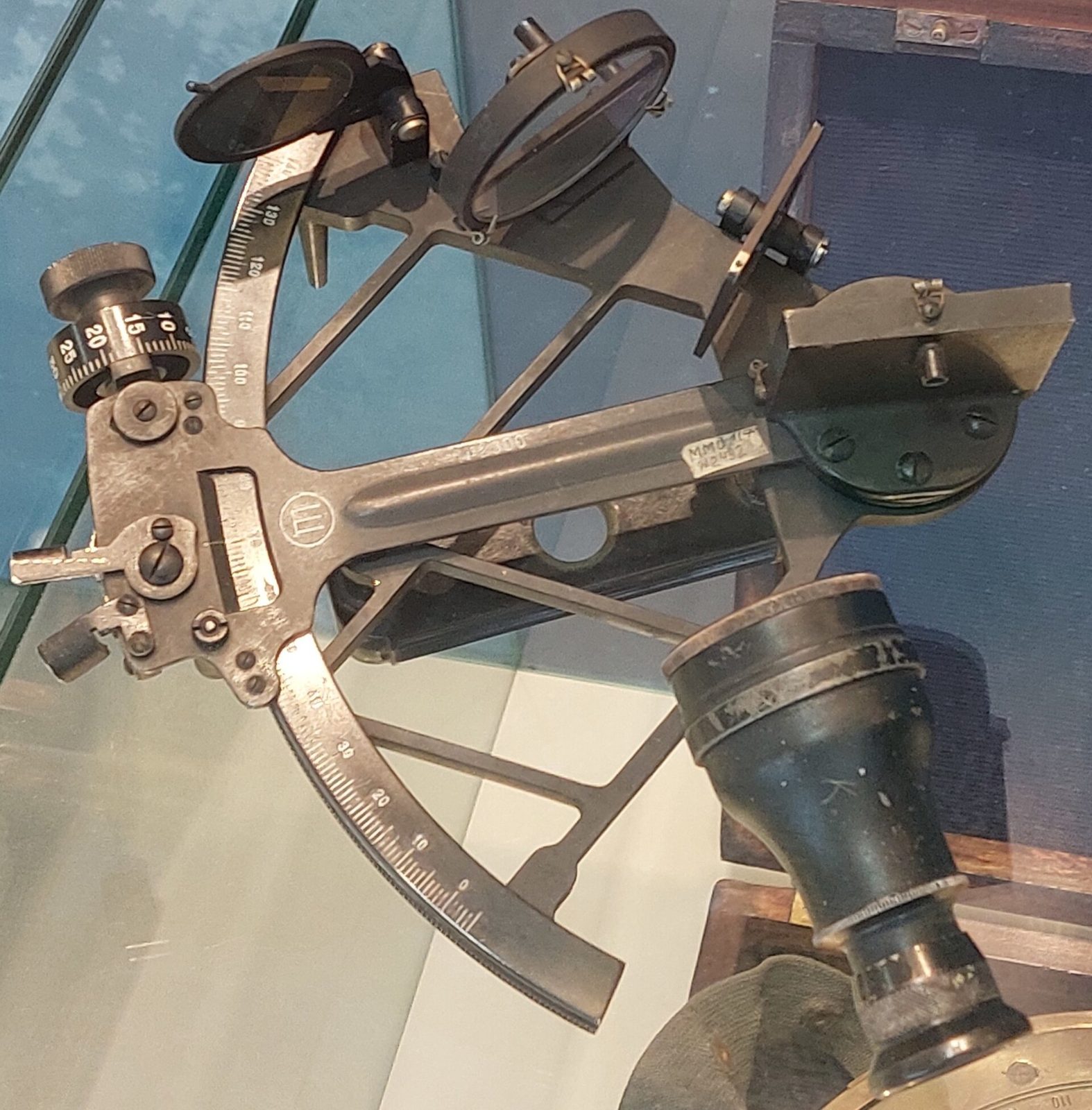 arc: whole degreesdrum: minutesindex arm swingstelescope
Story1790s and 1929
A metre and a sailor's mile
- 1790s, France: the metre, one ten-millionth of pole to equator. Earth: about 40,000 km round.
- 1929: the nautical mile, one minute of latitude, fixed at exactly 1,852 m.
- The knot: one nautical mile per hour.
See itEratosthenes' Earth
Every Earth for one walk
Circumference = 360 × d / θ: a hyperbola. A few tenths of a degree moves the Earth by thousands of kilometres.
Solve itThe mile and the pole star
Your turn
Solve it
Take the Earth to be 40,000 km round. How long, in metres, is one minute of arc along a line of longitude? Compare with the nautical mile.
Hint
Answer
Solve it
The pole star stands above the northern horizon at an angle almost equal to your latitude. From Bengaluru it is about \( 13^\circ \) up; from Delhi about \( 28.6^\circ \) up. How far north is Delhi of Bengaluru? Use 111 km per degree.
Hint
Answer
With the textbook's convention, what is \( \sin 30 \) (no degree sign)?
- \( 0.5 \)
- about \( -0.99 \)
- about 30
ConnectWhere this goes next
Every map pin is an angle
Connect it
- Minutes of arc. The nautical mile is the Babylonian minute laid on the Earth: measuring angles.
- Mapping India. The Great Trigonometrical Survey measured the length of a degree along India's central meridian, the same idea at a grander scale: see the deep dive on tan.
- Physics: the Earth's radius. \( R \approx 6,400 \) km goes into the weight of the Earth and the value of \( g \): weighing the Earth.
- Radians as the real unit. Why \( l = r\theta \) needs radians at all: what is a radian?
- Your phone. Every map pin is a latitude and longitude, angles at the Earth's centre; the distance between two pins is worked out with exactly these conversions.
Sources
- Eratosthenes, Wikipedia: dates, librarian at Alexandria, Cleomedes' account, 7.2° = 1/50 of a circle, 5,000 stadia, the disputed stadion (160 to 210 m).
- Nautical mile, Wikipedia: one minute of latitude, 1,852 m fixed in 1929, the knot.
- History of the metre, Wikipedia: one ten-millionth of the pole-to-equator distance.
- Marine sextant, 1951, Wikimedia Commons.
