Act 12NCERT §3.4 · pp. 63–675 min
Turning sums into products and back
Two points on the unit circle at angles x and y. The middle of the chord joining them lies on the half-way ray, at distance cos((x − y)/2) from the centre; its shadow on the x-axis is half of cos x + cos y.
Where the middle sits turns a sum into a product.
From the textbookpp. 63–67
NCERT Mathematics, Class 11 · Reprint 2026-27
12.0The big idea
A sum becomes a product, and back.
Add and subtract the sum and difference formulas: two sines or cosines added turn into a product, and a product into a sum.
Full text
The big ideaAdding and subtracting the sum and difference formulas lets you turn a sum of two sines or cosines into a product, and a product back into a sum.
In simple words
Sometimes a problem has two waves added together and you want them multiplied, because multiplied things cancel neatly in fractions. Other times you have them multiplied and want them added, because added things are easier to handle. These eight formulas are the switch between the two.
Try itTwo arrows of length 1
Their sum points half-way
12.1Where they come from
Add in pairs: one product cancels
Four lines: (1) cos(x + y), (2) cos(x − y), (3) sin(x + y), (4) sin(x − y). Add or subtract a pair and one product cancels, the other doubles.
(1) + (2)
cos + cos
- Gives
- cos(x + y) + cos(x − y) = 2 cos x cos y
(1) − (2)
cos − cos
- Gives
- cos(x + y) − cos(x − y) = −2 sin x sin y
(3) + (4)
sin + sin
- Gives
- sin(x + y) + sin(x − y) = 2 sin x cos y
(3) − (4)
sin − sin
- Gives
- sin(x + y) − sin(x − y) = 2 cos x sin y
Read right to left: the product-to-sum formulas.
Full text
Where they come from
Write the four sum and difference formulas one under another:
\[ \begin{aligned} \cos(x + y) &= \cos x \cos y - \sin x \sin y \quad &(1) \\ \cos(x - y) &= \cos x \cos y + \sin x \sin y &(2) \\ \sin(x + y) &= \sin x \cos y + \cos x \sin y &(3) \\ \sin(x - y) &= \sin x \cos y - \cos x \sin y &(4) \end{aligned} \]Add and subtract them in pairs. In each case one product cancels and the other doubles:
- (1) + (2): \( \cos(x + y) + \cos(x - y) = 2\cos x \cos y \)
- (1) − (2): \( \cos(x + y) - \cos(x - y) = -2\sin x \sin y \)
- (3) + (4): \( \sin(x + y) + \sin(x - y) = 2\sin x \cos y \)
- (3) − (4): \( \sin(x + y) - \sin(x - y) = 2\cos x \sin y \)
Read from right to left, these are the product-to-sum formulas.
See itMultiply two waves
Multiplied waves make a sum
2 sin mx cos nx = sin(m + n)x + sin(m − n)x. Try m = 5, n = 3.
CheckProduct to sum
2 sin 3x cos x as a sum
What is \( 2\sin 3x \cos x \) as a sum?
- \( \sin 4x + \sin 2x \)
- \( \cos 4x + \cos 2x \)
- \( \sin 2x + \sin x \)
12.2Two tabla players
A fast beat inside a slow pulse
- Nearly the same speed: together they swell and fade.
- The half-sum is the fast beat; the half-difference the slow pulse.
- Two waves added = a fast wave times a slow one.
12.3A picture-proof
The middle of the chord
P at angle x, Q at angle y. Join them.
It sits on the half-way ray, at angle (x + y)/2.
Radius 1, half the angle between: OM = cos((x − y)/2).
The average of P's and Q's: (cos x + cos y)/2 = OM · cos((x + y)/2).
Move P and Q anywhere: the middle still tells the truth.
12.4Sum to product
Rename the angles, run it backwards
Adding and subtracting gives x and y back. Put these into the four lines; θ and φ can be any real numbers, so call them x and y again.
Full text
Sum to product
Now rename the angles. Let \( x + y = \theta \) and \( x - y = \phi \). Adding and subtracting, \( x = \dfrac{\theta + \phi}{2} \) and \( y = \dfrac{\theta - \phi}{2} \). Put these into the four lines above. Since \( \theta \) and \( \phi \) can be any real numbers, we may call them \( x \) and \( y \) again:
Sum to product
- \( \cos x + \cos y = 2\cos \dfrac{x + y}{2} \cos \dfrac{x - y}{2} \)
- \( \cos x - \cos y = -2\sin \dfrac{x + y}{2} \sin \dfrac{x - y}{2} \)
- \( \sin x + \sin y = 2\sin \dfrac{x + y}{2} \cos \dfrac{x - y}{2} \)
- \( \sin x - \sin y = 2\cos \dfrac{x + y}{2} \sin \dfrac{x - y}{2} \)
Product to sum
- \( 2\cos x \cos y = \cos(x + y) + \cos(x - y) \)
- \( -2\sin x \sin y = \cos(x + y) - \cos(x - y) \)
- \( 2\sin x \cos y = \sin(x + y) + \sin(x - y) \)
- \( 2\cos x \sin y = \sin(x + y) - \sin(x - y) \)
A pattern to remember the sum-to-product list: the first factor always uses the half-sum \( \tfrac{x + y}{2} \), the second the half-difference \( \tfrac{x - y}{2} \). Cos plus cos gives cos cos; sin plus sin gives sin cos; sin minus sin gives cos sin; and cos minus cos gives sin sin with a minus sign in front.
Worked example
- \( \cos 75^\circ + \cos 15^\circ = 2\cos 45^\circ \cos 30^\circ = 2 \cdot \tfrac{1}{\sqrt{2}} \cdot \tfrac{\sqrt{3}}{2} = \sqrt{\tfrac{3}{2}} = \tfrac{\sqrt{6}}{2} \).
- \( \sin 75^\circ - \sin 15^\circ = 2\cos 45^\circ \sin 30^\circ = 2 \cdot \tfrac{1}{\sqrt{2}} \cdot \tfrac{1}{2} = \tfrac{1}{\sqrt{2}} \).
- \( \cos 80^\circ + \cos 40^\circ - \cos 20^\circ \): the first two give \( 2\cos 60^\circ \cos 20^\circ = \cos 20^\circ \). So the whole thing is 0.
- Product to sum: \( 2\sin 5x \cos 3x = \sin 8x + \sin 2x \).
Worked example
Prove that \( \dfrac{\sin 3x + \sin x}{\cos 3x + \cos x} = \tan 2x \).
- Top: \( \sin 3x + \sin x = 2\sin \tfrac{3x + x}{2} \cos \tfrac{3x - x}{2} = 2\sin 2x \cos x \).
- Bottom: \( \cos 3x + \cos x = 2\cos 2x \cos x \).
- Divide: the \( 2\cos x \) cancels, leaving \( \dfrac{\sin 2x}{\cos 2x} = \tan 2x \).
This is the typical use: sums do not cancel, but once they become products, common factors do.
Don't mix these up
- \( \cos x - \cos y \) has a minus in front: \( -2\sin\tfrac{x + y}{2}\sin\tfrac{x - y}{2} \). Check: for \( x \lt y \) in \( (0, \pi) \), \( \cos x \gt \cos y \), and the formula gives a positive answer only because of that minus.
- The order \( x - y \) matters in the difference formulas. Swapping \( x \) and \( y \) changes the sign of \( \tfrac{x - y}{2} \).
- Product to sum has no halves; sum to product has halves.
Answer
12.5A pattern to remember
Half-sum first, half-difference second
- First factor: the half-sum (x + y)/2. Second: the half-difference (x − y)/2.
- cos + cos gives cos cos; sin + sin sin cos; sin − sin cos sin.
- cos − cos gives sin sin, with a minus in front.
KeepEight formulas
Halves one way, none the other
Sum to product
- \( \cos x + \cos y = 2\cos \dfrac{x + y}{2} \cos \dfrac{x - y}{2} \)
- \( \cos x - \cos y = -2\sin \dfrac{x + y}{2} \sin \dfrac{x - y}{2} \)
- \( \sin x + \sin y = 2\sin \dfrac{x + y}{2} \cos \dfrac{x - y}{2} \)
- \( \sin x - \sin y = 2\cos \dfrac{x + y}{2} \sin \dfrac{x - y}{2} \)
Product to sum
- \( 2\cos x \cos y = \cos(x + y) + \cos(x - y) \)
- \( -2\sin x \sin y = \cos(x + y) - \cos(x - y) \)
- \( 2\sin x \cos y = \sin(x + y) + \sin(x - y) \)
- \( 2\cos x \sin y = \sin(x + y) - \sin(x - y) \)
CheckThe minus sign
cos 5x − cos x
What is \( \cos 5x - \cos x \) as a product?
- \( 2\sin 3x \sin 2x \)
- \( -2\sin 3x \sin 2x \)
- \( 2\cos 3x \cos 2x \)
12.6Worked example
75° and 15°, then a product
Worked example
- \( \cos 75^\circ + \cos 15^\circ = 2\cos 45^\circ \cos 30^\circ = 2 \cdot \tfrac{1}{\sqrt{2}} \cdot \tfrac{\sqrt{3}}{2} = \sqrt{\tfrac{3}{2}} = \tfrac{\sqrt{6}}{2} \).
- \( \sin 75^\circ - \sin 15^\circ = 2\cos 45^\circ \sin 30^\circ = 2 \cdot \tfrac{1}{\sqrt{2}} \cdot \tfrac{1}{2} = \tfrac{1}{\sqrt{2}} \).
- \( \cos 80^\circ + \cos 40^\circ - \cos 20^\circ \): the first two give \( 2\cos 60^\circ \cos 20^\circ = \cos 20^\circ \). So the whole thing is 0.
- Product to sum: \( 2\sin 5x \cos 3x = \sin 8x + \sin 2x \).
See itExample 1 as arrows
Length √3, along 45°
CheckSomething cancels
sin 50° + sin 10° − cos 20°
What is the value of \( \sin 50^\circ + \sin 10^\circ - \cos 20^\circ \)?
- \( \cos 20^\circ \)
- 0
- \( \sin 60^\circ \)
12.7Worked example
Products cancel, sums don't
Worked example
Prove that \( \dfrac{\sin 3x + \sin x}{\cos 3x + \cos x} = \tan 2x \).
- Top: \( \sin 3x + \sin x = 2\sin \tfrac{3x + x}{2} \cos \tfrac{3x - x}{2} = 2\sin 2x \cos x \).
- Bottom: \( \cos 3x + \cos x = 2\cos 2x \cos x \).
- Divide: the \( 2\cos x \) cancels, leaving \( \dfrac{\sin 2x}{\cos 2x} = \tan 2x \).
This is the typical use: sums do not cancel, but once they become products, common factors do.
See itBoth sides, graphed
One curve, with a gap
12.8Don't mix these up
Minus, order, halves
Easy slip
cos x − cos y = 2 sin sin
Correct
A minus in front: −2 sin sin
Don't mix these up
- \( \cos x - \cos y \) has a minus in front: \( -2\sin\tfrac{x + y}{2}\sin\tfrac{x - y}{2} \). Check: for \( x \lt y \) in \( (0, \pi) \), \( \cos x \gt \cos y \), and the formula gives a positive answer only because of that minus.
- The order \( x - y \) matters in the difference formulas. Swapping \( x \) and \( y \) changes the sign of \( \tfrac{x - y}{2} \).
- Product to sum has no halves; sum to product has halves.
Try itThree quick ones
sin 7x − sin 3x, and two more
(a) sin 7x − sin 3x as a product. (b) 2 cos 4x cos 2x as a sum. (c) Show (cos 5x + cos 3x)/(sin 5x − sin 3x) = cot x.
Answer
KeepJust remember
Eight formulas, one idea
Two lines, add or subtract, halve: under a minute. Tap a card for its hook.
WordsTo know
Four words
- Sum-to-product formula
- Writes \( \sin x \pm \sin y \) or \( \cos x \pm \cos y \) as a product.
- Product-to-sum formula
- Writes \( 2\sin x \cos y \) and similar products as a sum or difference.
- Half-sum
- \( \tfrac{x + y}{2} \), the angle in the first factor.
- Half-difference
- \( \tfrac{x - y}{2} \), the angle in the second factor.
RootsTurn y round, half cancels
Same arrow, two descriptions
- cos(x ± y) both hold cos x cos y: add, the sines cancel.
- −y mirrors the point in the x-axis: same across, opposite up.
- Two unit arrows: the sum points along (x + y)/2, length 2 cos((x − y)/2).
Full text
The roots: turn y round and half the formula cancels
- Why can \( \cos x\cos y \) be written as a sum?Because \( \cos(x + y) \) and \( \cos(x - y) \) both contain \( \cos x\cos y \), once with \( -\sin x\sin y \) and once with \( +\sin x\sin y \). Add them and the sine parts cancel, leaving \( 2\cos x\cos y \).
- Why do the two sine parts have opposite signs?Because \( x - y \) is \( x + (-y) \), and changing y to −y flips \( \sin y \) but leaves \( \cos y \) alone.
- Why does −y flip the sine and not the cosine?The point for −y is the point for y mirrored in the x-axis: the same distance across, the opposite distance up.
- And why does that decide sin and cos?Because cos and sin are just the across and the up of the point on the unit circle. That is the bedrock.
There is also a picture that makes sum to product obvious, the one at the top of this page. Add two arrows of length 1 pointing at angles x and y. They form a rhombus, and the diagonal of a rhombus cuts its angle in half, so the sum points along the half-sum \( \tfrac{x + y}{2} \). Its length is twice the shadow of each arrow on that diagonal, \( 2\cos\tfrac{x - y}{2} \). The across part of the sum is then \( 2\cos\tfrac{x - y}{2}\cos\tfrac{x + y}{2} \), and the across part of the sum is also \( \cos x + \cos y \). Same arrow, two descriptions: that is the formula.
The same fact explains beats. Two notes of frequencies \( f_1 \) and \( f_2 \), played together, add to \( 2\cos\left(\pi(f_1 - f_2)t\right)\sin\left(\pi(f_1 + f_2)t\right) \): a fast wave at the average pitch, inside a slow envelope. The loudness swells whenever the envelope reaches a peak or a trough, which happens \( |f_1 - f_2| \) times a second. Musicians use this to tune: as two strings come together, the throbbing slows down.
RootsBeats, heard
Two close notes throb
Notes of frequencies f₁ and f₂ swell |f₁ − f₂| times a second. Musicians tune by it: as the strings come together, the throbbing slows.
StoryHven, 1580
Prosthaphaeresis: Greek for adding, taking away
- 1468–1528Johannes WernerOf Nuremberg; unpublished papers, perhaps the true source.
- 1580Paul Wittich at UraniborgShows Tycho Brahe sin A sin B = ½[cos(A − B) − cos(A + B)].
- 1588Nicolaus Reimers (Ursus)Prints the rules. Tycho calls it theft; Ursus credits Wittich and Jost Bürgi.
- 1591The cosine versioncos A cos B = ½[cos(A − B) + cos(A + B)], in the observatory's manual.
- 1614John NapierLogarithms: one look-up, and the trick fades away.
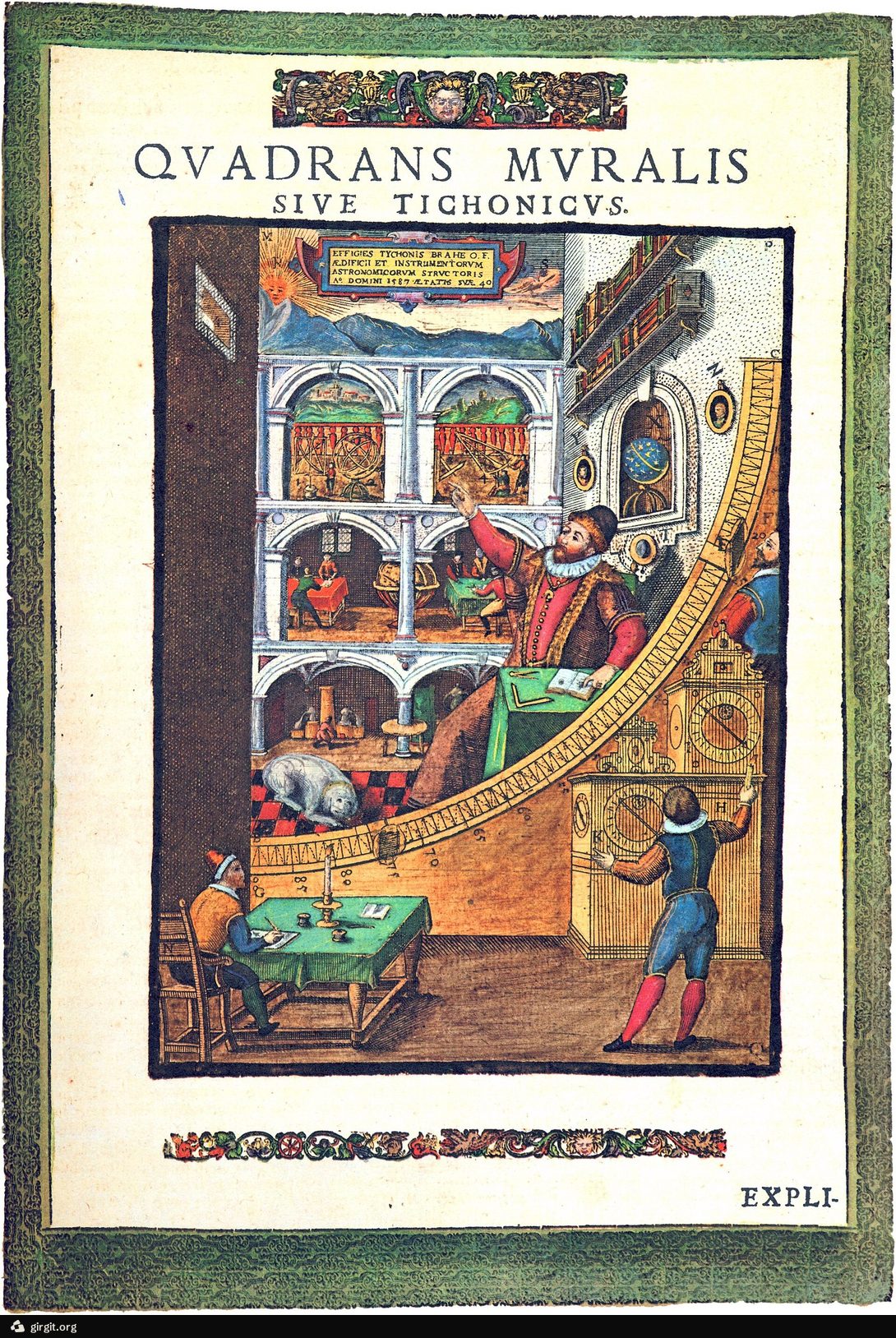 observer at the sightbrass arc, in degreesreading the clockwriting it down
StoryThe island of Hven, Denmark
Many-digit sines, every night
Star positions came from spherical trigonometry: long multiplications by hand. The shortcut: look two numbers up as cosines, add and subtract the angles, look up two cosines, halve.
See itDo what Tycho's assistants did
Multiply by looking up
Pick two numbers. Each becomes a cosine; the product is the point half-way between two others.
Solve itThree problems
Your turn
Solve it · by hand, the old way
Multiply \( 0.5 \times 0.866 \) using only the cosine values you know.
Answer
Solve it · predict the throb
Two tanpura strings ring at 240 Hz and 243 Hz. How many times a second does the sound swell? Many students say 1.5. Why is that wrong?
Hint
Answer
Solve it · a JEE classic
Show that \( \sin 20^\circ \sin 40^\circ \sin 60^\circ \sin 80^\circ = \tfrac{3}{16} \).
Hint
Answer
ConnectAnd still confused?
Where this goes next
Connect it
- Beats, Physics Ch 14. The swelling sound of two close notes is this page's formula heard: beats, with beat frequency \( |f_1 - f_2| \).
- Sum formulas, this chapter. All eight formulas are two lines of the sum and difference formulas added or subtracted.
- Double angles, this chapter. Put \( x = y \) in product to sum and you get \( 2\sin^2 x = 1 - \cos 2x \) and \( 2\cos^2 x = 1 + \cos 2x \): the half-angle forms.
- Integrals, Class 12. \( \int \sin 3x\cos x\,dx \) has no direct rule, but \( \tfrac{1}{2}\int(\sin 4x + \sin 2x)\,dx \) does: integrals using trig identities.
- Logarithms. Napier's logarithms (1614) did the same job as prosthaphaeresis, a product turned into a sum, and replaced it within a generation.
Why are there halves in sum to product but none in product to sum?
Product to sum starts from angles x and y and makes x + y and x − y. Sum to product goes the other way: given the sum and difference (call them x and y), the original angles are their average and half-difference, \( \tfrac{x + y}{2} \) and \( \tfrac{x - y}{2} \). The halves come from undoing the adding.
How could astronomers multiply numbers bigger than 1 with cosines?
They moved the decimal point. 309 × 788 becomes 0.309 × 0.788, which is \( \cos\alpha\cos\beta \) for two angles from the table; at the end the decimal point moves back by six places. The widget does the same.
Sources
- Tycho Brahe and mathematical techniques, Whipple Museum of the History of Science, University of Cambridge (Wittich's visit 1580; Ursus 1588; Werner; the 1591 manual; cos A cos B).
- Paul Wittich, MacTutor History of Mathematics, University of St Andrews.
- Prosthaphaeresis, Wikipedia (the four identities; Napier's logarithms 1614; worked example of a multiplication).
- Beat (acoustics), Wikipedia (beat frequency = difference; tuning by beats).
- Tycho's mural quadrant, from Astronomiae instauratae mechanica (1598), Wikimedia Commons.
