- 1. How do we measure an angle?
- 2. What is a radian?
- 3. Changing degrees into radians and back
- 4. Sine and cosine for any angle
- 5. Tan, cot, sec and cosec
- 6. Which functions are positive where?
- 7. Domain and range of the six functions
- 8. What the graphs look like, and why they repeat
- 9. Sine and cosine of a sum or difference
- 10. Angles like π − x, and tan of a sum
- 11. Double and triple angles
- 12. Turning sums into products and back
- Review
5 of 12·NCERT §3.3·5 min
Tan, cot, sec and cosec
The big ideaTangent, cotangent, secant and cosecant are all built from sine and cosine, and each one is undefined exactly where it would mean dividing by zero.
In simple words
Sine and cosine are the two main numbers. The other four are just these two divided by each other, or one divided by them. That works fine until the number on the bottom is zero. You cannot share sweets among zero friends, so at those angles the other four simply have no value.
Four more functions
For any real \( x \) where the bottom is not zero:
| Function | Definition | Not defined when |
|---|---|---|
| cosecant, \( \operatorname{cosec} x \) | \( \dfrac{1}{\sin x} \) | \( x = n\pi \) |
| secant, \( \sec x \) | \( \dfrac{1}{\cos x} \) | \( x = (2n + 1)\tfrac{\pi}{2} \) |
| tangent, \( \tan x \) | \( \dfrac{\sin x}{\cos x} \) | \( x = (2n + 1)\tfrac{\pi}{2} \) |
| cotangent, \( \cot x \) | \( \dfrac{\cos x}{\sin x} \) | \( x = n\pi \) |
Here \( n \) is any integer. Notice the pattern: the two with \( \sin x \) on the bottom (cosec and cot) fail where \( \sin x = 0 \), that is at multiples of \( \pi \); the two with \( \cos x \) on the bottom (sec and tan) fail where \( \cos x = 0 \), at odd multiples of \( \tfrac{\pi}{2} \).
On the unit circle, with \( P = (a, b) \): \( \tan x = \tfrac{b}{a} \) is the slope of the line OP. At \( x = \tfrac{\pi}{2} \) that line is vertical, and a vertical line has no slope. That is the picture behind "\( \tan \tfrac{\pi}{2} \) is not defined".
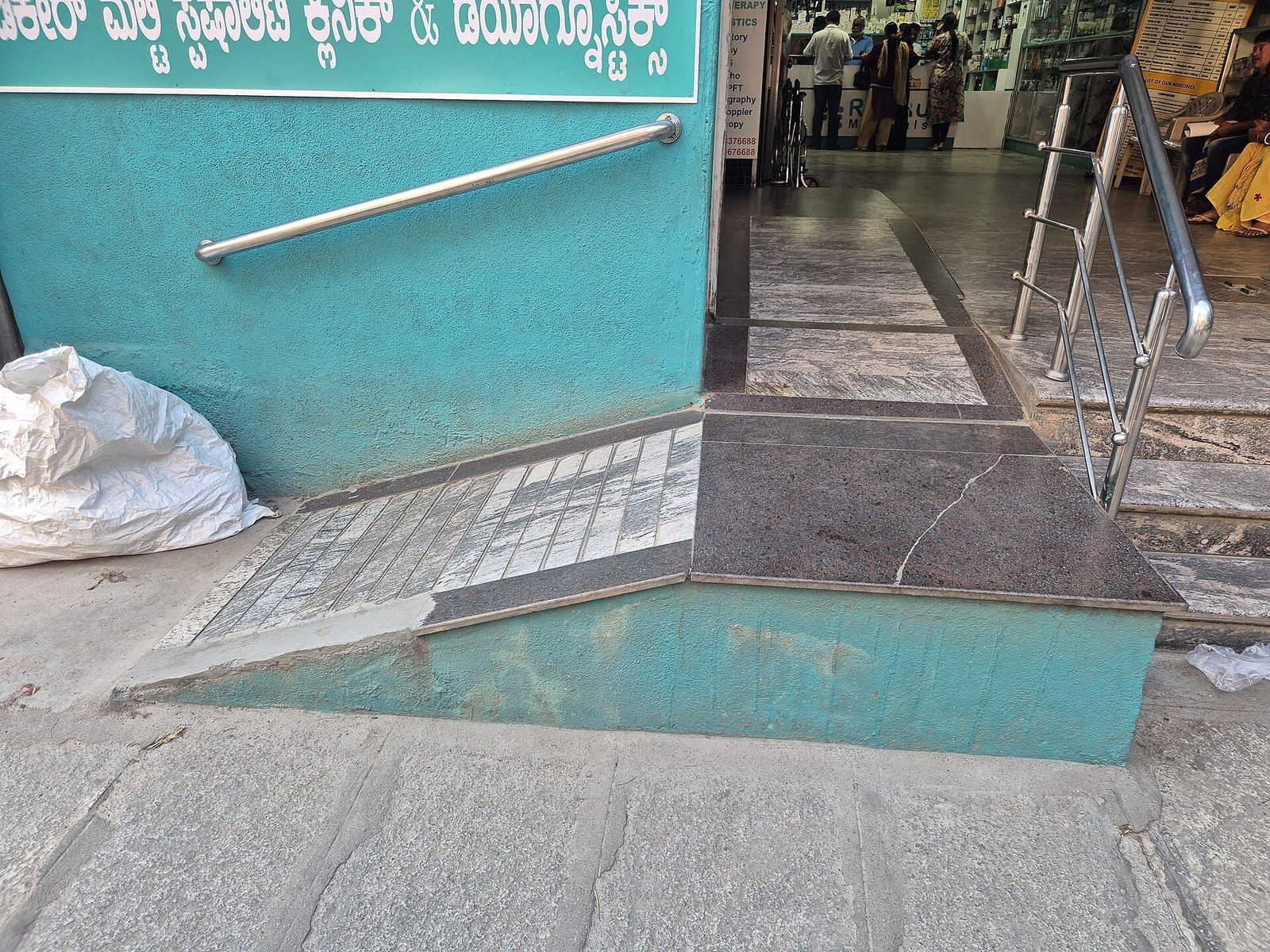
You meet this slope on every ramp. India's 2021 accessibility guidelines use a gradient of 1 in 12 for a 6 m ramp: 1 m up for every 12 m along, so \( \tan x = \tfrac{1}{12} \) and the ramp rises at about \( 4.8^\circ \).
 angle xriserunslope = rise ÷ run = tan x
Try it: drag P towards the top of the circle and watch T run away.
Two more identities
Start from \( \sin^2 x + \cos^2 x = 1 \).
- Divide every term by \( \cos^2 x \) (allowed when \( \cos x \ne 0 \)): \( \tfrac{\sin^2 x}{\cos^2 x} + 1 = \tfrac{1}{\cos^2 x} \), which is \[ 1 + \tan^2 x = \sec^2 x \]
- Divide every term by \( \sin^2 x \) (when \( \sin x \ne 0 \)): \( 1 + \tfrac{\cos^2 x}{\sin^2 x} = \tfrac{1}{\sin^2 x} \), which is \[ 1 + \cot^2 x = \operatorname{cosec}^2 x \]
These are the textbook's two "why?" questions, answered: each is the Pythagoras identity divided through by one of its own terms.
The values table
For \( 0, \tfrac{\pi}{6}, \tfrac{\pi}{4}, \tfrac{\pi}{3}, \tfrac{\pi}{2} \) the values are the same as the ratios you learnt in Class 10. Adding the quadrantal angles from the unit circle:
| Angle | sin | cos | tan |
|---|---|---|---|
| \( 0 \) | \( 0 \) | \( 1 \) | \( 0 \) |
| \( \tfrac{\pi}{6} \) | \( \tfrac{1}{2} \) | \( \tfrac{\sqrt{3}}{2} \) | \( \tfrac{1}{\sqrt{3}} \) |
| \( \tfrac{\pi}{4} \) | \( \tfrac{1}{\sqrt{2}} \) | \( \tfrac{1}{\sqrt{2}} \) | \( 1 \) |
| \( \tfrac{\pi}{3} \) | \( \tfrac{\sqrt{3}}{2} \) | \( \tfrac{1}{2} \) | \( \sqrt{3} \) |
| \( \tfrac{\pi}{2} \) | \( 1 \) | \( 0 \) | not defined |
| \( \pi \) | \( 0 \) | \( -1 \) | \( 0 \) |
| \( \tfrac{3\pi}{2} \) | \( -1 \) | \( 0 \) | not defined |
| \( 2\pi \) | \( 0 \) | \( 1 \) | \( 0 \) |
The values of \( \operatorname{cosec} x \), \( \sec x \) and \( \cot x \) are the reciprocals of \( \sin x \), \( \cos x \) and \( \tan x \). For example \( \sec \tfrac{\pi}{3} = 2 \), \( \operatorname{cosec} \tfrac{\pi}{4} = \sqrt{2} \), and \( \cot \tfrac{\pi}{2} = \tfrac{0}{1} = 0 \) (even though \( \tan \tfrac{\pi}{2} \) is not defined).
A memory trick for the sine column from 0 to \( \tfrac{\pi}{2} \): write \( \tfrac{\sqrt{0}}{2}, \tfrac{\sqrt{1}}{2}, \tfrac{\sqrt{2}}{2}, \tfrac{\sqrt{3}}{2}, \tfrac{\sqrt{4}}{2} \). The cosine column is the same list read backwards.
Worked example
Find \( \tan^2 \tfrac{\pi}{3} + 2\cos^2 \tfrac{\pi}{4} - \sec^2 \tfrac{\pi}{6} \).
- \( \tan \tfrac{\pi}{3} = \sqrt{3} \), so \( \tan^2 \tfrac{\pi}{3} = 3 \).
- \( \cos \tfrac{\pi}{4} = \tfrac{1}{\sqrt{2}} \), so \( 2\cos^2 \tfrac{\pi}{4} = 2 \times \tfrac{1}{2} = 1 \).
- \( \cos \tfrac{\pi}{6} = \tfrac{\sqrt{3}}{2} \), so \( \sec \tfrac{\pi}{6} = \tfrac{2}{\sqrt{3}} \) and \( \sec^2 \tfrac{\pi}{6} = \tfrac{4}{3} \).
- Total: \( 3 + 1 - \tfrac{4}{3} = \tfrac{8}{3} \).
Don't mix these up
- \( \sec x = \tfrac{1}{\cos x} \) and \( \operatorname{cosec} x = \tfrac{1}{\sin x} \). The "co" names do not pair up: cosec goes with sin.
- "Not defined" is not the same as "infinity" or "zero". \( \tan \tfrac{\pi}{2} \) has no value at all.
- \( \cot x \) can be 0 (at \( \tfrac{\pi}{2} \)) even where \( \tan x \) does not exist.
Try it. (a) Find \( \operatorname{cosec} \tfrac{\pi}{6} + \cot \tfrac{\pi}{4} \). (b) If \( \tan x = 2 \), find \( \sec^2 x \). (c) Is \( \sec \pi \) defined? Is \( \operatorname{cosec} \pi \)?
Answer
Just remember
The names are history, not logic, so the pairing has to be memorised. The values have reasons (triangles), but a pattern makes them quick.
- \( \operatorname{cosec} x = \tfrac{1}{\sin x} \), \( \sec x = \tfrac{1}{\cos x} \), \( \cot x = \tfrac{1}{\tan x} \)
- Every reciprocal pair has exactly one "co": sin–cosec, cos–sec, tan–cot. If both or neither have a "co", it is the wrong pair. Rebuild: on the unit circle the secant line OT has length \( \tfrac{1}{\cos x} \) (see the deep dive below), and sec starts at \( \sec 0 = 1 \) just like cos.
- sin at 0°, 30°, 45°, 60°, 90°: \( \tfrac{\sqrt{0}}{2}, \tfrac{\sqrt{1}}{2}, \tfrac{\sqrt{2}}{2}, \tfrac{\sqrt{3}}{2}, \tfrac{\sqrt{4}}{2} \)
- Count 0, 1, 2, 3, 4 under the root, all over 2; cos is the same list backwards; tan is sin ÷ cos. Rebuild: half an equilateral triangle of side 2 has sides 1, \( \sqrt{3} \), 2 (for 30° and 60°); half a square of side 1 has diagonal \( \sqrt{2} \) (for 45°).
- Tangent
- \( \tan x = \sin x / \cos x \); the slope of OP.
- Cotangent
- \( \cot x = \cos x / \sin x \), the reciprocal of tan.
- Secant
- \( \sec x = 1 / \cos x \).
- Cosecant
- \( \operatorname{cosec} x = 1 / \sin x \).
- Not defined
- The formula would divide by zero, so there is no value.
Words to know
For which \( x \) is \( \cot x \) not defined?
- \( x = (2n + 1)\tfrac{\pi}{2} \)
- \( x = n\pi \)
- It is defined for every real \( x \)
If \( \sec x = 3 \), what is \( \tan^2 x \)?
- 2
- 8
- 10
What is \( \sin \tfrac{\pi}{3} \cdot \operatorname{cosec} \tfrac{\pi}{3} \)?
- \( \tfrac{3}{4} \)
- 1
- \( \tfrac{\sqrt{3}}{2} \)
Deep dive · optional
Why is it called a tangent?
The four names are pictures: each one is a real length on the unit circle. Then the story of shadows, and of measuring the highest mountain on Earth with a tangent. None of this is examined; all of it makes the names stick.
The roots: four lengths on one circle
- Why is \( \tan x \) called the tangent?Draw the line that touches the unit circle at A(1, 0); it is a tangent line. Stretch OP until it meets that line at T. Then \( AT = \tan x \). Tangens is Latin for "touching": tan x is a length measured along the touching line.
- Why is AT equal to \( \tfrac{\sin x}{\cos x} \)?Triangles OMP and OAT have the same angles, so their sides are in the same ratio: \( \tfrac{AT}{OA} = \tfrac{MP}{OM} \), that is \( \tfrac{AT}{1} = \tfrac{\sin x}{\cos x} \).
- Why is \( \sec x \) called the secant?The line OT cuts right through the circle; secans means "cutting". In the same pair of triangles, \( \tfrac{OT}{OA} = \tfrac{OP}{OM} \), so \( OT = \tfrac{1}{\cos x} = \sec x \). The secant is the length of the cutting line.
- And the "co" ones?Do the same with the tangent line at B(0, 1). The length along it is \( \cot x \), and the cutting line is \( \operatorname{cosec} x \). They are the tangent and secant of the complementary angle \( 90^\circ - x \): \( \cot x = \tan(90^\circ - x) \).
- So why is tan not defined at 90°?At 90° the line OP is parallel to the tangent line at A. Parallel lines never meet: there is no point T, so there is no length to measure.
- Bedrock?Similar triangles: triangles with the same angles have their sides in the same ratio. Everything above is that one fact.
Triangle OAT is also where \( 1 + \tan^2 x = \sec^2 x \) lives: its sides are 1, \( \tan x \) and \( \sec x \), and it has a right angle at A. The identity is Pythagoras in that triangle.
The story: shadows, then a mountain
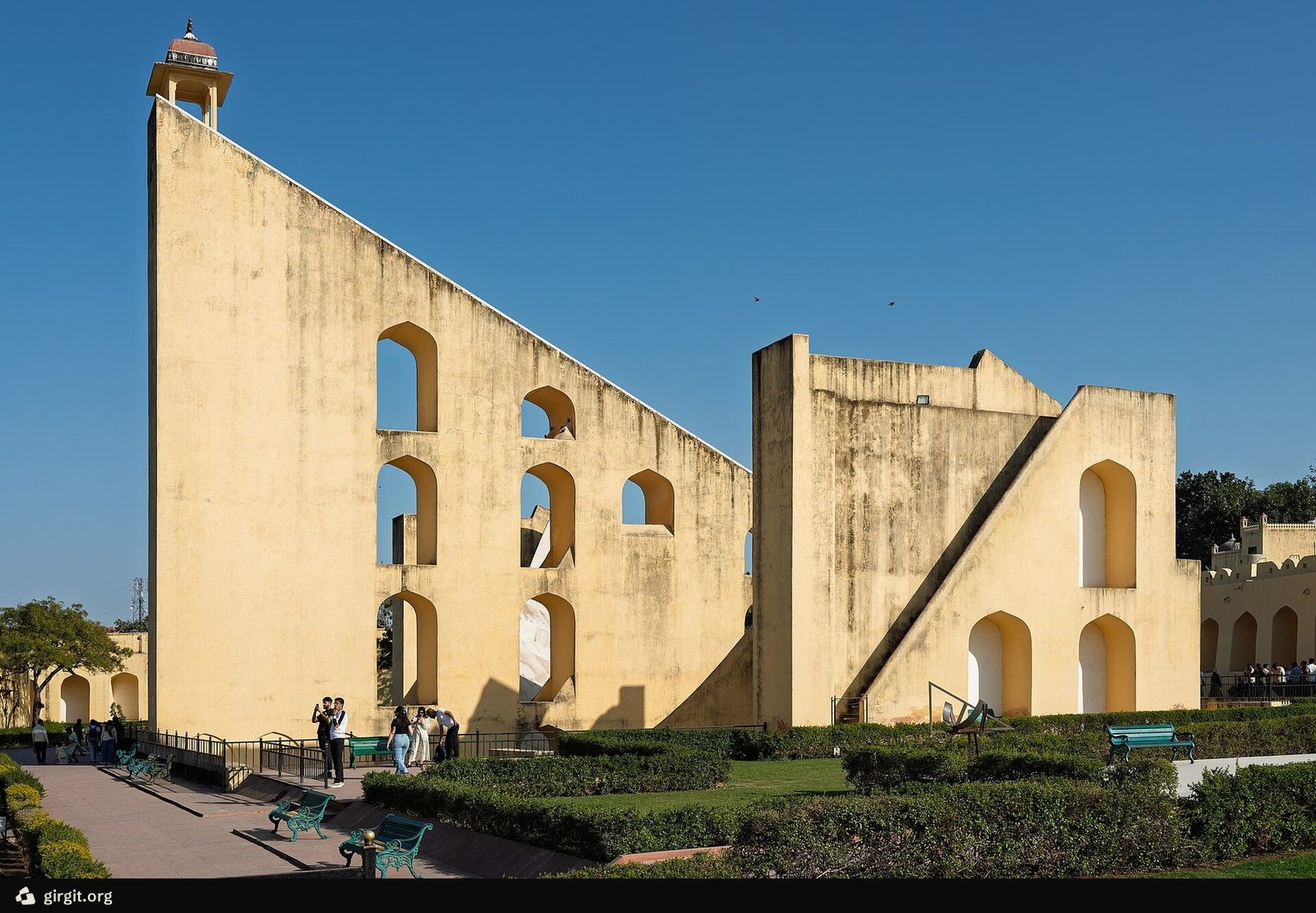 gnomon wall, 27 mpeople, for scale
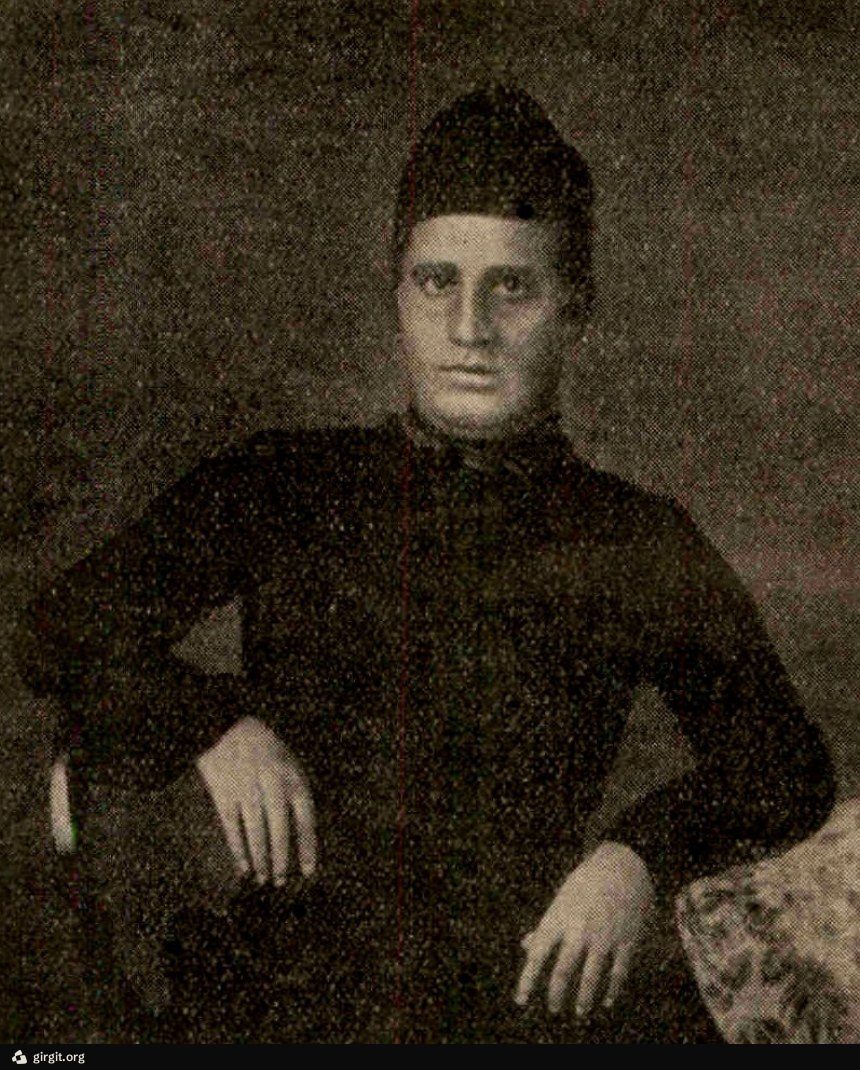
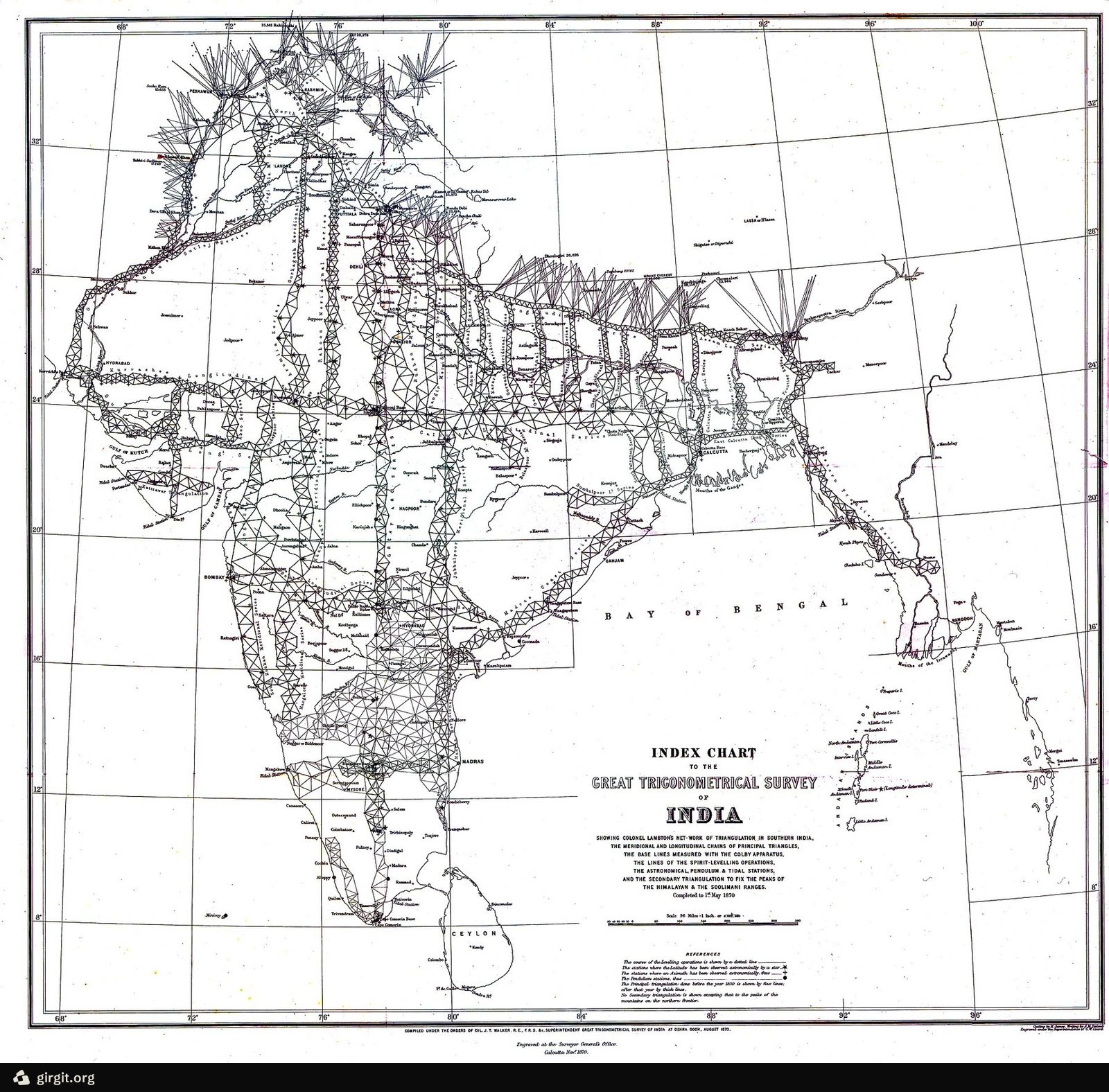 Great Arc, along 78° Esight lines to Himalayan peaksMadras: start, 1802
See it: measure a mountain
Guess first, then drag the peak. The green part is the tangent at work, \( d\tan\theta \). The red part is the bit the Earth's curve hides below your level line. Turn on "Every distance" to see how that hidden part grows.
Why \( \tfrac{d^2}{2R} \)? Stand on a ball of radius \( R \) and look along the level line for a distance \( d \). By Pythagoras the ground there is lower by \( h \), where \( (R + h)^2 = R^2 + d^2 \). Since \( h \) is tiny next to \( R \), \( 2Rh \approx d^2 \), so \( h \approx \tfrac{d^2}{2R} \).
Solve it
Solve it
A school entrance is 0.6 m above the road (about four steps). A ramp must have a gradient of 1 in 12. How long must the ramp run along the ground, and at what angle does it rise?
Answer
Predict, then check
A vertical pole 27 m tall stands on flat ground. Its shadow is 27 m long at one moment. Later the sun is lower and the shadow is \( 27\sqrt{3} \) m. How high was the sun each time?
Answer
Solve it (estimation)
A surveyor 170 km from a peak misreads the angle of elevation by just 1 minute of arc. Roughly how wrong is the height? (Hint: the angle is small, about 2°.)
Hint
Answer
Connect it
Connect it
- Slope of a line, Ch 9. The slope of a straight line is \( m = \tan\theta \), where \( \theta \) is its angle with the \( x \)-axis: slope of a line, and the angle between two lines uses tan of a difference.
- Tan of a sum, page 10. Stacking two ramps on top of each other is \( \tan(A + B) \): page 10.
- Physics: resolving forces. On a slope of angle \( \theta \) a block starts to slide when \( \tan\theta \) reaches the coefficient of friction: friction.
- Inverse tan, Class 12. "What angle has tan 1/12?" is \( \tan^{-1}\tfrac{1}{12} \): tan and cot inverse.
- Daily life. Road signs that say "6% gradient" mean \( \tan x = 0.06 \); a staircase's steepness is riser ÷ tread, a tangent too.
Still confused?
tan x is a slope, but slope is "rise over run". Where are the rise and run on the unit circle?
For OP the run is OM = \( \cos x \) and the rise is MP = \( \sin x \), so the slope is \( \tfrac{\sin x}{\cos x} \). Stretch the triangle until its run is 1 (that is triangle OAT) and the rise becomes AT = \( \tan x \). Slope is the rise for a run of 1.
Why is \( \sec x \) never between −1 and 1?
It is the length of the cutting line OT, which goes from the centre to a point outside or on the circle, so it is at least 1 long. When \( \cos x \) is negative, T is on the other side and the sign is negative, but the size is still at least 1.
Sources
- The trigonometric functions (shadow tables c. 860; Fincke 1583; Gunter's cotangens 1620), MacTutor History of Mathematics, St Andrews.
- History of trigonometry (Habash al-Hasib's tangent and cotangent tables, c. 830; tangens = touching), Wikipedia.
- Thomas Fincke, Geometria rotundi (1583), Wikipedia.
- Jantar Mantar, Jaipur (Vrihat Samrat Yantra, 27 m; time to about 2 s; built 1728–1734), Wikipedia.
- Great Trigonometrical Survey (began 10 April 1802, base line near Madras; corrections for curvature and refraction), Wikipedia.
- Radhanath Sikdar (joined 19 December 1831, aged 18, as a computer; Waugh's announcement March 1856; 29,029 ft in 1955), Wikipedia.
- The five men who measured Mount Everest (six stations 160–190 km away; refraction of six or seven minutes), ExplorersWeb.
- Who measured the height of Mount Everest first? (observations Nov 1849–Jan 1850; results 28,990–29,026 ft, mean 29,002 ft; the 1928 Mason quote), The Wire Science.
- Harmonised Guidelines and Standards for Universal Accessibility in India 2021 (ramp gradient 1:12 for a 6 m run), summary, GKToday.
Picture and video credits
Show 1 picture and video credits
- wheelchair-ramp-shop-entrance.jpg: Chongkian, CC BY-SA 4.0
