Act 01NCERT §3.1–3.2 · pp. 74–784 min
Why sort the elements?
The 31 elements known in 1800 lie in a heap; 32 more join it by 1865; then three sets of three rise as bars: lithium, sodium, potassium; calcium, strontium, barium; chlorine, bromine, iodine. In each, the middle bar's height, its atomic weight, is the average of the other two.
A heap of elements, then the first pattern: sets of three.
From the textbookpp. 74–78
NCERT Chemistry Part I, Class 11 · Reprint 2026-27
1.0The big idea
118elements
known today. The newest were made in laboratories, not found in nature.
- 180031 knownEach with its own chemistry and many compounds.
- 186563 knownMore than double, in one lifetime.
- Today118Far too many to study one by one.
Full text
The big ideaThere are too many elements to learn one by one, so chemists looked for a pattern that groups similar elements together, and the first patterns were found in sets of three and sets of eight.
In simple words
Think of a huge pile of shoes. You cannot find anything until you put them in pairs and on shelves. The building blocks of all stuff were like that pile. People kept finding new ones, and soon there were too many to remember. So clever people tried to put them on shelves, so that ones that act alike sit together. Their first shelves were not quite right, but each try taught them something.
Why classify at all?
All matter is built from elements. Chemists in 1800 knew of 31 of them; by 1865 the list had grown past double, to 63. Today 118 are known, and the newest ones were made in laboratories, not found in nature.
Textbook check · §3.1114 or 118 elements?
- The textbook says
- "At present 114 elements are known" (§3.1). A few pages later (§3.4) the same chapter names elements up to 118.
- What we know now
- 118 elements are known and named. The last four, nihonium (113), moscovium (115), tennessine (117) and oganesson (118), received their names from IUPAC on 28 November 2016, which completed the seventh row.Source: IUPAC: names of elements 113, 115, 117 and 118 (2016)
- In the exam
- Write 118 if asked how many elements are known today. The 114 is an older figure the book forgot to update.
Each element has its own chemistry, and each forms many compounds. Studying every one separately would be endless. So scientists wanted to classify the elements: put them into groups by their properties. A good classification does two jobs:
- It organises facts we already know, so that one rule covers many elements.
- It predicts facts we do not know yet, so it tells us what to look for next.
Textbook check§3.1
114 or 118?
The textbook says
"At present 114 elements are known"
Yet §3.4 of the same chapter names elements up to 118.
What we know now
118, all named
IUPAC named the last four on 28 November 2016: nihonium (113), moscovium (115), tennessine (117), oganesson (118). In the exam, write 118.
1.1To classify: group by properties
A good table does two jobs
- It organiseswhat we know: one rule covers many elements.
- It predictswhat we do not know yet: what to look for next.
Like a school timetable: nobody learns 300 class times; Monday repeats on Thursday and the week falls into place.
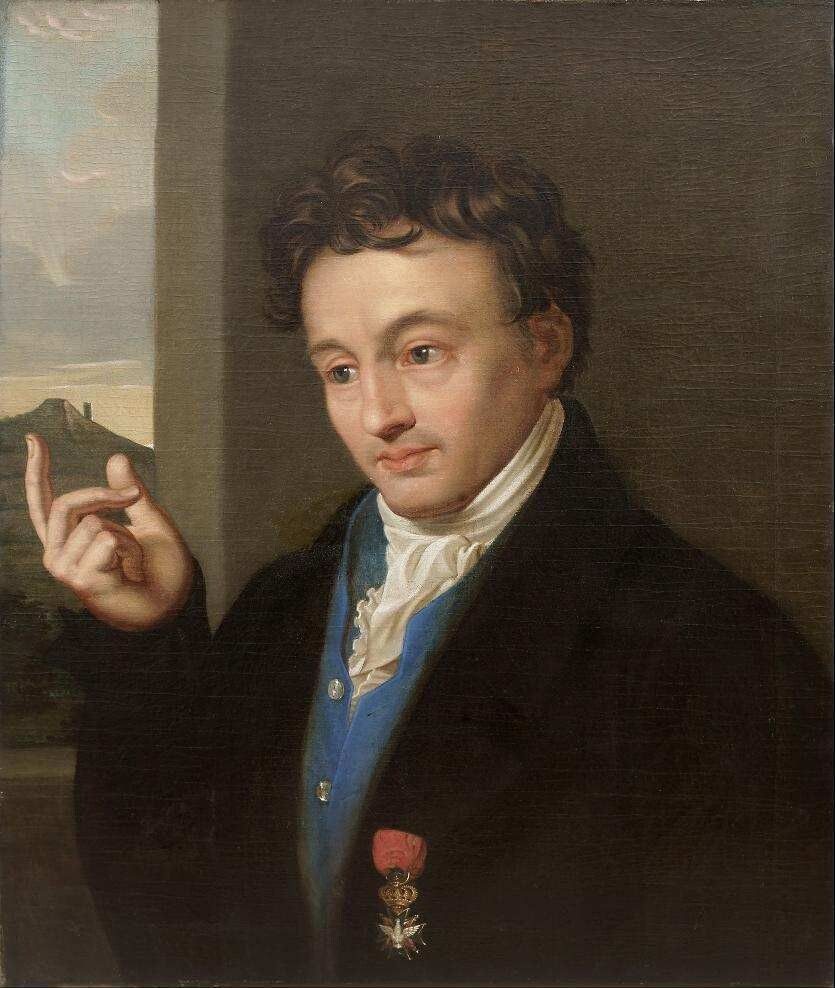
1.2German chemist Johann Dobereiner
1829
The first trend: sets of three
He found groups of three alike elements, triads. The middle one's atomic weight is roughly the average of the other two, and its properties lie between theirs too.
1.3Weigh the middle one
The middle is the average
(7 + 39) ÷ 2 = 23: exactly sodium.
(40 + 137) ÷ 2 = 88.5: strontium is 88.
(35.5 + 127) ÷ 2 = 81.25: bromine is 80.
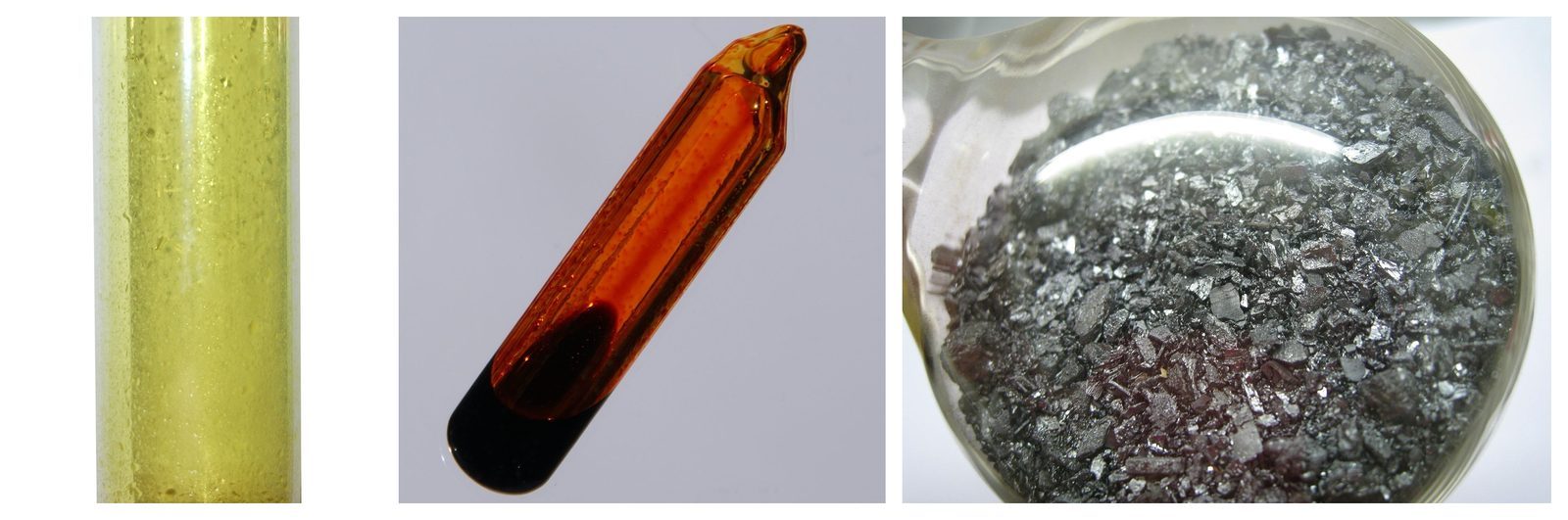
1.4The middle, in more than weight
Gas, liquid, solid
The colour deepens as the weight climbs. Dobereiner's rule became the Law of Triads. It fitted only a few elements, so it was dismissed as a coincidence.
Full text
Dobereiner's triads (1829)
The German chemist Johann Dobereiner was the first to notice trends in the properties of elements. By 1829 he had found groups of three similar elements, which he called triads. In each triad the middle element's atomic weight is roughly the average of the other two, and its properties also lie between theirs.
| Triad | Atomic weights | Average of first and last |
|---|---|---|
| Li, Na, K | 7, 23, 39 | (7 + 39) ÷ 2 = 23 |
| Ca, Sr, Ba | 40, 88, 137 | (40 + 137) ÷ 2 = 88.5 |
| Cl, Br, I | 35.5, 80, 127 | (35.5 + 127) ÷ 2 = 81.25 |
Look at the last triad with your own eyes. The middle one is in the middle in more than weight: chlorine is a gas, bromine a liquid, iodine a solid, and the colour deepens from pale green to red-brown to violet-black.
This was called the Law of Triads. It worked for only a few elements, so people dismissed it as a coincidence.
Answer
Guess firstSulphur 32 · selenium 79 · tellurium 128
Another triad?
Dobereiner saw these three behave alike. Average the outer two, then check.
Answer
Try itPut them on the scale
Which sets are real triads?
The classic three, and two look-alike sets that fail. Guess first.
CheckThe rule
What makes a triad?
Li (7), Na (23) and K (39) form a triad. What makes it a triad?
- They have nearly equal atomic weights
- They are alike, and the middle weight is the average of the other two
- They come one after another in order of atomic weight
1.5A.E.B. de Chancourtois · 1862
Wind them round a cylinder
Elements by rising atomic weight, in a spiral round a cylinder.
Properties come back again and again. Very few people paid attention.
 Li 7Na 23K 39
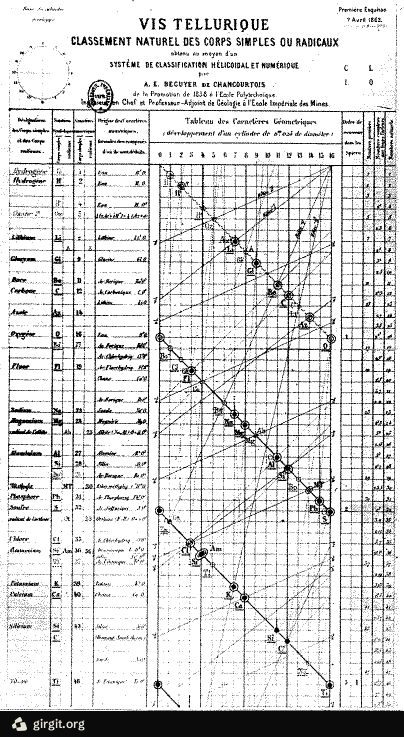
1.6The real sheet
His cylinder, unrolled
The spiral drawn flat: follow one slanting line and you meet the same kind of element again each turn.
Full text
De Chancourtois's cylinder (1862)
A French geologist, A.E.B. de Chancourtois, lined up the elements known to him by rising atomic weight and wrote them on a cylinder, winding round it like a spiral, so that similar elements fell one above the other. It showed that properties come back again and again. Very few people paid attention.
1.7English chemist John Alexander Newlands · 1865
The eighth is like the first
By increasing atomic weight, every eighth element is like the first: his Law of Octaves, after the eighth note of a scale.
Sa re ga ma pa dha ni, then sa again. Li, Be, B, C, N, O, F, then Na, which behaves like Li.
Try itCount to eight
Does the eighth match?
Guess first, then tap any element.
1.8Works only up to calcium
1887
The Royal Society, London gives Newlands the Davy Medal.
- Beyond calciumthe pattern breaks down.
- Not acceptedat the time.
- Honoured laterwith the Davy Medal, 1887.
Full text
Newlands' law of octaves (1865)
The English chemist John Alexander Newlands also lined up elements by increasing atomic weight. He saw that every eighth element had properties like the first one. He called this the Law of Octaves, after music: in "sa re ga ma pa dha ni", the eighth note, the next "sa", sounds like the first.
| 1 | 2 | 3 | 4 | 5 | 6 | 7 |
|---|---|---|---|---|---|---|
| Li 7 | Be 9 | B 11 | C 12 | N 14 | O 16 | F 19 |
| Na 23 | Mg 24 | Al 27 | Si 29 | P 31 | S 32 | Cl 35.5 |
| K 39 | Ca 40 |
Count from lithium: Li, Be, B, C, N, O, F, and the eighth is Na, which behaves like Li. The pattern holds only up to calcium; beyond that it breaks down. His idea was not accepted then, but the Royal Society, London later gave him the Davy Medal in 1887.
Don't mix these up
- Dobereiner: triads, groups of three, 1829. Newlands: octaves, every eighth, 1865.
- Newlands' rule works only up to calcium. Dobereiner's works for only a few elements.
- All of these early tries used atomic weight, not atomic number.
CheckThe octaves
Why was it rejected?
Why was Newlands' law of octaves not accepted at first?
- He ordered the elements by atomic number
- It worked well only for elements up to calcium
- It covered only three elements
1.9Don't mix these up
Threes, then eights
Dobereiner · 1829
Triads: groups of three
Worked for only a few elements.
Newlands · 1865
Octaves: every eighth
Worked only up to calcium.
Don't mix these up
- Dobereiner: triads, groups of three, 1829. Newlands: octaves, every eighth, 1865.
- Newlands' rule works only up to calcium. Dobereiner's works for only a few elements.
- All of these early tries used atomic weight, not atomic number.
KeepJust remember
Names, dates, sets
Nothing deeper fixes these: tap a card for its hook.
WordsTo know
Five words
- Classification
- Putting things into groups by what they have in common.
- Triad
- Dobereiner's set of three similar elements; the middle one's atomic weight is about the average of the other two.
- Law of Octaves
- Newlands' rule that every eighth element resembles the first.
- Atomic weight
- The old name for the relative mass of an atom; early tables were ordered by it.
- Periodic
- Repeating at regular intervals, like the days of the week.
RootsA triad is two equal steps
Equal jumps, or no triad
In today's numbering, weight climbs about evenly with each place. Two equal jumps in place give two equal jumps in weight.
Works
Equal jumps: the middle lands on the average.
Fails
Phosphorus sits nearer nitrogen, so it cannot be the average.
2 · 8 · 8 · 18 · 18 · 32
RootsThe bedrock
Row lengths, seen through weight
- Weight ≈ 2 × Z(Na 11, 23); more when heavy (I 53, 127).
- s + p = 2 + 6 = 8; add d: 2 + 10 + 6 = 18.
- Octaves break at K, Ca: a row of 18; rubidium is 18 on.
Full text
The roots: a triad is two equal steps
- Why is sodium's weight the average of lithium's and potassium's?Because sodium is the same number of places after lithium as potassium is after sodium. In today's table lithium is element 3, sodium 11 and potassium 19: two equal jumps of 8. If weight climbs evenly with each place, two equal jumps in place give two equal jumps in weight, and the middle one lands on the average.
- Why does weight climb fairly evenly with each place?Each next element has one more proton in its nucleus, and the nucleus also holds neutrons: about one per proton in light atoms, a little more in heavy ones. So atomic weight is roughly twice the atomic number for light elements (sodium: 11 protons, weight 23), and a bit more than twice for heavy ones (iodine: 53 protons, weight 127).
- Then why do nitrogen, phosphorus and arsenic fail?Their jumps are not equal. Nitrogen is element 7, phosphorus 15, arsenic 33: jumps of 8 and then 18. Phosphorus sits much nearer nitrogen than arsenic, so it cannot be the average. Every set of three neighbours in a group with equal jumps (8 and 8, or 18 and 18) is a good triad; every set with unequal jumps fails.
- Why are the jumps 8 in some places and 18 in others?Elements in one group have the same outer arrangement of electrons. To get from one member to the next, you must add enough electrons to fill one whole new row of the table. The second and third rows fill only s and p orbitals: 2 + 6 = 8 electrons. The fourth and fifth rows also fill a set of five d orbitals: 2 + 10 + 6 = 18.
- And why did Newlands' octaves break after calcium?The same reason. An octave is a jump of 8, and it holds only while the rows are 8 long. Potassium and calcium start the fourth row, which is 18 long, so the element "eight on" from potassium is no longer like it. The next alkali metal after potassium, rubidium, comes 18 places later.
- The bedrockThe rows of the periodic table are 2, 8, 8, 18, 18 and 32 long because of how many electrons each set of orbitals can hold (see the electron configuration page of Chapter 2). Triads and octaves are those row lengths, seen through atomic weight.
This is why the first attempts were half right. Dobereiner happened to pick the sets that straddle two rows of equal length. Newlands' octaves are exactly the first two rows of 8, and they break exactly where the first row of 18 begins. Even de Chancourtois's cylinder fits: one turn was 16 weight units, which is about 8 light elements at roughly 2 units each, so it lined up lithium, sodium and potassium and then drifted. None of them could know the reason. Electrons were discovered in 1897 and atomic numbers in 1913, long after all three.
RootsHalf right, without the reason
1913
Atomic numbers. Electrons only in 1897: long after all three.
- Dobereinerpicked sets straddling two rows of equal length.
- Newlands' octavesare the first two rows of 8.
- The cylinder: 16 units a turn ≈ 8 light elements, so Li, Na, K line up, then it drifts.
StoryThree people who saw it first
Seen early, believed late
- 1810Jena, GermanyProfessor of chemistry at the University of Jena: a coachman's son, once an apothecary's apprentice. Dobereiner's hydrogen lamp, lit on platinum, was the first lighter. Goethe came to his lectures every week.
- 1862ParisDe Chancourtois's vis tellurique (telluric screw, after tellurium) goes to the French Academy of Sciences. The diagram is left out of the printed paper.
- 18661 March, LondonNewlands, a sugar-refinery chemist who once volunteered to fight with Garibaldi in Italy, reads his octaves to the Chemical Society.
- 1866"Alphabetical order?"G. C. Foster's joke, and a fair point: chromium split from manganese, iron from cobalt and nickel. Two elements in one slot, no gaps. Not printed: "purely theoretical".
- 1882Davy MedalTo Mendeleev and Lothar Meyer, from the Royal Society.
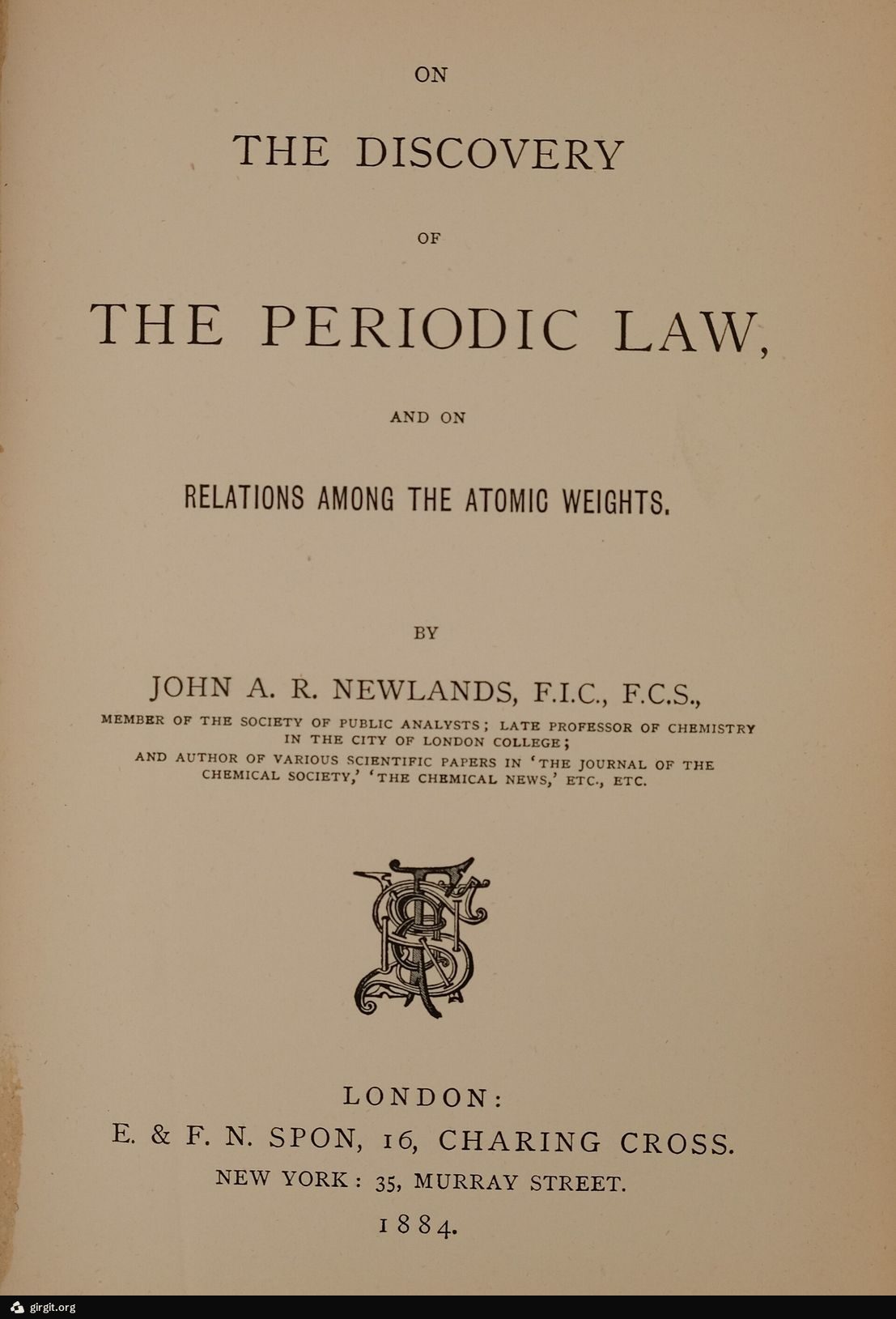
- 1884A bookNewlands collects his papers to claim priority; his own Davy Medal follows in 1887.
Full text
The story
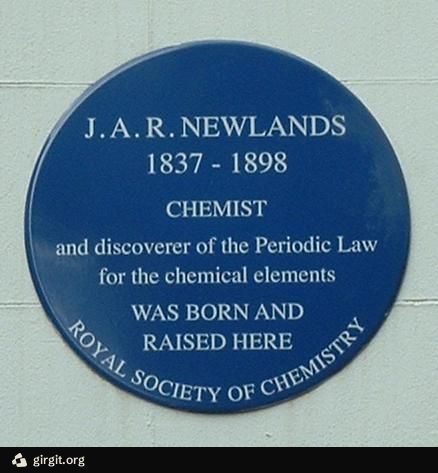
StoryWest Square, London
The society that said no
A blue plaque at his birthplace, put up by the Royal Society of Chemistry, descendant of the society that turned him down, calls him the discoverer of the periodic law.
See itNumber on the left, weight on the right
Equal jumps, equal weights
Pick the middle of three; then press Every triad for all twenty sets.
Solve itThree problems
Your turn
Solve it: predict, then check
Carbon (12.01), silicon (28.09), germanium (72.63) and tin (118.71) are four neighbours in group 14 (atomic numbers 6, 14, 32 and 50). Which three of them make a good triad, and which three do not? Decide from the atomic numbers first, then check with the weights.
Hint
Answer
Solve it
In today's numbering, Newlands' octave is a jump of 8: lithium 3 to sodium 11, sodium 11 to potassium 19. (The noble gases were unknown in 1865, so he counted it as "the eighth".) Jump 8 on from potassium: which element do you reach? Which element really is like potassium, and how far on is it? What does that tell you about the length of the fourth row?
Answer
Solve it: spot the error
A student writes: "Sodium's weight is the average of lithium's and potassium's, so sodium must be a kind of mixture of lithium and potassium." What is wrong?
Answer
ConnectAnd still confused?
Where this goes next
Connect it
- Electron configuration, Chapter 2. The row lengths 2, 8, 8, 18 come from how many electrons s, p and d orbitals hold. See Filling the orbitals, and in this chapter Why the table has the shape it has.
- Atomic number, Chapter 2. Weight is roughly twice the atomic number because the nucleus holds neutrons as well as protons: Atomic number, isotopes and isobars. Moseley's X-rays, next but one page, finally gave each element its number.
- Atomic weights, Chapter 1. What an atomic weight is, and why it is an average over isotopes: Atomic and molecular mass. Before the Karlsruhe meeting of 1860 many weights in use were wrong by a factor of two, which hid patterns from everyone.
- Mendeleev, next page. He did what Newlands did not: he left gaps, and let row lengths change. See Mendeleev's periodic table.
- Music. The octave in sargam is not just a name: the upper "sa" vibrates exactly twice as fast as the lower one, which is why they sound alike. Newlands borrowed a word; the chemistry turned out to have rows of different lengths, so the musical picture could only take him so far.
If the triads and octaves were right for some elements, why are they called failures?
Because a law has to work everywhere it claims to, and these worked only in patches. Nobody could say in advance which sets would fit. Now we can: the good triads are the ones with equal jumps in atomic number, and the octaves are the two rows of 8. They were true descriptions of part of the pattern, without the reason.
Did Newlands deserve the credit more than Mendeleev?
He saw the repeat earlier, and he was treated unfairly. But his table forced every row to be 8 long, put two elements in one slot, and left no room for undiscovered elements, so it could not grow. Mendeleev let the rows differ, left gaps and predicted what would fill them. Historians generally credit several people with seeing periodicity, and Mendeleev with turning it into a working system.
Why were the old atomic weights good enough to see a pattern, if they were not atomic numbers?
Because weight rises with atomic number almost everywhere, so ordering by weight gives nearly the right order. The few places where it does not (tellurium and iodine, cobalt and nickel, argon and potassium) were exactly where the early tables got stuck.
Sources
- Johann Wolfgang Döbereiner (Wikipedia): his life, the 1829 triads, the lamp, Goethe
- Döbereiner's lamp (Wikipedia): hydrogen lit by platinum
- History of the periodic table (Wikipedia): triads, Karlsruhe 1860, de Chancourtois, Newlands and the Chemical Society, Davy Medal 1882
- John Alexander Reina Newlands (Dictionary of Scientific Biography, via Encyclopedia.com): 1 March 1866, G. C. Foster's question and objection, the Society's refusal, Davy Medal 1887
- John R. Newlands (Linda Hall Library, Scientist of the Day)
- John Newlands (Wikipedia): Garibaldi, the sugar refinery, the 1884 book, the plaque at West Square
- Alexandre-Émile Béguyer de Chancourtois (Wikipedia): the telluric helix, 16 units per turn, the diagram left out of Comptes rendus
- IUPAC (2016): names of elements 113, 115, 117 and 118
- Atomic numbers and standard atomic weights: IUPAC Commission on Isotopic Abundances and Atomic Weights, standard atomic weights