Act 08NCERT §3.7–3.7.1 · pp. 85–926 min
How big is an atom?
Every tile rises to its atomic radius: a landscape that falls across each period and climbs down each group, with the alkali metals as ridges on the left and caesium and francium the tallest.
Tall on the left and low on the right; taller down every column.
From the textbookpp. 85–92
NCERT Chemistry Part I, Class 11 · Reprint 2026-27
- Atomic radiusthis act
- Ionic radiusthis act
- Ionization enthalpyact 09
- Electron gain enthalpyact 10
- Electronegativityact 10
8.0Periodic trends: what and why
Five trends, one cause
- Reactivity across: high in group 1, low mid-row, high in group 17.
- Down a group: rises for alkali metals, falls for halogens.
- The cause: how many electrons, in which energy levels.
Also periodic: melting, boiling, heats of fusion and vaporisation, energy of atomisation.
Full text
The big ideaAtoms get smaller from left to right across a period, because the nucleus pulls the same shell harder, and bigger down a group, because new shells are added further out.
In simple words
An atom is a tiny centre with a cloud of even tinier bits around it. Going along a row of the chart, the centre gets stronger but the cloud stays at the same level, so the centre pulls it in tighter and the atom shrinks. Going down a column, a whole new layer of cloud is added on the outside each time, so the atom grows, like adding another layer of clothes.
Periodic trends: what and why
Many properties change in a regular way across a period or down a group. For example, across a period reactivity is high in group 1, lower in the middle, and high again in group 17. Down a group of metals (alkali metals) reactivity rises; down a group of non-metals (halogens) it falls. To explain such patterns we look at two things: the number of electrons and the energy levels they sit in.
Many physical properties are periodic: melting and boiling points, heats of fusion and vaporisation, energy of atomisation. This chapter studies five: atomic radius, ionic radius, ionization enthalpy, electron gain enthalpy and electronegativity.
8.1How do you measure an atom?
1.2Å
About 1.2 × 10⁻¹⁰ m in radius, and the electron cloud has no sharp edge.
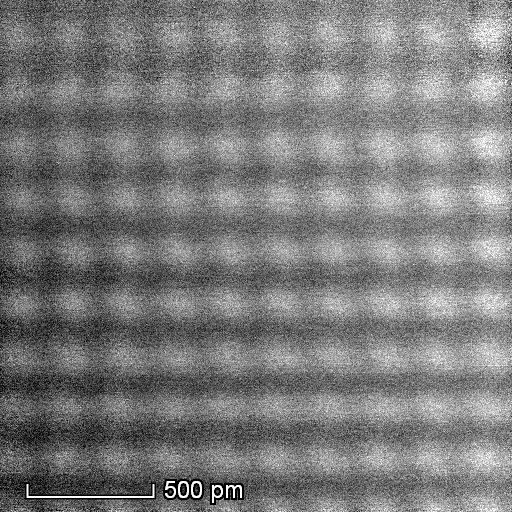 a column of Al atomsnext one, 0.2 nm away
- Not one atom: measure the distance between the centres of two joined atoms, and take half.
- From X-raysand other spectroscopy. 1 pm, a picometre, is 10−12 m.
8.2Atomic radius: centre to centre, then halve
Two squashed rasgullas
You cannot see where one ends; measure centre to centre and halve it.
Non-metals · covalent radius
Half a single covalent bond, in Cl₂.
Metals · metallic radius
Half the distance between neighbouring cores in the crystal.
Full text
How do you measure an atom?
Measuring an atom is far harder than measuring a ball, for two reasons. It is tiny, about 1.2 Å (1.2 × 10⁻¹⁰ m) in radius. And its electron cloud has no sharp edge. So we cannot measure one atom on its own. Instead we measure the distance between the centres of two atoms that are joined, and take half.
- Covalent radius (for non-metals): half the distance between two atoms joined by a single covalent bond. In \(\ce{Cl2}\) the bond length is 198 pm, so chlorine's radius is 99 pm.
- Metallic radius (for metals): half the distance between neighbouring metal cores in the metal crystal. In solid copper the distance is 256 pm, so copper's radius is 128 pm.
"Atomic radius" in this book means whichever of these fits: covalent for non-metals, metallic for metals. These distances come from X-ray and other spectroscopy measurements. (1 pm, a picometre, is 10−12 m.)
Today an electron microscope can even show atoms directly. It still cannot show an edge, only fuzzy bright spots whose centres we can measure between:
8.3Across period 2, to scale
One more proton, a smaller atom
Each step adds a proton: the effective nuclear charge grows, and the shell is pulled in.
The pull on the outer electron rises from about +1.3 to +5.2.
A new shell, n = 3, further out, behind filled shells that shield it.
8.4Every element, height is radius
Down a column, it grows
The outer electrons stay in the same shell while the nuclear charge rises by one each step.
n goes up: the valence shell is farther out, and filled inner shells shield it.
8.5Radius in pm, from the book
The numbers behind the landscape
Why shells and shielding do this: electronic configuration.
| Period 2 | Li | Be | B | C | N | O | F |
|---|---|---|---|---|---|---|---|
| Radius / pm | 152 | 111 | 88 | 77 | 74 | 66 | 64 |
| Period 3 | Na | Mg | Al | Si | P | S | Cl |
| Radius / pm | 186 | 160 | 143 | 117 | 110 | 104 | 99 |
| Group 1 | Li | Na | K | Rb | Cs |
|---|---|---|---|---|---|
| Radius / pm | 152 | 186 | 231 | 244 | 262 |
| Group 17 | F | Cl | Br | I | At |
| Radius / pm | 64 | 99 | 114 | 133 | 140 |
Full text
The two trends
| Period 2 | Li | Be | B | C | N | O | F |
|---|---|---|---|---|---|---|---|
| Radius / pm | 152 | 111 | 88 | 77 | 74 | 66 | 64 |
| Period 3 | Na | Mg | Al | Si | P | S | Cl |
| Radius / pm | 186 | 160 | 143 | 117 | 110 | 104 | 99 |
| Group 1 | Li | Na | K | Rb | Cs |
|---|---|---|---|---|---|
| Radius / pm | 152 | 186 | 231 | 244 | 262 |
| Group 17 | F | Cl | Br | I | At |
| Radius / pm | 64 | 99 | 114 | 133 | 140 |
- Across a period, radius decreases. The outer electrons stay in the same shell, but the nuclear charge rises by one each step. The effective nuclear charge (the pull an outer electron actually feels) grows, so the electrons are drawn in closer.
- Down a group, radius increases. The principal quantum number n goes up, so the valence electrons are in a shell farther out. The filled inner shells also shield (screen) the outer electrons from the nucleus. Both make the atom larger.
Noble gases are left out of these tables. They do not bond, so we can only measure their non-bonded radii, which are much larger. Those should be compared with the van der Waals radii of other elements, not with covalent radii.
Try itPeriod 2
Drag the proton count
Watch each new proton pull the same shell in tighter.
CheckLi 152 → F 64 pm
What shrinks it?
Going from Li to F across period 2, the atomic radius falls from 152 pm to 64 pm. The main reason is that
- new shells are added
- effective nuclear charge increases while the shell stays the same
- shielding increases strongly
8.6Why the tables skip group 18
Loners have another radius
Trap
Neon looks bigger than fluorine
Compared with covalent radii, it seems to break the trend.
Fact
Noble gases do not bond
Only their non-bonded radii exist, much larger: compare them with van der Waals radii.
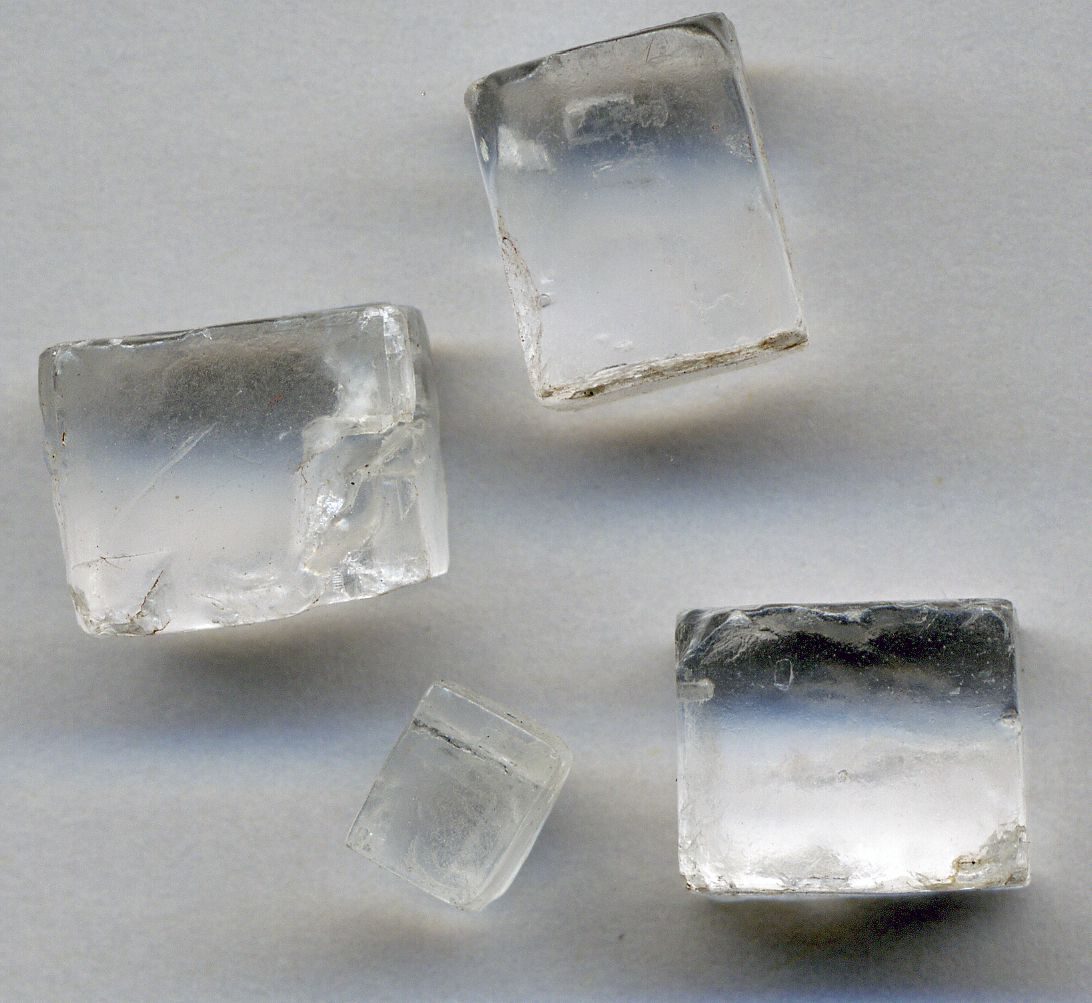 NaCl crystalfaces meet at right angles
8.7Ionic radius
Lose one, gain one
- Cation: an atom that loses an electron. Positive.
- Anion: an atom that gains one. Negative.
- Measuredfrom how far apart they sit in an ionic crystal, like common salt.
Full text
Ionic radius
An atom that loses an electron becomes a cation (positive ion); one that gains an electron becomes an anion (negative ion). We estimate ionic radii by measuring how far apart the cations and anions sit in an ionic crystal, such as common salt.
Before the rules, a guess. Then switch between atoms and ions and watch every size at once.
Ionic radii follow the same trends as atomic radii, plus two rules:
- A cation is smaller than its atom. It has fewer electrons but the same nuclear charge, so the rest are pulled in tighter. Na is 186 pm; Na+ is 95 pm.
- An anion is larger than its atom. The extra electron adds repulsion among the electrons and lowers the effective nuclear charge each one feels, so the cloud swells. F is 64 pm; F− is 136 pm.
Guess firstAtoms or ions
Switch every size at once
Guess, then switch between atoms and ions.
8.8Same trends, plus two rules
Sodium halves, fluorine doubles
Na → Na⁺
186 → 95 pm
Fewer electrons, same nuclear charge: pulled in tighter.
F → F⁻
64 → 136 pm
More repulsion, lower effective pull on each: the cloud swells.
Try itSodium fluoride, in toothpaste
Pass one electron across
Slide it and watch both sizes change.
CheckCl and Cl⁻
Why is the ion bigger?
Why is a chloride ion, \(\ce{Cl-}\), larger than a chlorine atom?
- It has more protons
- The extra electron increases repulsion and lowers the effective pull on each electron
- The extra electron starts a new shell
8.9Isoelectronic species · 10 electrons each
Same electrons, more protons, smaller
The bigger the positive charge, the smallest; the bigger the negative charge, the largest.
O²⁻ > F⁻ > Na⁺ > Mg²⁺: 8, 9, 11 and 12 protons. Neon has 10 too.
Full text
Isoelectronic species
Atoms and ions with the same number of electrons are called isoelectronic species. For example \(\ce{O^2-}\), \(\ce{F-}\), Ne, \(\ce{Na+}\) and \(\ce{Mg^2+}\) all have 10 electrons. They are not the same size, because their nuclei carry different charges:
- The more protons pulling on the same 10 electrons, the smaller the species. So the cation with the larger positive charge is smallest.
- The anion with the larger negative charge is largest: its electron repulsion outweighs the nuclear pull.
(8, 9, 11 and 12 protons; 10 electrons each.)
Textbook check · §3.7.1Two meanings of "isoelectronic"
- The textbook says
- In the text: isoelectronic species have the same number of electrons (O2−, F−, Na+, Mg2+). In its footnote: species with the same number of atoms, the same number of valence electrons and the same structure, whatever the elements.
- What we know now
- Both meanings are in use, but they are not the same. The footnote's meaning is meant for molecules: CO, NO+ and N2 are isoelectronic because each has two atoms and ten valence electrons. Taken literally for single atoms, it would make Na and K "isoelectronic" (one valence electron each), although they have 11 and 19 electrons. For comparing the sizes of atoms and ions, chemists use the stricter meaning: the same total number of electrons.Source: Isoelectronicity (Wikipedia), on the valence-only and total-electron definitions
- In the exam
- For ions and atoms, use the same total number of electrons (N3− to Al3+ all have 10). For molecules such as CO and N2, the two meanings agree anyway: both have 14 electrons in all.
Worked example: largest and smallest
Which of K, \(\ce{K+}\), Ca and \(\ce{Ca^2+}\) is largest, and which is smallest?
- K and Ca are in period 4; radius falls across a period, so K > Ca.
- Each cation is smaller than its atom: K > \(\ce{K+}\) and Ca > \(\ce{Ca^2+}\).
- \(\ce{K+}\) and \(\ce{Ca^2+}\) are isoelectronic (18 electrons). Ca has 20 protons, K 19, so \(\ce{Ca^2+}\) is smaller.
- Largest: K. Smallest: \(\ce{Ca^2+}\).
Answer
Now check your order: drag along six ions that all hold ten electrons.
Remember
- Radius: decreases across a period, increases down a group.
- Cation < parent atom < anion.
- Isoelectronic: more protons, smaller species.
Textbook check§3.7.1 · two meanings of "isoelectronic"
Total electrons, or valence?
The textbook says
Same number of electrons; its footnote: same atoms, same valence electrons, same structure
Taken literally for atoms, Na and K would be "isoelectronic", with 11 and 19 electrons.
What we know now
For atoms and ions: the same total
The footnote is for molecules: CO, NO⁺ and N₂ (two atoms, ten valence electrons). Source: Isoelectronicity, Wikipedia. Exam: N³⁻ to Al³⁺ all have 10; CO and N₂ have 14 in all.
8.10K, K⁺, Ca, Ca²⁺
Largest and smallest
Worked example: largest and smallest
Which of K, \(\ce{K+}\), Ca and \(\ce{Ca^2+}\) is largest, and which is smallest?
- K and Ca are in period 4; radius falls across a period, so K > Ca.
- Each cation is smaller than its atom: K > \(\ce{K+}\) and Ca > \(\ce{Ca^2+}\).
- \(\ce{K+}\) and \(\ce{Ca^2+}\) are isoelectronic (18 electrons). Ca has 20 protons, K 19, so \(\ce{Ca^2+}\) is smaller.
- Largest: K. Smallest: \(\ce{Ca^2+}\).
Guess firstSix ions, ten electrons
Largest to smallest
N³⁻, Al³⁺, F⁻, Mg²⁺, O²⁻, Na⁺. Order them, then check.
Answer
Try itA tray of ten-electron ions
Check your order
Drag along from N³⁻ to Al³⁺.
RememberThree lines
Down bigger, across smaller
Remember
- Radius: decreases across a period, increases down a group.
- Cation < parent atom < anion.
- Isoelectronic: more protons, smaller species.
KeepJust remember
Halve it, then rank it
Conventions and textbook numbers: tap a card for its hook.
WordsTo know
Six words
- Covalent radius
- Half the single-bond length between two like atoms.
- Metallic radius
- Half the distance between neighbouring atoms in a metal crystal.
- Effective nuclear charge
- The pull an outer electron really feels, after inner electrons shield part of it.
- Shielding (screening)
- Inner electrons blocking some of the nucleus's pull on outer electrons.
- Isoelectronic species
- Atoms or ions with the same number of electrons.
- Van der Waals radius
- Half the distance between non-bonded neighbouring atoms; larger than the covalent radius.
RootsPull minus shield
+0.65
net pull added per step across period 2: a proton (+1) minus a same-shell shield (0.35).
- Fluorine (64 pm)is less than half lithium (152 pm), same shell: lithium's electron feels about +1.3, fluorine's about +5.2.
- Inner shellshide nearly a whole proton each (0.85 to 1.00): charge inside a sphere acts from its centre; charge outside it does not pull.
RootsBohr's size rule, with the felt charge
More pull, smaller cloud
Settles where the pull balances the electron's wave-like spreading. Sodium: n² jumps from 4 to 9, and the pull drops from neon's +5.85 to +2.20: 186 pm.
RootsSlater's rules · John Slater, 1930
0.35, 0.85, 1.00
- Same group0.35; just inside 0.85; deeper 1.00. Subtract from Z.
- Rule of thumb: Clementi and Raimondi (1963): other numbers, same pattern.
- Down a group: the pull stays similar, n keeps rising: n² wins.
- Bedrock: Coulomb's law, and r ∝ n²/Z from the Bohr model.
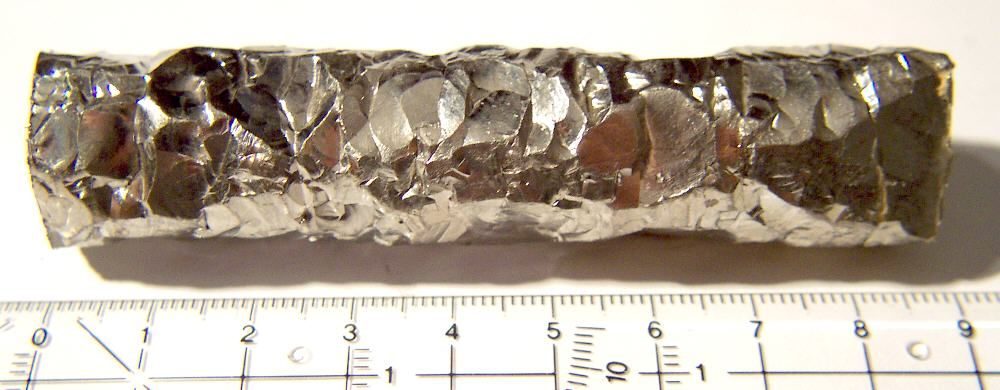 Zr: 160 pm
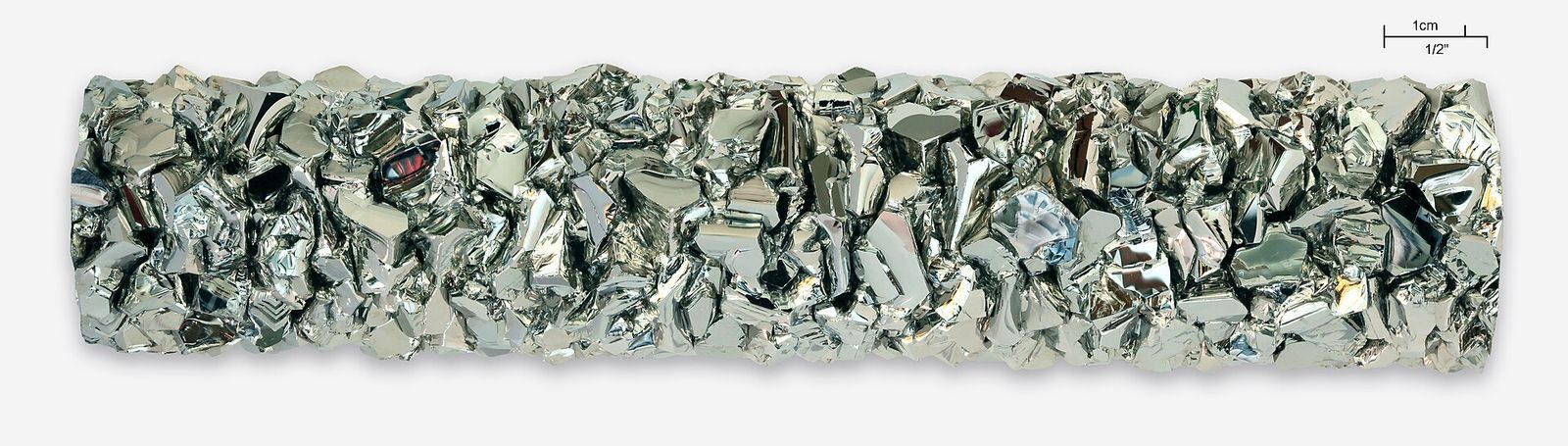 Hf: 159 pm
RootsThe lanthanoid contraction
A whole shell, cancelled
- The 14 lanthanoids,cerium to lutetium: 4f electrons, awkward shapes, poor shields.
- Their missing shielding piles upand pulls everything after them inwards.
- Hafnium(period 6) 159 pm, zirconium above it 160 pm.
StorySalt has no molecules
X-rays find the spacing
- 1912Cambridge and LeedsLawrence Bragg, a first-year research student: layers reflect strongly when the waves arrive in step. His father, William Henry Bragg, designs a spectrometer, built in winter 1912 to 1913: a crystal on a turning table, an ionisation chamber.
- 1913September: rock saltNo NaCl molecules: each sodium among six chlorines, each chlorine among six sodiums.
- 1915Nobel Prize in Physics"for their services in the analysis of crystal structure by means of X-rays". Lawrence was 25, still the youngest science laureate; serving in the First World War, his younger brother killed at Gallipoli.
- 1920Splitting the sumAlfred Landé: in lithium iodide the big iodides touch; halve that. Linus Pauling later split by effective nuclear charge: Na⁺ 95, F⁻ 136 pm.
- 1927"Poor Common Salt!"Henry Armstrong objects in Nature. The X-rays were right.
 crystal on a turntableionisation chamberswinging arm
StoryLeeds, 1912 to 1913
Turn the crystal, find the angles
From the angles of strong reflection: how far apart the layers of atoms are.
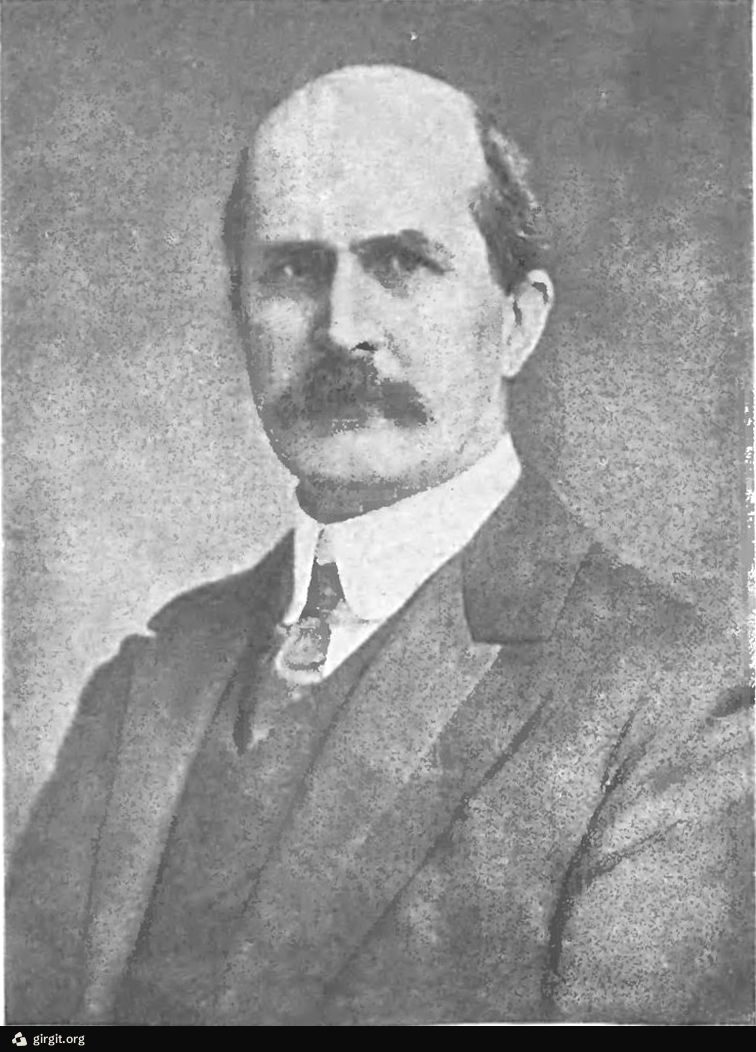
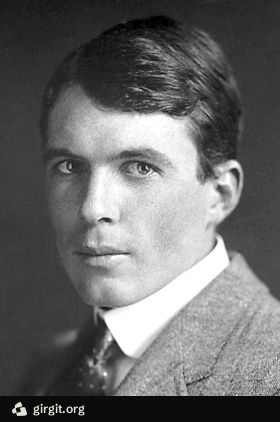
StoryFather and son
One designed it, one explained it
They shared the 1915 prize.
StoryTwins that hide in each other
Hafnium, hidden behind zirconium
- 1869A gap below zirconiumMendeleev leaves it; Georges Urbain hunts among the rare earths.
- 1923CopenhagenCharles Bury, then Niels Bohr, argue it should be like zirconium. Dirk Coster and George de Hevesy find it in zirconium ores: hafnium, after Hafnia, Latin for Copenhagen (the story).
- TodayHyderabadSame size, same four outer electrons: one of the hardest pairs to separate. Zirconium lets neutrons pass (fuel tubes, made at the Nuclear Fuel Complex); hafnium soaks them up (control rods). Hafnium: twice as dense, 32 more protons.
See itBe Slater
Nucleus minus three shields
Drag the protons; set same-shell shielding to 1.00; press Every element.
Solve itFour problems
Your turn
Solve it
X-rays show that in rock salt the centres of neighbouring Na+ and Cl− ions are 282 pm apart. Taking Cl− as 181 pm, how big is Na+? Why can no measurement of salt alone tell you the answer without such an assumption?
Hint
Answer
Solve it: use Slater
Use Slater's rules to find Zeff for the outer electron of chlorine (2, 8, 7) and of potassium (2, 8, 8, 1). Then use size \( \propto n^{*2}/Z_{\text{eff}} \) with \( n^* = 3 \) for chlorine and 3.7 for potassium to predict how many times wider potassium is. Compare with the measured 231 pm and 99 pm.
Answer
Solve it: what would happen if…
Suppose electrons in the same shell were perfect shields, each hiding a whole proton. What would period 2 look like?
Answer
Solve it: estimate
A human hair is about 0.07 mm thick. Roughly how many copper atoms (radius 128 pm) would sit side by side across it?
Answer
ConnectAnd still confused?
Where this goes next
Connect it
- Bohr's radius, Chapter 2. The size rule \( r = a_0 n^2/Z \) is Bohr's, for one electron. Shielding just replaces Z with Zeff. See Bohr's model.
- Shielding and penetration, Chapter 2. Why 2s electrons shield 2p ones a little, and why s electrons dive closer to the nucleus than p: shapes and energies of orbitals, and the filling order on electronic configuration.
- Next pages. The same Zeff sets how hard an electron is to pull off (ionisation enthalpy) and how strongly an atom grabs one (electron gain enthalpy). Small atoms with a big pull do both.
- The d- and f-block, Class 12. The lanthanoid contraction returns in full in the lanthanoids and in the sizes of the transition metals.
- Lattice enthalpy, Chapter 4. How tightly an ionic crystal holds together depends on how close the ion centres can get, the sum of the radii: ionic bond and lattice enthalpy.
- X-rays and life. The Braggs' method grew into X-ray crystallography. In Madras in 1954, G.N. Ramachandran and Gopinath Kartha used X-ray diffraction to propose the triple helix of collagen, the protein in skin and bone; the same method helped reveal the shape of DNA (DNA structure).
More electrons means more stuff. Why doesn't fluorine end up bigger than lithium?
Electrons take up almost no room themselves; the size of an atom is the size of the space their clouds fill, and that is set by how tightly they are held. Fluorine adds electrons to the same shell and adds protons to the nucleus. The extra protons win (each new electron hides only 0.35 of a proton), so the whole shell is pulled in. Size is a tug-of-war result, not a count of parts.
Why does Na+ shrink so much more than Cl− grows?
Na+ loses its whole outer shell: the one 3s electron was the only thing in n = 3, so the ion is just sodium's n = 2 core, pulled by 11 protons. Cl− keeps the same shell and only adds one electron to it, which slightly weakens the pull on each. Losing a shell is a big change; adding one electron to a shell is a small one.
Is an atom's radius a real, fixed number?
No. The electron cloud fades smoothly with no surface, so "radius" means a measured half-distance, and it depends on the situation: chlorine is 99 pm bonded to another chlorine, 181 pm as a chloride ion, and about 175 pm as a non-bonded neighbour. Always compare radii of the same kind.
Sources
- J.C. Slater, "Atomic Shielding Constants", Physical Review 36, 57 (1930) and Slater's rules (Wikipedia): the 0.35, 0.85, 1.00 rules
- E. Clementi and D.L. Raimondi, "Atomic Screening Constants from SCF Functions", J. Chem. Phys. 38, 2686 (1963)
- Atomic radii of the elements (Wikipedia data page): metallic radii incl. Zr 160 pm, Hf 159 pm, and van der Waals radii
- WebElements (Mark Winter, University of Sheffield): Pauling ionic radii for each element
- Lawrence Bragg (Wikipedia): the 1912 insight, the 1915 Nobel Prize at 25, his brother's death at Gallipoli and The Nobel Prize in Physics 1915 (nobelprize.org)
- University of Leeds Special Collections: the X-ray spectrometer, built winter 1912 to 1913 and Science Museum Group: Bragg X-ray spectrometer
- W.L. Bragg, "The structure of some crystals as indicated by their diffraction of X-rays", Proc. R. Soc. A 89, 248 (1913)
- H.E. Armstrong, "Poor Common Salt!", Nature 120, 478 (1927)
- Ionic radius (Wikipedia): Landé 1920 (LiI), Pauling, Shannon 1976
- Hafnium (Wikipedia): Bury, Bohr, Coster and Hevesy 1923, separation from zirconium, neutron absorption, density and Lanthanide contraction (Wikipedia)
- Nuclear Fuel Complex, Hyderabad (Wikipedia): zirconium alloy cladding for India's power reactors
- Sodium chloride (Wikipedia): lattice constant 564.02 pm
- G.N. Ramachandran (Wikipedia): the collagen triple helix with Gopinath Kartha, 1954