Act 04NCERT §3.4 · pp. 78–813 min
How do you name element 120?
In the long form, the elements after 100 rise and glow, the newest ones highest; under the table, two ghost tiles mark where 119 and 120 would start an eighth row.
The newest elements rise; two empty tiles wait for a row 8.
From the textbookpp. 78–81
NCERT Chemistry Part I, Class 11 · Reprint 2026-27
4.0Why a temporary name?
One element, two names
By tradition the discoverer names an element and IUPAC approves it. But rival teams sometimes claim the same discovery.
American scientists
Rutherfordium
Soviet scientists
Kurchatovium
Full text
The big ideaA brand-new element first gets a temporary name built from the digits of its atomic number, so nobody has to fight over what to call it.
In simple words
When two teams both say they found something first, they may each give it a different name, and people get confused. So there is a simple rule for a new building block: read out its number using a short word for each digit, glue the words together, and add "ium" at the end. Later, once everyone agrees who found it, it gets a proper name.
Why a temporary name?
By tradition the discoverer names a new element, and IUPAC approves the name. The heaviest elements are so unstable that a laboratory may make just a few atoms of one, using costly, sophisticated equipment in a handful of laboratories. Teams sometimes claim a discovery before the evidence is solid.
Element 104 is the classic quarrel: American scientists called it rutherfordium, Soviet scientists called it kurchatovium. To avoid such fights, IUPAC recommends a systematic name taken straight from the atomic number, used until the discovery is proved and a permanent name is agreed.
4.1The heaviest are so unstable
a fewatoms
may be all a laboratory makes of one.
- Costly, sophisticated equipment,in a handful of laboratories.
- Claims sometimes comebefore the evidence is solid.
- So IUPAC recommendsa systematic name from the atomic number, until the discovery is proved and a permanent name agreed.
4.2The digit roots
Ten digits, ten short words
Each root starts with a different letter, so the letters can make a symbol.
- 0niln
- 1unu
- 2bib
- 3trit
- 4quadq
- 5pentp
- 6hexh
- 7septs
- 8octo
- 9enne
4.3The rule, run five times
Roots in order, then -ium
Unnilquadium, Unq. Now rutherfordium.
Ununbium, not "ununbiium". Uub.
Ununoctium, Uuo. Now oganesson.
Ununennium, Uue. Not made yet.
Unbinilium, Ubn. The first letters of the roots.
4.4Write the roots, add -ium, take the first letters
Two rules keep it readable
enn before nil
Drop the final n
190 is "unennilium", not "unennnilium".
bi or tri before ium
Drop the i
112 is "ununbium", not "ununbiium".
Full text
The digit roots
| Digit | 0 | 1 | 2 | 3 | 4 | 5 | 6 | 7 | 8 | 9 |
|---|---|---|---|---|---|---|---|---|---|---|
| Root | nil | un | bi | tri | quad | pent | hex | sept | oct | enn |
| Letter | n | u | b | t | q | p | h | s | o | e |
The rule:
- Write the root for each digit of Z, in order.
- Add -ium at the end.
- The symbol is the first letters of the roots: always three letters, first one capital.
Two spelling rules keep it readable: the final "n" of enn is dropped before "nil" (so 190 is "unennilium", not "unennnilium"), and the "i" of bi or tri is dropped before "ium" (so 112 is "ununbium", not "ununbiium").
Worked example: element 116
- Digits: 1, 1, 6 → un, un, hex.
- Join and add -ium: ununhexium.
- Symbol: u, u, h → Uuh.
Its official name today is livermorium (Lv).
Answer
WorkedElement 116
Read the digits aloud
Worked example: element 116
- Digits: 1, 1, 6 → un, un, hex.
- Join and add -ium: ununhexium.
- Symbol: u, u, h → Uuh.
Its official name today is livermorium (Lv).
Guess firstZ = 120 and Z = 109
Name them both
Temporary name and symbol for each. Then check.
Answer
Try itAny number from 100 to 999
Watch the name build itself
Guess first, then dial.
CheckElement 107
Which name is 107?
What is the IUPAC temporary name of element 107?
- Unseptnilium
- Unnilseptium
- Unnilhexium
- Unniloctium
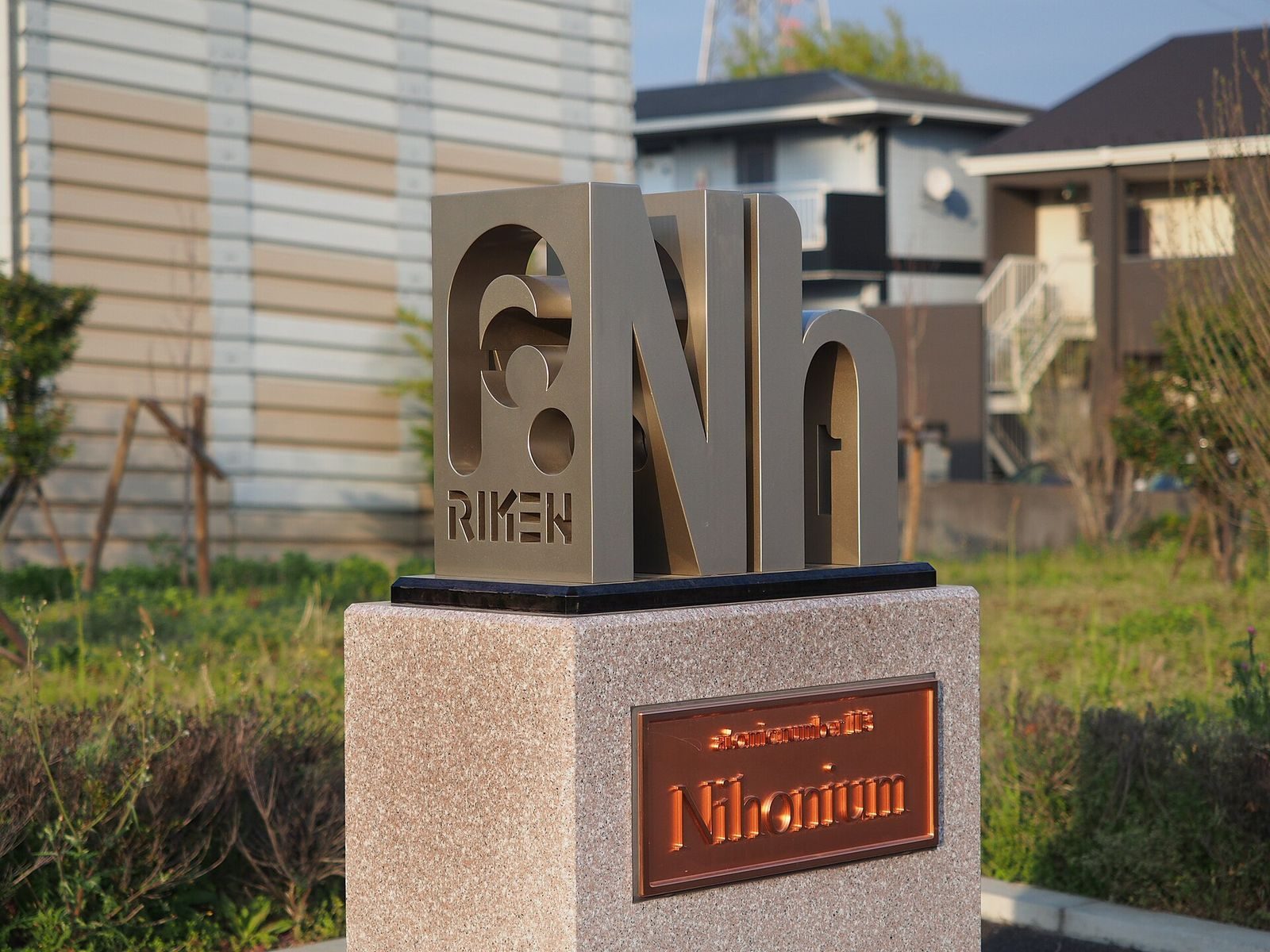 NhRIKEN
4.5From temporary to official
113: first found in an Asian country
- Once confirmed,IUPAC representatives from each country vote on a name and symbol.
- Made in Japan,113 became nihonium, from Nihon, a Japanese name for Japan.
- All up to Z = 118now have official names; the last four came in 2016.
Full text
From temporary to official
Once a discovery is confirmed, IUPAC representatives from each country vote on a permanent name and symbol. The name may honour the country or state where it was found, or a famous scientist. All elements up to Z = 118 have now been discovered and given official names.
The last four were named in 2016. Element 113 was made in Japan and became nihonium, from Nihon, a Japanese name for Japan. It was the first element discovered in an Asian country.
Today's rules let discoverers name an element after a myth or a heavenly body, a mineral, a place, a property of the element, or a scientist. The ending follows the element's group: -ium for most, -ine for group 17 (like chlorine) and -on for group 18 (like neon). That is why element 117 is tennessine and element 118 is oganesson, not "tennessium" and "oganessium".
| Z | IUPAC temporary name | Symbol | Official name | Symbol |
|---|---|---|---|---|
| 101 | Unnilunium | Unu | Mendelevium | Md |
| 102 | Unnilbium | Unb | Nobelium | No |
| 103 | Unniltrium | Unt | Lawrencium | Lr |
| 104 | Unnilquadium | Unq | Rutherfordium | Rf |
| 105 | Unnilpentium | Unp | Dubnium | Db |
| 106 | Unnilhexium | Unh | Seaborgium | Sg |
| 107 | Unnilseptium | Uns | Bohrium | Bh |
| 108 | Unniloctium | Uno | Hassium | Hs |
| 109 | Unnilennium | Une | Meitnerium | Mt |
| 110 | Ununnilium | Uun | Darmstadtium | Ds |
| 111 | Unununnium | Uuu | Roentgenium | Rg |
| 112 | Ununbium | Uub | Copernicium | Cn |
| 113 | Ununtrium | Uut | Nihonium | Nh |
| 114 | Ununquadium | Uuq | Flerovium | Fl |
| 115 | Ununpentium | Uup | Moscovium | Mc |
| 116 | Ununhexium | Uuh | Livermorium | Lv |
| 117 | Ununseptium | Uus | Tennessine | Ts |
| 118 | Ununoctium | Uuo | Oganesson | Og |
Don't mix these up
- un is 1, nil is 0. 110 is un-un-nil-ium (ununnilium), 101 is un-nil-un-ium (unnilunium).
- enn is 9, oct is 8. 119 is ununennium; 118 is ununoctium.
- The temporary symbol always has three letters; most official symbols have two.
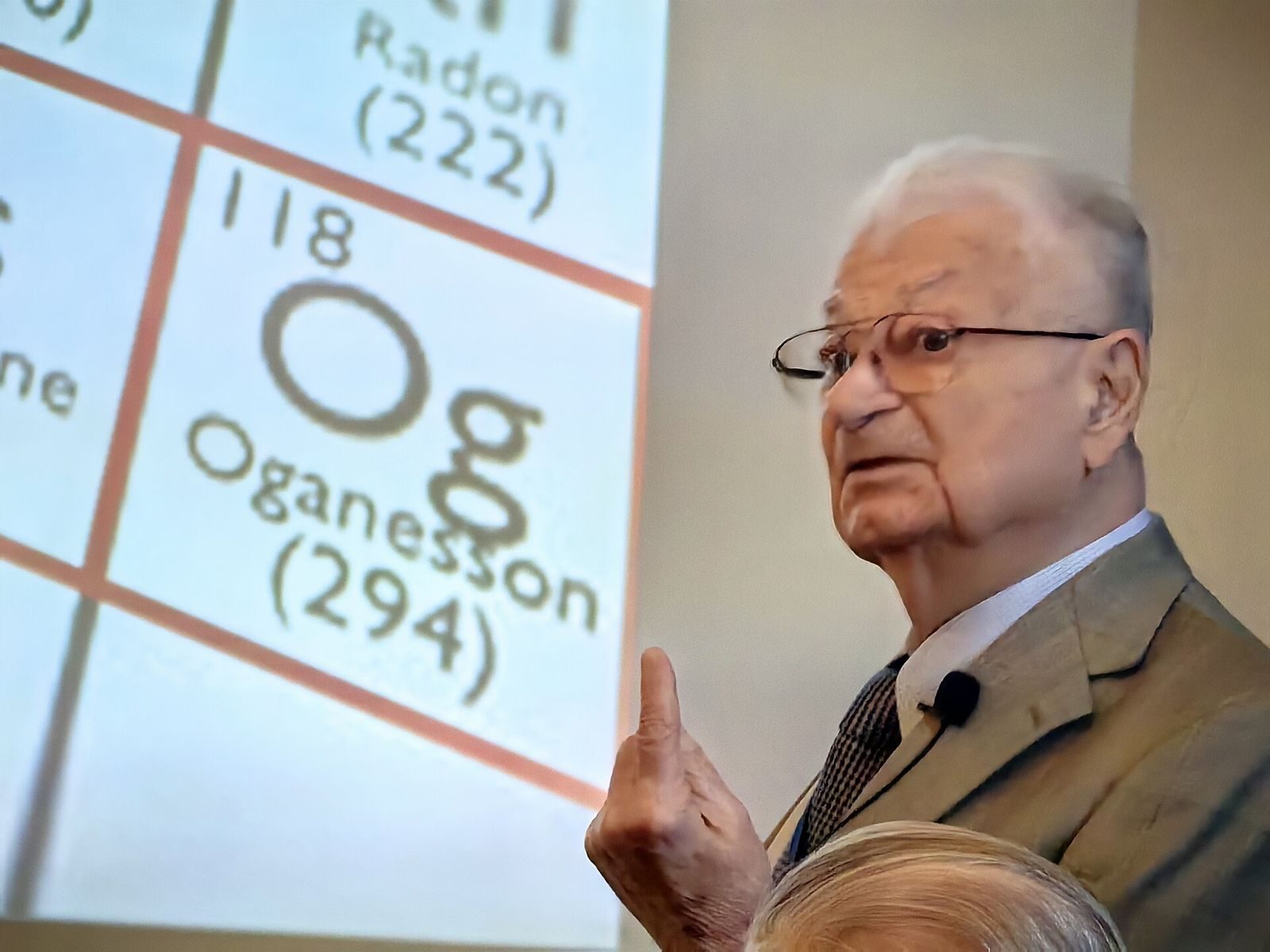 Yuri Oganessian118 Og, oganesson
4.6A myth or heavenly body, mineral, place, property, or scientist
The ending follows the group
- -iumfor most; a country or state, or a famous scientist, may be honoured.
- -inefor group 17, like chlorine: 117 is tennessine.
- -onfor group 18, like neon: 118 is oganesson.
4.7Eighteen temporary names
Every one now has a real name
Mendelevium to oganesson: each wore a digit name until its discovery was confirmed.
4.8Temporary and official, side by side
From Unnilunium to Ununoctium
On a phone, each row: Z, the temporary name and symbol, and under them the official name and symbol.
| Z | IUPAC temporary name | Symbol | Official name | Symbol |
|---|---|---|---|---|
| 101 | Unnilunium | Unu | Mendelevium | Md |
| 102 | Unnilbium | Unb | Nobelium | No |
| 103 | Unniltrium | Unt | Lawrencium | Lr |
| 104 | Unnilquadium | Unq | Rutherfordium | Rf |
| 105 | Unnilpentium | Unp | Dubnium | Db |
| 106 | Unnilhexium | Unh | Seaborgium | Sg |
| 107 | Unnilseptium | Uns | Bohrium | Bh |
| 108 | Unniloctium | Uno | Hassium | Hs |
| 109 | Unnilennium | Une | Meitnerium | Mt |
| 110 | Ununnilium | Uun | Darmstadtium | Ds |
| 111 | Unununnium | Uuu | Roentgenium | Rg |
| 112 | Ununbium | Uub | Copernicium | Cn |
| 113 | Ununtrium | Uut | Nihonium | Nh |
| 114 | Ununquadium | Uuq | Flerovium | Fl |
| 115 | Ununpentium | Uup | Moscovium | Mc |
| 116 | Ununhexium | Uuh | Livermorium | Lv |
| 117 | Ununseptium | Uus | Tennessine | Ts |
| 118 | Ununoctium | Uuo | Oganesson | Og |
Textbook checkTable 3.5
Two misprints in the table
The textbook prints
"Ununnillium" (110), "Rontgenium" (111)
IUPAC spells
Ununnilium; roentgenium (Rg)
un + un + nil + ium has one l. Write it this way.
Think of it likeA hospital tag
"Baby of Sharma, bed 14"
Ugly but clear, until the naming ceremony. Nobody mixes the babies up.
4.9Don't mix these up
un is 1, nil is 0
110 vs 101
Ununnilium vs unnilunium
Read the digits in order.
119 vs 118
enn is 9, oct is 8
Temporary symbols: three letters; most official ones: two.
Don't mix these up
- un is 1, nil is 0. 110 is un-un-nil-ium (ununnilium), 101 is un-nil-un-ium (unnilunium).
- enn is 9, oct is 8. 119 is ununennium; 118 is ununoctium.
- The temporary symbol always has three letters; most official symbols have two.
CheckThe reason
Why systematic names?
Why does IUPAC use systematic names for new elements?
- To replace the official names permanently
- To have a neutral name until a discovery is confirmed
- To show the properties of the element in its name
NEETPast questions
As the exam asks it
KeepJust remember
Choices people made
Not facts of nature: tap a card for its hook.
WordsTo know
Four words
- Systematic (IUPAC) name
- A temporary name built from the digits of Z plus -ium.
- Root
- The short word for each digit: nil, un, bi, tri, quad, pent, hex, sept, oct, enn.
- Temporary symbol
- Three letters, the first letters of the roots.
- Transuranium elements
- Elements after uranium (Z above 92), almost all man-made.
RootsZinc (Z = 30) fired at bismuth (Z = 83), for months
3atoms
of element 113 in nine years. Each lasted less than a second.
- First claimsare sometimes wrong: in 1999 a Berkeley team announced 118 on data that turned out to be made up.
- Too fewto weigh, see or do chemistry with. Someone independent must check.
Full text
The roots: a handful of atoms, gone in a blink
- Why not name a new element as soon as a lab announces it?Because the first claim is sometimes wrong. Rival teams have claimed the same element, and in 1999 a team at Berkeley announced element 118 on data that turned out to be made up. Someone independent has to check first, and checking takes years. Until then the element needs a name nobody can quarrel over: its number, spelled out.
- Why does checking take years?Because a lab makes only a few atoms. Element 113 was made by firing zinc nuclei (Z = 30) at bismuth (Z = 83) for months on end; almost every collision misses or bounces off. In nine years the Japanese team caught three atoms. Each lasted less than a second: far too little to weigh, see or do chemistry with.
- Then how do they know which element they made?By counting its decays. A superheavy nucleus throws out alpha particles (2 protons and 2 neutrons each), one after another, and every alpha lowers Z by 2. If the chain ends on a nucleus that is already well known, you count back: the 2012 atom of 113 gave six alphas and passed through dubnium-262 (Z = 105), lawrencium-258 and mendelevium-254, all known. Four alphas before dubnium means \( 105 + 4 \times 2 = 113 \).
- Why do these nuclei fall apart so fast?Every proton pushes on every other proton, so the push grows roughly as \( Z^2 \). The strong force that holds a nucleus together reaches only the nearest neighbours. Past about 100 protons the push nearly wins. Extra neutrons add grip without adding push, which is why a heavier isotope of the same element can live far longer.
- The bedrockLike charges repel, and in a nucleus every pair of protons counts; the strong force only holds neighbours together. That is why the end of the periodic table is so short-lived, and why its newest members wait for a name.
So the systematic name is not just a tidy rule. It is a way of saying "an element with this many protons, which we are still checking". The digits are neutral: they belong to no country and no laboratory. The roots were picked so that no two digits start with the same letter, which is why 5 is the Greek pent and not the Latin quint, which would clash with quad.
RootsCount its decays: each alpha is 2 protons and 2 neutrons
Count back to a known nucleus
Six alphas in all, through dubnium-262, lawrencium-258 and mendelevium-254: nuclei already studied.
RootsWhy they fall apart so fast
The push grows as Z²
- The strong forceholds only nearest neighbours.
- Past about 100 protonsthe push nearly wins.
- Extra neutronsadd grip without push: a heavier isotope can live far longer.
RootsThe digits belong to no country
Ten different first letters
A neutral way to say "Z protons, still checking". Greek pent, not Latin quint, which would clash with quad.
StoryJapan's second chance
Nipponium, then nihonium
- 1908TokyoJapanese chemist Masataka Ogawa announces nipponium (Np), for Mendeleev's gap at 43. Nobody confirms it.
- 1930Checked with X-raysJust before Ogawa dies, Kenjiro Kimura finds it was element 75, rhenium, under the gap. Rhenium was credited to German chemists in 1925; Np went to neptunium.
- 2003WakōKosuke Morita's team at RIKEN fires zinc-70 at bismuth-209.
- 2004JulyOne atom of 113. A second in April 2005; a third in August 2012, after 450 more days of beam.
- 2015DecemberThe judges give it to RIKEN. Nihonium, Nh, partly honours Ogawa.
Full text
The story
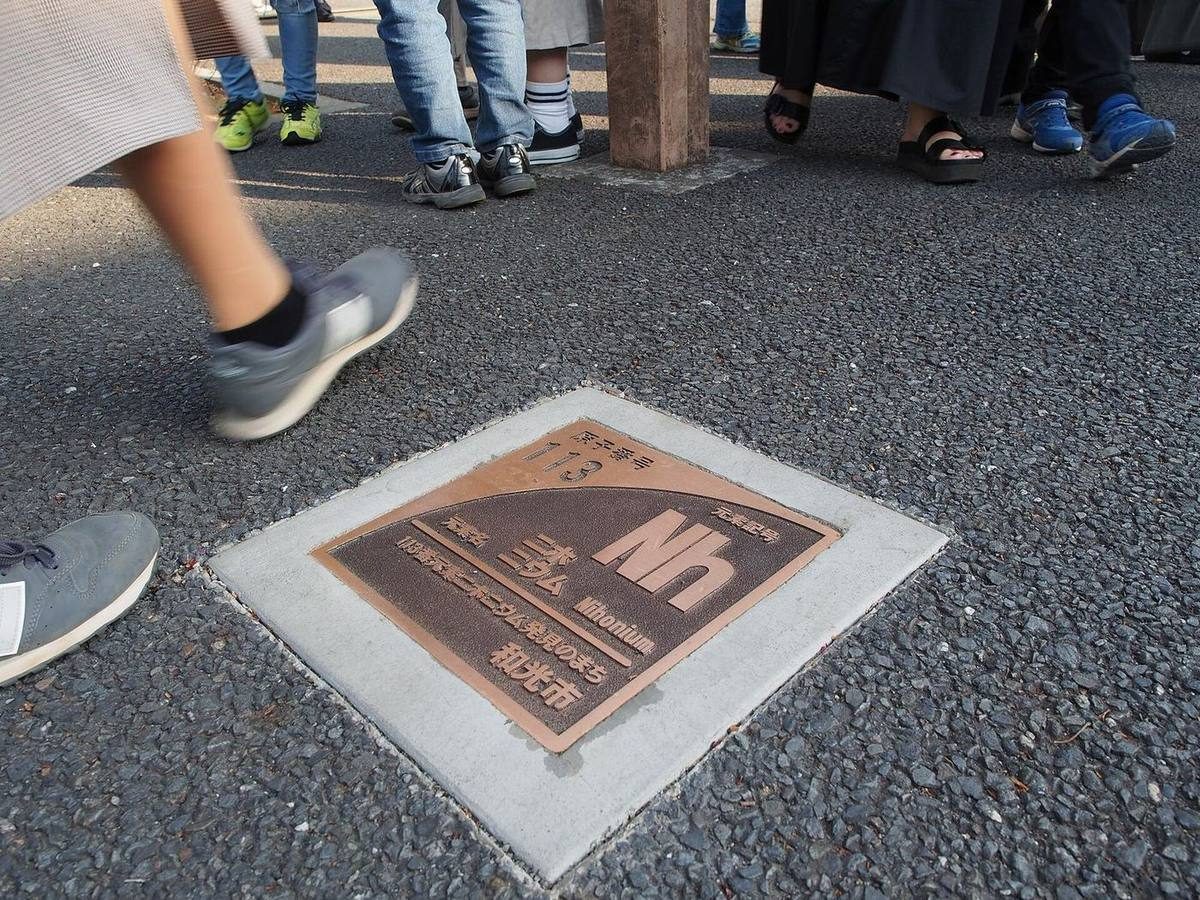 113 Nh plate
StoryOutside RIKEN
A plate for every element
Set into the pavement of the street to the gate.
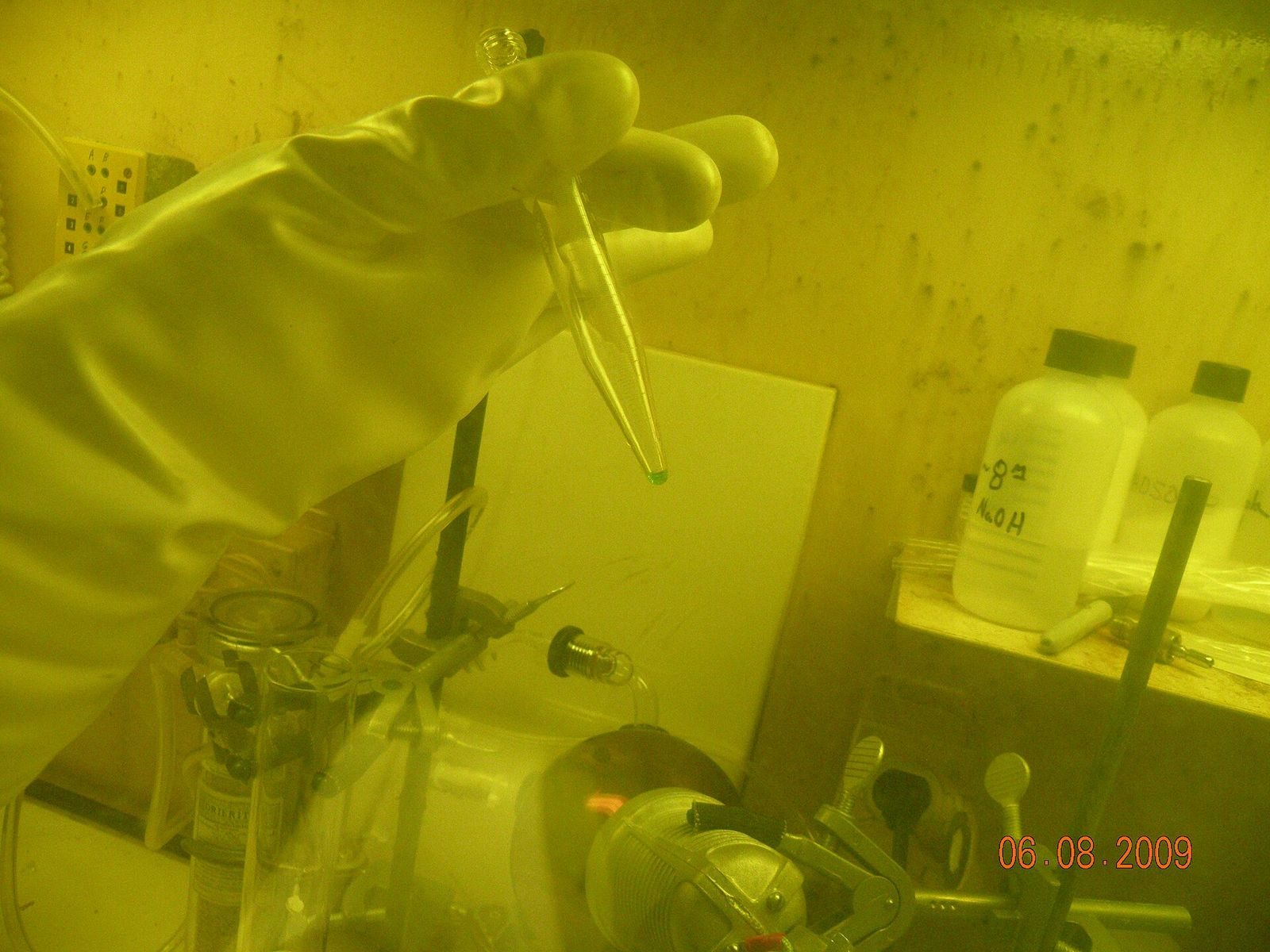 Berkelium-249 in the tip
Story2008 to 2010, Tennessee and Dubna
22 milligrams, five Atlantic crossings
- 97 + 20 = 117: berkelium-249 hit with calcium-48, by the Russian team of Yuri Oganessian.
- Oak Ridge's reactorran 250 days for 22 milligrams; half-life 330 days.
- Customs refused it twice; it reached Dubna in June 2009. Announced April 2010.
StoryThe "Transfermium Wars"
"I'm still alive"
- 1960sAmerican and Soviet labs, rival names for 104 to 106Rutherfordium and hahnium from Berkeley; kurchatovium and others from Dubna.
- 1984Books took sidesAt least one Indian chemistry textbook used kurchatovium and hahnium.
- 1995Glenn SeaborgThe committee was reluctant "because I'm still alive and they can prove it, they say."
- 1997IUPAC settles it104 rutherfordium, 105 dubnium, 106 seaborgium.
- 2016OganessonAfter Yuri Oganessian, born in 1933: the second element named after a living person, today its only living namesake.
See itThe corner of the chart of nuclei
More neutrons, longer lives
Guess first, then slide the neutrons. Physicists expect an "island of stability" near 114 protons and 184 neutrons.
Solve itThree problems
Your turn
Solve it
Element 115 was made by firing calcium-48 (Z = 20) at a target. Which element was the target? And which target would you use, with the same beam, to try for element 120?
Answer
Solve it: count back
A detector catches a new atom. It gives out five alpha particles in a row and then reaches seaborgium (Z = 106), a known element. What was the atom, and what is its systematic name and symbol?
Hint
Answer
Solve it: think harder
Why do the systematic roots use Greek pent for 5 instead of Latin quint, and Greek enn for 9 instead of Latin nov? Look at the first letters of all ten roots.
Answer
ConnectAnd still confused?
Where this goes next
Connect it
- The gaps, one page back. Ogawa's nipponium was really rhenium, one of Moseley's four missing rungs. See How do you know an element is missing?
- Atomic number, Chapter 2. An element is "all atoms with Z protons", which is why counting alpha decays (each −2 in Z) can name an atom you will never see. See Atomic number, isotopes and isobars.
- Alpha particles, Chapter 2. The same helium nuclei Rutherford fired at gold foil: Thomson's and Rutherford's atoms.
- Where 119 and 120 would go. Period 8 would start with an s-block pair, under francium and radium: The s, p, d and f blocks.
- Physics, Class 12. Why big nuclei are less tightly bound per nucleon: The binding energy curve and Radioactivity.
Does element 119 have a name?
Only its systematic one: un, un, enn + ium = ununennium, Uue. It has not been made yet. When it is, and the discovery is confirmed, the discoverers will propose a name.
Why does oganesson end in -on and tennessine in -ine?
Because the endings follow the group. Element 118 is in group 18, with neon, argon and the other noble gases, so it ends in -on. Element 117 is in group 17, with chlorine and the halogens, so it ends in -ine. Temporary names always end in -ium, whatever the group.
If the atoms vanish in a fraction of a second, how do we know oganesson is a noble gas?
We don't, by experiment. It sits in group 18 because of its atomic number. Calculations suggest the heaviest atoms behave unusually because their inner electrons move at a large fraction of the speed of light, so oganesson may not act like a typical noble gas at all.
Sources
- IUPAC (30 December 2015): discoveries of 113, 115, 117 and 118 verified; the 7th period complete
- IUPAC (June 2016): proposed names, the five naming categories, the -ium/-ine/-on endings, first element found in Asia, homage to Ogawa
- IUPAC (November 2016): names approved
- Nihonium (Wikipedia): RIKEN, Morita, zinc-70 on bismuth-209, atoms in 2004, 2005 and 2012, the decay chain to dubnium, lawrencium and mendelevium, the name
- Rhenium (Wikipedia): Ogawa's nipponium (1908), Kimura's X-ray check, Noddack, Tacke and Berg (1925)
- Tennessine (Wikipedia): the berkelium target, 250 days, 22 mg, 330-day half-life, customs, five Atlantic crossings, April 2010
- Oganesson (Wikipedia): Dubna and Livermore 2002, the retracted 1999 Berkeley claim, relativistic effects
- Moscovium (Wikipedia): americium-243 + calcium-48, 2003
- Transfermium Wars (Wikipedia): the 104–106 dispute, 1997 settlement, Seaborg's 1995 remark, kurchatovium and hahnium in a 1984 Indian textbook
- Yuri Oganessian (Wikipedia): the second element named after a living person
- Systematic element name (Wikipedia): 1978 IUPAC rules, pent instead of quint and Island of stability (Wikipedia): N = 184
- Unbinilium (Wikipedia): why 119 and 120 need einsteinium or fermium targets with calcium-48, and the titanium-50 on californium-249 attempts
- IAEA LiveChart of Nuclides: half-lives used in the widget