Chemical Bonding and Molecular Structure
- 1. Why do atoms join at all?
- 2. How do you draw a Lewis structure?
- 3. What holds salt together?
- 4. How long, how strong? Bond parameters
- 5. When one drawing is not enough: resonance
- 6. Why does water have a plus end? Polarity of bonds
- 7. Why is water bent but CO₂ straight? VSEPR theory
- 8. What happens when two atoms bond? Valence bond theory
- 9. How does carbon make four equal bonds? Hybridisation
- 10. Electrons that belong to the whole molecule: MO theory
- 11. Why does oxygen stick to a magnet? Bond order
- 12. What makes water so sticky? Hydrogen bonding
- Review
2 of 12·NCERT §4.1.3 · §4.1.4 · §4.1.5·pp. 103–106·6 min
How do you draw a Lewis structure?
The big ideaA Lewis structure is a count of every valence electron, placed as bonds and lone pairs so that each atom gets an octet; formal charge helps pick the best drawing, and some molecules simply break the octet rule.
In simple words
First count all the outer bits that every piece brings. Then join the pieces with lines, two bits per line. Hand out the bits that are left so that every piece has eight around it. If you run short, use two or three lines between the same two pieces. Sometimes you can draw it more than one way; pick the way where no piece has gained or lost much.
Drawing a Lewis structure, step by step
- Add up the valence electrons of all the atoms. \(\ce{CH4}\): 4 from carbon + 4 × 1 from hydrogen = 8.
- Adjust for charge. Each negative charge adds one electron; each positive charge removes one. \(\ce{CO3^2-}\) gets 2 extra; \(\ce{NH4+}\) has one fewer.
- Write the skeleton. Usually the least electronegative atom goes in the middle (hydrogen is always on the outside). In \(\ce{NF3}\) nitrogen is central; in \(\ce{CO3^2-}\) carbon is.
- Join each outer atom to the centre with a single bond (one pair each).
- Share out the rest as lone pairs (pairs that belong to one atom and are not shared), outer atoms first. If the central atom is still short of eight, turn lone pairs into double or triple bonds.
Worked example 1: hydrogen cyanide, HCN
- Electrons: H 1 + C 4 + N 5 = 10.
- Skeleton H–C–N (carbon in the middle). Two single bonds use 4; 6 are left.
- Put the 6 on nitrogen as three lone pairs. Nitrogen has 8, but carbon has only 4.
- Move two of nitrogen's lone pairs into the C–N link: \(\ce{H-C#N}\) with one lone pair on N. Now C has 8, N has 8, H has 2.
Worked example 2: the ammonium ion, \(\ce{NH4+}\)
Electrons: 5 + 4 × 1 − 1 = 8. Four N–H bonds use all 8. Nitrogen has an octet and no lone pair.
Try it: step through the Lewis structure of carbon monoxide.
Try it. Draw the Lewis structure of carbon dioxide.
Answer
Formal charge
A Lewis structure does not show the shape of a molecule. And in an ion like \(\ce{CO3^2-}\) the charge belongs to the whole ion, not to one atom. Still, it is useful to give each atom a formal charge: the difference between the valence electrons the atom has when free and the electrons it "owns" in the Lewis structure. An atom owns both electrons of each of its lone pairs and one of each shared pair.
\[ \text{F.C.} = V - L - \tfrac{1}{2}S \]Here \( V \) is the number of valence electrons of the free atom, \( L \) the number of lone-pair (non-bonding) electrons on it, and \( S \) the number of shared (bonding) electrons around it.
Worked example 3: carbon monoxide, \(\ce{C#O}\)
Each atom has one lone pair (2 electrons) and shares 6.
- Carbon: \( 4 - 2 - \tfrac{1}{2}(6) = -1 \).
- Oxygen: \( 6 - 2 - \tfrac{1}{2}(6) = +1 \).
The formal charges add up to 0, the charge of the molecule. They always add up to the overall charge.
In ozone, \(\ce{O3}\), drawn with one O=O and one O–O, the middle oxygen gets +1, the double-bonded end oxygen 0 and the single-bonded end oxygen −1.
Try it: split ozone's shared pairs and count what each oxygen owns.
What formal charge is for
- It is bookkeeping, not real charge. It assumes every bond is shared perfectly equally.
- When several Lewis structures are possible, the one with the smallest formal charges is usually the lowest in energy, so the best.
Guess first. For \(\ce{CO2}\), which is better: O=C=O or O≡C–O?
Answer
When the octet rule breaks
The octet rule works well for most organic compounds and for second-period elements. It fails in three kinds of molecule:
- Incomplete octet: the central atom has fewer than eight. This happens with atoms that have fewer than four valence electrons. In LiCl, \(\ce{BeH2}\) and \(\ce{BCl3}\), Li, Be and B have only 2, 4 and 6 electrons around them. \(\ce{AlCl3}\) and \(\ce{BF3}\) are also short.
- Odd-electron molecules: with an odd total, someone must be left with an unpaired electron. Nitric oxide, NO (11 valence electrons), and nitrogen dioxide, \(\ce{NO2}\) (17).
- Expanded octet: elements of the third period and beyond have empty 3d orbitals as well as 3s and 3p, and can hold more than eight. \(\ce{PF5}\) (10 around P), \(\ce{SF6}\) (12 around S), \(\ce{H2SO4}\) (12 around S) and many coordination compounds.
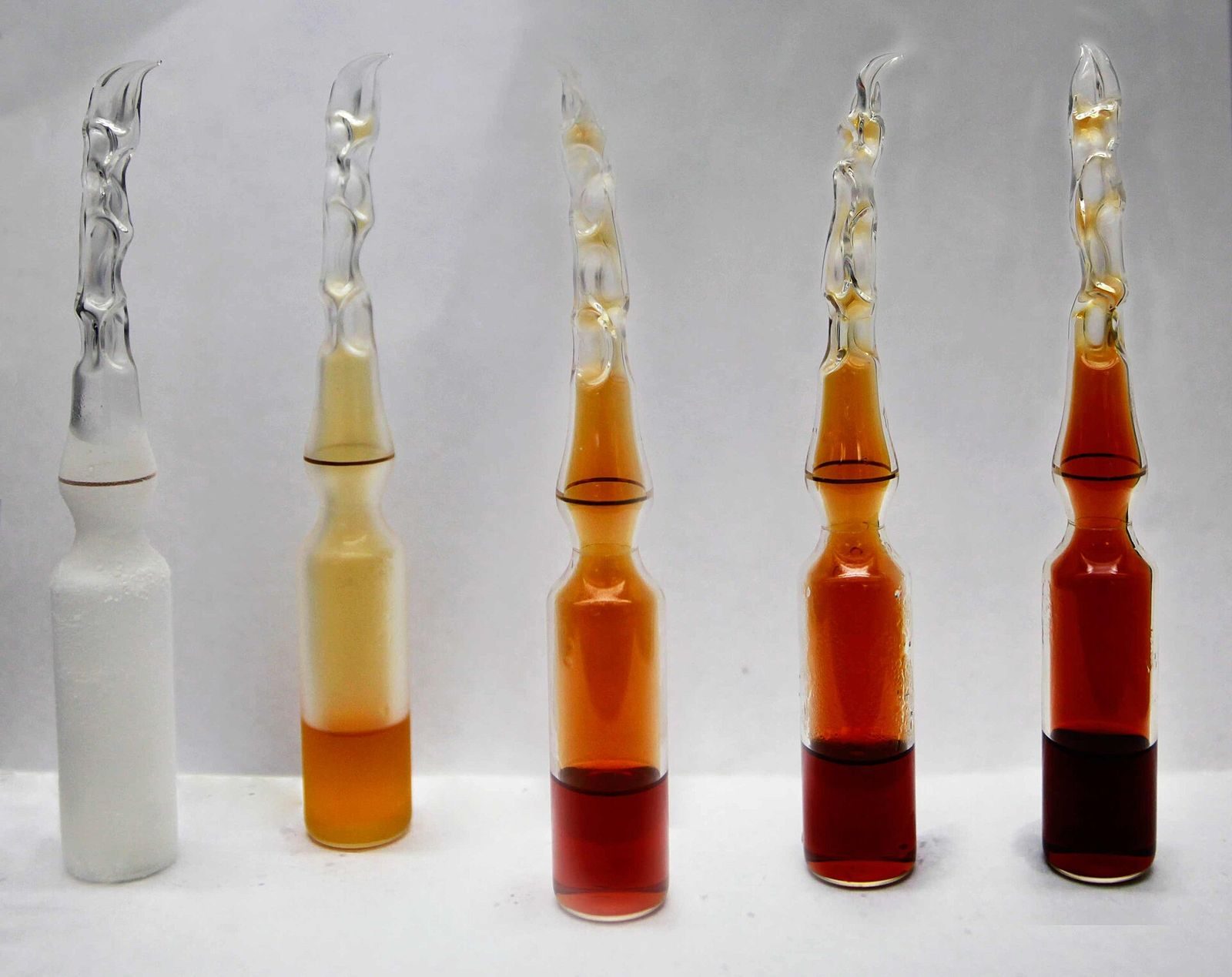 −196 °C: N₂O₄23 °C50 °C: more NO₂
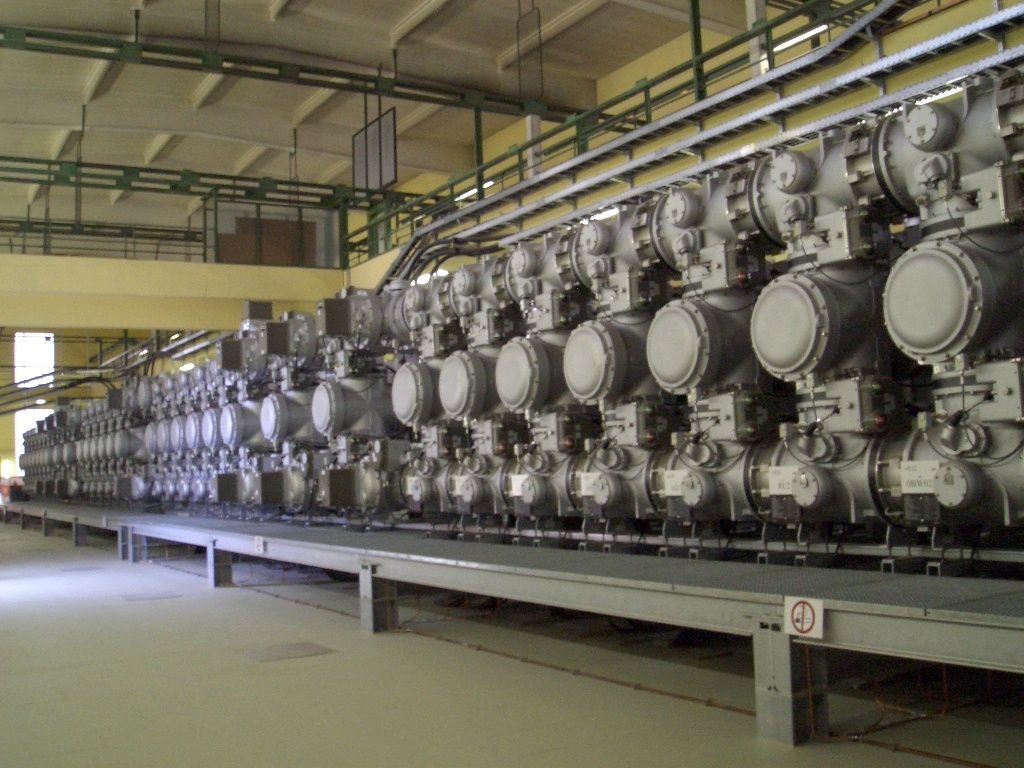 SF₆ inside: 12 round S
Textbook check · §4.1.5Do SF6 and PF5 really use 3d orbitals?
- The textbook says
- Elements of the third period have 3d orbitals as well as 3s and 3p, and they use them to hold more than eight electrons, as in PF5 and SF6.
- What we know now
- The counting is right: phosphorus in PF5 is bonded to five atoms and sulphur in SF6 to six. But careful calculations since 1990 show the 3d orbitals are too high in energy to take much part. What really lets period 3 atoms hold so many neighbours is their larger size (room around them) and bonds in which one electron pair is spread over three atoms, with much of the electron charge sitting on the fluorines.Source: Hypervalent molecule (Wikipedia), citing E. Magnusson, J. Am. Chem. Soc. 1990
- In the exam
- Write the textbook's reason: period 3 elements have vacant 3d orbitals, so they can expand their octet; period 2 elements cannot, because n = 2 has no d orbitals.
Try it: tap four molecules and count the electrons round each centre.
Sulphur does not always expand: in \(\ce{SCl2}\) it has an ordinary octet.
Other drawbacks. The rule rests on noble gases being inert, yet xenon and krypton form compounds such as \(\ce{XeF2}\), \(\ce{KrF2}\) and \(\ce{XeOF2}\). It says nothing about the shapes of molecules, and nothing about their energy, so it cannot explain why one molecule is more stable than another.
Just remember
The method on this page has reasons; these counting conventions and lists are simply to be known. Hooks:
- Formal charge = V − L − ½S
- "Brought minus owned." V is what the atom brought. It owns all of its lone-pair electrons (L) and half of every shared pair (½S), like flatmates who keep their own things and split the rent.
- Charge on an ion: add one electron per minus, remove one per plus
- "Minus means more." CO32−: 4 + 18 + 2 = 24. NH4+: 5 + 4 − 1 = 8.
- Centre: the least electronegative atom; hydrogen never
- The shyest atom sits in the middle of the group photo. Hydrogen has only one hand (one bond), so it always stands at the edge.
- Three ways to break the octet: incomplete (BeH2, BF3, BCl3, AlCl3, LiCl), odd (NO 11, NO2 17), expanded (PF5 10, SF6 12, H2SO4 12)
- "Few, Odd, Big." Few electrons to start with (Li, Be, B, Al); an Odd total so one is left alone; a Big atom from period 3 or below with room for more neighbours.
- Lone pair
- A pair of valence electrons on one atom, not shared in a bond.
- Lewis structure
- A drawing showing every bonding pair and lone pair in a molecule or ion.
- Formal charge
- Valence electrons of the free atom minus lone-pair electrons minus half the shared electrons.
- Incomplete octet
- Fewer than eight electrons around the central atom, as in BF3.
- Odd-electron molecule
- A molecule with an odd number of electrons, such as NO.
- Expanded octet
- More than eight electrons around a central atom of period 3 or beyond, as in SF6.
Words to know
How many valence electrons must be placed in the Lewis structure of the nitrate ion, \(\ce{NO3-}\)?
- 23
- 24
- 22
What is the formal charge on the nitrogen atom in \(\ce{NH4+}\)?
- 0
- +1
- −1
Which molecule has an expanded octet on its central atom?
- \(\ce{BF3}\)
- \(\ce{NH3}\)
- \(\ce{PCl5}\)
Deep dive · optional
Is formal charge real? Bookkeeping, lonely electrons and atoms that hold twelve
Why the smallest formal charges usually win, why they are still not the real charges, and what is actually going on in the molecules that break the octet rule. Not needed for the exam, but it turns three rules to memorise into one picture.
The roots: charge costs energy
- Why do we need formal charge at all?Because the counting method often gives more than one drawing that satisfies every octet: O=C=O and O≡C–O, or N=N=O and N=O=N. Lewis's rules alone can't choose. Formal charge is the tiebreaker.
- Why does the drawing with the smallest formal charges usually win?Pulling plus and minus charge apart costs energy, the same way you must pull to separate two magnets. A drawing with charges of +1 and −1 on neighbouring atoms describes a molecule that has paid that cost; a drawing with zeros everywhere has not. Lower energy wins. When some charge cannot be avoided, the minus sign should sit on the more electronegative atom, which holds electrons better.
- Then is the formal charge the real charge on the atom?No. It pretends every shared pair is split exactly half and half. Real pairs lean towards the more electronegative atom. Oxidation numbers, which you meet in the Redox chapter, pretend the opposite: the greedier atom takes the whole pair. The real charge lies somewhere between the two, and neither number is what you would measure.
- How can a molecule live with an odd electron?Nothing forbids it, but an unpaired electron is restless. Nitrogen dioxide has 17 valence electrons. Cool it and pairs of NO2 molecules join through their lonely electrons to make N2O4, which is colourless. Warm it and they come apart again: the brown colour returns. (The picture in the core of this page is one sealed sample at five temperatures.)
- Why can sulphur hold six fluorines but oxygen can't?The outer shell of oxygen (n = 2) has only four orbitals, one s and three p, and oxygen is small: there is no room for six neighbours. Sulphur is bigger, with space around it, and fluorine pulls electrons out towards itself, so the "twelve electrons" around sulphur are really shared out over the whole molecule.
- The bedrockCoulomb's law (separating opposite charges costs energy) and orbital counting (two electrons per orbital, four orbitals in the n = 2 shell).
So the three rules of the core page are one idea seen three ways. Formal charge measures how much charge a drawing has had to separate. The octet is what you get when the four s and p orbitals are full. And the exceptions are molecules where the energy is lower some other way: boron happy with six because pulling another pair in from fluorine costs more than it gives, NO and NO2 simply being odd, and big atoms with room to spare.
The story
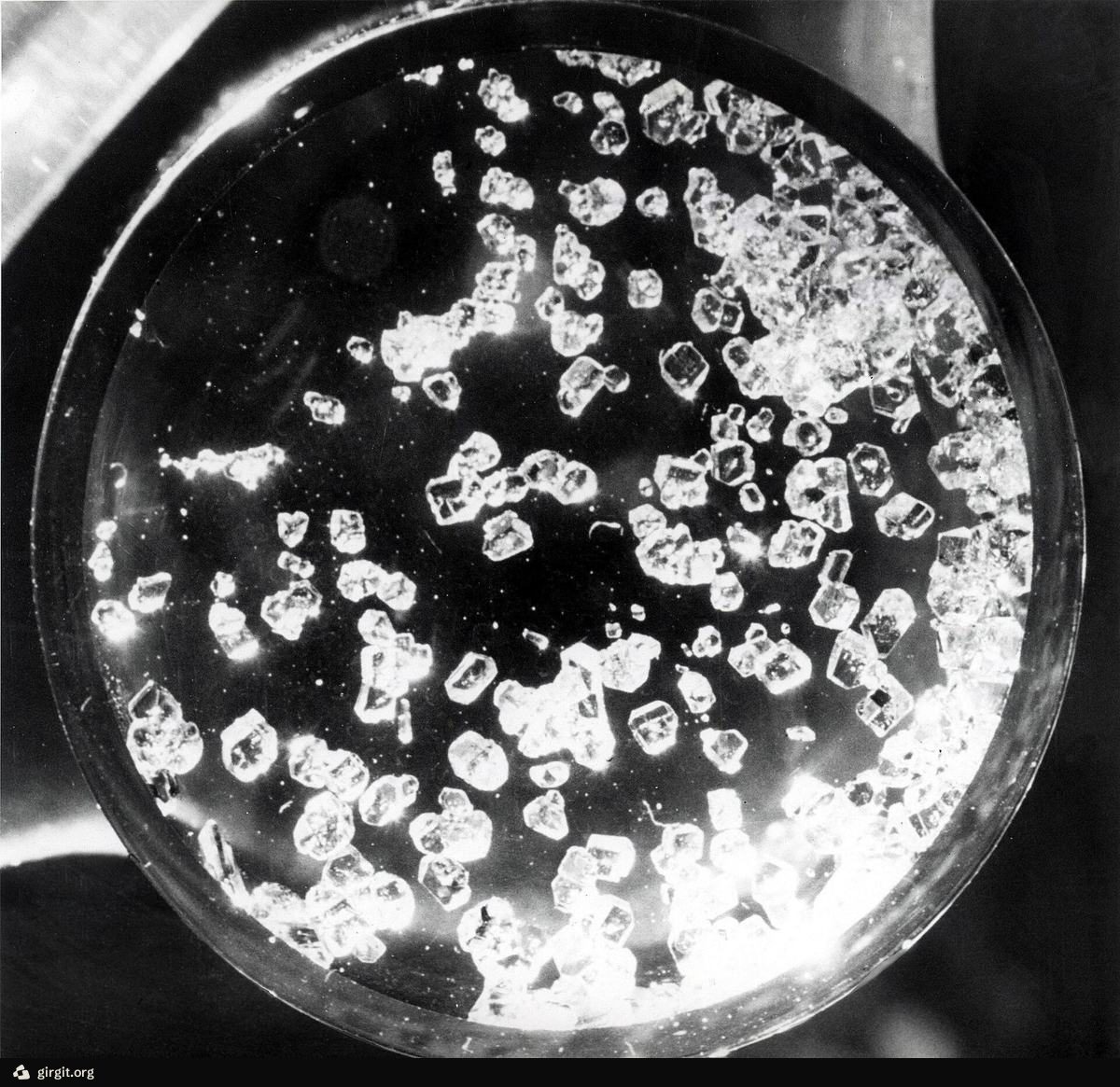 XeF₄ crystal
See it
Formal charge and oxidation number are two ways of splitting the same shared pairs. Guess first about carbon monoxide, then slide from one rule to the other and watch every atom's charge change. Try NH4+ too: the "+1 on nitrogen" turns into −3.
Solve it
Solve it: which way round is laughing gas?
Nitrous oxide, N2O, could be arranged N–N–O or N–O–N. Draw the best Lewis structure for each (16 valence electrons) and use formal charges to decide which is real.
Hint
Answer
Solve it: brown in summer
A sealed tube of brown NO2 goes pale in ice and dark on a hot day. Using only electron counting, explain why. Then predict whether chlorine dioxide, ClO2, has an unpaired electron.
Answer
Solve it: spot the error
"In the hydronium ion, H3O+, the formal charge on oxygen is +1, so the positive charge sits on the oxygen atom." What is wrong?
Answer
Solve it: which cannot exist?
From each pair pick the molecule that cannot exist, and say why: NF3 or NF5; SF6 or OF6; PCl5 or NCl5.
Answer
Connect it
Connect it
- Why four orbitals, Structure of Atom. One s and three p in every outer shell: quantum numbers and shapes of orbitals.
- Period 2 is different, Periodicity. Maximum covalency 4 for period 2 and the same 3d-orbital textbook check: valence and the second period. Who is "greedier" comes from electronegativity.
- Real charges. Measured instead of booked, as dipole moments: polarity of bonds. When one drawing is not enough, formal charges help rank the drawings: resonance.
- The other bookkeeping. The all-or-nothing split is the oxidation number of the Redox chapter.
- Five and six neighbours. The shapes of PCl5 and SF6: hybridisation and VSEPR.
Still confused?
Formal charge, oxidation number, real charge: which one is "the" charge?
Only the real one, which you can't read off a drawing. Formal charge assumes perfectly fair sharing, oxidation number assumes total grabbing; real bonds are in between. Use formal charge to choose Lewis structures and oxidation numbers to balance redox equations; use dipole moments to talk about real charge.
If smallest formal charges win, why is CO drawn with −1 on carbon and +1 on oxygen?
Because the octet wins first. The drawing C=O with zero formal charges leaves carbon with only six electrons. Of the drawings that give both atoms an octet, C≡O is the only one, so we accept its charges. Formal charge is a tiebreaker among octet structures, not a rule above the octet.
Does BF3 just stay with six electrons forever?
It is eager to get two more. Give it any molecule with a lone pair, such as ammonia, and boron grabs that pair at once to make F3B–NH3, with an octet. That eagerness to accept a pair is what Lewis later called acidity: BF3 is a classic Lewis acid.
Sources
- Formal charge (Wikipedia): compared with oxidation state
- Carbon monoxide (Wikipedia): bond length 112.8 pm, dipole 0.122 D with carbon negative
- Hypervalent molecule (Wikipedia): Musher 1969, three-centre bonds, Magnusson 1990
- N. Bartlett, "Xenon hexafluoroplatinate(V) Xe+[PtF6]−", Proc. Chem. Soc. 1962
- Xenon hexafluoroplatinate (Wikipedia): the 23 March 1962 experiment
- Neil Bartlett (Wikipedia): the 1963 explosion
- G.N. Lewis, "The Atom and the Molecule", J. Am. Chem. Soc. 38, 762 (1916): odd molecules
- The Nobel Prize in Physiology or Medicine 1998: nitric oxide as a signalling molecule
- Sulfur hexafluoride (Wikipedia): use in electrical switchgear
- NO2/N2O4 sample at −196 to 50 °C (file page)

Picture and video credits
Show 2 picture and video credits
- nitrogen-dioxide-ampoules-by-temperature.jpg: Eframgoldberg, CC BY-SA 3.0
- sf6-gas-insulated-switchgear.jpg: Wdwd, CC BY-SA 3.0
