Chemical Bonding and Molecular Structure
- 1. Why do atoms join at all?
- 2. How do you draw a Lewis structure?
- 3. What holds salt together?
- 4. How long, how strong? Bond parameters
- 5. When one drawing is not enough: resonance
- 6. Why does water have a plus end? Polarity of bonds
- 7. Why is water bent but CO₂ straight? VSEPR theory
- 8. What happens when two atoms bond? Valence bond theory
- 9. How does carbon make four equal bonds? Hybridisation
- 10. Electrons that belong to the whole molecule: MO theory
- 11. Why does oxygen stick to a magnet? Bond order
- 12. What makes water so sticky? Hydrogen bonding
- Review
4 of 12·NCERT §4.3 · §4.3.1 · §4.3.2 · §4.3.3 · §4.3.4·pp. 107–109·6 min
How long, how strong? Bond parameters
The big ideaEvery bond can be measured: how long it is, the angle it makes with its neighbours, how much energy breaks it, and how many electron pairs it holds; and more pairs mean a shorter, stronger bond.
In simple words
A link between two pieces has a length, like a rope. Two links leaving the same piece make an angle, like the hands of a clock. Some links are harder to break than others. And a link can be one, two or three ropes thick. The thicker it is, the shorter and harder to break it gets.
These measurable features are the bond parameters.
Bond length
Bond length is the equilibrium distance between the nuclei of two bonded atoms. It is measured by spectroscopy, X-ray diffraction and electron diffraction. Each atom contributes its share, its covalent radius:
\[ R = r_A + r_B \]where \( R \) is the bond length and \( r_A \), \( r_B \) are the covalent radii of atoms A and B. For two identical atoms, the covalent radius is half the bond length.
Atoms also have a van der Waals radius: the overall size of the atom, valence shell included, when it is not bonded. It is half the distance between two identical atoms in neighbouring molecules of a solid. For chlorine:
- Inside a \(\ce{Cl2}\) molecule the nuclei are 198 pm apart, so the covalent radius is 99 pm.
- Between chlorine atoms of two touching molecules the gap is 360 pm, so the van der Waals radius is 180 pm.
Textbook check · §4.3.1Is Cl–Cl 198 pm or 199 pm?
- The textbook says
- Fig. 4.2 gives the Cl–Cl bond length as 198 pm; Table 4.3, a few lines later, gives 199 pm.
- What we know now
- Both are roundings of one measured number: the Cl2 bond is 198.7 pm long, from its vibration and rotation spectrum. 199 pm is the nearer round value; 198 pm is a slight under-rounding, harmless for the covalent radius (99 pm either way).Source: NIST Chemistry WebBook, Cl2 constants of diatomic molecules (re = 1.987 Å)
- In the exam
- Use whichever number the question gives. If you need to quote it, 199 pm, and the covalent radius of chlorine 99 pm.
| Bond | Length (pm) | Molecule | Bond length (pm) |
|---|---|---|---|
| C–C | 154 | \(\ce{H2}\) | 74 |
| C=C | 133 | \(\ce{N2}\) (N≡N) | 109 |
| C≡C | 120 | \(\ce{O2}\) (O=O) | 121 |
| C–O | 143 | \(\ce{F2}\) | 144 |
| C=O | 121 | \(\ce{Cl2}\) | 199 |
| C–N | 143 | \(\ce{Br2}\) | 228 |
| C≡N | 116 | \(\ce{I2}\) | 267 |
| O–H | 96 | HF / HCl | 92 / 127 |
| C–H | 107 | HBr / HI | 141 / 160 |
Textbook check · Table 4.2Is an average C–H bond 107 pm or 109 pm?
- The textbook says
- Table 4.2 lists the average C–H bond length as 107 pm, but section 4.6.2 gives C–H in ethane as 109 pm.
- What we know now
- A typical C–H bond is about 109 pm (1.09 Å). It varies a little with the carbon's hybridisation: about 109 pm on an sp3 carbon, slightly shorter on sp2 and sp carbons. 107 pm is too short for an average.Source: Carbon–hydrogen bond (Wikipedia): about 1.09 Å, about 413 kJ mol−1
- In the exam
- If asked for the C–H bond length in ethane or methane, write 109 pm. If a question quotes Table 4.2's 107 pm, work with the number it gives.
Two patterns to notice: for the same pair of atoms, single > double > triple in length; and going down a group (F, Cl, Br, I), bonds get longer as atoms get bigger.
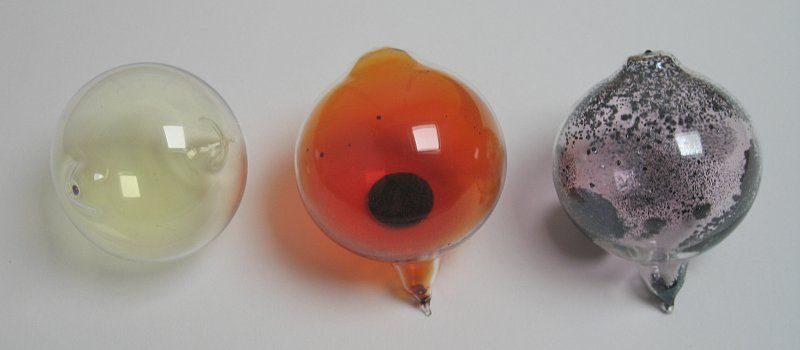 Cl–Cl 199 pmBr–Br 228 pmI–I 267 pm
Worked example 1: estimating a bond length
The covalent radius of carbon is 77 pm and of chlorine 99 pm. Estimate the C–Cl bond length in \(\ce{CCl4}\).
\( R = 77 + 99 = 176 \) pm. (The measured value is about 177 pm.)
Bond angle
Bond angle is the angle between the orbitals holding the bonding electron pairs around the central atom. It is measured in degrees, by spectroscopy, and it tells us about the shape of the molecule. In water, the H–O–H angle is 104.5°.
Try it: swap bond pairs for lone pairs and watch the angle close.
Bond enthalpy
Bond enthalpy is the energy needed to break one mole of bonds of one type between two atoms in the gas phase. Unit: kJ mol−1. The bigger it is, the stronger the bond.
| Bond broken | Reaction | Bond enthalpy (kJ mol−1) |
|---|---|---|
| H–H | \(\ce{H2(g) -> H(g) + H(g)}\) | 435.8 |
| O=O | \(\ce{O2(g) -> O(g) + O(g)}\) | 498 |
| N≡N | \(\ce{N2(g) -> N(g) + N(g)}\) | 946.0 |
| H–Cl | \(\ce{HCl(g) -> H(g) + Cl(g)}\) | 431.0 |
Try it: guess first, then pull the two hydrogens off a water molecule.
In a molecule with several identical bonds, they do not all cost the same to break. In water, the first O–H bond takes 502 kJ mol−1; the second, now in the changed surroundings of an OH fragment, takes 427 kJ mol−1. The same O–H bond is also a little different in ethanol than in water. So for polyatomic molecules we use the average bond enthalpy: total energy to break all bonds of that type, divided by their number.
\[ \text{O–H average} = \frac{502 + 427}{2} = 464.5\ \mathrm{kJ\,mol^{-1}} \]Worked example 2: methane
Breaking all four C–H bonds of one mole of \(\ce{CH4(g)}\) into C and H atoms takes 1664 kJ. Average C–H bond enthalpy = 1664 ÷ 4 = 416 kJ mol−1.
Bond order
In the Lewis picture, bond order is the number of bonds (shared pairs) between two atoms: \(\ce{H2}\) 1, \(\ce{O2}\) 2, \(\ce{N2}\) 3, CO 3. Nitrogen's triple bond, at 946 kJ mol−1, is one of the strongest of any diatomic molecule; that is why \(\ce{N2}\) in air is so unreactive.
 breaks N≡N: N₂ + O₂ → 2NO
Isoelectronic molecules and ions (same number of electrons) have the same bond order: \(\ce{F2}\) and \(\ce{O2^2-}\) both 1; \(\ce{N2}\), CO and \(\ce{NO+}\) all 3.
The one rule to remember
- As bond order increases, bond enthalpy increases and bond length decreases.
- C–C 154 pm, C=C 133 pm, C≡C 120 pm: more pairs pull the atoms closer and hold them harder.
Try it. Arrange C–O, C=O and the C–O bond in carbon monoxide (C≡O) by length.
Answer
Just remember
The rule "more pairs, shorter and stronger" has a reason (the deep dive below), but the numbers themselves are measurements: nothing to derive, only to know. Hooks:
- Bond orders: N2 3, O2 2, F2 1; lengths 109, 121, 144 pm
- Read the row N, O, F as a rocket countdown: 3, 2, 1. Each step down the count lets the atoms drift apart: 109 → 121 → 144.
- C–C 154, C=C 134 (NCERT also prints 133), C≡C 120 pm; 347, 611, 837 kJ mol−1
- "One-five-four, one-three-four, one-two-oh": the middle digit falls 5, 3, 2. For the energies, each extra pair adds less than the one before: +264, then +226. Strength never doubles.
- H–H: 74 pm, 435.8 kJ mol−1; N≡N: 946 kJ mol−1
- H2 is the shortest bond of all (two tiny atoms). N≡N is the giant: about double O=O (498), which is why air's nitrogen just sits there and its oxygen does the reacting.
- Same electron count, same bond order: N2, CO, NO+ (14 electrons) all 3; F2, O22− (18) both 1
- "Count electrons, not atoms." Fourteen is the triple-bond number; eighteen, the single-bond number.
- Cl: covalent radius 99 pm, van der Waals radius 180 pm
- The van der Waals radius is an atom's personal space with a stranger from another molecule; the covalent radius is how close it sits holding hands with its bonded partner. Strangers stand farther off.
- Bond length
- Equilibrium distance between the nuclei of two bonded atoms.
- Covalent radius
- Half the distance between two identical atoms joined by a covalent bond.
- van der Waals radius
- Half the distance between two identical non-bonded atoms in neighbouring molecules.
- Bond angle
- Angle between the bonding orbitals around a central atom.
- Bond enthalpy
- Energy to break one mole of a given bond in the gas phase.
- Bond order
- The number of bonds (shared pairs) between two atoms.
Words to know
Which has the shortest bond?
- \(\ce{F2}\)
- \(\ce{O2}\)
- \(\ce{N2}\)
The covalent radius of chlorine is 99 pm and its van der Waals radius is 180 pm. Why is the van der Waals radius larger?
- Atoms in separate molecules only touch; bonded atoms overlap and come closer
- The van der Waals radius is for the \(\ce{Cl-}\) ion
- Bonding pushes atoms further apart
\(\ce{NO+}\) is isoelectronic with \(\ce{N2}\). What is its bond order?
- 2.5
- 3
- 2
Deep dive · optional
Why isn't a double bond twice as strong as a single bond?
What sets a bond's length and strength, why a second shared pair adds less for carbon but a third adds far more for nitrogen, and how chemists finally photographed the bonds in a single molecule. Not needed for the exam; it is here so the numbers in the tables stop being a list.
The roots: a well with a bottom and a depth
- Why does a bond have a length at all?Two pulls and two pushes. Both nuclei attract the shared electrons sitting between them, which draws the atoms together. The two nuclei repel each other, and so do their inner electrons, which pushes them apart. The push grows much faster at short range than the pull does, so at one distance the two balance and the energy is lowest. That distance is the bond length; how far the energy has dropped below that of two free atoms is the bond enthalpy. You met this curve for H2 on the valence bond page.
- Why does a second pair pull the atoms closer?More negative charge between the nuclei means a stronger pull towards the middle, so the balance point moves inwards. That is the whole of "more pairs, shorter bond": C–C 154, C=C 134, C≡C 120 pm.
- Then why isn't C=C twice as strong as C–C?The first pair takes the best seat: right on the line between the nuclei, made by head-on overlap (a σ bond). The second pair cannot sit in the same place. It has to use two p orbitals lying side by side, which overlap less (a π bond). From the tables, the π bond adds only 611 − 347 = 264 kJ mol−1, against 347 for the σ bond.
- So why is N≡N more than five times N–N?The surprise is not the triple bond; it is the single one. In hydrazine, H2N–NH2, each nitrogen carries a lone pair, and on two small atoms only 145 pm apart those lone pairs and the bonding pair crowd each other and repel. That pulls the N–N single bond down to 159 kJ mol−1, less than half of C–C. O–O (138) and F–F (155) are weak for the same reason. In N2 the two lone pairs point straight outwards, away from each other, and nothing spoils the three shared pairs.
- The bedrockCoulomb's law (unlike charges attract, like charges repel, both more strongly when closer) and orbital overlap (the more two orbitals overlap, the more electron charge sits between the nuclei). The same balance of pull and crowding decides the size of atoms on the atomic radius page.
Point 4 has big consequences. Carbon's single bond is strong, so carbon happily makes long chains and rings of C–C bonds: fuels, plastics, sugars, DNA. Nitrogen and oxygen cannot: chains of N–N or O–O bonds are weak and fall apart. And any compound with N–N or N=N bonds releases a lot of energy when its nitrogens pair off into N≡N. That is why hydrazine is a rocket fuel, and why sodium azide, NaN3, has been used to fill car airbags with nitrogen gas in a fraction of a second.
How are the numbers measured if nobody can hold a ruler to a molecule? Three main ways. Microwave spectroscopy: a gas molecule spins only at certain speeds, and the light it absorbs tells you its moment of inertia, hence its bond length (you will do this for HCl below). Electron diffraction: a beam of electrons fired through a gas scatters into rings whose spacing depends on the distances between atoms. X-ray diffraction: X-rays scattered by a crystal give the positions of all its atoms. Bond enthalpies come from the heat taken in or given out by reactions (Hess's law, which you will meet in Thermodynamics) and from spectra.
The story
See it
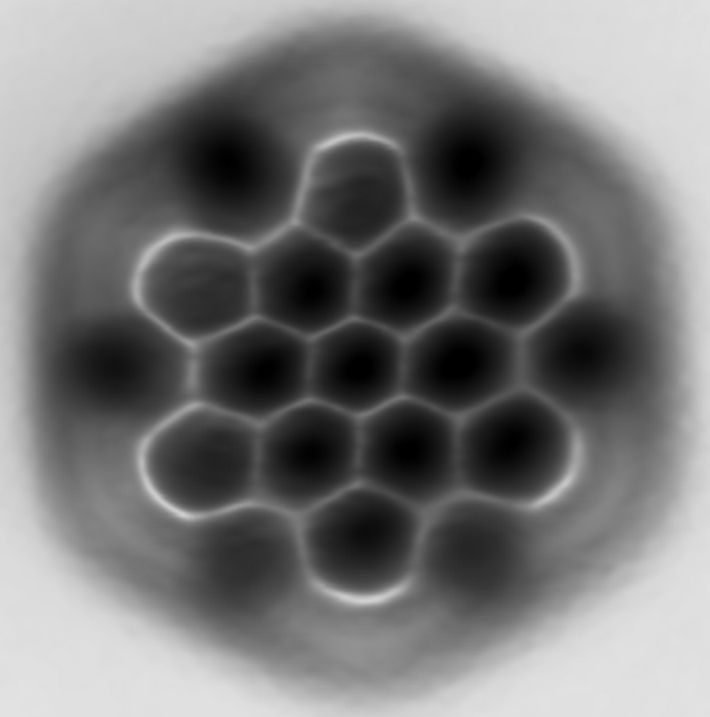 C–C bond (bright, short)ring of 6 C atoms
Now the numbers behind such pictures. Guess first; then scrub the number of shared pairs, switch atoms, and drag the right-hand atom to stretch the bond until it breaks. "Every bond" sets each multiple bond beside "n times the single bond".
Notice the two opposite stories in the bar chart. For carbon with carbon every bar falls below its dashed line: extra pairs are π bonds, and π is weaker than σ. For nitrogen and oxygen the bars shoot far above the line, because their single bonds are the weak ones. Carbon with oxygen sits in between, almost on the line: one oxygen's lone pairs weaken the single bond a little, roughly making up for π being weaker.
Solve it
Solve it: why adding hydrogen to ethene gives out heat
Use the mean bond enthalpies (kJ mol−1): C=C 611, C–C 347, C–H 414, H–H 435.8. Estimate the enthalpy change of \( \ce{CH2=CH2 + H2 -> CH3-CH3} \), all gases.
Hint
Answer
Solve it: rocket fuel from weak bonds
Hydrazine, H2N–NH2, can decompose into nitrogen and hydrogen: \( \ce{N2H4(g) -> N2(g) + 2H2(g)} \). Estimate ΔH from N–H 389, N–N 159, N≡N 946 and H–H 435.8 kJ mol−1. Then say which single number in the data makes it come out negative.
Answer
Solve it: measure a bond with microwaves
From its rotation spectrum, the HCl molecule has a moment of inertia \( I = 2.64 \times 10^{-47}\ \mathrm{kg\,m^2} \). For two atoms, \( I = \mu r^2 \), where the reduced mass \( \mu = \dfrac{m_H m_{Cl}}{m_H + m_{Cl}} \). Take \( m_H = 1.008 \) u, \( m_{Cl} = 34.97 \) u, 1 u = \( 1.661 \times 10^{-27} \) kg. Find the bond length \( r \).
Hint
Answer
Connect it
Connect it
- The energy curve, this chapter. The well you just stretched is the H2 curve of valence bond theory; σ and π are explained there and on hybridisation (more s character, shorter bond).
- Bond order from orbitals. Why N2 is 3, O2 2 and F2 1, counted properly with molecular orbitals: Bond order.
- Sizes, Chapter 3. Covalent radius, van der Waals radius and why atoms shrink across a period: Atomic and ionic radius; how orbital size sets it, in Shapes and energies of orbitals.
- Using bond enthalpies, Chapter 5. Estimating reaction enthalpies from bonds broken and made, as in the problems above: Atomisation and bond enthalpy.
- Lightning and fields. Almost nothing on Earth's surface breaks N≡N: lightning does, making nitrogen oxides that rain carries down as nitrate. Bacteria in the root nodules of pulses such as chana and moong do it with enzymes, which is why farmers rotate pulses with wheat or rice.
Still confused?
Atoms vibrate. So what does "bond length 154 pm" mean?
The atoms of a bond are always vibrating, stretching and squeezing a few picometres either side. The bond length is the equilibrium distance, the bottom of the energy well that they vibrate about. Different methods average the vibration slightly differently, which is one reason tables disagree in the last digit.
Why do different tables give different values, like 133 and 134 pm for C=C?
For a bond in many molecules (C=C, C–H, O–H) the table gives an average, and the exact value shifts a little from molecule to molecule: the C–C single bond is 154 pm in ethane but shorter next to a double bond. For a diatomic molecule (H2, Cl2) there is only one value, and differences are just rounding.
Is bond enthalpy the energy stored "in" the bond?
No, and this trips up many students. Energy is always needed to break a bond; it is released when a bond forms. A fuel releases heat when it burns because the bonds made (C=O, O–H) are stronger than the bonds broken, not because energy pours out of broken bonds.
Sources
- NCERT Chemistry Part I, Class 11: Table 4.2 (bond lengths) and Table 6.3 (mean single and multiple bond enthalpies, Thermodynamics)
- L. Gross, F. Mohn, N. Moll, P. Liljeroth, G. Meyer, "The Chemical Structure of a Molecule Resolved by Atomic Force Microscopy", Science 325, 1110 (2009)
- L. Gross et al., "Bond-Order Discrimination by Atomic Force Microscopy", Science 337, 1326 (2012)
- D. G. de Oteyza et al., "Direct Imaging of Covalent Bond Structure in Single-Molecule Chemical Reactions", Science 340, 1434 (2013)
- Hexabenzocoronene AFM image, IBM Research Zurich (Wikimedia Commons)
- NIST Chemistry WebBook: HCl rotational constant Be = 10.593 cm−1, re = 127.5 pm
- Hydrazine (Wikipedia): N–N 144.7 pm; ΔfH (liquid) +50.6 kJ mol−1; Hydrogen peroxide: O–O 147.4 pm; Azobenzene: N=N 125.1 pm (cis)
- Sodium azide (Wikipedia): gas-forming component of airbags; Nitrogen fixation (Wikipedia): lightning, legume root nodules

Picture and video credits
Show 3 picture and video credits
- chlorine-bromine-iodine-bulbs.jpg: W. Oelen, CC BY-SA 3.0
- lightning-central-india.jpg: T. R. Shankar Raman, CC BY 3.0
- hexabenzocoronene-afm-image.jpg: Patrik Tschudin, CC BY 2.0

