Chemical Bonding and Molecular Structure
- 1. Why do atoms join at all?
- 2. How do you draw a Lewis structure?
- 3. What holds salt together?
- 4. How long, how strong? Bond parameters
- 5. When one drawing is not enough: resonance
- 6. Why does water have a plus end? Polarity of bonds
- 7. Why is water bent but CO₂ straight? VSEPR theory
- 8. What happens when two atoms bond? Valence bond theory
- 9. How does carbon make four equal bonds? Hybridisation
- 10. Electrons that belong to the whole molecule: MO theory
- 11. Why does oxygen stick to a magnet? Bond order
- 12. What makes water so sticky? Hydrogen bonding
- Review
9 of 12·NCERT §4.6 · §4.6.1 · §4.6.2 · §4.6.3·pp. 120–125·7 min
How does carbon make four equal bonds? Hybridisation
The big ideaBefore bonding, an atom can mix some of its valence orbitals into an equal number of identical hybrid orbitals that point in the best directions, and the type of mixing fixes the shape: sp linear, sp2 trigonal planar, sp3 tetrahedral, sp3d trigonal bipyramidal, sp3d2 octahedral.
In simple words
Carbon has one round cloud and three long ones, all different. But in methane its four links to hydrogen are exactly the same. So we say carbon first stirs its four clouds together, like mixing four colours of paint, and pours the mix into four new clouds that are all alike. They point as far from each other as they can. That is why the links come out equal and evenly spread.
What hybridisation is
Pauling introduced hybridisation to explain shapes such as those of \(\ce{CH4}\), \(\ce{NH3}\) and \(\ce{H2O}\). It is the mixing of atomic orbitals of slightly different energies to give a new set of orbitals of equal energy and shape, the hybrid orbitals. Mixing one 2s and three 2p orbitals of carbon gives four sp3 hybrids.
Features
- Number of hybrid orbitals = number of atomic orbitals mixed.
- Hybrid orbitals are all equivalent in energy and shape.
- They make stronger bonds than pure atomic orbitals (they overlap better).
- They point in directions that keep electron pairs as far apart as possible, so the type of hybridisation gives the shape.
Conditions. Only valence-shell orbitals hybridise; they must have nearly equal energy; promotion of an electron is not essential; and even filled orbitals can take part, not only half-filled ones.
sp, sp2 and sp3
sp hybridisation: one s + one p → two sp hybrids, each 50% s, 50% p character, pointing opposite ways at 180°: linear. Also called diagonal hybridisation. Example \(\ce{BeCl2}\): Be (\(1s^2 2s^2\)) promotes one 2s electron to 2p, the 2s and one 2p mix into two sp hybrids, and each overlaps head-on with a Cl 3p orbital to make two Be–Cl σ bonds in a straight line.
sp2 hybridisation: one s + two p → three sp2 hybrids (33% s), in a flat triangle at 120°: trigonal planar. Example \(\ce{BCl3}\): B (\(1s^2 2s^2 2p^1\)) promotes a 2s electron, giving three half-filled orbitals that mix into three sp2 hybrids. Each overlaps a Cl 3p orbital: three B–Cl bonds at 120°.
sp3 hybridisation: one s + three p → four sp3 hybrids (25% s, 75% p) pointing to the corners of a tetrahedron at 109.5°. In \(\ce{CH4}\) each overlaps a H 1s orbital: four identical C–H bonds.
- In \(\ce{NH3}\), nitrogen (\(2s^2 2p^3\)) is also sp3: three hybrids hold one electron each and bond to H; the fourth holds a lone pair. The lone pair repels the bonds more strongly, so the angle closes to 107°: pyramidal.
- In \(\ce{H2O}\), oxygen is sp3 with two lone pairs in two hybrids: angle 104.5°, a V shape (angular).
Try it: mix the 2s with one, two or three 2p orbitals.
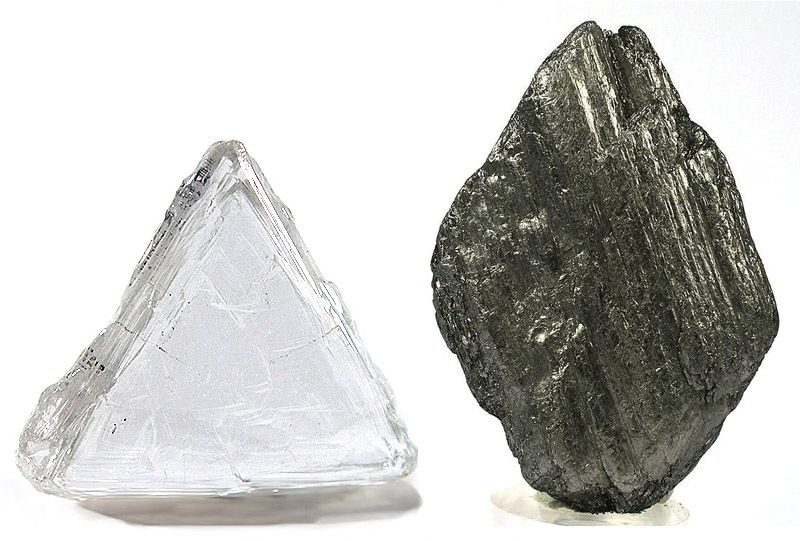 diamond: every C sp³graphite: every C sp²
Ethane, ethene and ethyne
| Ethane \(\ce{C2H6}\) | Ethene \(\ce{C2H4}\) | Ethyne \(\ce{C2H2}\) | |
|---|---|---|---|
| Carbon hybridisation | sp3 | sp2 | sp |
| C–C bond | sp3–sp3 σ | sp2–sp2 σ + one π | sp–sp σ + two π |
| C–C length | 154 pm | 134 pm | 120 pm |
| C–H bond | sp3–s σ, 109 pm | sp2–s σ, 108 pm | sp–s σ |
| Angles | 109.5° | H–C–H 117.6°, H–C–C 121° | 180° |
In ethene each carbon keeps one unhybridised p orbital, perpendicular to the plane of the molecule. These two overlap sideways to form the π bond, with electron clouds above and below the plane. In ethyne each carbon keeps two unhybridised p orbitals (2px and 2py), giving two π bonds at right angles to each other.
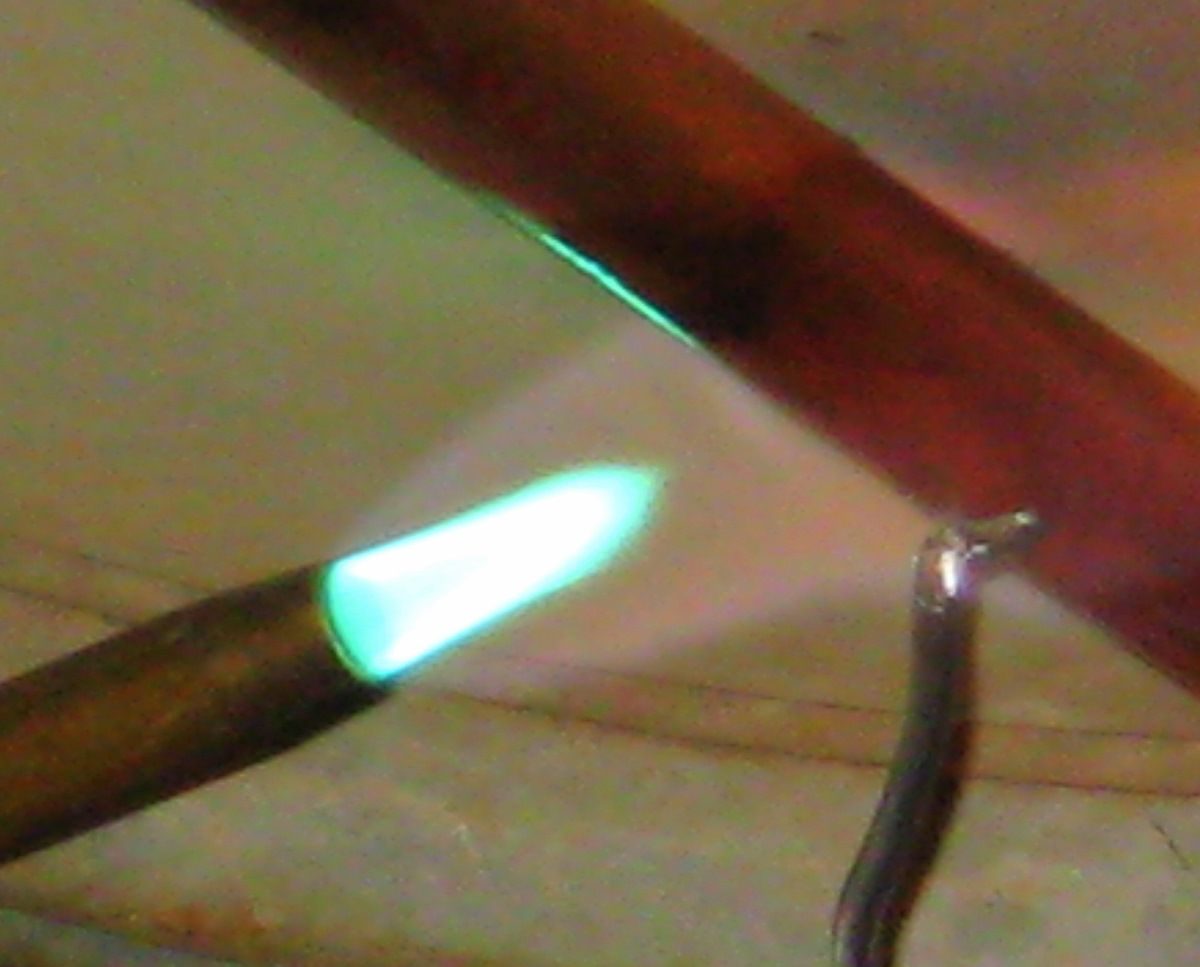 ethyne + oxygen
Try it: compare the bonds in ethane, ethene and ethyne.
Hybridisation with d orbitals
From the third period on, atoms have d orbitals close in energy to their s and p orbitals. So 3s, 3p and 3d can mix, and so can 3d, 4s and 4p. But 3p, 3d and 4s cannot all mix together, because 3p and 4s are too far apart in energy.
| Type | Orbitals mixed | Shape | Examples |
|---|---|---|---|
| dsp2 | d + s + 2p | Square planar | \(\ce{[Ni(CN)4]^2-}\), \(\ce{[PtCl4]^2-}\) |
| sp3d | s + 3p + d | Trigonal bipyramidal | \(\ce{PF5}\), \(\ce{PCl5}\) |
| sp3d2 | s + 3p + 2d | Square pyramidal | \(\ce{BrF5}\) |
| sp3d2, d2sp3 | s + 3p + 2d | Octahedral | \(\ce{SF6}\), \(\ce{[CrF6]^3-}\), \(\ce{[Co(NH3)6]^3+}\) |
\(\ce{PCl5}\), sp3d. Phosphorus (\(3s^2 3p^3\)) promotes a 3s electron into 3d, giving five half-filled orbitals that mix into five sp3d hybrids pointing to the corners of a trigonal bipyramid. Each overlaps a Cl 3p orbital. Three P–Cl bonds are equatorial, in one plane at 120°; two are axial, one above and one below, at 90° to that plane. The angles are not all equal. The axial bonds feel more repulsion from the equatorial bond pairs, so they are slightly longer and weaker, which makes \(\ce{PCl5}\) quite reactive.
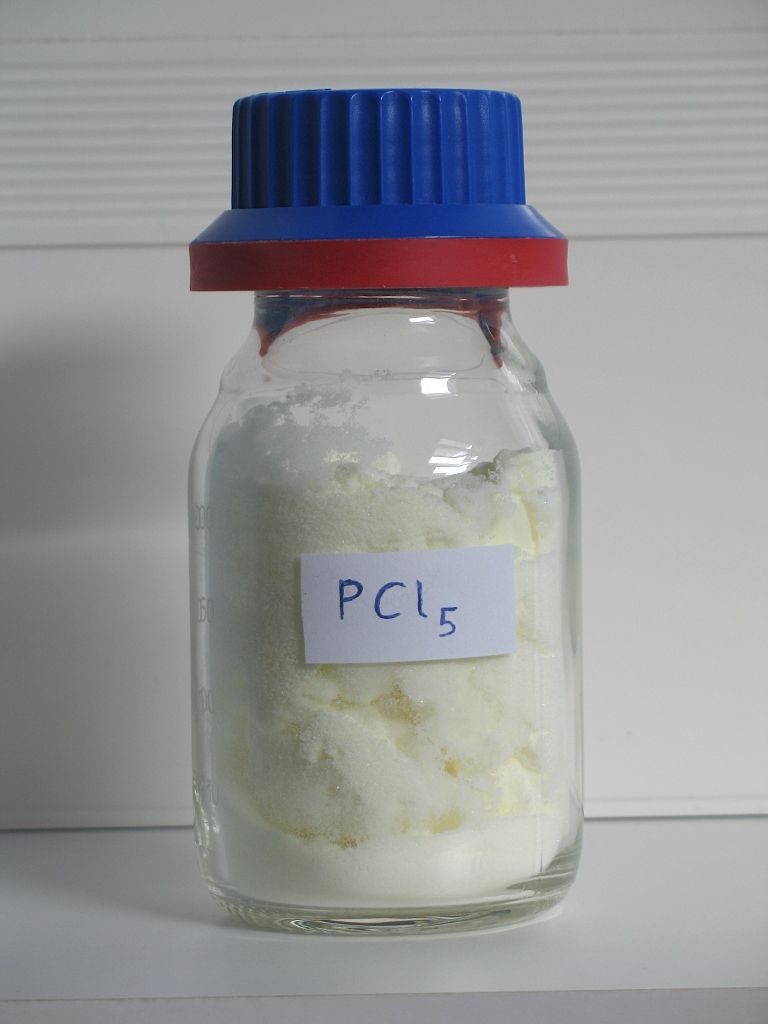 PCl₅: P is sp³d
\(\ce{SF6}\), sp3d2. Sulphur (\(3s^2 3p^4\)) gets six half-filled orbitals (one 3s, three 3p, two 3d), which mix into six sp3d2 hybrids pointing to the corners of a regular octahedron. Six S–F σ bonds, all at 90° to their neighbours.
Try it: mix in one 3d orbital, or two.
Worked example: a quick way to the hybridisation
Count the electron pairs on the central atom as in VSEPR (bond pairs + lone pairs). 2 → sp, 3 → sp2, 4 → sp3, 5 → sp3d, 6 → sp3d2.
- C in \(\ce{CO2}\): two "super pairs" (the double bonds), no lone pair → sp.
- S in \(\ce{SF4}\): 4 bond pairs + 1 lone pair = 5 → sp3d.
- Xe in \(\ce{XeF4}\): 4 + 2 = 6 → sp3d2.
Try it. What is the hybridisation of the carbon in methanal, HCHO (C bonded to two H and double bonded to O)?
Answer
Don't mix these up
- More s character means a shorter, stronger bond: sp (50%) > sp2 (33%) > sp3 (25%).
- Lone pairs sit in hybrid orbitals too: \(\ce{NH3}\) and \(\ce{H2O}\) are both sp3, though neither is tetrahedral in shape.
- π bonds are made from unhybridised p orbitals, never from hybrids.
Just remember
Each shape has a reason (the hybrids point as far apart as they can), but the names, angles and examples are what the exam asks. Count the pairs on the central atom, then:
- sp: 2, linear, 180° (BeCl2, C2H2, CO2) · sp2: 3, trigonal planar, 120° (BF3, BCl3, C2H4) · sp3: 4, tetrahedral, 109.5° (CH4, C2H6)
- The superscript plus one is the number of hybrids: sp = 1 + 1 = 2, sp2 = 1 + 2 = 3, sp3 = 1 + 3 = 4. Then the shapes go line, triangle, tetrapod.
- sp3d: 5, trigonal bipyramidal (PCl5, PF5) · sp3d2: 6, octahedral (SF6) · dsp2: 4, square planar ([Ni(CN)4]2−, [PtCl4]2−)
- Add the letters again: s + p3 + d = 5, s + p3 + d2 = 6. d before s (dsp2) means an inner d orbital is used, and four orbitals lying in one plane give a flat square.
- s character: sp 50%, sp2 33%, sp3 25%
- One s shared among 2, 3 or 4 hybrids: ½, ⅓, ¼. More s, shorter and stronger bond, and a wider angle: "more s, more spread".
- C–C: 154 (ethane), 134 (ethene), 120 pm (ethyne)
- Each extra bond pulls the carbons about 14 to 20 pm closer: 154 → 134 → 120. "One-five-four, one-three-four, one-two-oh": the middle digits fall 5, 3, 2.
- Hybridisation
- Mixing atomic orbitals of similar energy into equal new orbitals.
- Hybrid orbital
- One of the new, identical orbitals made by mixing.
- s character
- The share of s orbital in a hybrid: 50% sp, 33% sp2, 25% sp3.
- Diagonal hybridisation
- Another name for sp hybridisation (linear).
- Equatorial and axial bonds
- The three in-plane and the two top-and-bottom bonds of a trigonal bipyramid.
- Unhybridised orbital
- A p orbital left out of the mixing; it forms π bonds.
Words to know
What is the hybridisation of boron in \(\ce{BF3}\), and how many electrons surround it?
- sp3, 8
- sp2, 6
- sp2, 8
In \(\ce{PCl5}\), why are the axial bonds longer than the equatorial bonds?
- They use pure d orbitals
- They suffer more repulsion from the equatorial bond pairs
- A lone pair pushes them out
The carbon–carbon triple bond in ethyne is made of
- three σ bonds
- one σ bond and two π bonds
- two π bonds only
Deep dive · optional
Why does mixing orbitals give 109.5°, and why doesn't sulphur bother?
Where the angles of sp, sp2 and sp3 come from, how a measured angle tells you how much s is in a bond, and the December night in 1930 when Pauling worked it out. Not needed for the exam; it is here so the hybrid angles stop being a list.
The roots: lopsided orbitals and one geometry rule
- Why mix orbitals at all?A pure p orbital has two equal lobes, one on each side of the nucleus; a bond can use only one of them. Mixing in some s (a sphere, same sign everywhere) adds to one lobe and cancels part of the other. The result is lopsided: most of the orbital points one way, so it overlaps more with the partner atom, and more overlap means a stronger bond. Pauling saw this in 1930: hybrids are "more highly directed".
- Isn't mixing paid for?Yes. Carbon has to lift one 2s electron into 2p (promotion) before it has four half-filled orbitals. But it then forms four strong bonds instead of two, and the energy released by the two extra C–H bonds is far more than the promotion cost.
- Why exactly 109.5° for sp3?Hybrids made from the same s and p orbitals must not overlap each other (they must be "independent"). That one condition fixes the angle between two equal hybrids with an s share α: \( \cos\theta = -\dfrac{\alpha}{1-\alpha} \) (Coulson's theorem). For α = ¼, cos θ = −⅓ and θ = 109.47°; for ⅓, cos θ = −½ and θ = 120°; for ½, cos θ = −1 and θ = 180°. The angles in the Just remember box are this one formula at three values.
- Then why is water 104.5°?Run the formula backwards: cos 104.5° = −0.25, so α = 0.20. Each O–H bond orbital is 20% s, 80% p (chemists write sp4). The s left over (60%) sits in the lone pairs, where an electron gains most from s: an s electron spends more time close to the nucleus, so it is held more tightly.
- And sulphur's 92°?Mixing works only if the s and p orbitals are about the same size. A 2p orbital is less than 10% bigger than the 2s; a 3p orbital is 20 to 33% bigger than the 3s, and the gap grows down the group. For sulphur, mixing gives little extra overlap, so it hardly mixes: its bonds use almost pure 3p orbitals, which are 90° apart.
- The bedrockThe shapes of s and p orbitals (Chapter 2), the rule that more overlap makes a stronger bond (previous page), and the geometry of independent waves. Energy decides how much s goes where; geometry turns that into an angle.
The story
 molecular model
See it
Two hybrids drawn to their real shape. Guess first; then drag the s share and watch the lobes fatten on one side and the angle open. Tap a molecule to run its measured angle backwards, and "Every s share" to see all of them on Coulson's curve at once.
Notice where the real molecules sit: methane, BF3 and BeCl2 exactly on the textbook values; ammonia and water a little below sp3 (their lone pairs have taken extra s); phosphine and hydrogen sulphide down near the pure-p corner, because the s and p orbitals of the third period are too different in size to mix well.
Solve it
Solve it: 109.47° from a cube
Put carbon at the centre of a cube and the four hydrogens on alternate corners, at (1, 1, 1), (1, −1, −1), (−1, 1, −1) and (−1, −1, 1). Find the angle between two C–H bonds without a protractor.
Hint
Answer
Solve it: ammonia, backwards
Ammonia's measured H–N–H angle is 106.7°. How much s is in each N–H bond orbital, and how much is left for the lone pair? (cos 106.7° = −0.287.)
Answer
Solve it: predict
Ethyne's C–H bonds use sp hybrids (50% s); ethane's use sp3 (25% s). Which C–H bond is shorter, and in which molecule are the hydrogens held more tightly by carbon's electrons, so that the C–H electron pair stays closer to carbon?
Answer
Connect it
Connect it
- Same count, two languages. VSEPR counts electron pairs; hybridisation names the orbitals they sit in. Both say 4 pairs → 109.5°, and both stumble on H2S: Why is water bent?
- Orbital shapes, Chapter 2. The sphere, the dumbbells and their + and − signs that mixing adds and cancels: Shapes and energies of orbitals; carbon's 2s2 2p2 on Electronic configuration.
- No d orbitals in period 2, Chapter 3. Why nitrogen stops at four bonds while phosphorus seems to reach five, and what modern calculations say about "sp3d": Valence and the second period.
- Benzene, Chapter 9. Six sp2 carbons in a flat ring, each with a leftover p orbital sticking up: Benzene and aromaticity.
- Carbide and mangoes. Calcium carbide gives off acetylene (ethyne) with water. It has been used to ripen fruit, including mangoes in Indian markets, but this is illegal in several countries, because carbide-made acetylene carries traces of the poisons phosphine and arsine.
Still confused?
Does carbon really promote an electron and then mix its orbitals, step by step?
No. The molecule simply settles into its lowest-energy arrangement; "promote, then mix" is bookkeeping that lets us describe that arrangement with familiar orbitals. Hybridisation describes the shape that is there; it does not cause it, and it is not a process that happens in time.
Are both of water's lone pairs sp3?
In the textbook picture, yes. Careful calculations describe them differently: one lone pair in an almost pure p orbital, the other in an s-rich hybrid. Both descriptions give the same total electron cloud, so for the exam "sp3, two lone pairs" is right.
Is SF6 really sp3d2?
It is the textbook answer and the one to write. But in 1990 Eric Magnusson showed by calculation that the 3d orbitals of period 3 atoms take almost no part in bonding; the extra bonds of SF6 and PCl5 come from more ionic, shared-over-three-atoms bonding instead. The shapes are still exactly what VSEPR and "sp3d2" predict.
Sources
- Linus Pauling and The Nature of the Chemical Bond: A Documentary History, Oregon State University: "Breakthrough" (December 1930, the radial short cut, "quite a simple one"), "Euphorious" (the all-night quote), "The Nature of the Chemical Bond" (submitted mid-February 1931), "Competition" (Slater, Physical Review, 1 March 1931), "Cornell" and "An Instant Classic" (1939, Smyth's fishing trip)
- L. Pauling, "The Nature of the Chemical Bond. Application of results obtained from the quantum mechanics...", J. Am. Chem. Soc. 53, 1367 (1931)
- The Nobel Prize in Chemistry 1954, nobelprize.org
- Bent's rule, Wikipedia: Coulson's theorem, cos ω = −1/λ for hybrids s + √λ p (Coulson, Valence, 1961)
- Orbital hybridisation, Wikipedia: water's bond orbitals sp4.0, 20% s; hybridisation defects (3p 20–33% larger than 3s, 2p under 10% larger than 2s; Kaupp 2007); the two kinds of lone pair in water; Magnusson 1990 on d orbitals
- Hydrogen chalcogenide, Phosphine and Ammonia, Wikipedia: measured angles (H2S 92.1°, PH3 93.5°, NH3 106.7°, H2O 104.45°)
- Diamond and Graphite, Wikipedia: sp3 carbon with four neighbours, hardest on the Mohs scale; sp2 sheets, 0.142 nm bonds, 0.335 nm between layers
- Acetylene, Wikipedia: oxygen with acetylene is the hottest-burning common gas mixture; Calcium carbide, Wikipedia: fruit ripening, illegal in some countries because of phosphine and arsine
Picture and video credits
Show 3 picture and video credits
- diamond-and-graphite.jpg: Robert M. Lavinsky, CC BY-SA 3.0
- oxyacetylene-torch-flame.jpg: Sheila, CC BY 2.0
- phosphorus-pentachloride-jar.jpg: W. Oelen, CC BY-SA 3.0


