- 1. What is a vector?
- 2. How do you add two arrows?
- 3. Breaking a vector into parts
- 4. Adding vectors with numbers
- 5. Velocity and acceleration in a plane
- 6. Motion in a plane with constant acceleration
- 7. How does a thrown ball move?
- 8. How high, how long, how far?
- 9. Why is steady circling still accelerating?
- Review
7 of 9·NCERT §3.9·pp. 38–40·6 min
How does a thrown ball move?
The big ideaA thrown object moves sideways at a steady speed while it falls freely up and down, and together these make a parabola.
In simple words
Throw a ball across a field. Sideways, nothing pulls it, so it keeps going sideways at the same speed. Up and down, the earth pulls it, so it slows on the way up and speeds up on the way down, just like a ball thrown straight up. Put the steady sideways motion and the up-and-down motion together and you get the curved arc you see.
What is a projectile?
An object that is flying freely after being thrown or launched is a projectile: a cricket ball after it leaves the bowler's hand, a football after a kick, a javelin, a stone from a catapult, water leaving a garden hose. We assume air resistance is negligible, so the only force on it is gravity.
A projectile's motion is the result of two separate motions happening together:
- horizontal: no acceleration, so constant velocity;
- vertical: constant acceleration \( g \) downward, exactly as in free fall.
Galileo was the first to state that these two parts are independent, in his Dialogue on the Great World Systems (1632). It is the result of the last concept applied to gravity.
The equations
Put the origin at the launch point, x horizontal and y vertically up. The object is launched with speed \( v_0 \) at angle \( \theta_0 \) above the x-axis (the angle of projection). Once it is in the air,
\[ \mathbf{a} = -g\,\hat j, \qquad a_x = 0, \quad a_y = -g \]Resolve the launch velocity into components:
\[ v_{0x} = v_0\cos\theta_0, \qquad v_{0y} = v_0\sin\theta_0 \]With \( x_0 = y_0 = 0 \), the constant-acceleration equations become
\[ x = (v_0\cos\theta_0)\,t, \qquad y = (v_0\sin\theta_0)\,t - \tfrac12 g t^2 \] \[ v_x = v_0\cos\theta_0, \qquad v_y = v_0\sin\theta_0 - g t \]Only two numbers, \( v_0 \) and \( \theta_0 \), fix the whole flight. The x-component of velocity never changes. Only the y-component changes, falling by \( g \) every second, like a ball thrown straight up. It shrinks to zero at the highest point and then becomes negative on the way down. At the top, therefore, the velocity is purely horizontal, of size \( v_0\cos\theta_0 \), and at any moment its angle with the horizontal is \( \theta = \tan^{-1}(v_y/v_x) \).
Try it: throw the javelin and watch the two parts of its velocity. The blue one never changes; the red one falls by g every second.
Here is the same idea as two shadows. Light from straight above casts the ball's x-story on the ground; light from the side casts its y-story on a wall.
The path is a parabola
To find the shape of the path, remove \( t \). From the x-equation, \( t = x/(v_0\cos\theta_0) \). Put this into the y-equation:
\[ y = (\tan\theta_0)\,x - \frac{g}{2\,(v_0\cos\theta_0)^2}\,x^2 \]Since \( g \), \( v_0 \) and \( \theta_0 \) are constants, this has the form \( y = ax + bx^2 \) with \( a \) and \( b \) constants (\( b \) is negative). That is the equation of a parabola. The trajectory (path) of every projectile, without air resistance, is a parabola that opens downward and is symmetric about its highest point.
A water jet makes the parabola visible: every drop is a projectile launched from the same nozzle at the same speed and angle, so the drops line up along one path.
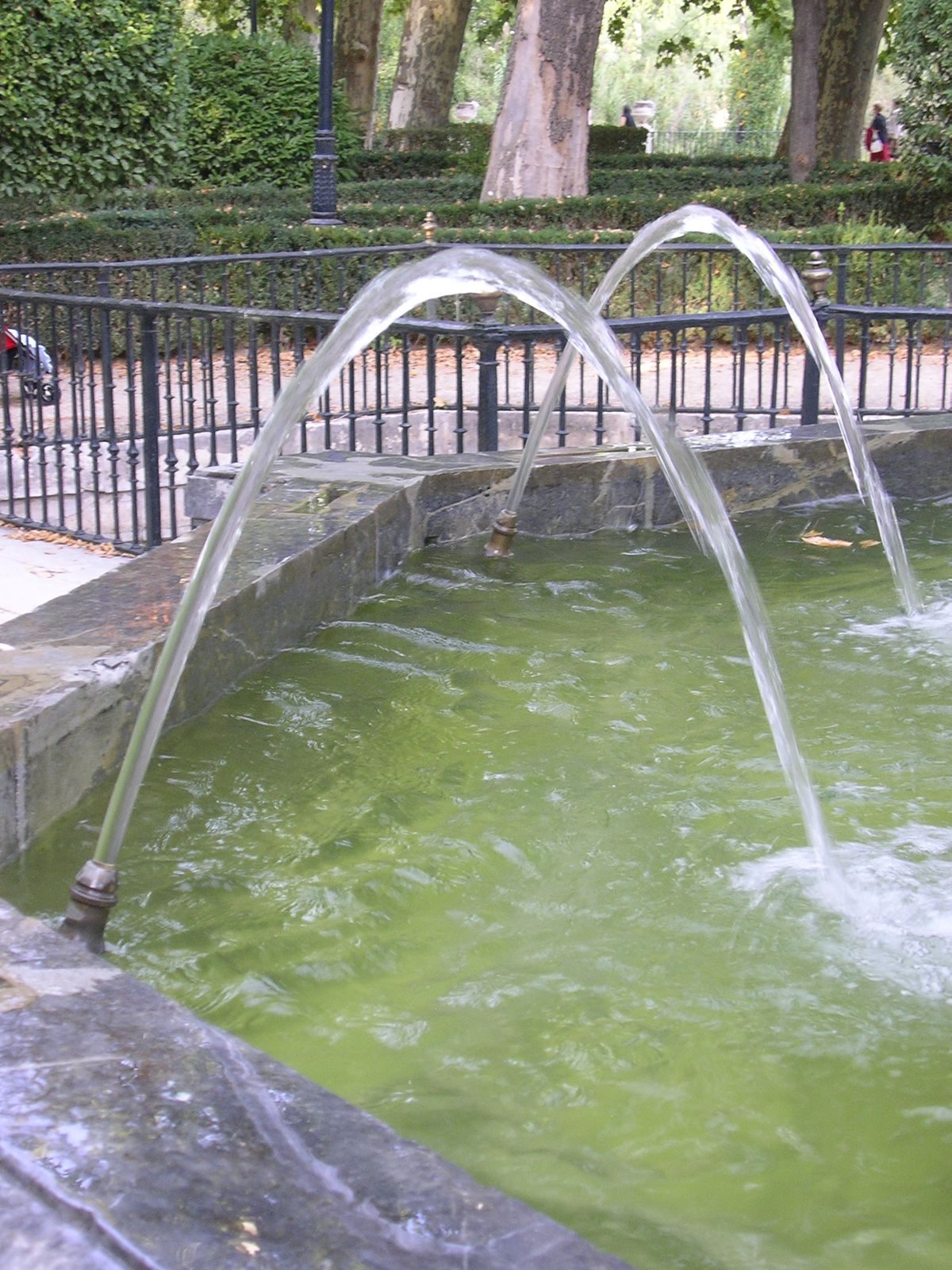 top: moving only sidewaysnozzle: the launchcomes down as steeply as it went up

Try it: guess where the ball comes down, then watch it from the road and from the cycle.
Thrown sideways from a height
A common case: the object is launched horizontally (\( \theta_0 = 0 \)) from a height \( h \). Then \( v_{0y} = 0 \), and the vertical motion is a plain drop from rest. The time to reach the ground is \( t = \sqrt{2h/g} \), the same as if it were simply dropped. The horizontal speed only decides how far it lands, not when.
Try it: throw one stone sideways off a cliff while the other is simply dropped, and see which lands first.
Worked example
A boy on a rooftop 20 m high throws a ball horizontally at 10 m s−1. Find the time to reach the ground, how far from the building it lands, and its speed on landing. (Take g = 10 m s−2.)
- Origin at the throw, x along the throw, y up. Then \( v_{0x} = 10 \), \( v_{0y} = 0 \), \( a_y = -10 \).
- Vertical: the ball lands when \( y = -20 \) m: \( -20 = -\tfrac12(10)t^2 \), so \( t^2 = 4 \) and \( t = \) 2 s.
- Horizontal: \( x = 10 \times 2 = \) 20 m from the building.
- Landing velocity: \( v_x = 10 \), \( v_y = 0 - 10 \times 2 = -20 \) m s−1. Speed \( = \sqrt{100 + 400} = \sqrt{500} \approx \) 22.4 m s−1, at \( \tan^{-1}(20/10) \approx 63^\circ \) below the horizontal.
Don't mix these up
- A ball dropped and a ball thrown sideways from the same height land at the same time. The sideways speed does not change the falling.
- At the top of the path the velocity is not zero; only its vertical part is. The speed there is \( v_0\cos\theta_0 \).
- The acceleration is \( g \) downward everywhere on the path, including the top.
- Something dropped from a moving vehicle is a projectile too: at the moment of release it keeps the vehicle's horizontal velocity, and from then on only \( g \) acts on it.
Try it
A stone is thrown horizontally at 15 m s−1 from a cliff and hits the ground 3 s later. How high is the cliff and how far out does the stone land? (g = 10 m s−2.)
Answer
Just remember
Conventions, not physics. Fix them once and use the hooks.
- The angle of projection \( \theta_0 \) is measured up from the horizontal
- "Ground first": you measure from the ground up, the way a bowler or a javelin thrower sees it. If a question gives the angle with the vertical, convert first: 30° to the vertical is 60° to the horizontal.
- With θ₀ from the horizontal: \( v_{0x} = v_0\cos\theta_0 \), \( v_{0y} = v_0\sin\theta_0 \)
- "Cos goes across, sin goes to the sky." (Only true when θ₀ is from the horizontal; that is why the first rule matters.)
- The 0 in \( v_0 \), \( \theta_0 \) means "at launch"
- Zero seconds on the clock. \( v_0 \) is the launch speed; \( v \) without the 0 is the speed at time \( t \).
- \( v_x \) never changes; only \( v_y \) does
- "Sideways is lazy": nothing pushes it, so it keeps its launch value all flight. Every change happens in \( v_y \), at 9.8 m s−1 every second.
- Projectile
- An object in free flight after being thrown or launched.
- Angle of projection, θ₀
- The angle of the launch velocity above the horizontal.
- Trajectory
- The path an object follows through the air.
- Parabola
- The curve y = ax + bx², the shape of every projectile's path.
- Air resistance
- The push of air against a moving object; ignored here.
Words to know
At the highest point of its path, a projectile's velocity is
- zero
- horizontal, with size v₀ cos θ₀
- vertical
From the same table top, one coin slides off the edge fast and another is just nudged off slowly. Which hits the floor first?
- The fast one
- The slow one
- Both together
What is the acceleration of a cricket ball at the top of its flight (no air resistance)?
- Zero
- g, straight down
- Less than g
Deep dive · optional
Why a parabola, and why did nobody see it before 1600?
A picture-proof of the parabola you can do in your head, the strange three-part path gunners drew for a century, and the page in Galileo's notebook where a ball rolling off a table gave the real answer. The exam doesn't need this; it makes the page stick.
The roots: an aim line and a fall
- Why is the path a parabola?Because \( x \) grows in step with \( t \), while \( y \) has a \( t^2 \) term. Swap \( t \) for \( x/v_{0x} \) and \( y \) becomes \( ax - bx^2 \): a parabola.
- Why does \( x \) grow in step with \( t \)?Nothing pushes the ball sideways once it is in the air, so \( v_x \) never changes. Equal times, equal sideways steps.
- Why is there a \( t^2 \) in \( y \)?Without gravity the ball would fly along a straight aim line, in the direction it was thrown. Gravity makes it fall below that line, from rest, by \( \tfrac12 g t^2 \): 4.9 m after 1 s, 19.6 m after 2 s, 44.1 m after 3 s. That growing drop is the \( t^2 \).
- So what is a parabola, as a picture?Take equal steps along a straight line, and from step 1, 2, 3, 4 drop down by 1, 4, 9, 16 units. Join the dots. Every projectile's path is drawn exactly this way.
- And the bedrock?Two things you already believe: a body keeps its velocity unless something changes it, and near the ground gravity gives everything the same constant downward acceleration. Nothing else goes in.
Look at the equation of the path again with this picture in mind:
\[ y = \underbrace{(\tan\theta_0)\,x}_{\text{aim line}} \; - \; \underbrace{\tfrac12 g \left(\tfrac{x}{v_0\cos\theta_0}\right)^2}_{\text{drop } \frac12 g t^2} \]The first term is the straight line the ball is aimed along; the second is the free-fall drop, with \( t \) written as \( x/v_{0x} \). The model has limits, and Galileo knew them. Air slows the sideways motion, so a fast ball comes down more steeply than it went up. And gravity points to the earth's centre, not along parallel lines; over a few kilometres that hardly matters, but over thousands of kilometres the path becomes part of an ellipse round the earth's centre.
Why did older thinkers get it wrong? They believed a thrown body needs something inside it, an impetus given by the thrower, to keep it moving. While the impetus is strong, the ball goes straight; as it weakens, gravity slowly takes over; at the end the ball drops straight down. That gives a path made of a straight climb, a curve and a straight drop. Two ideas were missing: that nothing is needed to keep a body moving, and that gravity and the sideways motion act together from the very first instant. Real cannonballs did not help: they fly in a few seconds, too fast to see, and the air really does make their descent steeper.
The story
See it
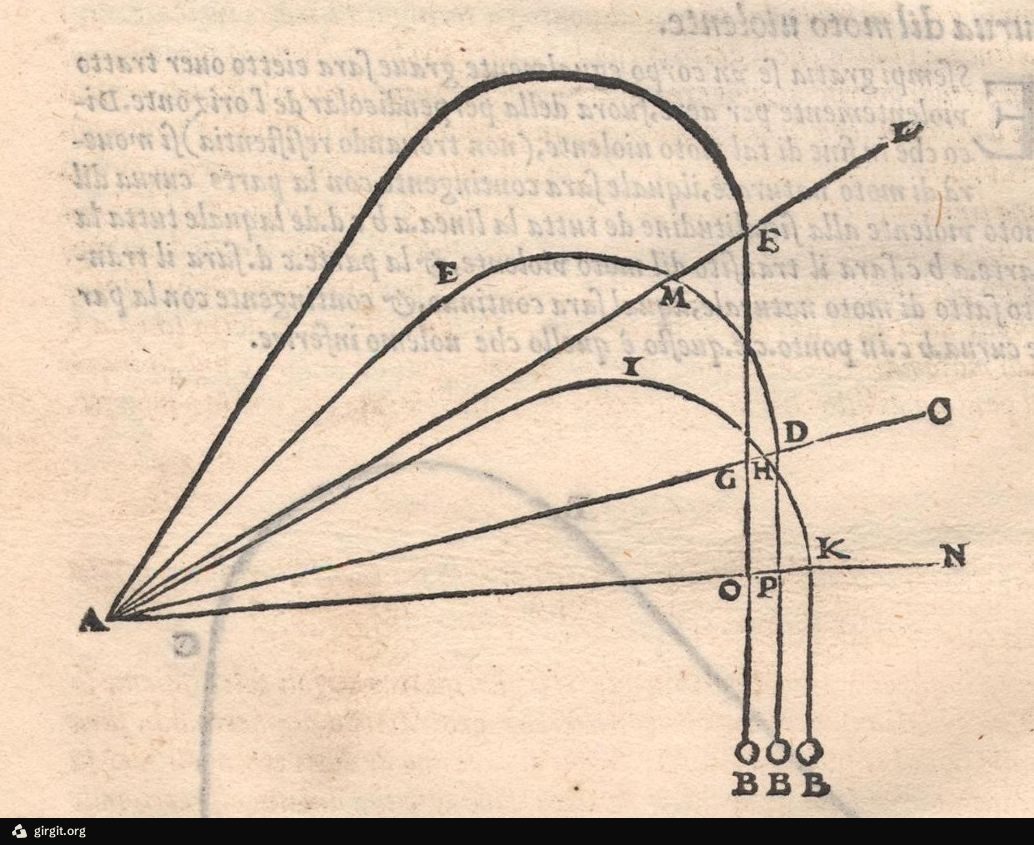 cannon1: a straight line2: an arc3: straight down
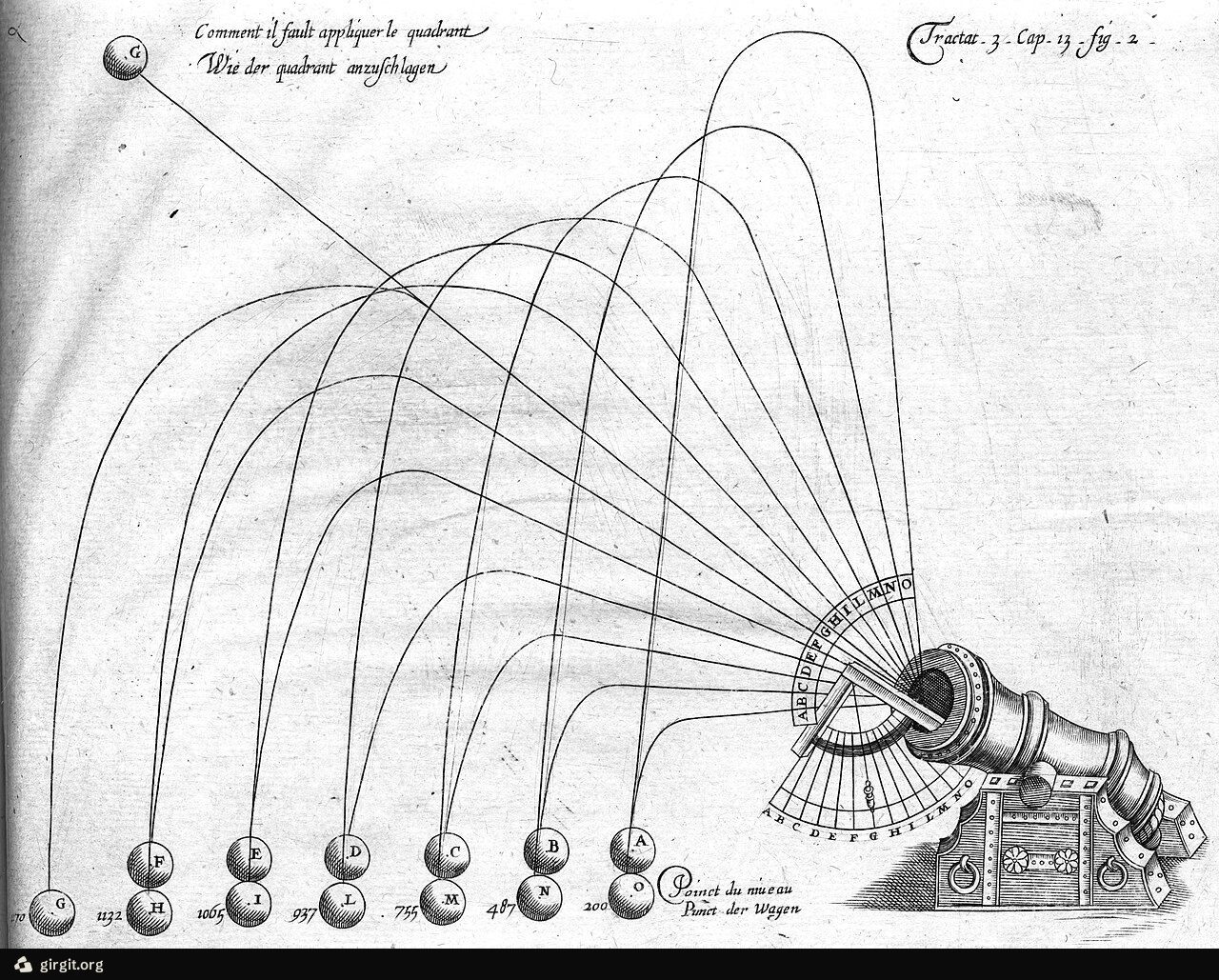 gunner's quadrant sets the anglerises almost straightfalls almost straight
Now Galileo's table. Guess first, then set the ball off from his five heights and watch it land on his marks.
Two things to notice. The landing distance goes as the square root of the height, because the speed off the table does (\( v^2 \propto h \)) while the fall time is fixed by the table. And his marks sit a little short of the rolling-ball line: some energy is lost at the bend from ramp to table, and the ball rubs on its groove.
Solve it
Solve it
Check Galileo's first run with physics. The ball starts 300 punti (0.282 m) up the ramp; the table is 828 punti (0.778 m) high. (a) If the ball slid without friction, \( v^2 = 2gh \). (b) A rolling solid ball keeps some energy in its spin, and \( v^2 = \tfrac{10}{7}gh \). Predict the landing distance both ways and compare with his 800 punti.
Hint
Answer
Solve it
Spot the error. In a cartoon, a car races off a cliff edge, carries on straight out in mid-air, stops, looks down, and only then falls straight down. Name everything wrong with this path and describe the real one.
Answer
Solve it
A ball is thrown at 20 m s−1 at 30° above the horizontal (g = 10 m s−2). Using only the "aim line minus drop" picture, find how far below its aim line it is when it has gone 17.3 m sideways, and its height then.
Answer
Connect it
Connect it
- Free fall, Chapter 2. The drop below the aim line is free fall from rest, 1 : 4 : 9 : 16 in equal times: free fall and the odd-number rule.
- Maths, Conic sections. The same curve Apollonius studied as a slice of a cone, and the one Galileo's characters worry they need to learn: what is a parabola?
- Next page. How high, how long and how far, from the same two equations: height, range and time of flight.
- Gravitation, Chapter 7. When the range is so large that gravity's direction changes along the way, the parabola becomes an orbit: earth satellites.
- Daily life. Every drop in a garden hose, every spark from a sparkler and every ball a fielder throws to the keeper flies on its own parabola (bent a little by the air).
Still confused?
Is a real thrown ball's path exactly a parabola?
No, only very nearly. Air drag slows the ball, mostly its sideways motion, so the far side of the arc is shorter and steeper than the near side. For a cricket ball thrown 30 to 40 m the difference is small; for a shuttlecock it is huge. Galileo himself wrote that the air spoils his parabolas for very fast shots.
If gravity pulls down from the start, why does the ball go up at first?
Because it starts with an upward velocity, \( v_0\sin\theta_0 \). Gravity does not reverse that at once; it shrinks it by 9.8 m s−1 every second. The ball keeps rising, more and more slowly, until \( v_y \) reaches zero at the top.
Why does a ball thrown sideways from a table land farther from a higher ramp, but not later?
The ramp only changes the sideways speed at the edge. The time in the air is set by the table's height alone (\( t = \sqrt{2H/g} \)), so a faster ball covers more ground in the same time.
Sources
- Museo Galileo, Galileo's notes on motion (Ms. Gal. 72), folio 116v, with the transcribed drawing D01A: table height, heights, distances, "doveria" values and differences.
- Galileo, Two New Sciences (1638), Fourth Day, Crew and de Salvio translation (1914): Theorem 1, the set-up, the air and the earth's centre.
- MacTutor, Niccolò Tartaglia: Brescia 1512, the wound and the nickname, Nova Scientia (1537).
- Wikipedia, "Niccolò Fontana Tartaglia", citing Valleriani, Metallurgy, Ballistics and Epistemic Instruments: The Nova Scientia of Nicolò Tartaglia (2013): the three-part path, 45°, Galileo's annotated copies.
- MacTutor, Thomas Harriot: gunnery for Raleigh, components, the tilted parabola by 1607.
- R. Vergara Caffarelli, "How long is Galileo's punctus?" (2005): 1 punto ≈ 0.94 mm.
Picture and video credits
Show 2 picture and video credits
- fountain-parabola-aranjuez.jpg: GuidoB, CC BY-SA 3.0
- water-jets-arching-night.jpg: PattayaPatrol, CC BY-SA 4.0

