- 1. What is a vector?
- 2. How do you add two arrows?
- 3. Breaking a vector into parts
- 4. Adding vectors with numbers
- 5. Velocity and acceleration in a plane
- 6. Motion in a plane with constant acceleration
- 7. How does a thrown ball move?
- 8. How high, how long, how far?
- 9. Why is steady circling still accelerating?
- Review
8 of 9·NCERT §3.9·pp. 38–40·6 min
How high, how long, how far?
The big ideaThe vertical part of the launch velocity decides how long and how high a projectile flies; both parts together decide how far, and 45° gives the longest range.
In simple words
Throw a ball more steeply and it goes higher and stays up longer, but it moves forward slowly. Throw it flatter and it races forward, but it falls back almost at once. Somewhere in the middle, halfway between flat and straight up, the ball goes farthest.
We keep the set-up of the last concept: launch from the origin at speed \( v_0 \) and angle \( \theta_0 \), landing back at the same level, no air resistance.
Time to reach the top
At the highest point \( v_y = 0 \). Call this time \( t_m \). From \( v_y = v_0\sin\theta_0 - g t \):
\[ v_0\sin\theta_0 - g\,t_m = 0 \quad\Rightarrow\quad t_m = \frac{v_0\sin\theta_0}{g} \]Time of flight
The projectile is back at launch height when \( y = 0 \). Put \( y = 0 \) in \( y = (v_0\sin\theta_0)t - \tfrac12 g t^2 \): either \( t = 0 \) (the launch) or
\[ T_f = \frac{2\,v_0\sin\theta_0}{g} \]\( T_f \) is the time of flight. Notice \( T_f = 2t_m \): going up takes exactly as long as coming down, as you would expect from the symmetric shape of the parabola.
Maximum height
Put \( t = t_m \) into the y-equation to get the maximum height \( h_m \):
\[ h_m = (v_0\sin\theta_0)\frac{v_0\sin\theta_0}{g} - \frac{g}{2}\left(\frac{v_0\sin\theta_0}{g}\right)^2 \] \[ h_m = \frac{(v_0\sin\theta_0)^2}{2g} \]This is the height a ball would reach if thrown straight up with speed \( v_0\sin\theta_0 \), which makes sense: the vertical motion does not know about the horizontal one.
 top: vertical speed zerohalfway: up time = down time
Horizontal range
The horizontal range \( R \) is the horizontal distance from the launch point to where the projectile comes back down to the same level (y = 0). It is the steady horizontal speed times the time of flight:
\[ \begin{aligned} R &= (v_0\cos\theta_0)\,T_f = (v_0\cos\theta_0)\frac{2v_0\sin\theta_0}{g} \\ &= \frac{v_0^2\,(2\sin\theta_0\cos\theta_0)}{g} \end{aligned} \] \[ R = \frac{v_0^2\sin 2\theta_0}{g} \]For a fixed speed, \( R \) is largest when \( \sin 2\theta_0 \) is largest, which is 1 at \( 2\theta_0 = 90^\circ \), that is \( \theta_0 = 45^\circ \). The maximum range is
\[ R_m = \frac{v_0^2}{g} \]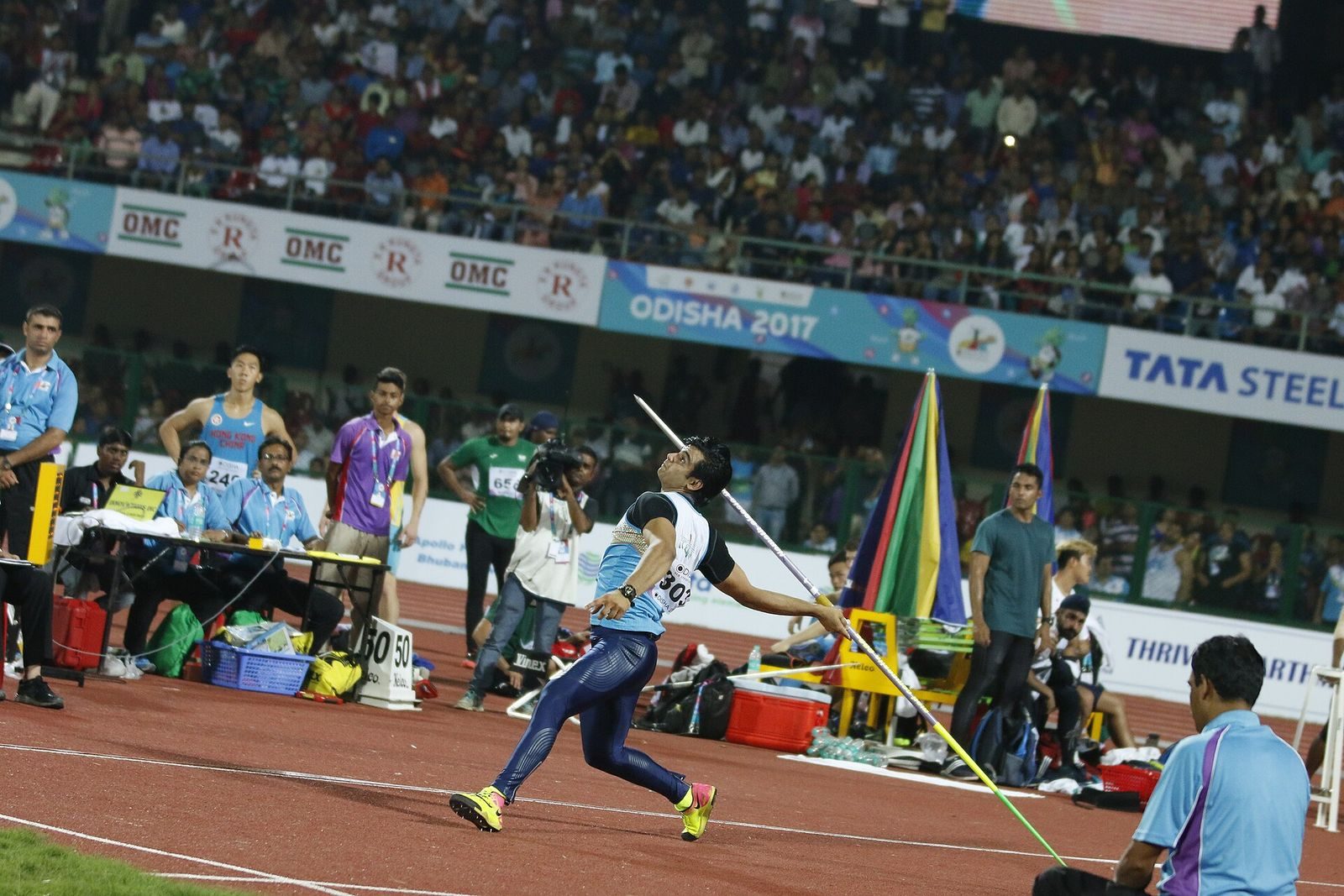 tip raised: sets the launch angleNeeraj Choprathrowing hand: the release point
Try it: drag back and hit the ball. Compare shots at different angles: the previous one stays as a ghost.
Two angles, one range
Galileo wrote, in his Two New Sciences, that throws at angles the same amount above and below 45° land at the same distance. Here is why. For \( \theta_0 = 45^\circ + \alpha \) and \( 45^\circ - \alpha \), the values of \( 2\theta_0 \) are \( 90^\circ + 2\alpha \) and \( 90^\circ - 2\alpha \). Both have the same sine, \( \cos 2\alpha \). So the ranges are equal.
Try it: tilt the hose and find two angles that wet the same patch.
Put another way, angles that add to 90° (such as 30° and 60°, or 15° and 75°) give the same range. They do not give the same flight: the steeper throw goes higher and stays up longer.
Try it: two balls, same speed, same landing spot. Guess which comes down first.
Projectile formulas (launch and landing at the same level)
- Time to top: \( t_m = v_0\sin\theta_0 / g \)
- Time of flight: \( T_f = 2v_0\sin\theta_0 / g \)
- Maximum height: \( h_m = (v_0\sin\theta_0)^2 / 2g \)
- Range: \( R = v_0^2\sin 2\theta_0 / g \), largest at 45°: \( R_m = v_0^2/g \)
- Speed at the top: \( v_0\cos\theta_0 \)
Worked example
A fielder throws a cricket ball at 20 m s−1 at 30° above the horizontal. Find the time to the top, the time of flight, the maximum height and the range. (g = 10 m s−2.)
- Components: \( v_{0y} = 20\sin 30^\circ = 10 \) m s−1, \( v_{0x} = 20\cos 30^\circ \approx 17.3 \) m s−1.
- \( t_m = 10/10 = \) 1 s; \( T_f = 2 \times 1 = \) 2 s.
- \( h_m = 10^2 / (2 \times 10) = \) 5 m.
- \( R = 17.3 \times 2 \approx \) 34.6 m. Check: \( v_0^2\sin 60^\circ / g = 400 \times 0.866 / 10 = 34.6 \) m.
- At 60° with the same speed: the range is the same 34.6 m, but \( v_{0y} = 17.3 \), so \( h_m = 300/20 = 15 \) m and \( T_f \approx 3.5 \) s.
Worked example
A football rises to a greatest height of 5 m and lands 40 m from where it was kicked. At what angle was it kicked?
- Divide the height formula by the range formula. The \( v_0^2 \) and \( g \) cancel: \( \dfrac{h_m}{R} = \dfrac{\sin^2\theta_0/2}{2\sin\theta_0\cos\theta_0} = \dfrac{\tan\theta_0}{4} \).
- So \( \tan\theta_0 = 4h_m/R = 4 \times 5 / 40 = 0.5 \), and \( \theta_0 \approx \) 27°.
- Handy result: \( R = 4h_m/\tan\theta_0 \). At 45°, \( \tan\theta_0 = 1 \), so the range is four times the height.
Try it
The farthest a student can throw a ball on level ground is 80 m. How fast does she throw it, and how long is it in the air on that longest throw? (g = 10 m s−2.)
Answer
Just remember
Each formula has its reason above, but in an exam you want them in a second. The symbols are NCERT's choice; the hooks are ours.
- Time and height use only the up part, \( v_0\sin\theta_0 \)
- "Up decides up": \( T_f = 2v_0\sin\theta_0/g \) and \( h_m = (v_0\sin\theta_0)^2/2g \) are just the straight-up throw of the last chapter with \( u = v_0\sin\theta_0 \).
- Range: \( R = v_0^2\sin 2\theta_0/g \)
- "Double the angle, then sine it." The 2 comes from \( 2\sin\theta_0\cos\theta_0 \): forward speed times time in the air.
- 45° is best; 45° ± α tie
- Complementary angles (adding to 90°) are "range twins": same landing spot, different flight. At 45°, \( R = 4h_m \): "four heights fit under the 45° arch".
- Time of flight, Tf
- How long the projectile stays in the air.
- Maximum height, hm
- The greatest height above the launch point.
- Horizontal range, R
- The horizontal distance to where it comes back to launch height.
- Maximum range
- The longest range for a given speed, v₀²/g, reached at 45°.
- Complementary angles
- Two angles that add up to 90°; they give equal ranges.
Words to know
A ball thrown at 30° lands 40 m away. At which other angle, with the same speed, would it land 40 m away?
- 45°
- 60°
- 15°
- 90°
You double the launch speed and keep the angle. The range becomes
- twice as large
- four times as large
- the same
A ball is thrown at 20 m s−1 at 30° to the vertical. What is its speed at the top of its path?
- 10√3 m s⁻¹ (about 17.3)
- 10 m s⁻¹
- Zero
Deep dive · optional
Why 45°, and why do real throwers aim lower?
Where the 45° rule comes from, a picture proof of it, why a shot-putter or a fielder does better a little below it, and the two men who found the rule a century apart. The exam doesn't need this; it makes the page stick.
The roots: one speed, two jobs
- Why does 45° throw farthest on flat ground?The range is just (forward speed) × (time in the air). Forward speed goes as \( \cos\theta_0 \); time in the air goes as \( \sin\theta_0 \). Tilt up and you buy time but lose forward speed; tilt down and the opposite.
- Why is the product largest when the two are equal?Draw a rectangle with sides \( \cos\theta_0 \) and \( \sin\theta_0 \). Its diagonal is always 1, because \( \cos^2\theta_0 + \sin^2\theta_0 = 1 \). Of all rectangles with the same diagonal, the square has the most area. Square means \( \cos\theta_0 = \sin\theta_0 \): 45°.
- Why does letting go above the ground lower the best angle?A shot released 2 m up gets some time in the air for free: it has 2 m to fall after it is back at hand height. Time is now cheaper, so it pays to put more of the speed into going forward. The best angle drops below 45°, and it drops more for a slow throw from high up than for a fast one.
- Then why do athletes go lower still?Because a human arm does not throw equally hard at every angle. Measurements on shot-putters and footballers show the release speed falls as the angle rises: our muscles push harder forward than upward. A javelin also flies like a wing, and air drag slows every ball.
- And the bedrock?Range = forward speed × time in the air, with gravity setting the time. Everything above is that one product, traded off.
Put numbers in. From the ground, \( R \propto \sin 2\theta_0 \), so the peak is flat: 40° or 50° gives \( \sin 80^\circ = 0.985 \), only 1.5% short of the best. That flatness is why small effects shift the best angle so easily. From a height \( h \), the best angle obeys
\[ \tan\theta^{*} = \frac{v_0}{\sqrt{v_0^2 + 2gh}} \]which is less than 1, so \( \theta^{*} < 45^\circ \). For a shot let go 2 m up at 13 m s−1, \( \theta^{*} \approx 42^\circ \). Add the falling release speed, and the physicist Nick Linthorne found that the real best angle for shot-putters comes out at about 32° to 35°, which is what good shot-putters actually use. For the javelin, a similar study found about 37°; for the long jump, where the run-up gives a lot of forward speed but little upward speed, about 20° to 25°.
The story
See it
Guess first, then raise and lower the hand and watch the best angle move.
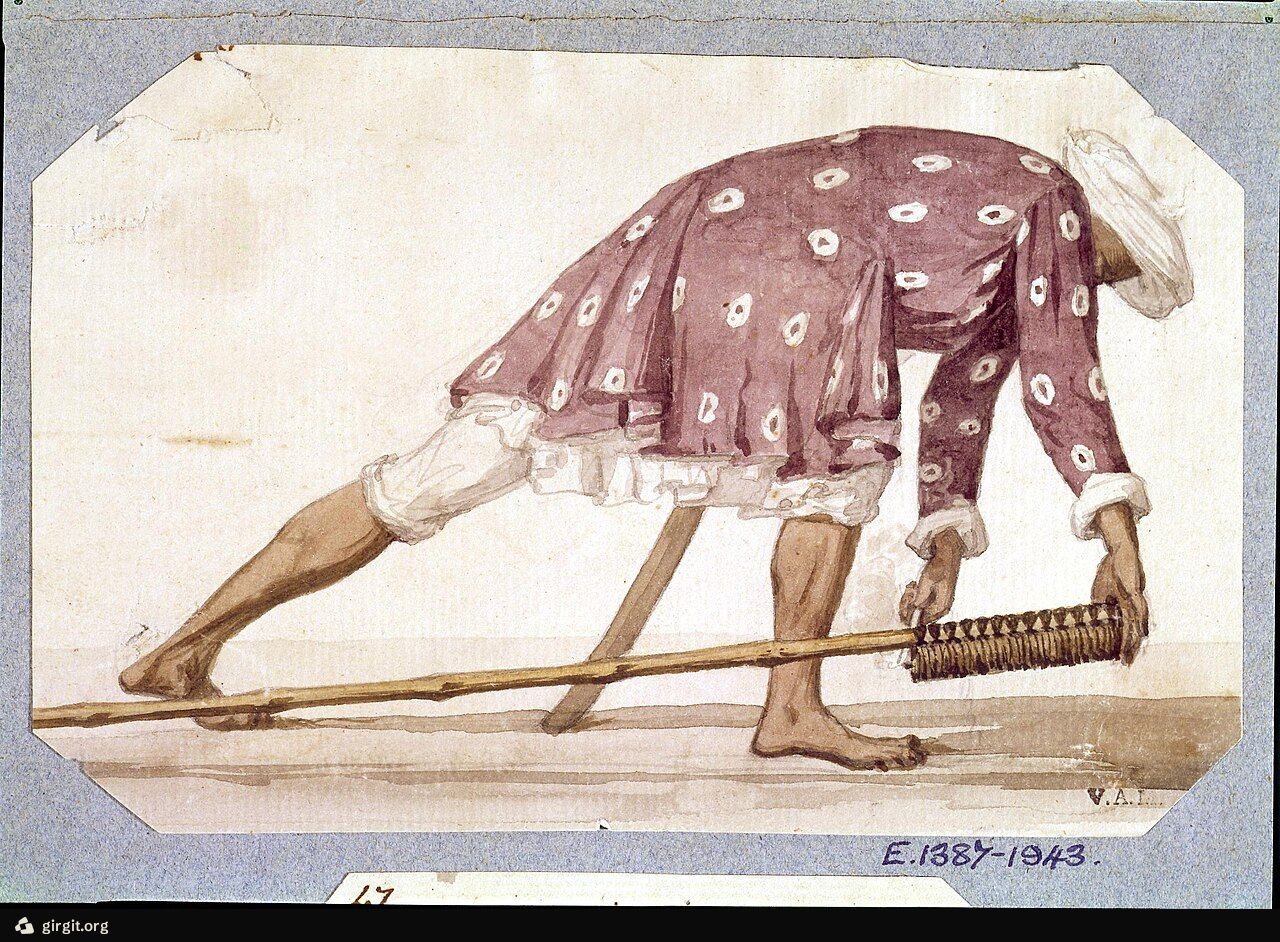 rocket: powder in an iron casebamboo stick keeps it pointing forward
Solve it
Solve it
A fielder on the boundary must return the ball to the keeper 70 m away (take the throw and the catch at the same height, no air, g = 9.8 m s−2). (a) What is the slowest throw that can reach? (b) A strong fielder throws at 30 m s−1. At which two angles does the ball reach the keeper, and which should she use?
Hint
Answer
Solve it
Spot the error: "45° gives the longest range, so a ball thrown at 45° also stays in the air longest."
Answer
Solve it
JEE style. A ball is thrown at speed \( v_0 \) from a height \( h \) above level ground. Show that the greatest range is \( R^{*} = \dfrac{v_0}{g}\sqrt{v_0^2 + 2gh} \), reached when \( \tan\theta^{*} = v_0/\sqrt{v_0^2 + 2gh} \). Check that both give the familiar answers when \( h = 0 \).
Hint
Answer
Solve it
Estimate. If the air did not matter and the javelin were let go at ground level at 45°, what is the least release speed that would carry it 87.58 m?
Answer
Connect it
Connect it
- Projectiles, this chapter. Why the path is a parabola, and Tartaglia's wrong drawing of it: projectile motion.
- Free fall, Chapter 2. Time up equals time down for any throw straight up; here it is the same for the vertical part of a slanted throw: free fall.
- Trigonometry, Maths Chapter 3. The 2 in \( \sin 2\theta_0 \) is the double-angle formula \( 2\sin\theta\cos\theta = \sin 2\theta \): double and triple angles.
- Energy, Chapter 5. Whatever the angle, a ball thrown at speed \( v_0 \) lands back at the same level with the same speed \( v_0 \); energy says why in one line: conservation of mechanical energy.
- Tipu Sultan's rockets. In the late 1700s the armies of Mysore under Hyder Ali and Tipu Sultan used the first successful iron-cased rockets against the British. A rocket is not a projectile while it burns, because its push keeps acting; only after burn-out does gravity alone shape its path. Why the push works is Newton's third law.
Still confused?
Does a heavier ball need a different angle?
Not without air. Mass appears nowhere in \( R = v_0^2\sin 2\theta_0/g \): a shot and a tennis ball thrown at the same speed and angle fly the same path. In real life the heavy shot is harder to throw fast, and the light ball is slowed more by the air, so the speeds and the best angles differ, but the parabola itself does not care about mass.
If 41° and 45° give almost the same range, why do exams fuss about 45°?
Because 45° is exact for the model: same launch and landing level, no air. The real world adds a height, a speed that depends on angle, and drag, each pulling the best angle down a little. In an exam, use 45° unless the question gives you a height or something else to account for.
Sources
- Nick Linthorne, "A new angle on throwing", Physics World, June 2006: the time-speed trade-off, shot put 32 to 35°, the 41° advice, javelin about 37° (Ed Red), long jump 20 to 25°.
- Linthorne, "Optimum release angle in the shot put", Journal of Sports Sciences 19 (2001) 359–372.
- Arnaldo Masotti, "Tartaglia", Dictionary of Scientific Biography and MacTutor, Tartaglia: the nickname, Nova Scientia (1537), 45° from a faulty argument.
- Galileo, Two New Sciences (1638), Fourth Day: the 45° corollary, the gunners, equal ranges.
- Wikipedia, "Neeraj Chopra": Tokyo 2020 final, 7 August 2021, 87.58 m on his second throw.
- Wikipedia, "Mysorean rockets" (citing R. Narasimha, Rockets in Mysore and Britain, 1750–1850, NAL and IISc, 1985) and the V&A record of Robert Home's watercolour.
Picture and video credits
Show 2 picture and video credits
- fountain-jets-arching-night.jpg: PattayaPatrol, CC BY-SA 4.0
- neeraj-chopra-javelin-bhubaneswar-2017.jpg: Athletics Federation of India, CC BY-SA 4.0

