Act 01NCERT §2.1–2.1.4 · pp. 30–326 min
What is an atom made of?
Dalton's solid ball of an atom cracks open into Thomson's picture: a soft ball of positive charge with electrons set in it.
Something far smaller flew out of every kind of atom.
From the textbookpp. 30–32
NCERT Chemistry Part I, Class 11 · Reprint 2026-27
1.0The big idea
Not a solid ball. An atom has parts.
Electricity through gases split Dalton's 1808 atom into sub-atomic particles: the electron, the proton and the neutron. One rule runs through them all: like charges repel, unlike charges attract.
Full text
The big ideaAtoms are not solid balls: they are built from three smaller particles, the electron, the proton and the neutron.
In simple words
People once thought an atom was the smallest bit of stuff, and could not be broken. Then scientists sent sparks through glass tubes with almost no air in them. Tiny bits with a minus charge flew out of every kind of metal and every kind of gas. So those bits had to be inside every atom. Later they found bits with a plus charge, and bits with no charge at all.
Dalton's atom (1808) could not be split. Experiments with electricity through gases showed it is made of smaller sub-atomic particles. One rule runs through all of them: like charges repel, unlike charges attract.
1.1A century of sparks
Electricity comes in pieces
- 1830Michael FaradayElectricity through a solution makes substances collect at the electrodes.
- 1850sDischarge tubesFaraday and others send electricity through gas in sealed tubes.
- 1897J.J. ThomsonMeasures the electron's charge to mass ratio.
- 1906R.A. MillikanOil drops, to 1914: the charge itself.
- 1919The protonNamed and described.
- 1932James ChadwickFinds neutrons.
1.2Cathode ray discharge tubes
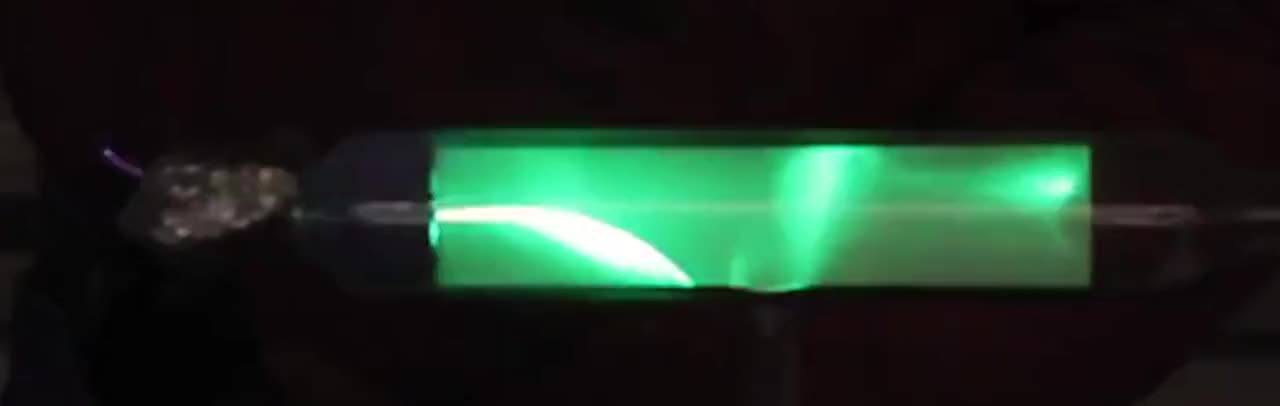
Switch on the tube
Very low pressure. Then very high voltage.
A stream of particles leaves the cathode (−) for the anode (+): cathode rays.
Rays that pass it light a zinc sulphide coating: a bright spot.
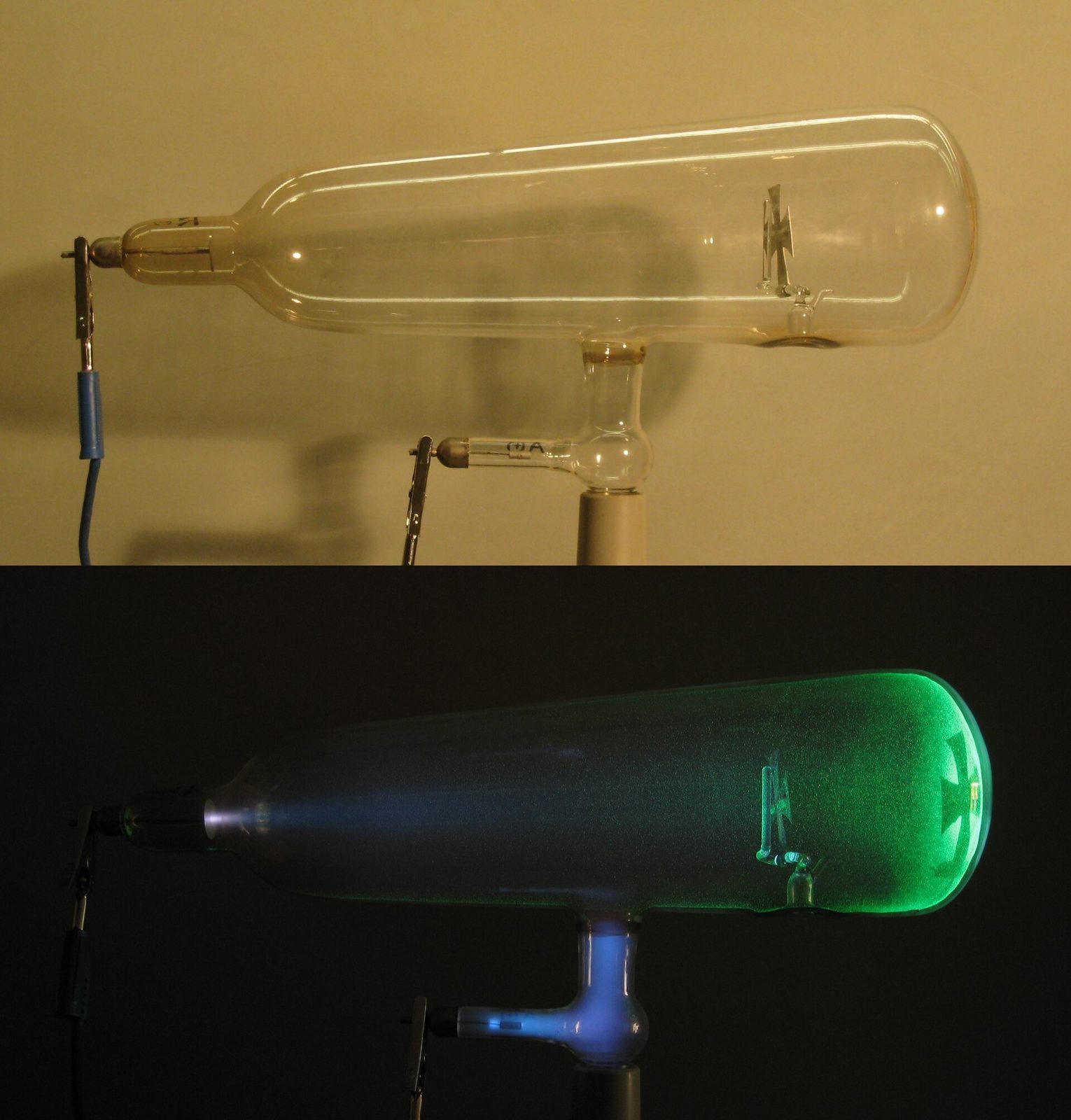 cathode (−)metal crossshadow of the crossglass glows green
1.3Five findings
What the rays showed
- From the cathode to the anode.
- Invisible, but they make things glow.Fluorescent and phosphorescent stuff, like an old box TV screen.
- Straight lines with no field.
- Bent like negative charges by fields: electrons.
- Same for every metal and gas: in every atom.
Full text
The electron: cathode rays
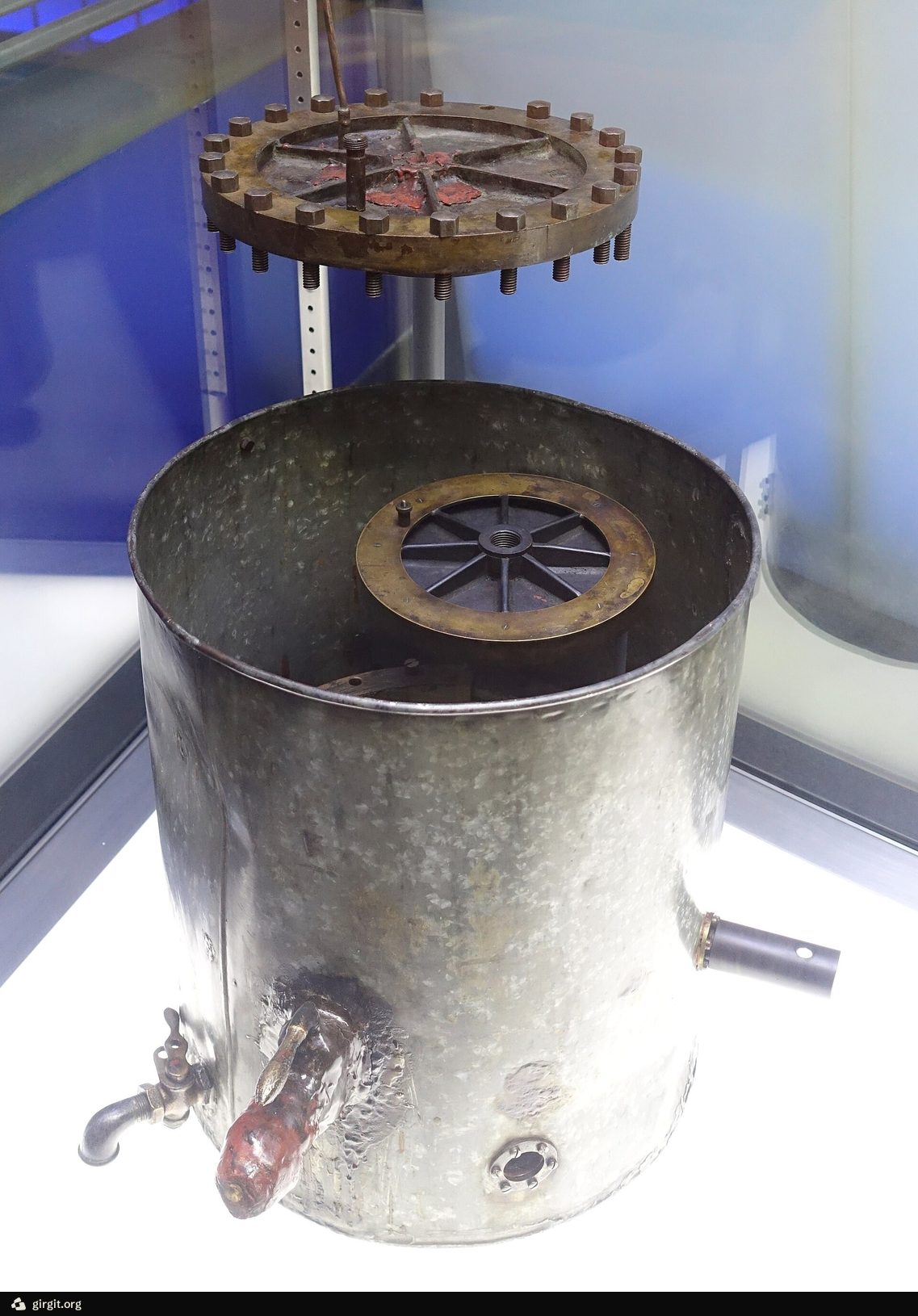
In 1830 Michael Faraday showed that sending electricity through an electrolyte solution makes substances form or collect at the electrodes. This hinted that electricity itself comes in particles. From the mid 1850s Faraday and others studied cathode ray discharge tubes: glass tubes with two metal plates (electrodes) sealed in, and most of the gas pumped out.
At very low pressure and very high voltage, a current flows as a stream of particles from the negative plate, the cathode, to the positive plate, the anode. These are cathode rays. If the anode has a hole and the glass behind it is coated with zinc sulphide, the rays that pass through make a bright spot there. What the experiments showed:
- Cathode rays start at the cathode and travel towards the anode.
- The rays are invisible, but they make fluorescent or phosphorescent materials glow. Old box-shaped television sets were cathode ray tubes; the picture was this glow on the coated screen.
- With no electric or magnetic field, they travel in straight lines.
- In an electric or magnetic field they bend the way negatively charged particles would. These particles are electrons.
- They are the same whatever metal the electrodes are made of and whatever gas is in the tube. So electrons are a part of every atom.
CheckEvery atom?
Why in every atom?
Why did scientists conclude that electrons are present in all atoms?
- Cathode rays travel in straight lines
- Cathode rays were the same for every electrode material and every gas
- Cathode rays make zinc sulphide glow
- Canal rays depend on the gas used
1.4Thomson's tube · 1897
Bend it, then balance it
An electric field and a magnetic field, at right angles to each other and to the beam.
Straight: one spot in the middle.
Pushed one way, towards the + plate.
Pushed the other way.
Back on the straight path.
1.5The charge to mass ratio
Charge over mass
- More charge bends more.
- Less mass bends more.
- Stronger field (higher voltage, stronger magnet) bends more.
The electron is negative, so its charge is written \( -e \).
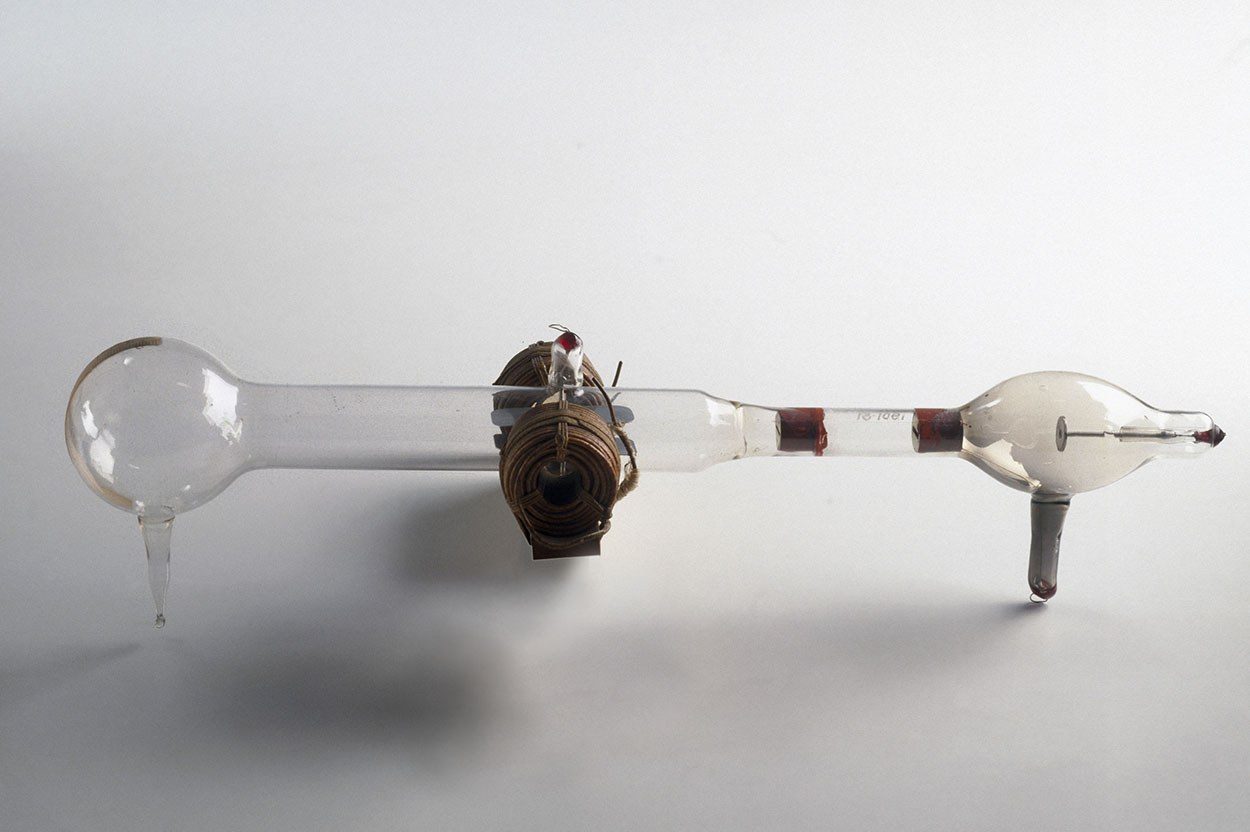 magnet coilsglass tube, air pumped out
Full text
Charge to mass ratio: Thomson, 1897
J.J. Thomson put an electric field and a magnetic field across the tube, at right angles to each other and to the beam. The electric field alone pushed the beam one way; the magnetic field alone pushed it the other way. By balancing the two he could bring the beam back to the straight path. How far a particle is bent depends on three things:
- its charge: more charge, more bending;
- its mass: a lighter particle bends more;
- the field strength: a higher voltage or a stronger magnet bends it more.
From careful measurements he found the charge to mass ratio of the electron:
\[ \frac{e}{m_e} = 1.758820 \times 10^{11}\ \mathrm{C\,kg^{-1}} \]Here \( e \) is the size of the electron's charge in coulombs (C) and \( m_e \) its mass in kilograms. The electron is negative, so its charge is written \( -e \).
Try itThomson's balance
Bend the beam yourself
Push it with the electric field, bring it back with the magnet.
CheckSame field
Which bends most?
In Thomson's apparatus, which particle would be bent the most by the same field?
- An electron
- A proton
- A neutron
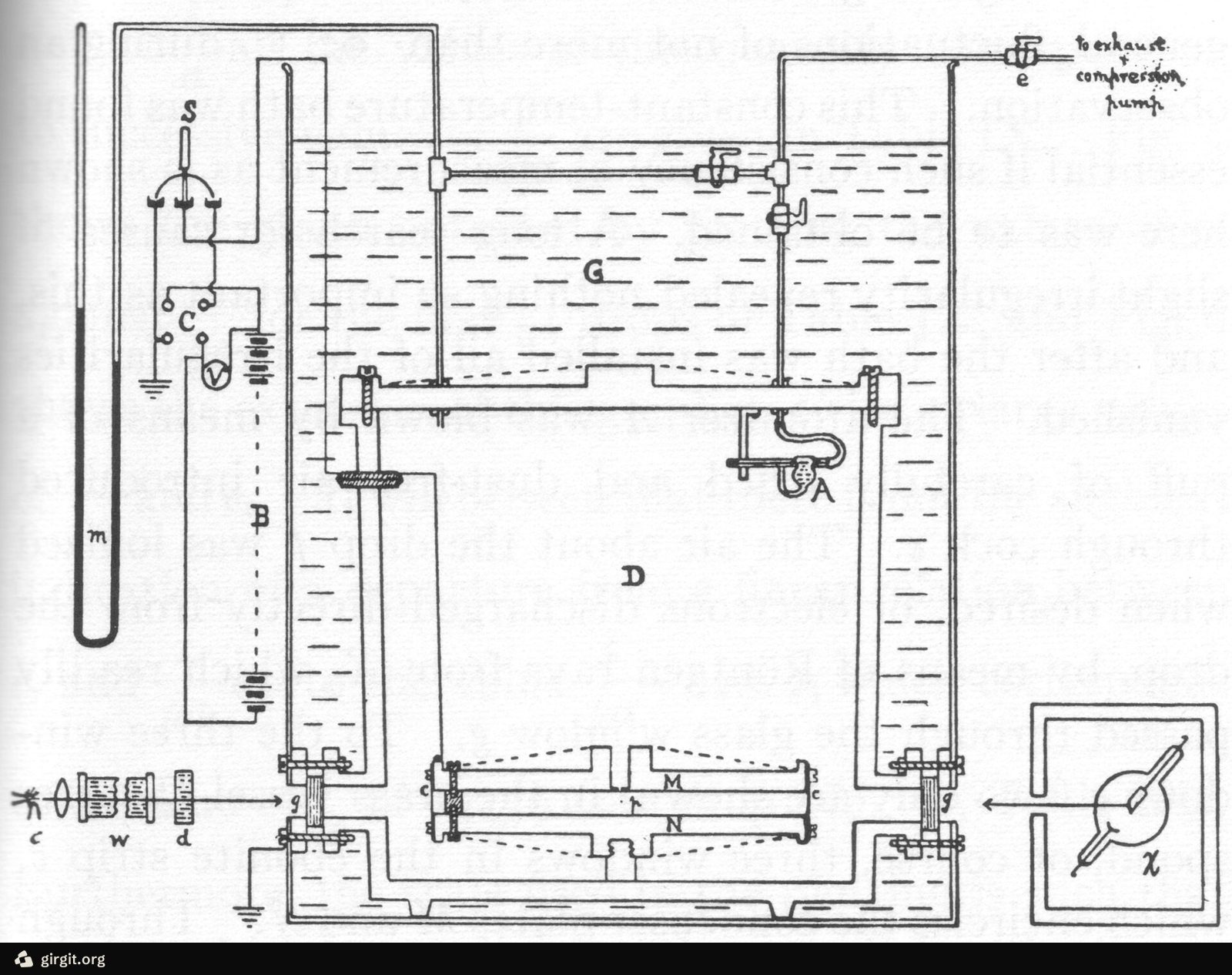 atomisertwo charged platesX-ray tubelightbattery
1.6R.A. Millikan · 1906 to 1914
Weighing one charge
- Oil drops fall between charged plates.X-rays ionise the air; drops pick up charge.
- Forces: gravity, the electric force, air drag. The rate of fall gives the mass.
- Change the voltage: slow a drop, speed it, hold it still.
Full text
The charge itself: Millikan's oil drops
R.A. Millikan (1906 to 1914) let a mist of oil drops fall between two charged plates and watched them through a telescope. X-rays ionised the air, and the drops picked up charge from the ions. From a drop's rate of fall he found its mass; by changing the voltage he could slow it, speed it up or hold it still. The forces on a drop are gravity, the electric force and air drag.
His key finding: the charge \( q \) on any drop is always a whole-number multiple of one smallest charge, \( q = ne \) with \( n = 1, 2, 3 \ldots \). He measured \( e = -1.6 \times 10^{-19} \) C; today's value is \( -1.602176 \times 10^{-19} \) C. Combining this with Thomson's ratio gives the electron's mass.
Worked example 1: the mass of an electron
Use \( e = 1.602176 \times 10^{-19} \) C and \( e/m_e = 1.758820 \times 10^{11} \) C kg−1.
\[ m_e = \frac{e}{e/m_e} = \frac{1.602176 \times 10^{-19}\ \mathrm{C}}{1.758820 \times 10^{11}\ \mathrm{C\,kg^{-1}}} = 9.1094 \times 10^{-31}\ \mathrm{kg} \]The coulombs cancel and kilograms are left. That is about 1/1840 of the mass of a hydrogen atom.
Worked example 2: thinking like Millikan
Four drops carry 3.2, 8.0, 4.8 and 11.2 (all × 10−19 C). What is the smallest charge they suggest?
- Look for the largest number that divides all four: 3.2 = 2 × 1.6, 8.0 = 5 × 1.6, 4.8 = 3 × 1.6, 11.2 = 7 × 1.6.
- So the unit is \( 1.6 \times 10^{-19} \) C, and the drops hold 2, 5, 3 and 7 extra electrons.
1.7Charge on one electron
1.6× 10⁻¹⁹ C
Every charge is a whole number of these: \( q = ne \), \( n = 1, 2, 3 \ldots \) Millikan: \( e = -1.6 \times 10^{-19} \) C. Today: \( -1.602176 \times 10^{-19} \) C.
Worked example 1: the mass of an electron
Use \( e = 1.602176 \times 10^{-19} \) C and \( e/m_e = 1.758820 \times 10^{11} \) C kg−1.
\[ m_e = \frac{e}{e/m_e} = \frac{1.602176 \times 10^{-19}\ \mathrm{C}}{1.758820 \times 10^{11}\ \mathrm{C\,kg^{-1}}} = 9.1094 \times 10^{-31}\ \mathrm{kg} \]The coulombs cancel and kilograms are left. That is about 1/1840 of the mass of a hydrogen atom.
Worked example 2: thinking like Millikan
Four drops carry 3.2, 8.0, 4.8 and 11.2 (all × 10−19 C). What is the smallest charge they suggest?
- Look for the largest number that divides all four: 3.2 = 2 × 1.6, 8.0 = 5 × 1.6, 4.8 = 3 × 1.6, 11.2 = 7 × 1.6.
- So the unit is \( 1.6 \times 10^{-19} \) C, and the drops hold 2, 5, 3 and 7 extra electrons.
1.8Put the two together
The electron's mass
9.1094× 10⁻³¹ kg
\( m_e = e \div (e/m_e) \). About 1/1840 of a hydrogen atom.
Try itBe Millikan
Find the unit of charge
CheckWhole numbers
How many electrons?
An oil drop carries a charge of −6.4 × 10⁻¹⁹ C. How many extra electrons does it hold?
- 2
- 4
- 6.4
1.9A changed discharge tube
Rays going the other way
Cathode rays
Electrons
Same for every gas and metal. Bend as negative charges.
Canal rays
Positive ions of the gas
Mass and charge to mass ratio depend on the gas. Some carry a whole-number multiple of the basic charge. Bend the opposite way.
 cathode with holesglow from canal rays
The lightest positive ion, from hydrogen, is the proton.
Full text
Protons and neutrons
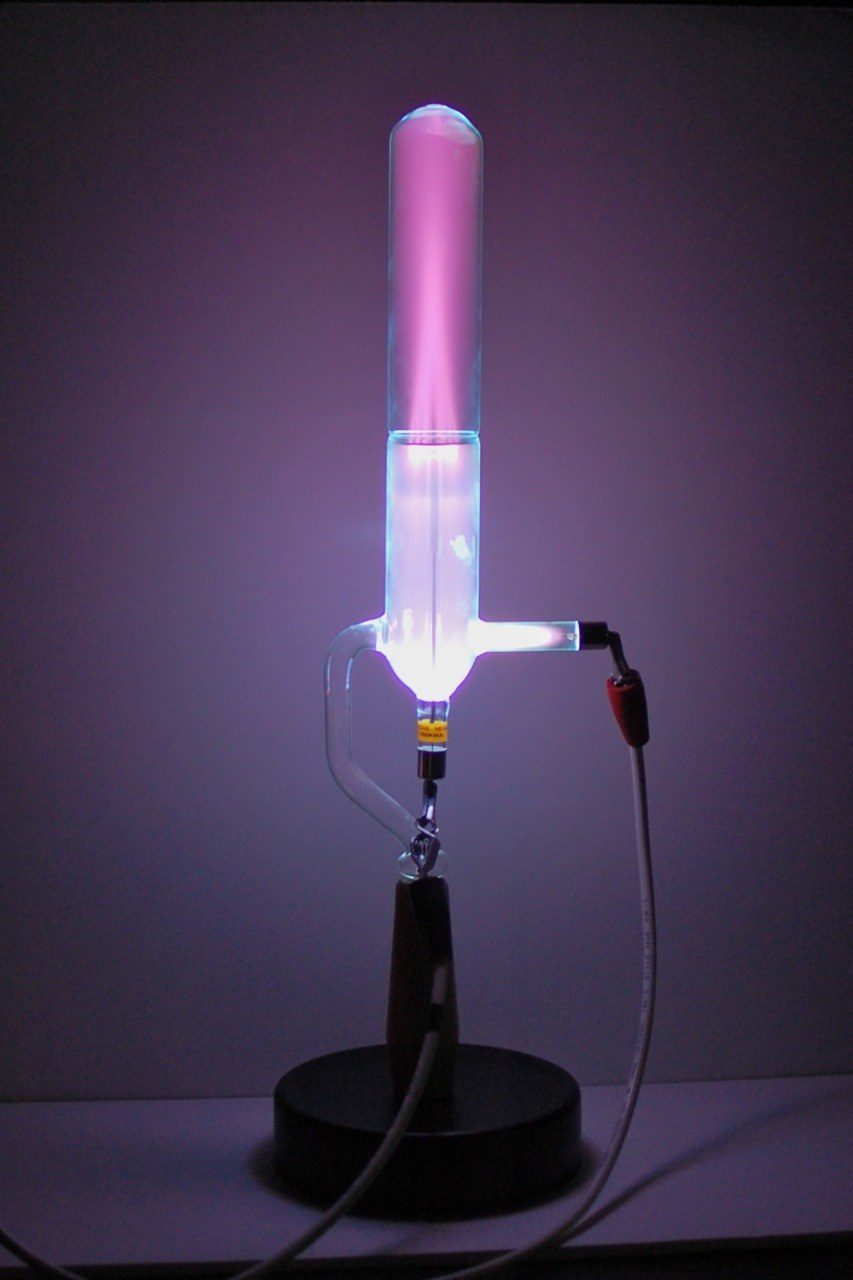
With a changed discharge tube, scientists found rays moving the other way, called canal rays. They carry positive particles, and they are quite unlike cathode rays:
- Their mass depends on the gas in the tube. They are simply positive ions of that gas.
- Their charge to mass ratio also depends on the gas.
- Some carry a whole-number multiple of the basic charge.
- Electric and magnetic fields bend them the opposite way to electrons.
The smallest, lightest positive ion came from hydrogen. It was named the proton and described in 1919. A neutral particle was also expected, and in 1932 James Chadwick found it by hitting a thin sheet of beryllium with alpha particles. Out came neutral particles a little heavier than protons: neutrons.
| Particle | Symbol | Charge / C | Relative charge | Mass / kg | Mass / u | Approx. mass / u |
|---|---|---|---|---|---|---|
| Electron | e | −1.602176 × 10⁻¹⁹ | −1 | 9.109382 × 10⁻³¹ | 0.00054 | 0 |
| Proton | p | +1.602176 × 10⁻¹⁹ | +1 | 1.6726216 × 10⁻²⁷ | 1.00727 | 1 |
| Neutron | n | 0 | 0 | 1.674927 × 10⁻²⁷ | 1.00867 | 1 |
Don't mix these up
- Cathode rays are the same for every gas (they are electrons). Canal rays change with the gas (they are that gas's positive ions).
- Thomson measured \( e/m_e \); Millikan measured \( e \); the mass came from putting the two together.
- The neutron is slightly heavier than the proton, not equal to it.
Answer
1.10On the scales
1836
electrons weigh as much as one proton. So we call the electron's mass almost zero.
Answer
1.11Spec sheet
Three particles
e−
Electron
- Charge
- −1.602176 × 10⁻¹⁹ C · relative −1
- Mass
- 9.109382 × 10⁻³¹ kg
- Mass in u
- 0.00054 · approx. 0
- Found
- Thomson, 1897
p+
Proton
- Charge
- +1.602176 × 10⁻¹⁹ C · relative +1
- Mass
- 1.6726216 × 10⁻²⁷ kg
- Mass in u
- 1.00727 · approx. 1
- Found
- Named 1919
n0
Neutron
- Charge
- 0 · relative 0
- Mass
- 1.674927 × 10⁻²⁷ kg
- Mass in u
- 1.00867 · approx. 1
- Found
- Chadwick, 1932: alphas on beryllium
1.12Don't mix these up
Three traps
Myth
A neutron weighs the same as a proton
Fact
Slightly heavier: 1.00867 u vs 1.00727 u
Don't mix these up
- Cathode rays are the same for every gas (they are electrons). Canal rays change with the gas (they are that gas's positive ions).
- Thomson measured \( e/m_e \); Millikan measured \( e \); the mass came from putting the two together.
- The neutron is slightly heavier than the proton, not equal to it.
KeepJust remember
Six numbers, six hooks
Measured values and names from history: tap a card for its hook.
WordsTo know
Six words
- Sub-atomic particle
- A particle smaller than an atom: electron, proton, neutron.
- Cathode / anode
- The negative / positive electrode in a discharge tube.
- Cathode rays
- A stream of electrons from cathode to anode.
- Canal rays
- Positive ions of the gas in the tube, moving the other way.
- e/me
- Charge to mass ratio of the electron, 1.758820 × 10¹¹ C kg−1.
- Oil drop experiment
- Millikan's method that measured the charge on one electron.
NEETAsked in the exam
The real thing
RootsWhy only a ratio?
The tube sees q/m
- The magnet is a speedometer: \( qE = qvB \) gives \( v = E/B \).
- Hydrogen ion: about \( 9.6 \times 10^{7} \) C kg⁻¹. Cathode rays: about 1800 times bigger.
- Millikan: gravity sees mass, the field sees charge.
Full text
The roots: why only a ratio?
- Why could Thomson's tube measure only \( e/m_e \), and not \( e \) or \( m_e \) on its own?Because the only thing the tube shows is how much the beam bends, and the bend depends on how hard the field pushes divided by how hard the particle resists being pushed.
- Why is it push divided by resistance?The electric push on a charge is \( F = qE \): double the charge, double the push. Newton's second law says the change in motion is \( a = F/m \): double the mass, half the change. Put together, \( a = (q/m)E \). Charge and mass enter only as a pair.
- Then why did Thomson need a magnet as well?Because the bend also depends on speed: a fast particle spends less time between the plates and bends less. The magnetic push \( qvB \) grows with speed, the electric push \( qE \) does not. When the two cancel, \( qE = qvB \), the charge drops out and \( v = E/B \). The magnet was a speedometer.
- Why did a big \( e/m \) mean a tiny particle?Electrolysis already gave the charge to mass ratio of a hydrogen ion: about \( 9.6 \times 10^{7} \) C kg−1. Cathode rays came out about 1800 times bigger. Either the charge was 1800 times bigger or the mass 1800 times smaller. Cathode rays also pass through thin metal foil that stops atoms, so "much lighter" was the answer that fitted.
- And why did Millikan's drops get past the ratio?Because gravity pulls on mass and ignores charge, while the electric field pulls on charge and ignores mass. Weigh the drop with gravity (from how fast it falls through air), then balance it with the field, and the charge comes out on its own.
- The bedrockA push divided by a mass gives the change in motion, \( a = F/m \). Every measurement on this page is that one law used cleverly.
This is a general trap in science: an experiment can only tell you about the combination of quantities that actually appears in its equations. Thomson's tube "sees" \( q/m \), so a particle with twice the charge and twice the mass would fly along exactly the same path. To separate them you need a second experiment with a force that sees only one of the two. Millikan used gravity. Today mass spectrometers still sort ions by \( q/m \), not by mass, for the same reason.
The same idea gives the electron's mass in one line: divide Millikan's \( e \) by Thomson's \( e/m_e \). Neither man could get \( m_e \) alone; together they got it to better than one part in a hundred.
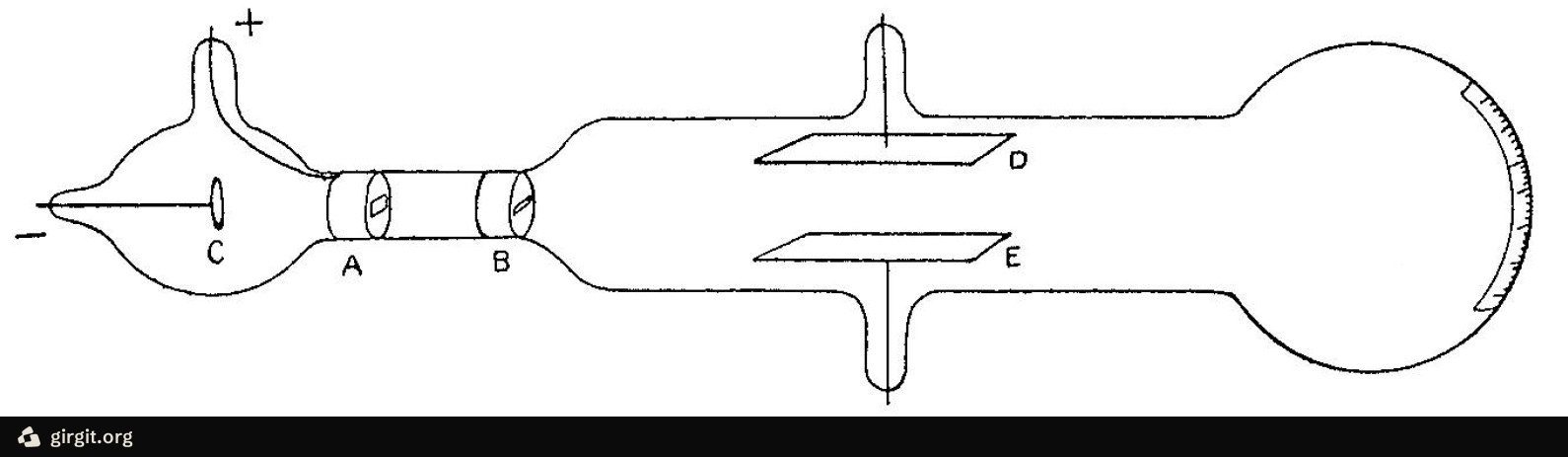 cathodeslitsplatesscale
30 April 1897Royal Institution, London
Corpuscles
Thomson's word for particles far smaller than atoms: about 1000 times lighter than hydrogen (today, 1840). Paper: "Cathode Rays", Philosophical Magazine, October. George Johnstone Stoney's name, "electron", stuck.
Full text
The story
StoryChicago and Cambridge
Oil, then the neutron
- 1909Chicago, to 1913Water drops evaporated. Harvey Fletcher's idea: oil, from a perfume atomiser.
- 191358 drops, "60 consecutive days" Millikan's value 1.592 × 10⁻¹⁹ C, a little low.
- 1974"Cargo Cult Science"Richard Feynman on later values creeping up slowly.
- 193217 February, Cavendish LaboratoryChadwick, after Irène Joliot-Curie and Frédéric Joliot in Paris: Nature, "Possible Existence of a Neutron".
- 1935Nobel PrizesPhysics: Chadwick. Chemistry: the Joliot-Curies.
See itBe the particle
28 particles, fewer paths
Change charge and mass in the sentence. Then press Every particle.
Solve itFour problems
Your turn
Solve it
In a Thomson tube the electric field is \( 1.5 \times 10^{4} \) V m−1. A magnetic field of \( 7.5 \times 10^{-4} \) T across it brings the beam back to the centre. (a) How fast are the electrons? (b) If the electric field is now switched off, the magnet alone bends the beam into a circle of radius \( r = m_e v / (eB) \). How big is the circle?
Hint
Answer
(b) \( r = \dfrac{2.0 \times 10^{7}}{(1.7588 \times 10^{11})(7.5 \times 10^{-4})} = \dfrac{2.0 \times 10^{7}}{1.32 \times 10^{8}} \approx 0.15 \) m, a circle with a radius of about 15 cm. Measure \( r \) and you get \( e/m_e \) back: that was Thomson's method in reverse.
Solve it
One mole of hydrogen ions (1.008 g) carries a charge of 96,485 C (the Faraday constant). Find the charge to mass ratio of a hydrogen ion and compare it with the electron's. What does the comparison tell you, if you assume both carry the same size of charge?
Answer
Solve it: what would happen if…
Every charge Millikan measured was a whole multiple of \( 1.6 \times 10^{-19} \) C. But every one of them is also a whole multiple of \( 0.8 \times 10^{-19} \) C. How could he be sure the true unit was not 0.8?
Hint
Answer
Solve it: estimate
A phone charger pushes about 2 A down its cable. Roughly how many electrons pass any point in the cable each second?
Answer
ConnectAnd still confused?
Where this goes next
Connect it
- Electrolysis, Class 12 Chemistry. The Faraday constant is just Avogadro's number of electron charges: \( 6.022 \times 10^{23} \times 1.602 \times 10^{-19} = 96{,}485 \) C. See Electrolysis and Faraday's laws.
- The magnetic push, Class 12 Physics. Thomson's balance \( qE = qvB \) is the Lorentz force; the circle in Solve it is a charge moving in a magnetic field. See Lorentz force and Motion in a magnetic field.
- Falling drops, Class 11 Physics. Millikan found each drop's size from its steady falling speed, using Stokes' law for drag. See Stokes' law.
- Isotopes, next pages. Sorting ions by \( q/m \) is how isotopes were first separated and weighed. See Atomic number, isotopes and isobars.
- At home and in hospital. Old box television sets were Thomson tubes with a coated screen. Hospital X-ray machines still make their X-rays by firing cathode rays at a metal target.
Are cathode rays a kind of light?
No. Light is not bent by a magnet or by charged plates; cathode rays are, and in the direction a negative charge would go. The glow you see in a discharge tube is gas or glass giving off light where the electrons hit it. The rays themselves are invisible.
Is the electron's charge −1 or −1.602 × 10⁻¹⁹ C?
Both, in different units. \( -1.602 \times 10^{-19} \) C is the charge in coulombs. "−1" is the charge counted in units of \( e \), the smallest charge found free in nature. Chemists use the second because it makes ion charges simple whole numbers: Na+, O2−.
Why is the neutron heavier than the proton, and does it matter?
It matters a lot. A neutron on its own, outside a nucleus, does not last: on average after about a quarter of an hour it turns into a proton, an electron and a tiny neutral particle (an antineutrino). That change is possible only because the neutron is heavier; the extra mass pays for the electron and the energy released. Inside a stable nucleus the neutron is safe.
Sources
- J.J. Thomson, "Cathode Rays", Philosophical Magazine 44, 293 (1897)
- I. Falconer, "Corpuscles, Electrons and Cathode Rays: J.J. Thomson and the 'Discovery of the Electron'", British Journal for the History of Science (1987)
- APS News, "August 1913: Robert Millikan reports his oil drop results"
- R.P. Feynman, "Cargo Cult Science", Caltech commencement address, 1974
- APS News, "May 1932: Chadwick reports the discovery of the neutron"
- J. Chadwick, "Possible Existence of a Neutron", Nature 129, 312 (1932)
- The Nobel Prize in Physics 1935 and in Chemistry 1935
- Philipp Lenard, Nobel Prize 1905: cathode rays through thin foil
- NIST, CODATA values of the fundamental constants (e, mₑ, F)
- Encyclopaedia Britannica, "Neutron" (free neutron decay)