Act 03NCERT §2.2.3–2.2.4 · pp. 35–364 min
Atomic number, mass number, isotopes and isobars
The camera dives into Rutherford's nucleus until the protons and neutrons inside it can be counted.
The centre is made of pieces you can count.
From the textbookpp. 35–36
NCERT Chemistry Part I, Class 11 · Reprint 2026-27
3.0The big idea
Count the protons. That is the element.
The number of protons, Z, decides which element an atom is. Protons plus neutrons, A, decide how heavy it is.
Full text
The big ideaThe number of protons (Z) decides which element an atom is; protons plus neutrons (A) decide its mass.
In simple words
Every atom has a centre with plus bits and no-charge bits. Count the plus bits and you know which element it is: one means hydrogen, six means carbon, always. Add up both kinds of bits in the centre and you know how heavy the atom is. Two atoms of the same element can have a different number of no-charge bits. They behave the same in chemistry, but one is a little heavier.
3.1Atomic number, Z
Protons pick the element
Start with an empty centre.
One is hydrogen, six carbon, eleven sodium.
Still sodium. A climbs from 11 to 23.
Each cancels one plus: 11 make it neutral.
Neutrons = A − Z = 23 − 11 = 12.
3.2Mass number, A
Mass on top, protons below
- Protons and neutronstogether are nucleons. A counts them all.
- A = Z + n, so n = A − Zwhere n is the number of neutrons.
- Neutral atom: electrons = protons = Z.Hydrogen has 1 (Z = 1), sodium 11.
Full text
Atomic number and mass number
The nucleus is positive because of its protons. The number of protons is the atomic number, \( Z \). A neutral atom has as many electrons as protons, so the charges cancel.
\[ Z = \text{number of protons} = \text{number of electrons in a neutral atom} \]Hydrogen has 1 proton (Z = 1) and sodium has 11 (Z = 11), so a neutral sodium atom has 11 electrons.
The mass of the nucleus comes from its protons and neutrons. Together these are called nucleons. Count all the nucleons and you get the mass number, \( A \):
\[ A = Z + n \qquad\text{so}\qquad n = A - Z \]where \( n \) is the number of neutrons. An atom is written with A as a raised number and Z as a lowered number, both on the left of the symbol: \( {}^{A}_{Z}\mathrm{X} \). For example \( {}^{23}_{11}\mathrm{Na} \) has 11 protons, 11 electrons and 23 − 11 = 12 neutrons.
Worked example 1: an ion
How many protons, neutrons and electrons are in \( {}^{56}_{26}\mathrm{Fe^{3+}} \)?
- Protons = Z = 26.
- Neutrons = A − Z = 56 − 26 = 30. (This is true for atoms and ions alike.)
- Charge +3 means 3 electrons have been lost: electrons = 26 − 3 = 23.
Worked example 2: name the species
A particle has 8 protons, 8 neutrons and 10 electrons. What is it?
- 8 protons, so Z = 8: oxygen.
- A = 8 + 8 = 16.
- Two more electrons than protons, so the charge is −2. It is the oxide ion, \( {}^{16}_{8}\mathrm{O^{2-}} \).
Before you write the symbol
- First decide: neutral atom, cation (positive ion, more protons than electrons) or anion (negative ion, more electrons than protons)?
- Only a neutral atom has electrons = protons = Z.
- Neutrons are always A − Z, whatever the charge.
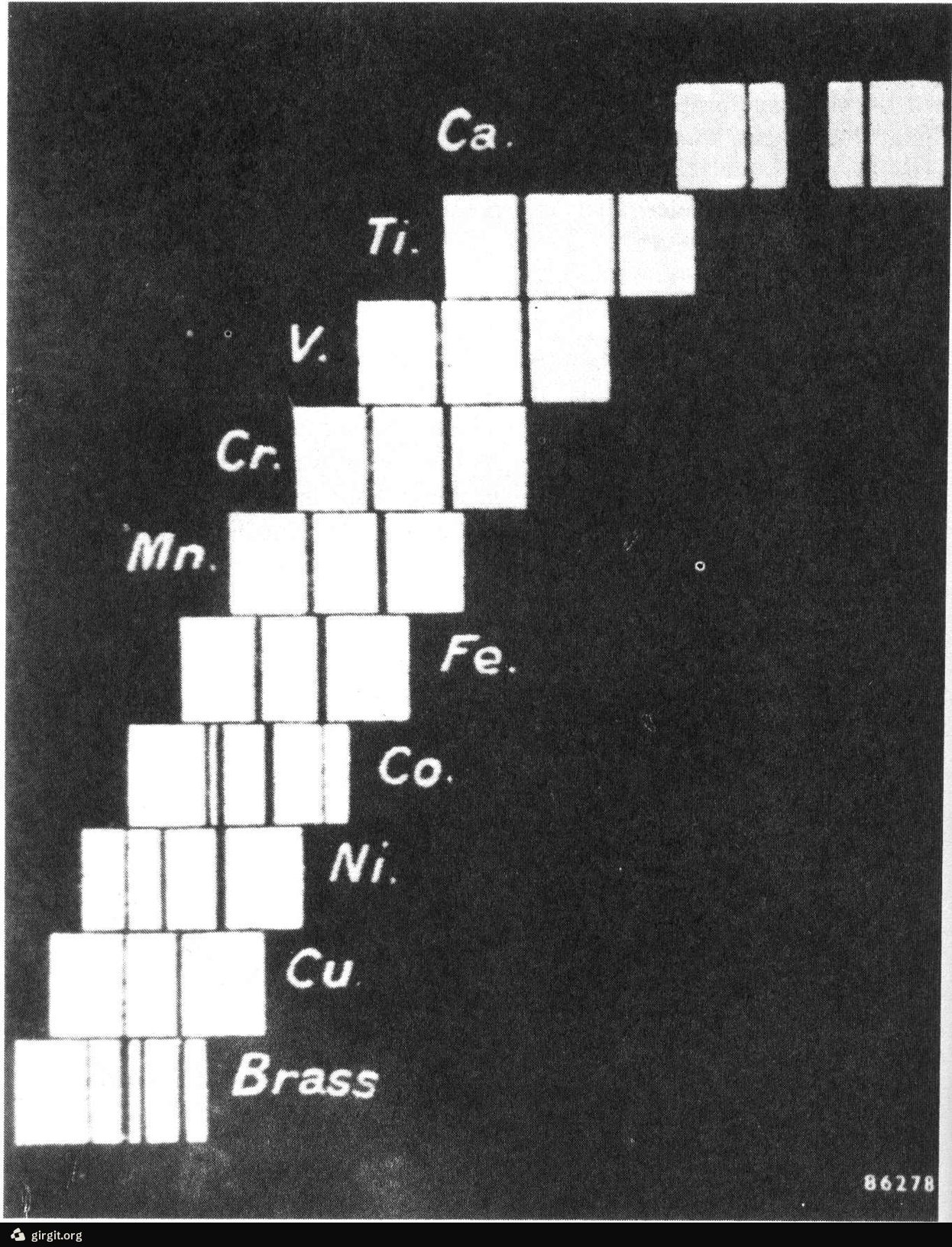 Ca, Z = 20gap: Sc, Z = 21Fe, Z = 26Co, Z = 27Ni, Z = 28
3.3Henry Moseley · 1913 to 1914
One step for each proton
His X-ray photographs, calcium to copper: each element's lines sit one even step from the last. Cobalt comes before nickel by its protons, though cobalt is heavier.
3.4Before you write the symbol
Atom, cation or anion?
Only a neutral atom has electrons = protons = Z. Neutrons are always A − Z, whatever the charge.
X
Neutral atom
- Electrons
- = protons
- Charge
- 0
X+
Cation
- Electrons
- fewer than protons
- Charge
- positive ion
X−
Anion
- Electrons
- more than protons
- Charge
- negative ion
Worked example 1: an ion
How many protons, neutrons and electrons are in \( {}^{56}_{26}\mathrm{Fe^{3+}} \)?
- Protons = Z = 26.
- Neutrons = A − Z = 56 − 26 = 30. (This is true for atoms and ions alike.)
- Charge +3 means 3 electrons have been lost: electrons = 26 − 3 = 23.
Worked example 2: name the species
A particle has 8 protons, 8 neutrons and 10 electrons. What is it?
- 8 protons, so Z = 8: oxygen.
- A = 8 + 8 = 16.
- Two more electrons than protons, so the charge is −2. It is the oxide ion, \( {}^{16}_{8}\mathrm{O^{2-}} \).
3.5Worked: two ions
Count all three
26 · 30 · 23p · n · e in Fe³⁺
Protons from Z, neutrons from A − Z, electrons from Z and the charge.
Try itBuild atoms and ions
Watch the symbol change
CheckName the species
Atom or ion?
A species has 17 protons, 18 neutrons and 18 electrons. It is
- an argon atom
- a chloride ion, ³⁵Cl−
- a Cl+ ion
3.6Isotopes
Same Z, different A
No neutron. 99.985% of all hydrogen.
One neutron: twice as heavy. 0.015%.
Two neutrons. Only traces on earth.
Different neutrons: isotopes of hydrogen.
3.7Why isotopes react alike
Electrons do the chemistry
- Chemistry is decided by electrons.
- Electrons are fixed by protons.Neutrons hardly change a thing.
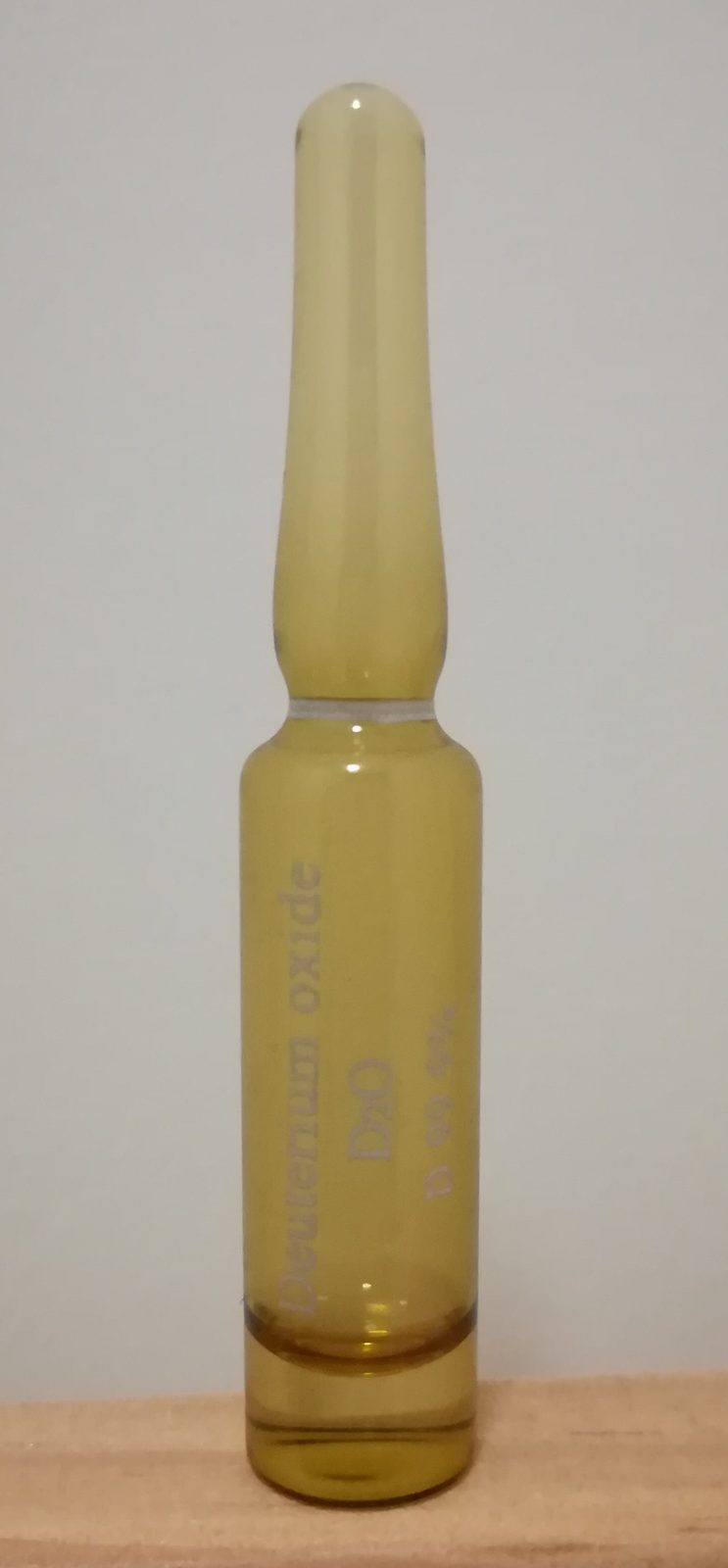
- So all isotopes of an element behave the same.Heavy water, D₂O, looks and reacts like water.
3.8Carbon and chlorine
35.5u, an average
Chlorine: ³⁵₁₇Cl with 18 neutrons, ³⁷₁₇Cl with 20, about three to one. Carbon: ¹²₆C, ¹³₆C and ¹⁴₆C, with 6, 7 and 8 neutrons.
CheckChlorine's two
What differs?
Chlorine-35 and chlorine-37 differ in their number of
- protons
- neutrons
- electrons
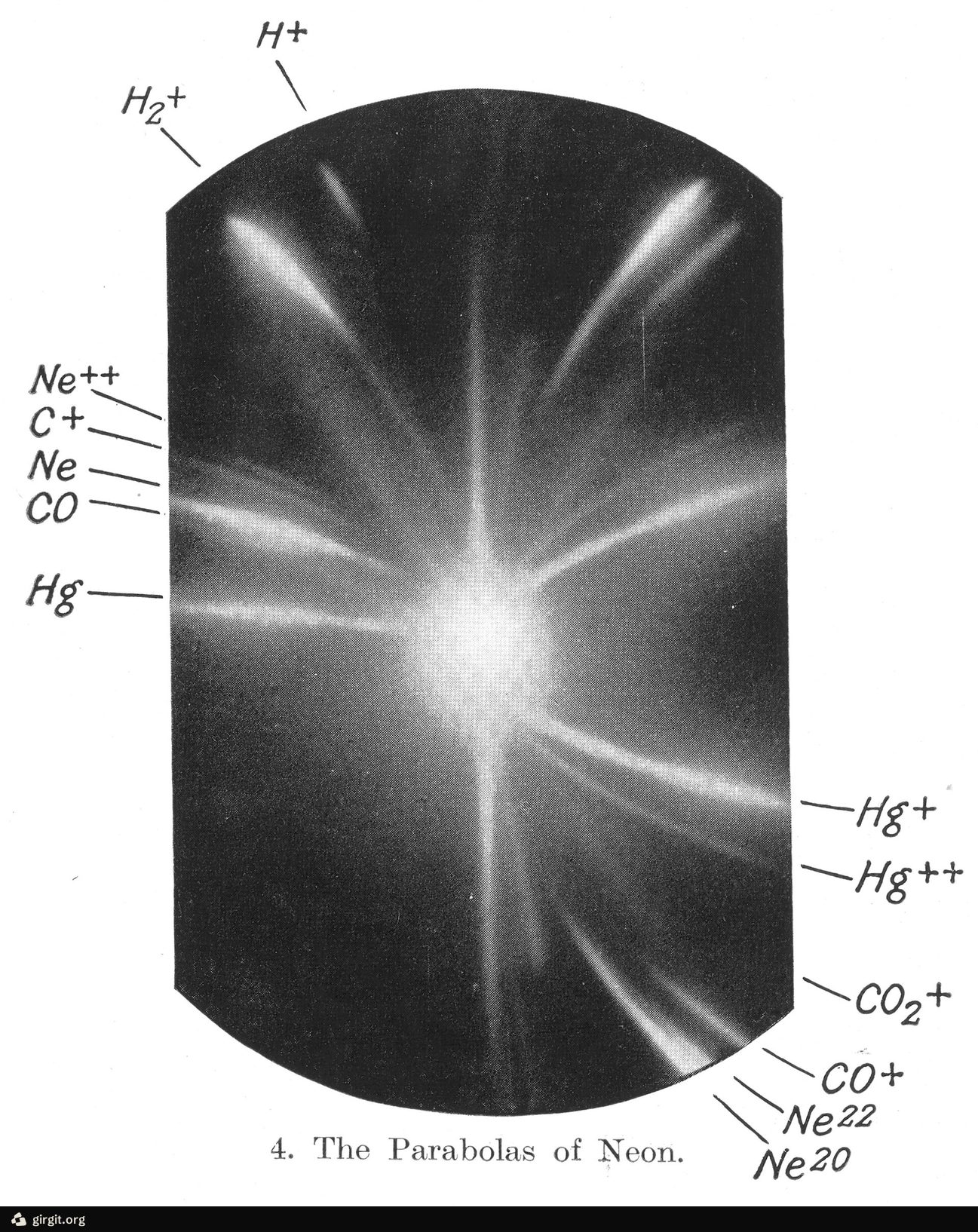
each curve: one kind of ionneon-20 and neon-223.9Francis Aston, Isotopes · 1922
One element, two streaks
Each curved streak is made by ions of one charge to mass ratio. Neon makes two, mass 20 and mass 22: two isotopes.
3.10Isobars
Same A, different Z
Isotopes keep Z. Now keep A instead.
It throws out an electron: a beta particle.
Seven protons: nitrogen now.
Same mass number, two different elements.
3.11Think of it like
Twins, and strangers
Isotopes · same Z
Twins with school bags of different weight
Same element, same behaviour; only the total weight differs. ¹₁H and ²₁H.
Isobars · same A
Two strangers who weigh the same
Different elements that happen to match on the scale. ¹⁴₆C and ¹⁴₇N.
Full text
Isotopes and isobars
Isotopes are atoms with the same atomic number but different mass numbers. Same protons, different neutrons. Hydrogen has three:
| Isotope | Symbol | Protons | Neutrons | How common |
|---|---|---|---|---|
| Protium | \( {}^{1}_{1}\mathrm{H} \) | 1 | 0 | 99.985% |
| Deuterium | \( {}^{2}_{1}\mathrm{D} \) | 1 | 1 | 0.015% |
| Tritium | \( {}^{3}_{1}\mathrm{T} \) | 1 | 2 | Only traces on earth |
Carbon has isotopes with 6, 7 and 8 neutrons (\( {}^{12}_{6}\mathrm{C}, {}^{13}_{6}\mathrm{C}, {}^{14}_{6}\mathrm{C} \)) and chlorine has isotopes with 18 and 20 neutrons (\( {}^{35}_{17}\mathrm{Cl}, {}^{37}_{17}\mathrm{Cl} \)).
Why isotopes react alike: chemistry is decided by electrons, and the number of electrons is fixed by the number of protons. Neutrons hardly affect chemical properties. So all isotopes of an element show the same chemical behaviour.
Isobars are the opposite: atoms with the same mass number but different atomic numbers, so they are different elements. Example: \( {}^{14}_{6}\mathrm{C} \) and \( {}^{14}_{7}\mathrm{N} \).
Don't mix these up
- Isotopes: same Z (same number of protons). Isobars: same A (same "bar" on the weighing scale).
- Nucleons are protons + neutrons. Electrons are not nucleons.
Answer
CheckSame A
Which pair are isobars?
Which pair are isobars?
- \( {}^{1}_{1}\mathrm{H} \) and \( {}^{2}_{1}\mathrm{H} \)
- \( {}^{40}_{18}\mathrm{Ar} \) and \( {}^{40}_{20}\mathrm{Ca} \)
- \( {}^{12}_{6}\mathrm{C} \) and \( {}^{16}_{8}\mathrm{O} \)
3.12Don't mix these up
Mass says nothing about chemistry
Myth
Same mass number, same chemistry
Fact
Same atomic number, same chemistry
Electrons are not nucleons; nucleons are protons and neutrons.
Don't mix these up
- Isotopes: same Z (same number of protons). Isobars: same A (same "bar" on the weighing scale).
- Nucleons are protons + neutrons. Electrons are not nucleons.
Try itCalcium-40, twice positive
Count the particles in Ca²⁺
A = 40, Z = 20, charge 2+. Then: which neutral atom has as many electrons?
Answer
KeepJust remember
Ways of writing, and names
Agreed conventions, not facts of nature. Tap a card for its hook.
WordsTo know
Six words
- Atomic number, Z
- Number of protons in the nucleus.
- Mass number, A
- Protons + neutrons.
- Nucleons
- The particles in the nucleus: protons and neutrons.
- Isotopes
- Same Z, different A: same element, different neutrons.
- Isobars
- Same A, different Z: different elements.
- Cation / anion
- A positive / negative ion.
NEETAsked in the exam
The real thing
RootsWhy Z and not mass
Ordered by mass, upside down
Mass counts neutrons too, and they vary. Cobalt is heavier than nickel, tellurium than iodine. Mendeleev swapped such pairs by hand, trusting chemistry. By Z, every pair falls into place.
Argon · Z = 18 · first
39.95u
Potassium · Z = 19 · second
39.10u
Full text
The roots: why Z and not mass
- Why does the number of protons decide which element an atom is?Because an element is defined by how it behaves in chemistry, and chemistry is done by electrons: sharing them, giving them, taking them.
- Why does the proton count fix the electrons?A neutral atom holds exactly as many electrons as it has protons, Z. An atom with too few or too many is an ion, and in ordinary matter ions always pair up with opposite charges. So Z protons means Z electrons, arranged in the same way every time.
- Then why don't neutrons matter for chemistry?A neutron has no charge. Adding one changes how heavy the nucleus is but not how strongly it pulls on the electrons. The electrons cannot tell. That is why isotopes react alike, and why the differences that do appear (heavy water boils at 101.4 °C instead of 100 °C) are small effects of mass alone.
- Why did ordering elements by mass go wrong?Mass counts protons plus neutrons, and the neutron count varies. Argon (39.95 u) is heavier than potassium (39.10 u) but comes first; cobalt is heavier than nickel; tellurium heavier than iodine. Mendeleev had to swap such pairs by hand, trusting chemistry over mass. Ordered by Z, every pair falls into place.
- How could anyone count protons before seeing inside an atom?Moseley found that each element's X-rays climb in frequency by one even step from one element to the next: the square root of the frequency goes up in a straight line with Z. A straight line with equal steps means Z is a real count, the charge of the nucleus, not just a position in a list.
- The bedrockOpposite charges attract, and ordinary matter is neutral overall. Everything on this page follows from those two facts.
So an element is "the set of all atoms with Z protons". Mass number, neutron count and atomic mass are properties of particular atoms or of particular mixtures of them. The atomic mass printed in your periodic table is the second kind: a weighted average over the isotopes found in nature. For chlorine it is 35.45 u, and not one chlorine atom has that mass.
101.4°C, not 100
RootsThe electrons cannot tell
A neutron changes only the mass
- Z protons, Z electrons: ions always pair up with opposite charges.
- No charge: a neutron leaves the pull on the electrons alone.
- Mass alone: heavy water boils at 101.4 °C. The bedrock: opposite charges attract; matter is neutral.
RootsAn element is every atom with Z protons
35.45u, chlorine
Your periodic table's atomic mass: a weighted average over natural isotopes. No chlorine atom has it.
- Counting protons with X-rays: Moseley's √(frequency) climbs straight with Z.
- Equal steps: Z is a real count, the nuclear charge.
StoryManchester to Gallipoli
Henry Moseley, 27
- 1913"The High-Frequency Spectra of the Elements"In Rutherford's laboratory: cathode rays on one target after another, X-ray lines photographed.
- gaps43, 61, 72 and 75All found later: hafnium and rhenium in nature, technetium and promethium only once made artificially.
- 1914Joins the British Army
- 191510 August, Gallipoli, TurkeyKilled by a bullet while sending a military order. Britain then kept its leading scientists out of front-line combat. The Turkish sniper of popular accounts has no firm evidence.
Full text
The story
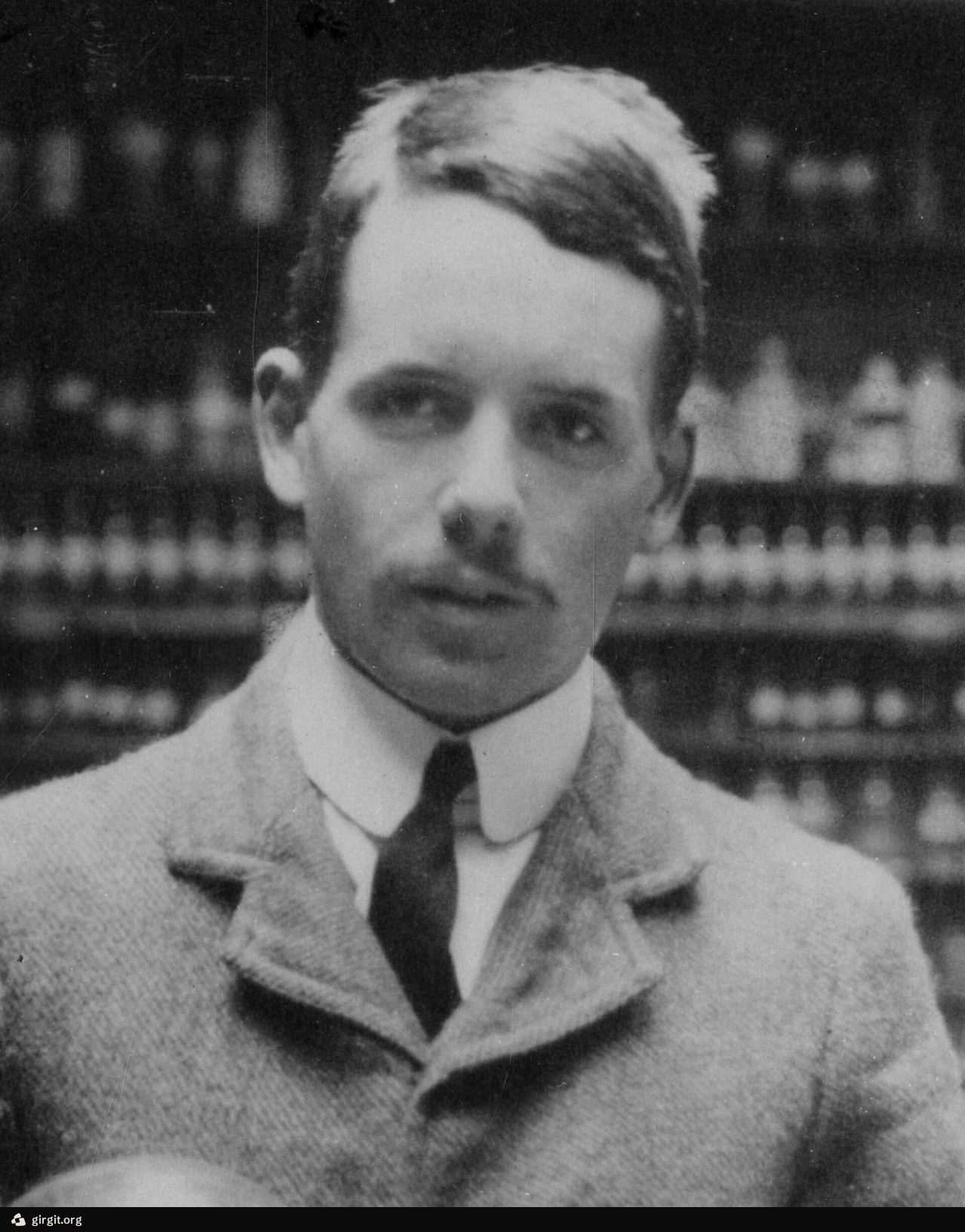
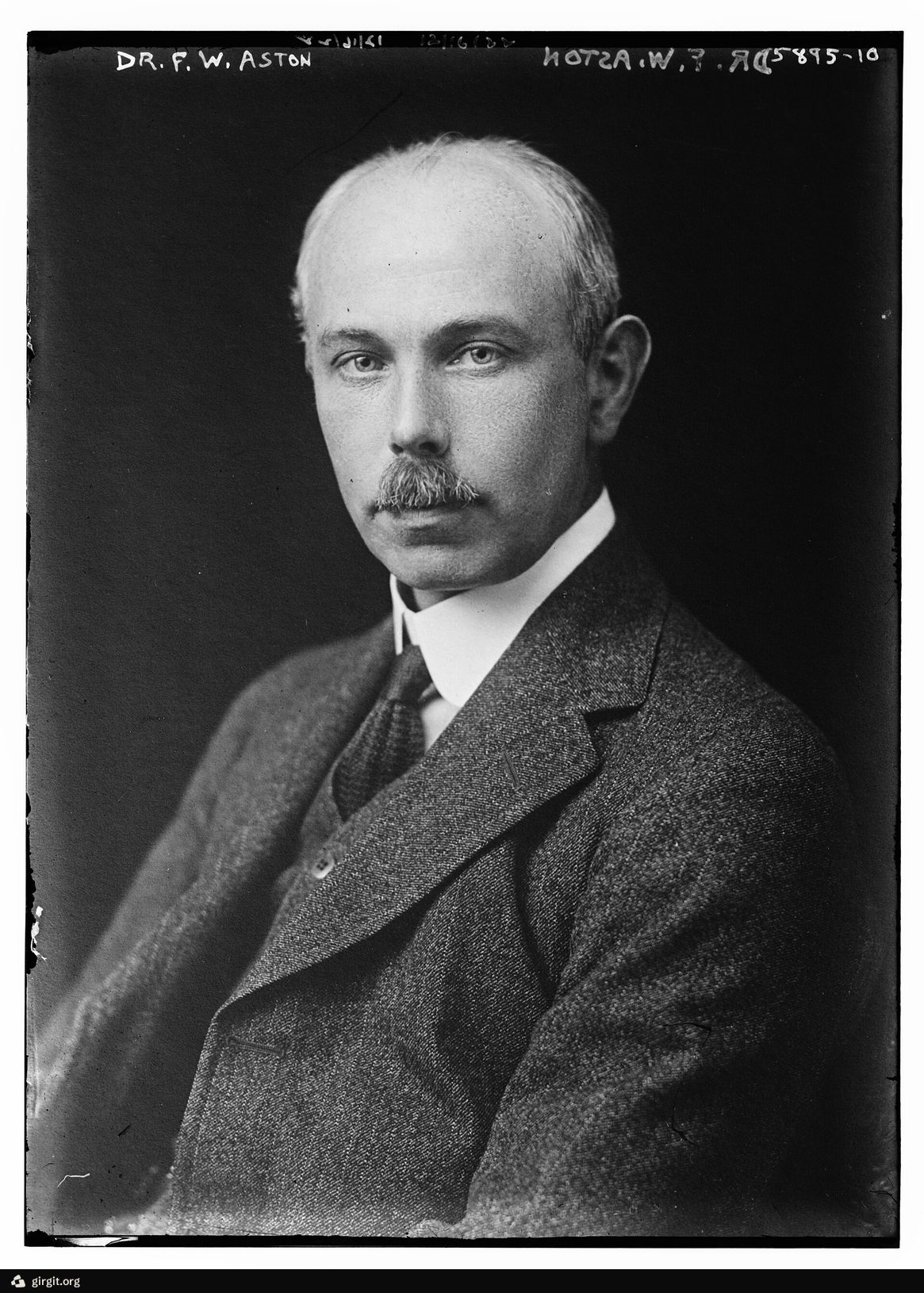
StoryHenry Moseley · Francis Aston
One counted, one weighed
Moseley counted protons with X-rays. Aston weighed atoms one by one, and found isotopes in element after element.
StoryGlasgow and Cambridge
"Same place"
- 1912J.J. Thomson, to 1913Neon ions through electric and magnetic fields: two streaks, mass 20 and 22.
- 1913Frederick SoddyRadioactive substances of different mass no chemistry could separate. At a dinner party his cousin Margaret Todd, an early woman doctor trained in Edinburgh, offers the Greek: isotopes.
- 1919Francis AstonHis assistant builds the mass spectrograph: 212 natural isotopes with later instruments, each mass close to a whole number.
- 1922Nobel Prize in ChemistryAston, for the whole-number rule.
See itA mass spectrometer
Heavier swings wider
Give ions one speed and bend them with a magnet. Chlorine splits in two; change the mix and the average moves.
Solve itFour problems
Your turn
Solve it
Copper has two isotopes, \( ^{63}\mathrm{Cu} \) (62.930 u) and \( ^{65}\mathrm{Cu} \) (64.928 u). Its atomic mass is 63.546 u. What percentage of copper atoms are copper-63?
Hint
Answer
Solve it: predict, then check
Moseley's rule says the X-ray frequency of an element's main line grows as \( (Z - 1)^2 \). Copper (Z = 29) gives this line at 0.154 nm. Predict the wavelength for iron (Z = 26).
Answer
Solve it: estimate
Heavy water, D2O, has deuterium (2.014 u) where ordinary water has hydrogen (1.008 u). If heavy water molecules pack as closely as ordinary ones, how dense should it be? (Oxygen-16: 15.995 u.)
Answer
Solve it: spot the error
"Carbon-14 and nitrogen-14 have the same mass number, so they behave the same way in chemistry." What is wrong?
Answer
ConnectAnd still confused?
Where this goes next
Connect it
- Atomic mass, Chapter 1. The "average atomic mass" you calculated there is exactly the weighted average the mass spectrometer measures. See Atomic and molecular mass.
- The modern periodic law, Chapter 3. Moseley's discovery is why the periodic table is ordered by atomic number. See The modern periodic table.
- Sorting by \( q/m \), concept 1. A mass spectrometer is Thomson's cathode ray tube turned into a weighing machine. See What is an atom made of?
- Nuclei, Class 12 Physics. Why some isotopes are stable and others radioactive. See Atomic mass and isotopes.
- India's reactors. Many of India's nuclear power reactors use heavy water to slow down neutrons, which lets them run on natural uranium, and India's Heavy Water Board is among the world's largest producers of it. An isotope you cannot tell from water by looking is a pillar of the country's power programme.
If isotopes have the same chemistry, how can anyone separate them?
By mass, not by chemistry. Heavier molecules move, diffuse and evaporate a little more slowly, and a magnet bends heavier ions less. Each step separates only a little, so it is repeated many times. That is why heavy water and enriched uranium are expensive.
Why are atomic masses not whole numbers when mass numbers are?
Two reasons. Mostly, because natural elements are mixtures of isotopes, so the table shows an average (chlorine, 35.45). And even a single isotope is not exactly a whole number of u, because protons and neutrons are not exactly 1 u each and some mass is lost as binding energy when the nucleus forms. Carbon-12 is exactly 12 u only because the unit is defined that way.
Can an element change into another?
Only if the nucleus changes, which chemistry never does. Radioactive decay can: when carbon-14 gives off a beta particle, one neutron becomes a proton, Z goes from 6 to 7, and the atom is now nitrogen-14, its isobar.
Sources
- APS News, "August 10, 1915: Henry G.J. Moseley killed in action"
- University of Manchester, "Gallipoli 100 years on: Manchester pays tribute to genius lost to war"
- Accademia Nazionale delle Scienze detta dei XL, Rendiconti (2019), study of Moseley's death
- H.G.J. Moseley, "The High-Frequency Spectra of the Elements", Philosophical Magazine 26, 1024 (1913) and 27, 703 (1914)
- Chemistry World, "Transmutations and isotopes" (Soddy and Margaret Todd)
- The Nobel Prize in Chemistry 1922: Francis W. Aston
- Encyclopedia.com, "Aston, Francis William" (neon 20 and 22, 212 isotopes, whole-number rule)
- "Heavy water", Wikipedia (density, boiling point, reactors, India's Heavy Water Board)
- IUPAC Commission on Isotopic Abundances and Atomic Weights (isotope masses and abundances)