Act 04NCERT §2.2.5–2.3.1 · pp. 36–395 min
Why should Rutherford's atom collapse? And what is light?
Rutherford's circling electron, if it gave off light as theory says it must, spirals into the nucleus.
A circling charge gives off light, and falls in.
From the textbookpp. 36–39
NCERT Chemistry Part I, Class 11 · Reprint 2026-27
4.0The big idea
Atoms should collapse. They don't.
A circling electron should give off light, lose energy and fall into the nucleus. Since atoms last, we need to understand light itself.
Full text
The big ideaA circling electron should give off light, lose energy and fall into the nucleus; since atoms do not collapse, we need to understand light itself.
In simple words
Anything with a charge that keeps turning a corner sends out light, and light carries energy away. An electron going round and round should leak energy, spiral inwards and hit the centre in far less than a blink. That does not happen, so the old picture of the atom has a hole in it. To fix it, scientists looked closely at light: a wave of electric and magnetic push and pull that needs no air or water to travel.
4.1Rutherford's atom: a tiny solar system
Same law, different fate
Classical mechanics, Newton's laws for large objects, keeps planets on steady orbits. The pull on an electron has exactly the same form.
Planet · gravity
\( F = G\dfrac{m_1 m_2}{r^2} \)
No charge: circles for ever.
Electron · the Coulomb force
\( F = k\dfrac{q_1 q_2}{r^2} \)
Charged: there is a catch.
4.2Maxwell's electromagnetic theory
Watch it fall in
It could circle like this for ever.
An accelerating charge gives off light.
The orbit shrinks, the pull grows: a runaway.
The ripples crowd: higher frequency.
In about 10⁻⁸ s. Real atoms last billions of years.
4.3How long it would last
10−8s, says the book
Planets have no charge, so they never radiate. Electrons are charged, so they must, and the atom would be gone almost at once.
Textbook check · §2.2.5 · what we know now
1.6 × 10⁻¹¹s
The standard classical calculation from hydrogen's real size (52.9 pm): about a thousand times shorter.
In the exam
Write NCERT's 10⁻⁸ s
Asked why the model fails: an accelerating charge radiates, so the atom would collapse.
Full text
Drawbacks of Rutherford's model
Rutherford's atom is a tiny solar system. Classical mechanics, the physics of Newton's laws for large everyday objects, works perfectly for planets: gravity, \( F = G\dfrac{m_1 m_2}{r^2} \), keeps them in steady orbits. The pull between an electron and the nucleus, the Coulomb force \( F = k\dfrac{q_1 q_2}{r^2} \), has exactly the same form. So electrons ought to circle steadily too. But there is a catch.
- A body moving in a circle is accelerating, even at constant speed, because its direction keeps changing.
- By Maxwell's electromagnetic theory, an accelerating charged particle gives off electromagnetic radiation. Planets have no charge, so this does not affect them; electrons are charged, so it does.
- The radiation carries away the electron's energy, so its orbit shrinks. Calculation says it would spiral into the nucleus in about \( 10^{-8} \) s.
Textbook check · §2.2.5The collapse would be even faster than the book says
- The textbook says
- The electron would spiral into the nucleus in about \( 10^{-8} \) s.
- What we know now
- The standard classical calculation, starting from hydrogen's real size (52.9 pm), gives about \( 1.6 \times 10^{-11} \) s, roughly a thousand times shorter. Either way the atom would die almost instantly, which is the point.Source: J.D. Olsen and K.T. McDonald, "Classical Lifetime of a Bohr Atom" (Princeton, 2005)
- In the exam
- If asked for the time, write NCERT's \( 10^{-8} \) s; if asked why the model fails, write that an accelerating charge radiates and the atom would collapse.
Atoms are clearly stable, so the model cannot explain the stability of the atom. Making the electrons stand still does not help: the nucleus would pull them in, giving a small Thomson-like atom. A second drawback: the model says nothing about how electrons are arranged round the nucleus or what energies they have.
Try itRun the clock
A circling charge, giving out light
CheckPlanets and electrons
Why do planets survive?
Why does the same reasoning that keeps planets in orbit fail for electrons?
- The Coulomb force follows a different law from gravity
- An accelerating charge radiates energy, and planets are not charged
- Electrons move too fast to stay in orbit
4.4Drawbacks of Rutherford's model
Two things it cannot explain
Stop the electrons and the nucleus pulls them in: a small, Thomson-like atom. Like a spinning top losing energy, it falls; only millions of times faster.
01
Stability
- Says
- The atom collapses
- Reality
- Atoms are clearly stable
02
Arrangement
- Says
- Nothing about how electrons are arranged
- Or
- what energies they have
4.5Niels Bohr improved the model
Two clues from light
Clue 1 · this act and the next
The dual character of electromagnetic radiation
It behaves both as a wave and as particles. First, the wave side.
Clue 2 · concept 6
Atomic spectra
The light each element gives out.
Full text
Two clues that led to Bohr
Niels Bohr improved the model using two discoveries about how radiation and matter interact: the dual character of electromagnetic radiation (it behaves both as a wave and as particles) and the atomic spectra (concept 6). First, the wave side.
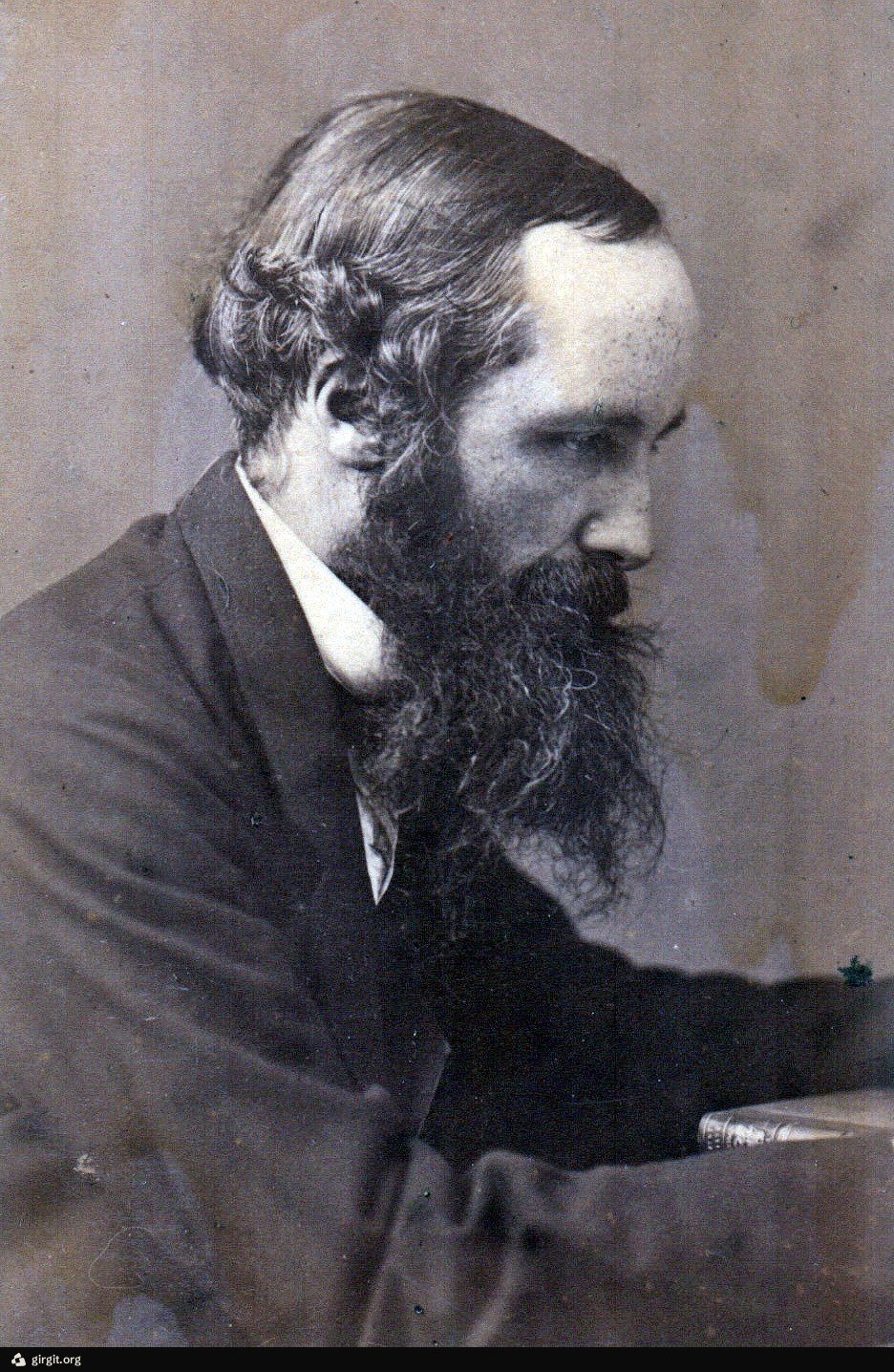
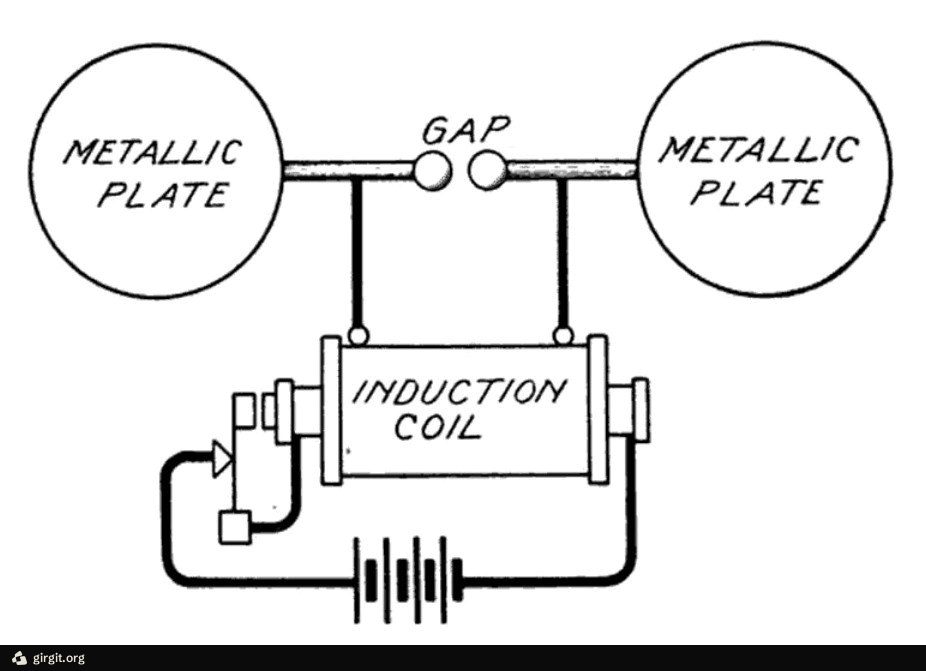 sparks jump herebattery
4.6James Clerk Maxwell · around 1870
Light is a ripple of fields
- 1850s: radiation from hot objects, thermal radiation.
- An accelerating charge makes changing fields that travel out: electromagnetic waves, or electromagnetic radiation. Heinrich Hertz confirmed it.
- Newton: a stream of particles, corpuscles. The 19th century proved waves.
Full text
Light as an electromagnetic wave
In the 1850s physicists studied the radiation given off by hot objects, called thermal radiation. Around 1870 James Clerk Maxwell explained it: a charged particle that accelerates produces electric and magnetic fields that keep changing, and these travel outward as electromagnetic waves or electromagnetic radiation. Heinrich Hertz later confirmed it by experiment. Newton had thought light was a stream of particles (corpuscles); in the 19th century its wave nature was established, and Maxwell showed light is one of these waves.
- The electric and magnetic fields vibrate at right angles to each other, and both at right angles to the direction the wave travels.
- Unlike sound or water waves, electromagnetic waves need no medium: they cross empty space.
- There are many types, differing only in wavelength (or frequency). Together they form the electromagnetic spectrum.
| Region | Typical frequency | Use or source |
|---|---|---|
| Radio waves | about \( 10^{6} \) Hz | Broadcasting |
| Microwaves | about \( 10^{10} \) Hz | Radar |
| Infrared | about \( 10^{13} \) Hz | Heating |
| Visible light | about \( 10^{15} \) Hz | The only part our eyes detect |
| Ultraviolet | about \( 10^{16} \) Hz | Part of sunlight |
4.7Three facts about these waves
Fields at right angles
- E and B vibrate at right anglesto each other and to the direction of travel.
- No medium needed: unlike sound or water waves, they cross empty space.
- They differ only in wavelength(or frequency): together, the electromagnetic spectrum.
4.8Radio to gamma
Shrink the wave
Broadcasting: waves hundreds of metres long.
λ = 3.05 m: about the length of a car.
Radar; a 2.45 GHz oven, about 12 cm.
Heating: you feel these.
750 nm (red) to 400 nm (violet): all we see.
Part of sunlight.
The size of one atom.
Through it all, ν × λ stayed at c.
4.9Typical frequencies
Five regions, one kind of wave
- 10⁶Radio wavesHz · broadcasting
- 10¹⁰MicrowavesHz · radar
- 10¹³InfraredHz · heating
- 10¹⁵Visible lightHz · the only part our eyes detect
- 10¹⁶UltravioletHz · part of sunlight
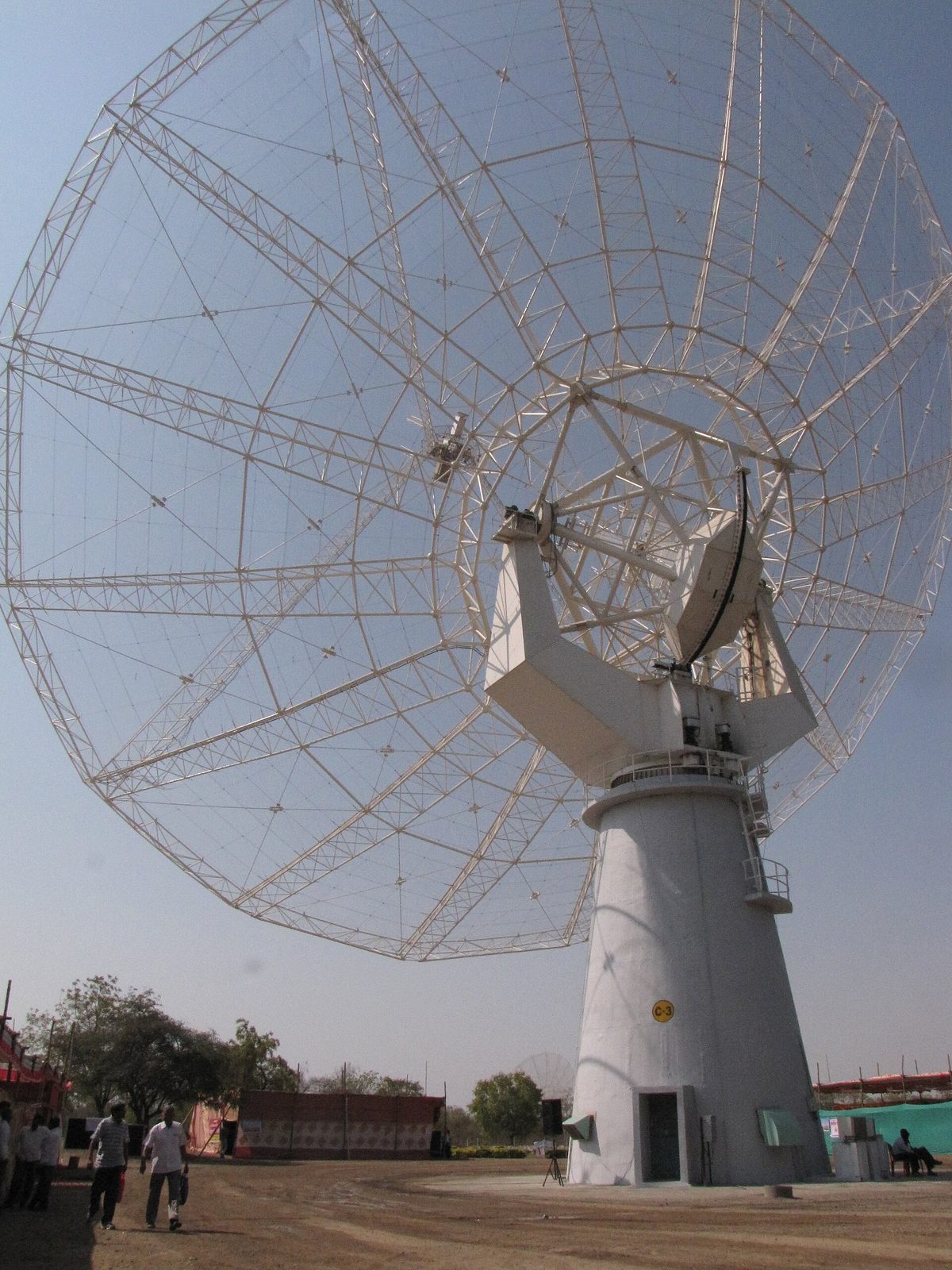 wire-mesh dish, 45 m acrosspeople, for scale
4.10Giant Metrewave Radio Telescope · Khodad, near Pune
A mirror made of mesh
It catches radio waves from space, 0.2 m to 6 m long. To waves that long, a wire mesh works as well as a solid mirror.
4.11Frequency, wavelength and wavenumber
More waves, shorter waves
c = 3.0 × 10⁸ m s−1 (2.997925 × 10⁸ precisely). ν and λ are inversely related. Visible: about 400 nm (violet) to 750 nm (red).
Full text
Frequency, wavelength and wavenumber
- Frequency, \( \nu \) (Greek "nu"): the number of waves passing a point each second. SI unit: hertz, Hz = s−1.
- Wavelength, \( \lambda \) (lambda): the length of one wave, in metres (or nm, Å for short waves).
- In a vacuum every electromagnetic wave moves at the speed of light, \( c = 3.0 \times 10^{8} \) m s−1 (2.997925 × 10⁸ m s−1 to be precise).
- Wavenumber, \( \bar{\nu} \) ("nu bar"): the number of wavelengths per unit length, \( \bar{\nu} = 1/\lambda \). SI unit m−1, but cm−1 is commonly used.
More waves per second means each wave is shorter: frequency and wavelength are inversely related. Visible light runs from violet (about 400 nm) to red (about 750 nm).
Worked example 1: an FM station
An FM radio station broadcasts at 98.3 MHz. What is its wavelength?
\[ \lambda = \frac{c}{\nu} = \frac{3.0 \times 10^{8}\ \mathrm{m\,s^{-1}}}{98.3 \times 10^{6}\ \mathrm{s^{-1}}} = 3.05\ \mathrm{m} \]About the length of a car: a radio wave.
Worked example 2: green light
Find the frequency and wavenumber of green light of wavelength 500 nm.
- \( \nu = \dfrac{c}{\lambda} = \dfrac{3.0 \times 10^{8}}{500 \times 10^{-9}} = 6.0 \times 10^{14} \) Hz.
- \( \bar{\nu} = \dfrac{1}{\lambda} = \dfrac{1}{500 \times 10^{-9}\ \mathrm{m}} = 2.0 \times 10^{6}\ \mathrm{m^{-1}} = 2.0 \times 10^{4}\ \mathrm{cm^{-1}} \).
Try it. A microwave oven uses waves of frequency 2.45 GHz (2.45 × 10⁹ Hz). What is their wavelength?
Answer
Don't mix these up
- Higher frequency means shorter wavelength and higher wavenumber.
- To change m−1 to cm−1, divide by 100 (there are 100 cm in a metre, so fewer waves fit in one cm).
Try itGamma to radio
Watch ν and λ trade places
4.12Worked: λ = c / ν and back
A car, and a green leaf
FM station · 98.3 MHz
3.05m
3.0 × 10⁸ ÷ 98.3 × 10⁶. About the length of a car: a radio wave.
Green light · 500 nm
6.0 × 10¹⁴Hz
ν̄ = 1/λ = 2.0 × 10⁶ m−1 = 2.0 × 104 cm−1.
Try it: a microwave oven runs at 2.45 GHz (2.45 × 10⁹ Hz). How long are its waves?
Answer
CheckTwice the frequency
What halves?
Wave A has twice the frequency of wave B. Compared with B, A has
- twice the speed
- half the wavelength
- half the wavenumber
4.13Don't mix these up
Higher frequency, shorter wave
Myth
Higher frequency means a longer wave
Fact
Shorter wavelength, higher wavenumber
m⁻¹ to cm⁻¹: divide by 100. Fewer waves fit in one cm.
Don't mix these up
- Higher frequency means shorter wavelength and higher wavenumber.
- To change m−1 to cm−1, divide by 100 (there are 100 cm in a metre, so fewer waves fit in one cm).
CheckThe waves themselves
Which is true?
Which statement about electromagnetic waves is correct?
- They need air or water to travel
- The electric and magnetic fields point the same way
- Different types differ only in wavelength and frequency
KeepJust remember
An order, a range, a speed
Agreed names and measured values. Tap a card for its hook.
WordsTo know
Six words
- Classical mechanics
- Newton's laws of motion, which work for large objects.
- Electromagnetic radiation
- Waves of changing electric and magnetic fields; light is one kind.
- Electromagnetic spectrum
- All the kinds, from radio waves to γ-rays, sorted by wavelength.
- Frequency, ν
- Waves per second, in hertz.
- Wavelength, λ
- Length of one wave.
- Wavenumber, ν̄
- Waves per unit length, 1/λ.
NEETAsked in the exam
The real thing
RootsWhere light comes from
A kink in the field
- Field lines spread out from a charge.
- Change its motion: the news travels outward at c. Where old meets new, each line kinks sideways.
- That kink is light. Nothing travels faster than light; steady speed sends no news.
Full text
The roots: where light comes from
- Why does a circling electron give off light?Because moving in a circle means its velocity keeps changing direction, so it is accelerating, and any charge that accelerates sends out electromagnetic waves.
- Why does accelerating make waves?A charge is surrounded by its electric field, which you can draw as lines spreading out from it. When the charge changes its motion, the far-away parts of the field cannot know at once. The news spreads outward at a fixed speed, the speed of light. Inside the "news has arrived" sphere the lines point from the new motion; outside, from the old. Where the two meet, every line has a sideways kink.
- Why is that kink light?The kink is a sideways electric field running outward at speed \( c \), and a changing electric field always comes with a changing magnetic field. A travelling, sideways, electric-plus-magnetic disturbance is exactly what an electromagnetic wave is. Shake the charge regularly and you get a regular train of kinks: a wave with the frequency of your shaking.
- Why does a charge at steady speed not radiate?Then there is no news to send. The lines simply move along with the charge, staying straight, and nothing runs off. Only a change in velocity (speeding up, slowing down or turning) makes a kink.
- The bedrockNothing, not even news about where a charge is, travels faster than light, and the field lines must stay joined to their charge. Those two facts force the kinks, and the kinks are light.
The kink also explains how much light comes out. Its sideways size grows with the acceleration, and the energy carried grows with the square of that. This is Larmor's result: the power radiated is proportional to \( a^2 \). For an electron in orbit the pull of the nucleus gives \( a = \dfrac{ke^2}{m_e r^2} \), so the power grows like \( 1/r^4 \). As the orbit shrinks the electron radiates faster and faster, a runaway. Put in hydrogen's numbers and the electron goes round about a hundred thousand times and hits the nucleus in about \( 1.6 \times 10^{-11} \) s. Since every atom around you has lasted billions of years, something in this picture had to be wrong. Bohr's answer (page 7) was to declare that on certain orbits the electron simply does not radiate. The full reason came only with quantum mechanics.
RootsLarmor's result
How much light comes out
So power grows like 1/r⁴. About a hundred thousand turns, then the nucleus, in about 1.6 × 10⁻¹¹ s. Bohr (page 7) simply declared some orbits do not radiate; quantum mechanics explained why.
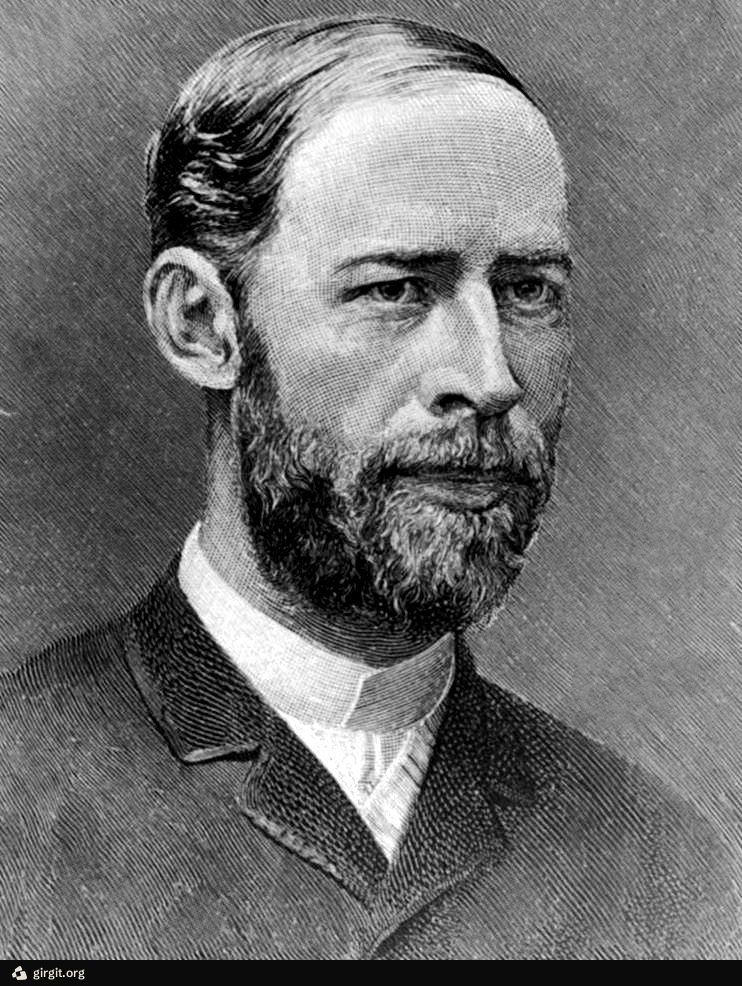
Story1861 to 1889 · London and Karlsruhe
We can scarcely avoid the inference that light consists in the transverse undulations of the same medium
James Clerk Maxwell's model of electric and magnetic forces predicted the speed of light. Heinrich Hertz then made such waves on purpose: a spark sloshing charge billions of times a second.
StoryWaves nobody had made
From a formula to a phone
- 1861Maxwell, to 1862In London, a disturbance's speed comes out almost exactly the speed of light.
- 1886Hertz, to 1889A loop across the room sparks too. Waves reflect, bend, move at c. One transmitter: waves 66 cm long.
- "no use"AnecdoteBooks say he called them of no use at all; radio, television and mobile phones followed.
- 1894Hertz dies, aged 36The unit of frequency carries his name.
Full text
The story
Story1895 · Presidency College, Kolkata
60GHz
Jagadish Chandra Bose: waves of 2.5 cm down to 5 mm (millimetre waves) sent about 23 m through two walls to ring a bell and fire gunpowder. His horn antenna, dielectric lens and crystal detector are still used. IEEE plaque: 2012.
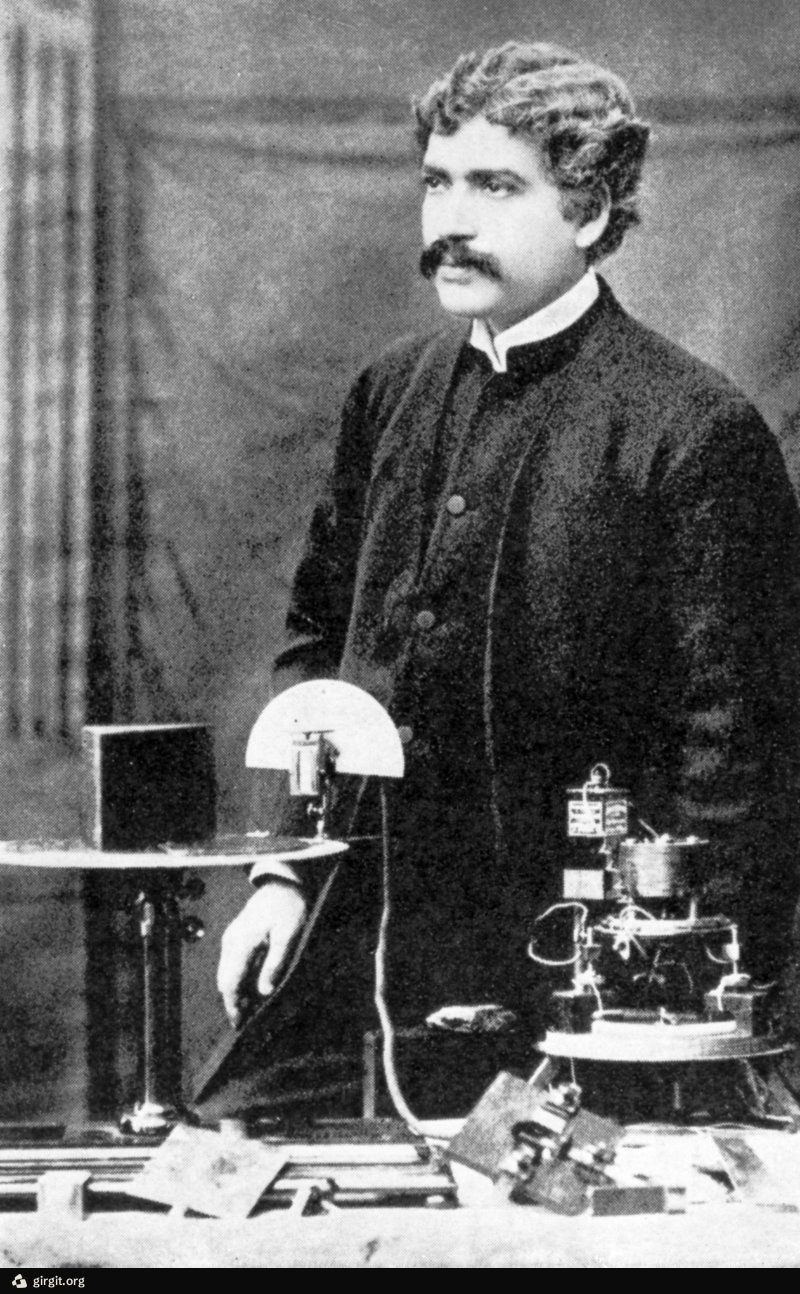
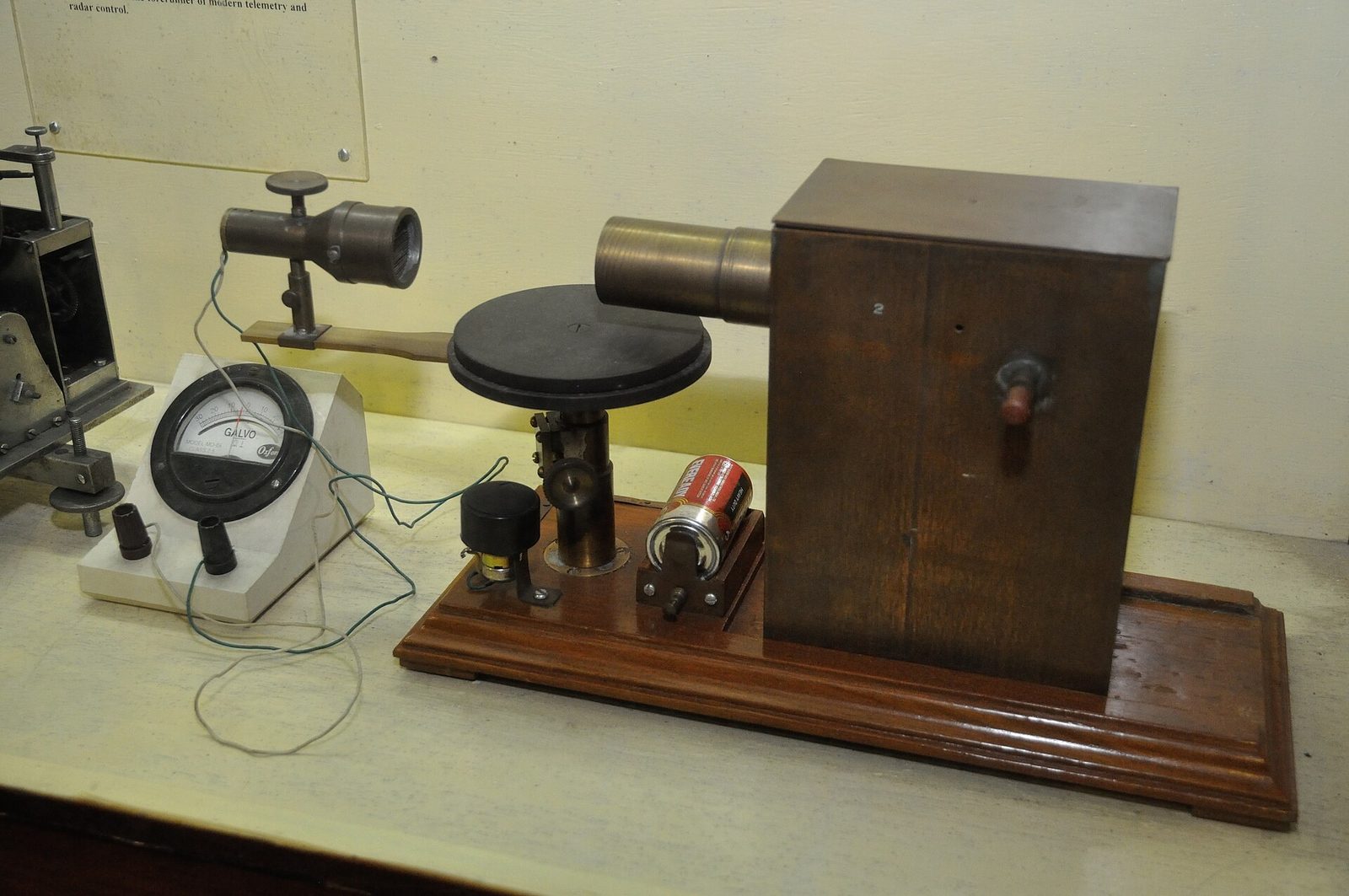 transmitter (in the box)waves leave herereceiver hornmeter
See itMake light yourself
Shake the charge
Grey lines are its field; distance is how long ago. Try each motion, then Your finger. The real atom puts in hydrogen's numbers.
Solve itThree problems
Your turn
Solve it
The GMRT near Pune listens between 50 MHz and 1500 MHz. What range of wavelengths is that? Its dishes are made of wire mesh, not solid metal. Why can it get away with that, when a telescope for visible light needs a polished mirror?
Hint
Answer
Solve it: spot the idea
The glass door of a microwave oven has a metal sheet with holes about 1 mm across. You can see your food through it, yet the 2.45 GHz microwaves stay inside. Explain using numbers.
Answer
Solve it: estimate
A classical electron in a hydrogen orbit (52.9 pm) gives out light at about \( 4.7 \times 10^{-8} \) W. It has about \( 2 \times 10^{-18} \) J to lose before it reaches the nucleus (more, actually, since the energy falls without limit as \( r \to 0 \), but take this). Estimate how long the atom would last. Is the true answer longer or shorter than your estimate?
Hint
Answer
ConnectAnd still confused?
Where this goes next
Connect it
- Circular motion, Class 11 Physics. Steady speed in a circle still means an acceleration \( v^2/r \) towards the centre. See Uniform circular motion.
- Maxwell's equations, Class 12 Physics. The full theory of how accelerating charges make waves, and the whole spectrum. See Maxwell's equations and wave sources and The electromagnetic spectrum.
- The same puzzle in Physics. Why the Rutherford atom collapses, from the physics book's side.
- The fix, this chapter. Bohr simply forbids radiation on certain orbits: Bohr's model. Light coming in packets, the other clue, is on the next page.
- Every day. The antenna on a mobile tower or an FM transmitter is Hertz's idea: electrons pushed up and down a metal rod millions or billions of times a second. Your phone's antenna does the same when you send a message.
Is the light the charge itself flying outward?
No. The charge stays where it is (or moves only a little). What travels out is a change in its field, the kink, much as a ripple travels across a pond while the water itself only bobs up and down.
So why don't electrons in real atoms radiate?
Classical physics has no answer, which is the whole problem on this page. Bohr just postulated it. Quantum mechanics later explained it: in a steady state (an orbital, page 10) the electron is not a little ball going round; its charge cloud does not change with time, so there is nothing shaking and nothing to send out. Light is given out only during a jump between states.
Do all accelerating charges radiate, even in a car going round a corner?
Yes, but the amount is tiny unless the acceleration is enormous, because the power goes as \( a^2 \). An electron in a hydrogen orbit has an acceleration of about \( 9 \times 10^{22} \) m s−2, some \( 10^{22} \) times a car's. That is why the atom's problem is so severe and the car's is invisible.
Sources
- "On Physical Lines of Force" (J.C. Maxwell, 1861–62), Wikipedia summary with the quoted sentence
- Heinrich Hertz, Wikipedia (experiments 1886–1889 at Karlsruhe, 66 cm waves, the "no use" remark and its anecdotal sources, death in 1894)
- IEEE Milestone: First Millimeter-wave Communication Experiments by J.C. Bose, 1894–96 (ETHW)
- Giant Metrewave Radio Telescope, Wikipedia (30 dishes of 45 m, Khodad, 50–1500 MHz)
- J.D. Olsen and K.T. McDonald, "Classical Lifetime of a Bohr Atom", Princeton (2005): fall time 1.6 × 10⁻¹¹ s
- "Old Quantum Mechanics by Bohr and Sommerfeld from a Modern Perspective", arXiv:2506.00408 (spiral-in time and about 10⁵ orbits)
- E.M. Purcell and D.J. Morin, Electricity and Magnetism, 3rd ed., Cambridge University Press (2013), on the kinked field lines of an accelerated charge (Larmor's formula)