Act 06NCERT §2.4 · pp. 17–216 min
The three equations of motion
A motorbike at 10 m/s speeds up at 1.5 m/s² for 10 s. Its velocity-time graph is a straight line; the area under it splits into a rectangle, v₀t = 100 m, and a triangle, ½at² = 75 m: 175 m in all.
1.5 m/s², every second. A straight v-t line; its area splits into a rectangle and a triangle.
From the textbookpp. 17–21
NCERT Physics Part I, Class 11 · Rationalised 2023-24

6.0The big idea
Constant a: know three, find the other two.
Speed up by the same amount every second and the motion is tidy. Three short equations tie together its five numbers.
Full text
The big ideaWhen acceleration is constant, three short equations connect the five quantities of motion, so knowing any three gives you the other two.
In simple words
If something speeds up by the same amount every second, its motion is very tidy. You only need to know a few things, like how fast it started and how hard it speeds up, and you can work out everything else: how fast it is going later, and how far it has gone.
For motion along a line with constant acceleration, we use five quantities:
- \( v_0 \): the initial velocity, at \( t = 0 \) (many books write \( u \));
- \( v \): the final velocity, at time \( t \);
- \( a \): the constant acceleration;
- \( t \): the time taken;
- \( x \): the displacement in that time (many books write \( s \)).
6.1Five quantities
The five numbers of a trip
Many books write u for v₀ and s for x. Same equations.
v₀
Initial velocity
Initial velocity, at t = 0. Also u.
v
Final velocity
Final velocity, at time t.
a
Acceleration
Constant all the way.
t
Time
The time taken.
x
Displacement
In that time. Also s.
6.2First equation
Start height plus slope × time
The definition of constant acceleration, from Act 04. On a v-t graph: a straight line starting at height v₀ with slope a.
6.3From the v-t graph
Three equations, one picture
A motorbike at 10 m/s speeds up at 1.5 m/s² for 10 s; on the road, its ghosts every second pull ahead of a ghost bike that keeps 10 m/s. Its v-t graph is a straight line from 10 to 25 m/s. The area under it splits into a rectangle, v₀t = 100 m, and a triangle, ½at² = 75 m: 175 m. The same area fits under the middle height, 17.5 m/s, for 10 s. Then v² is plotted against x: a straight line from 100 to 625, slope 2a.
Start at v₀, climb a every second: v = v₀ + at.
Rectangle v₀t + triangle ½at²: the steady bike, plus the extra.
Same area under the middle height: x = ½(v₀ + v)t.
Plot v² against x: a straight line. v² = v₀² + 2ax.
6.4Second equation
Rectangle plus triangle
The same area
\( x = \dfrac{v_0 + v}{2}\,t \)
As if it went the whole time at the plain average.
Careful
Constant a only
The shortcut \( \bar v = (v_0 + v)/2 \) holds only then.
Full text
Getting the equations from the v-t graph
First equation. From the definition of constant acceleration (concept 4):
\[ v = v_0 + at \]On a v-t graph this is a straight line starting at height \( v_0 \) with slope \( a \).
Second equation. The displacement is the area under this line from 0 to \( t \). Split it into a rectangle of height \( v_0 \) and width \( t \), with a triangle on top whose height is \( v - v_0 \):
\[ x = v_0 t + \tfrac12 (v - v_0)\,t \]Since \( v - v_0 = at \), the triangle's area is \( \tfrac12 at^2 \), giving
\[ x = v_0 t + \tfrac12 a t^2 \]The same area can be written as \( x = \dfrac{v_0 + v}{2}\,t \). This says the object moved as if it had gone the whole time at the plain average of the starting and ending velocities, \( \bar v = (v_0 + v)/2 \). This shortcut is true only for constant acceleration.
Third equation. Put \( t = (v - v_0)/a \) into \( x = \tfrac12(v_0 + v)\,t \):
\[ x = \frac{(v + v_0)(v - v_0)}{2a} = \frac{v^2 - v_0^2}{2a} \]Multiply both sides by \( 2a \) and rearrange:
\[ v^2 = v_0^2 + 2ax \]The kinematic equations (constant a)
- \( v = v_0 + at \)
- \( x = v_0 t + \tfrac12 a t^2 \)
- \( v^2 = v_0^2 + 2ax \)
- If the object starts at \( x_0 \) instead of 0, replace \( x \) by \( x - x_0 \): for example \( x = x_0 + v_0 t + \tfrac12 at^2 \).
These are the kinematic equations of rectilinear motion for constant acceleration (the "equations of motion").
Try itThe area is the distance
See both pieces as road
A ghost bike keeps 10 m/s: that is the rectangle. The real bike, at 1.5 m/s², gains the triangle on top.
6.5Third equation
Take the time out
Together: the kinematic equations, the "equations of motion". Starting at x₀? Write x − x₀ for x.
The kinematic equations (constant a)
- \( v = v_0 + at \)
- \( x = v_0 t + \tfrac12 a t^2 \)
- \( v^2 = v_0^2 + 2ax \)
- If the object starts at \( x_0 \) instead of 0, replace \( x \) by \( x - x_0 \): for example \( x = x_0 + v_0 t + \tfrac12 at^2 \).
\( \int_{v_0}^{v} dv = \int_0^t a\,dt \)
\( \int_{x_0}^{x} dx = \int_0^t (v_0 + at)\,dt \)
\( \int_{v_0}^{v} v\,dv = \int_{x_0}^{x} a\,dx \)
6.6With calculus
Add up the tiny pieces
- From a = dv/dt: v − v₀ = at.
- From v = dx/dt: x − x₀ = v₀t + ½at².
- From a = v dv/dx: ½(v² − v₀²) = a(x − x₀).
Integration still works when a is not constant.
Full text
Getting them with calculus
The same results come from integrating. Start from \( a = dv/dt \), with \( a \) constant:
\[ \int_{v_0}^{v} dv = \int_0^t a\,dt \;\Rightarrow\; v - v_0 = at \]Then \( v = dx/dt \), so \( dx = (v_0 + at)\,dt \):
\[ \int_{x_0}^{x} dx = \int_0^t (v_0 + at)\,dt \;\Rightarrow\; x - x_0 = v_0 t + \tfrac12 at^2 \]Finally, \( a = \dfrac{dv}{dt} = \dfrac{dv}{dx}\dfrac{dx}{dt} = v\dfrac{dv}{dx} \), so \( v\,dv = a\,dx \):
\[ \int_{v_0}^{v} v\,dv = \int_{x_0}^{x} a\,dx \;\Rightarrow\; \tfrac12(v^2 - v_0^2) = a(x - x_0) \]The calculus method has one big advantage: it still works when the acceleration is not constant, as long as you can integrate it.
6.7Choosing the right equation
Each one leaves one out
Like keys on a ring: find the quantity you neither know nor need, and pick the key without it.
\( v = v_0 + at \)
Leaves out x
\( x = v_0 t + \tfrac12 at^2 \)
Leaves out v
\( v^2 = v_0^2 + 2ax \)
Leaves out t
\( x = \tfrac12(v_0 + v)\,t \)
Leaves out a
Full text
Choosing the right equation
Each equation leaves out one of the five quantities. Pick the one that leaves out the quantity you neither know nor need.
| Equation | Leaves out |
|---|---|
| \( v = v_0 + at \) | \( x \) |
| \( x = v_0 t + \tfrac12 at^2 \) | \( v \) |
| \( v^2 = v_0^2 + 2ax \) | \( t \) |
| \( x = \tfrac12(v_0 + v)\,t \) | \( a \) |
Worked example
A local train leaves a station from rest with a constant acceleration of 0.5 m s−2 for 40 s. Find its speed and the distance it covers.
- Known: \( v_0 = 0 \), \( a = 0.5 \) m s−2, \( t = 40 \) s.
- \( v = 0 + 0.5 \times 40 = \) 20 m s−1 (72 km/h).
- \( x = 0 + \tfrac12 \times 0.5 \times 40^2 = \) 400 m.
- Check with the third equation: \( v^2 = 2ax = 2 \times 0.5 \times 400 = 400 \), so \( v = 20 \) m s−1. It agrees.
Worked example
A car moving at 72 km/h brakes with constant deceleration and stops in 50 m. Find the deceleration and the time it takes to stop.
- Convert: 72 km/h = \( 72 \times \tfrac{1000}{3600} = 20 \) m s−1. So \( v_0 = 20 \), \( v = 0 \), \( x = 50 \) m. Time is not given, so use the equation without \( t \).
- \( 0 = 20^2 + 2a(50) \Rightarrow a = -4 \) m s−2. The minus sign means the acceleration opposes the motion.
- \( 0 = 20 + (-4)t \Rightarrow t = \) 5 s.
Try itFive doors
Pick the right key
CheckNo time given
Straight to a
You know v₀, v and x, and you need a. Which equation goes straight there?
- v = v₀ + at
- x = v₀t + ½at²
- v² = v₀² + 2ax
6.8Worked example
A local train pulls out
From rest, 0.5 m/s² for 40 s.
Speed
20m/s
72 km/h
Distance
400m
Check: v² = 2ax
Worked example
A local train leaves a station from rest with a constant acceleration of 0.5 m s−2 for 40 s. Find its speed and the distance it covers.
- Known: \( v_0 = 0 \), \( a = 0.5 \) m s−2, \( t = 40 \) s.
- \( v = 0 + 0.5 \times 40 = \) 20 m s−1 (72 km/h).
- \( x = 0 + \tfrac12 \times 0.5 \times 40^2 = \) 400 m.
- Check with the third equation: \( v^2 = 2ax = 2 \times 0.5 \times 400 = 400 \), so \( v = 20 \) m s−1. It agrees.
Worked example
A car moving at 72 km/h brakes with constant deceleration and stops in 50 m. Find the deceleration and the time it takes to stop.
- Convert: 72 km/h = \( 72 \times \tfrac{1000}{3600} = 20 \) m s−1. So \( v_0 = 20 \), \( v = 0 \), \( x = 50 \) m. Time is not given, so use the equation without \( t \).
- \( 0 = 20^2 + 2a(50) \Rightarrow a = -4 \) m s−2. The minus sign means the acceleration opposes the motion.
- \( 0 = 20 + (-4)t \Rightarrow t = \) 5 s.
6.9Two worked examples
72 km/h to rest in 50 m
The train, step by step. Then a car braking: no time given, so use the equation without t.
−4m/s²
The minus: the acceleration opposes the motion. Stopped in 5 s.
Check10 to 30 m/s in 5 s
How far?
A car speeds up steadily from 10 m/s to 30 m/s in 5 s. How far does it go in those 5 s?
- 150 m
- 100 m
- 50 m
6.10Distance in the nth second
Each second, a more
Not in the current textbook, but NEET has asked it. The one-second strip under the v-t line:
\( s_n = v_0 + \dfrac{a}{2}(2n - 1) \)
- From rest: 1st, 2nd, 3rd seconds go 1 : 3 : 5.
- Neighbours: \( s_n : s_{n+1} = (2n - 1) : (2n + 1) \).
- Galileo's odd numbers, again in Act 07.
Full text
Distance in the nth second
Not in the current textbook, but NEET has asked it: the displacement during the \( n \)th second alone (from \( t = n-1 \) to \( t = n \)) is the displacement in \( n \) seconds minus that in \( n - 1 \) seconds:
\[ s_n = v_0 + \frac{a}{2}(2n - 1) \]From rest (\( v_0 = 0 \)), the distances in the 1st, 2nd, 3rd seconds are in the ratio 1 : 3 : 5 : …, and the ratio of two neighbouring seconds is \( s_n : s_{n+1} = (2n - 1) : (2n + 1) \). This is Galileo's odd-number rule, which we meet again with free fall.
Try it
A motorbike moving at 5 m s−1 accelerates at 2 m s−2 for 5 s. How fast is it then, and how far did it go?
Answer
6.11Your turn
5 m/s, then 2 m/s² for 5 s
A motorbike speeds up. How fast is it then, and how far did it go?
Answer
CheckThe plain average
When does it work?
When is x = ½(v₀ + v)t true?
- For any motion at all
- Only when the acceleration is constant
- Only when there is no acceleration
6.12Don't mix these up
The constant-a warning
Myth
The equations work for any motion
Fact
Constant acceleration only. Its sign can be anything: a braking car, a ball thrown up.
KeepJust remember
Letters, order, odd numbers
Habits of textbooks, not physics. Tap a card for its hook.
WordsTo know
Five words
- Kinematic equations
- The three equations linking v₀, v, a, t and x when a is constant.
- Initial velocity, v₀ or u
- The velocity when we start the clock.
- Final velocity, v
- The velocity at time t.
- Deceleration
- Acceleration opposite to the velocity; it slows the object.
- Integration
- The calculus way of adding up tiny pieces; the reverse of differentiation.
NEETAsked in the exam
The real thing
RootsTwo facts, dressed three ways
Only two are independent
- Two steps undo a rate: they need v₀ and x₀.
- The third is the first two, t removed.
- \( x = \tfrac12(v_0 + v)t \): a straight line is symmetric; excesses cancel shortfalls.
- Quadratic in t: two roots, up and down.
Full text
The roots: two facts, dressed three ways
- Why does knowing three of v₀, v, a, t, x always give the other two?Because only two of the equations are independent. Two equations can fix two unknowns.
- Why only two?Constant acceleration fixes the shape of the motion completely; what is left free is where it starts and how fast. Going from a to v needs one starting value (v₀), and going from v to x needs one more (x₀). Two "undo a rate" steps, two equations.
- Then where does the third come from?It is the first two with t removed: put \( t = (v - v_0)/a \) into the second and you get \( v^2 = v_0^2 + 2ax \). It says nothing new; it just saves a step when t is not given.
- Why does \( x = \tfrac12(v_0 + v)\,t \) work?Because with constant acceleration the velocity grows evenly with time, so for every moment a little above the middle velocity there is a matching moment the same amount below it. The excesses and the shortfalls cancel, and the trip is exactly as long as one at the middle velocity throughout.
- And the bedrock?The definition of constant acceleration: equal gains of velocity in equal times. A straight v-t line is symmetric about its midpoint, and that symmetry is the whole proof.
Take the symmetry away and the rule breaks. If a car does most of its speeding up early, it spends more of the time near its top speed, and it goes further than \( \tfrac12(v_0+v)t \). If it speeds up late, it goes less far. Only a straight v-t line balances exactly. That is why every equation on this page carries the warning "constant a only", and why the calculus method, which needs no such symmetry, is the one that survives when the acceleration changes.
The second equation is quadratic in t, so it can give two times. Often both are real: a ball thrown upward passes the same height once going up and once coming down. A negative root means the moment the motion would have been there if it had been running before you started the clock.
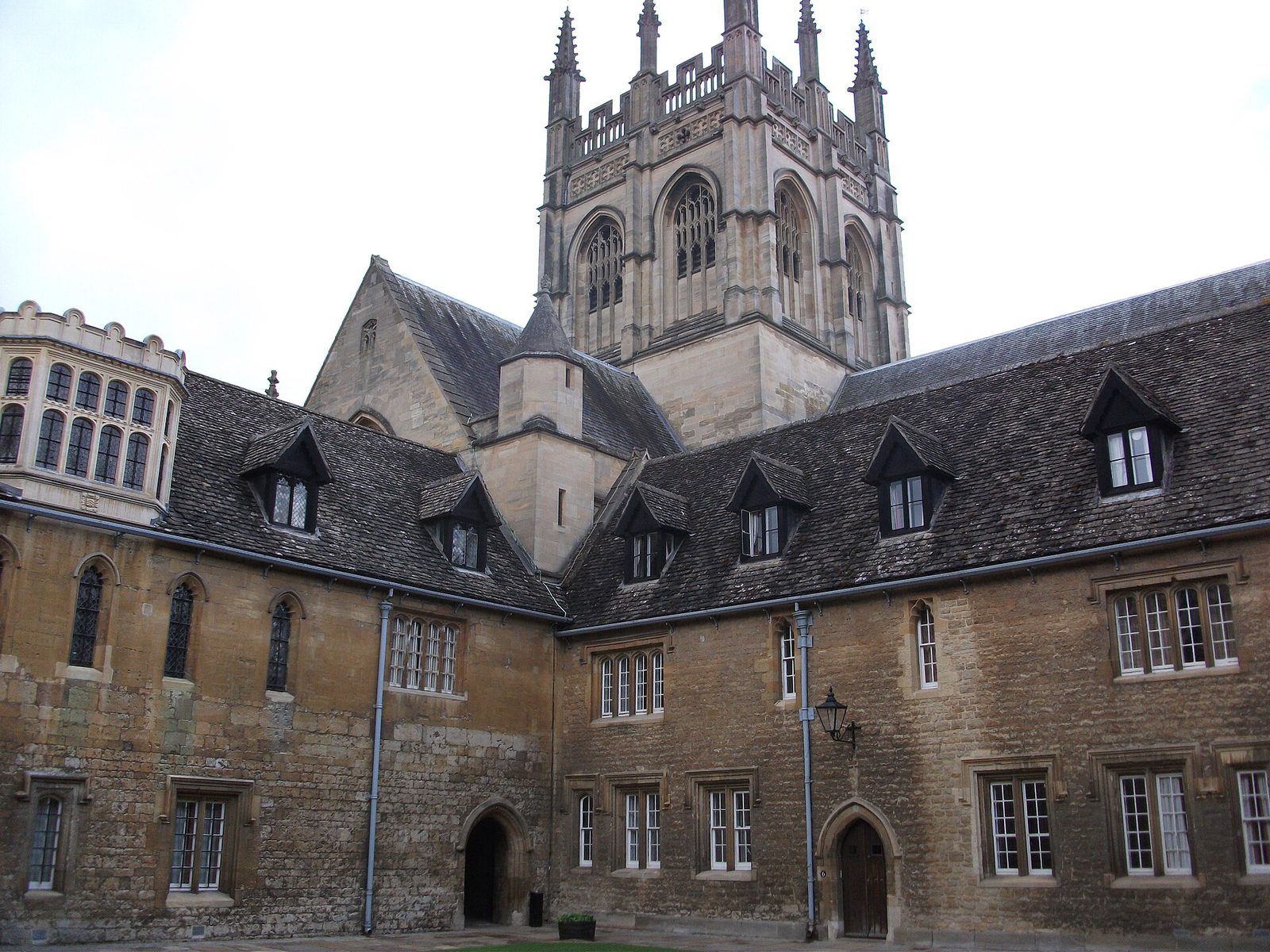
The 1330sMerton College, Oxford
The mean speed theorem
Speed growing evenly covers what the middle speed would, in the same time. Three hundred years before Galileo.
Full text
The story
StoryOxford, Paris, Leiden
An old rule, finally tested
- 1330sThe "Oxford Calculators"Thomas Bradwardine, William Heytesbury, Richard Swineshead, John Dumbleton argue how to measure heat, brightness, speed.
- 1330sHeytesburyStates the mean speed theorem, in a book of rules for logic puzzles.
- 1350Nicole Oresme, ParisA picture proof: a triangle has the area of a rectangle at half its height.
- 1638Galileo's claimTheorem I of falling, backed by experiments: real falling bodies obey it.
See itSpin the triangle
Then bend the line
Why start and end speeds give the distance, and when the rule fails.
Solve itThree problems
Your turn
Solve it
A body moving with uniform acceleration covers 10 m in the 2nd second and 20 m in the 4th second. Find its initial velocity and acceleration.
Hint
Answer
Solve it
A ball is thrown straight up at 20 m s−1 (take g = 10 m s−2). When is it 15 m above the hand? Why are there two answers?
Answer
Solve it
Spot the error. A car goes from rest to 20 m s−1 in 10 s. A student writes "distance = ½(0 + 20) × 10 = 100 m". The car's speedometer showed 18 m s−1 after only 4 s. Is 100 m right, too big or too small?
Answer
ConnectAnd still confused?
Where this goes next
Connect it
- Free fall, next. The same three equations with a = −g: why does a ball fall faster and faster?
- Motion in a plane, Chapter 3. The equations come back as vectors, one set for each direction: constant acceleration in a plane.
- Energy, Chapter 5. Multiply \( v^2 = v_0^2 + 2ax \) by ½m and it becomes the work-energy theorem: the work-energy theorem.
- Rotation, Chapter 6. Swap x for an angle and you get the same three equations for spinning wheels: rotational kinematics.
If two equations are enough, why learn three?
Speed in exams. Each equation leaves out a different quantity, so the right one gets you to the answer in one step without finding the unneeded quantity first. They are three doors to the same room.
Do the equations work if the acceleration is negative?
Yes. "Constant" means the same value all the time, whatever its sign. A ball thrown up has a = −g from the moment it leaves the hand until it lands, through the top and back.
Sources
- Stanford Encyclopedia of Philosophy, "William Heytesbury": Merton College, the 1330s, the mean speed (middle degree) theorem.
- Stanford Encyclopedia of Philosophy, "Nicole Oresme": his geometric proof of the Merton theorem.
- Galileo, Two New Sciences (1638), Third Day, Theorem I, Proposition I (Crew and de Salvio translation).