Act 02NCERT §2.1–2.2 · pp. 13–155 min
How fast, on average?
The walk from Act 01 turns on its side: its ghosts spread out in time and become the position-time graph, a line up to +300 m and back down to −200 m. A chord joins the start and the end; its slope is the average velocity.
Up to +300 m, back down to −200 m. The straight line from start to end is the average.
From the textbookpp. 13–15
NCERT Physics Part I, Class 11 · Rationalised 2023-24
2.0The big idea
Two kinds of "how far". Two averages.
Where you ended up, over the time: average velocity. Every step you walked, over the time: average speed. Turn back, and they part ways.
Full text
The big ideaAverage velocity is displacement divided by time; average speed is path length divided by time.
In simple words
If you want to know how fast a trip was overall, take how far you went and share it out over the time it took. You can count "how far" in two ways: only where you ended up, or every step you walked. The two ways give two different answers.
2.1Average velocity
Displacement shared over the time
- Average velocity has a sign, like displacement.
- Negative: it ended on the negative side of where it began.
- Velocity: a size and a direction.
Full text
Average velocity
The average velocity of an object over a time interval is its displacement divided by the time taken:
\[ \bar v = \frac{x_2 - x_1}{t_2 - t_1} = \frac{\Delta x}{\Delta t} \]Here \( x_1 \) is the position at time \( t_1 \), \( x_2 \) is the position at the later time \( t_2 \), and the bar over \( v \) means "average". The SI unit is metre per second, m s−1.
Because displacement has a sign, so does average velocity. A negative value means the object ended up on the negative side of where it started. Velocity has both a size and a direction.
2.2Average speed
Every step counts
\( \ge |\bar v| \)
average speed, over any time interval
- Average speed = total path length ÷ total time.
- Never negative. No direction. The odometer adds it up and never counts back.
- Equal to |average velocity| only if it never turns back.
Full text
Average speed
Average speed is the total path length divided by the total time:
\[ \text{average speed} = \frac{\text{total path length}}{\text{total time}} \]Path length is never negative, so average speed is never negative. It has no direction.
Worked example
Back to the walk from concept 1: 300 m east to the shop in 5 minutes, then 500 m west to the temple in 10 minutes. Find the average velocity and average speed. (East is positive.)
- Total time = 15 min = 900 s.
- Displacement = −200 m, so average velocity = \( \dfrac{-200}{900} \approx -0.22 \) m s−1 (that is, 0.22 m s−1 towards the west).
- Path length = 800 m, so average speed = \( \dfrac{800}{900} \approx 0.89 \) m s−1.
The two numbers are very different because the walk turned back.
Over any time interval, average speed ≥ |average velocity|. They are equal only if the object never turns back.
Worked example
Back to the walk from concept 1: 300 m east to the shop in 5 minutes, then 500 m west to the temple in 10 minutes. Find the average velocity and average speed. (East is positive.)
- Total time = 15 min = 900 s.
- Displacement = −200 m, so average velocity = \( \dfrac{-200}{900} \approx -0.22 \) m s−1 (that is, 0.22 m s−1 towards the west).
- Path length = 800 m, so average speed = \( \dfrac{800}{900} \approx 0.89 \) m s−1.
The two numbers are very different because the walk turned back.
2.3The walk from Act 01
Same 900 s, two answers
Average velocity
−0.22m/s
West
Average speed
0.89m/s
No direction
Try itWalk to the market
Drag the clock, watch the chord
2.5 km out, shutters down, home faster. At home the chord lies flat: average velocity zero. His average speed: 6 km/h.
2.4On a position-time graph
The slope is the velocity
A position-time graph: time along, position up. Join two points with a chord: rise Δx over run Δt is the average velocity. Like a hill path: steeper climbs faster.
Flat line
At rest: position does not change
Straight, sloping
Uniform motion: equal displacements in equal times
Steeper
A bigger velocity
Sloping down
Negative velocity: coming back
Full text
On a position-time graph
A position-time graph (x-t graph) has time along the bottom and position up the side. Pick two points on it. The straight line joining them is a chord, and its slope, rise \( \Delta x \) over run \( \Delta t \), is exactly the average velocity between those two times.
- A flat line: the position does not change. The object is at rest.
- A straight sloping line: equal displacements in equal times. This is uniform motion, and the velocity is the same all the time.
- A steeper line means a bigger velocity. A line sloping down means negative velocity: moving in the negative direction.
CheckRead the line
A horizontal x-t line
On a position-time graph, a horizontal straight line means the object is
- moving with constant velocity
- at rest
- speeding up
2.5Guess first
30 km/h, then 60 km/h
Equal distances. Most people guess wrong here.
2.6The half-distance trap
The slow half always wins
A scooter's position-time graph: 30 km in 1 hour at 30 km/h, then 30 km in half an hour at 60 km/h. A ghost every 6 minutes sits on the position axis, crowded where it is slow. A 45 km/h line would reach 60 km at 1 hour 20 minutes; the true chord reaches it at 1.5 hours, a slope of 40 km/h.
30 km at 30 km/h: one whole hour.
30 km more at 60 km/h: half an hour.
At 45 km/h it would be home at 1 h 20 min. It isn't.
60 ÷ 1.5 = 40 km/h. The slow half took two-thirds of the time.
2.7Two equal distances
Not the plain mean
Equal distances
\( 2v_1v_2/(v_1+v_2) \)
Leans to the slow speed.
Equal times
\( (v_1+v_2)/2 \)
Only then the simple mean.
Worked example
- Time for the first 30 km = 30 ÷ 30 = 1 h.
- Time for the second 30 km = 30 ÷ 60 = 0.5 h.
- Average speed = total distance ÷ total time = 60 ÷ 1.5 = 40 km/h.
The scooter spends more time at the slow speed, so the average leans towards 30. For two equal distances at speeds \( v_1 \) and \( v_2 \):
\[ \bar v = \frac{2 v_1 v_2}{v_1 + v_2} \]Only when the two speeds last for equal times is the answer the simple mean, \( (v_1 + v_2)/2 \).
Full text
The half-distance trap
Before you read on, make a guess.
Most people guess wrong here. A scooter rides 30 km at 30 km/h, then another 30 km at 60 km/h. What is its average speed? The tempting answer is 45 km/h. It is not.
Worked example
- Time for the first 30 km = 30 ÷ 30 = 1 h.
- Time for the second 30 km = 30 ÷ 60 = 0.5 h.
- Average speed = total distance ÷ total time = 60 ÷ 1.5 = 40 km/h.
The scooter spends more time at the slow speed, so the average leans towards 30. For two equal distances at speeds \( v_1 \) and \( v_2 \):
\[ \bar v = \frac{2 v_1 v_2}{v_1 + v_2} \]Only when the two speeds last for equal times is the answer the simple mean, \( (v_1 + v_2)/2 \).
Try it
An auto-rickshaw goes 4 km east in 10 min, then 1 km west in 5 min. Find its average speed and average velocity in km/h.
Answer
Remember
- \( \bar v = \Delta x / \Delta t \): uses displacement, has a sign.
- Average speed = path length ÷ time: never negative.
- Average speed ≥ |average velocity| over any interval.
- Equal distances: \( 2v_1v_2/(v_1+v_2) \). Equal times: \( (v_1+v_2)/2 \).
CheckUp the hill and back
10 km/h up, 30 down
A cyclist goes up a hill at 10 km/h and comes back down the same road at 30 km/h. What is the average speed for the round trip?
- 20 km/h
- 15 km/h
- 0 km/h
2.8Your turn
An auto-rickshaw turns back
4 km east in 10 min, then 1 km west in 5 min. Average speed and average velocity, in km/h?
Answer
2.9Don't mix these up
The average of speeds
Myth
Average speed is the mean of the speeds used
Fact
Total path ÷ total time. Each second gets one vote.
Remember
- \( \bar v = \Delta x / \Delta t \): uses displacement, has a sign.
- Average speed = path length ÷ time: never negative.
- Average speed ≥ |average velocity| over any interval.
- Equal distances: \( 2v_1v_2/(v_1+v_2) \). Equal times: \( (v_1+v_2)/2 \).
KeepJust remember
Three names, three hooks
Names and symbols chosen long ago. Tap a card for its hook.
WordsTo know
Five words
- Average velocity
- Displacement divided by the time taken.
- Average speed
- Total distance travelled divided by the time taken.
- Position-time graph
- A graph of position (up) against time (along).
- Uniform motion
- Equal displacements in equal intervals of time; a straight x-t line.
- Chord
- A straight line joining two points of a curve; its slope is the average velocity.
NEETAsked in the exam
The real thing
RootsEvery second gets one vote
A time-weighted mean
- Not 45: twice as long at 30 as at 60.
- Always between the slowest and fastest speed.
- A slow start can eat the whole budget: then infinite speed.
- Velocity too: run 42 km, average velocity near zero.
Full text
The roots: every second gets one vote
- Why isn't 30 km/h then 60 km/h, over equal distances, an average of 45?Because you spend twice as long at 30 as at 60. The slow half fills two-thirds of the trip's time.
- Why should time decide?Because average speed is defined as total distance over total time. Each second of the trip counts equally, not each kilometre.
- Why define it that way?So that it answers a useful question: what single steady speed would cover the same distance in the same time? That is what a timetable needs.
- What does that make the average, in symbols?For pieces of the trip at steady speeds: \( \bar v = \dfrac{v_1 t_1 + v_2 t_2 + \dots}{t_1 + t_2 + \dots} \). A time-weighted mean: each speed counts in proportion to how long it lasted.
- And the bedrock?Distance = speed × time for steady motion, and distances add. Nothing more.
Two things follow at once. First, an average of this kind always lies between the slowest and the fastest speed used: it is a weighted mean of them. Second, the slower a piece, the more time it eats, so the more weight it gets. When the distances are equal, the weights work out to give \( 2v_1v_2/(v_1+v_2) \), always below the plain mean.
Push it to the limit. Suppose the first half of a trip went slowly. Your whole time budget for a target average is fixed: total distance ÷ target speed. If the slow half has already used it all, the second half would need zero time, which means infinite speed. That is the trap in the widget below.
The same is true of velocity, with one change: displacement replaces distance, so pieces in opposite directions cancel. That is why an athlete can run 42 km and have an average velocity close to zero.
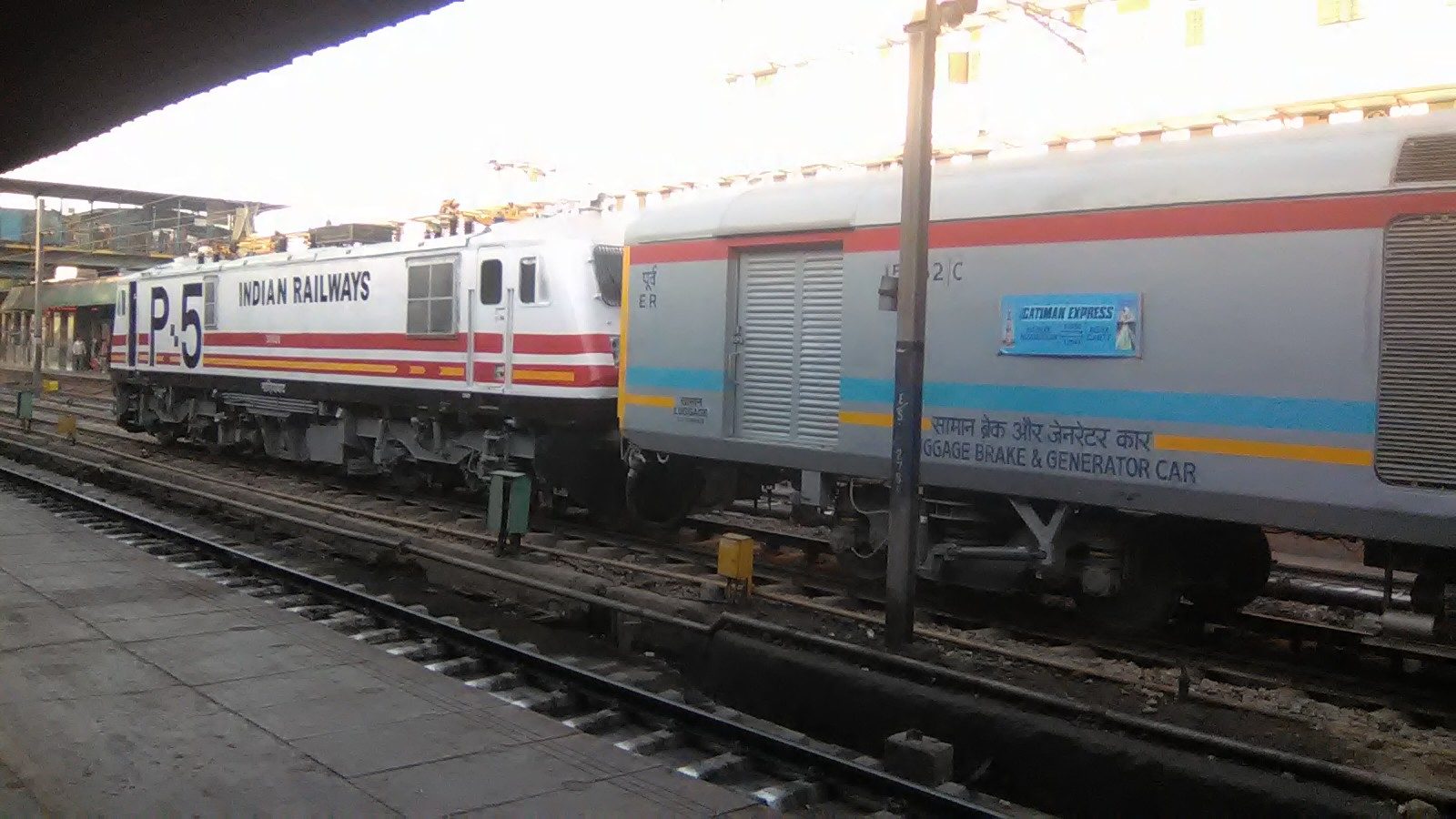 WAP-5 locomotiveGatimaan Express board
5 April 2016Hazrat Nizamuddin to Agra Cantonment
113km/h
average, for a top speed of 160 km/h
Delhi to Agra on the Gatimaan Express, India's first train cleared for 160 km/h: 188 km in 1 hour 40 minutes, a good 47 km/h below its top. Towns, curves and stations ate the rest.
Full text
The story
8 October 2023Chicago · Kelvin Kiptum of Kenya
5.83m/s
average speed over 42,195 m in 7235 s (2:00:35, a world record)
About 21 km/h for two hours. The course starts and finishes in Grant Park, a few hundred metres apart: his average velocity was under 0.1 m/s.
See itRescue a slow start
How fast must the second half be?
Solve itThree problems
Your turn
Solve it
Suppose a train like the Gatimaan covered 188 km at a steady 160 km/h, except for the first and last 10 km, which it ran at 40 km/h. What would its average speed be?
Hint
Answer
Solve it
Can the average speed of a trip ever be less than the slowest speed used during it, if the vehicle never stops?
Answer
Solve it
A bus goes from A to B at 40 km/h and returns at 60 km/h. A second bus does the round trip at a steady 48 km/h. Which gets back first?
Answer
ConnectAnd still confused?
Where this goes next
Connect it
- The half-distance trap, above. The formula \( 2v_1v_2/(v_1+v_2) \) is a special case of the time-weighted mean, for two equal distances.
- Instantaneous velocity, next. Shrink one of the pieces to a tiny instant and the "average over that piece" becomes the velocity at an instant: how fast right now?
- Maths: other averages. The arithmetic mean, the geometric mean and this one (the harmonic mean) each answer a different question: why the A.M. is never less than the G.M.
- Daily life. A scooter's "km per litre" works the same way: half the petrol at 30 km/l and half at 50 km/l is not the same as half the distance at each.
So is average velocity ever the plain average of two velocities?
Yes, whenever the two velocities last for equal times. And for one more case: steady acceleration, where the velocity changes evenly with time, so the average is exactly half-way between the start and the end. You meet that in the equations of motion.
Why can average speed be bigger than average velocity, but never smaller?
Because path length is never smaller than the size of the displacement: turning back adds to the path and takes away from the displacement. Divide both by the same time and the inequality stays.
Sources
- Railway Gazette, "India launches first 160 km/h semi-high speed train" (2016): launch date, 188 km, 1 h 40 min, 160 km/h.
- World Athletics, Kiptum's world marathon record ratified: 2:00:35, Chicago, 8 October 2023.
- CBS Chicago, Chicago Marathon course map: start and finish on Columbus Drive in Grant Park.