- 1. How do we sort animals?
- 2. Symmetry, germ layers and the coelom
- 3. Segments, the notochord, and the map of all phyla
- 4. Sponges, cnidarians and comb jellies
- 5. Flatworms, roundworms and segmented worms
- 6. Arthropods and molluscs: the two biggest phyla
- 7. Echinoderms and hemichordates
- 8. What makes a chordate?
- 9. Jawless vertebrates and fishes
- 10. Amphibians and reptiles
- 11. Birds and mammals
- Review
5 of 11·NCERT §4.2.4 · §4.2.5 · §4.2.6·pp. 42–44·6 min
Flatworms, roundworms and segmented worms
The big ideaThree kinds of worm show three steps up in body plan: flatworms have no body cavity, roundworms have a false one, and segmented annelids have a true coelom.
In simple words
Not all worms are the same. Some are flat like a ribbon and mostly live inside other animals, soaking up food. Some are round like a thread, with a tube for food from mouth to bottom. And some, like the earthworm in your garden, are made of many rings joined together, with a real space inside, blood in tubes, and muscles to wriggle through soil.
Phylum Platyhelminthes: flatworms
The body is flattened from top to bottom (dorso-ventrally flattened), hence the name flatworms. Most are endoparasites, living inside other animals, including humans.
- Bilateral, triploblastic, acoelomate, with an organ level of organisation.
- Parasitic forms have hooks and suckers to cling inside the host. Some absorb food straight through their body surface; a tapeworm has no gut at all.
- Special flame cells handle osmoregulation (keeping water and salt balanced) and excretion.
- Sexes not separate (hermaphrodite). Fertilisation internal. Development passes through many larval stages.
- Planaria, a free-living flatworm, has a high power of regeneration: cut it into pieces and each piece can grow into a whole worm.
Examples: Taenia (tapeworm), which can reach us through undercooked pork; Fasciola (liver fluke), common in the livers of sheep and cattle.
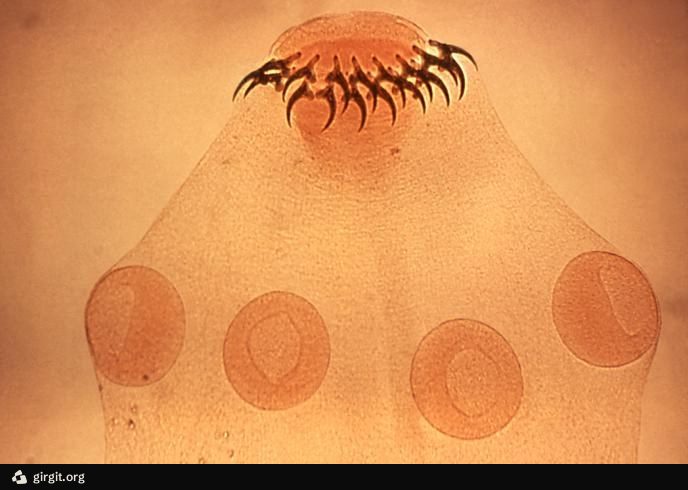 crown of hookssuckersucker
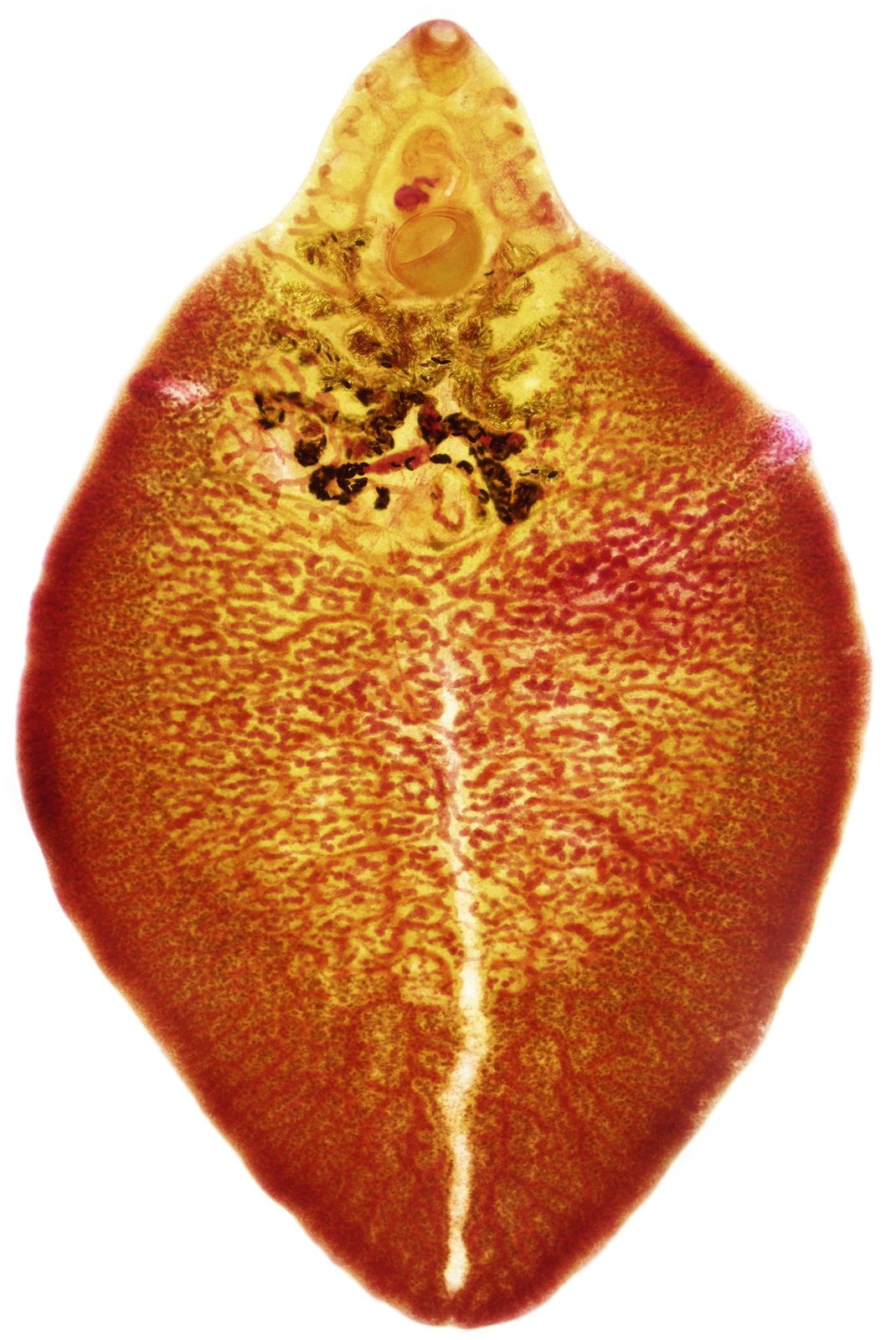 oral suckerventral suckerflat, leaf-shaped body
Not every flatworm is a parasite. Free-living planarians glide on a carpet of beating cilia; the long land planarian below, a Bipalium, often turns up on walls and paths in India after rain.
Try it: cut a planarian and predict what each piece becomes.
Phylum Aschelminthes: roundworms
The body is circular in cross-section, hence roundworms. They can be free-living (in water or soil) or parasites of plants and animals.
- Organ system level, bilateral, triploblastic, pseudocoelomate.
- Complete alimentary canal with a well-developed muscular pharynx (the throat that sucks food in).
- Waste is collected from the body cavity by an excretory tube and leaves by a small opening, the excretory pore.
- Sexes are separate: they are dioecious. Females are often longer than males.
- Fertilisation internal. Development may be direct (the young look like small adults) or indirect (through a larva).
Examples, all human parasites that matter in India:
- Ascaris: the common intestinal roundworm, picked up from unwashed vegetables.
- Wuchereria: the filaria worm, spread by mosquitoes, causing elephantiasis (filariasis).
- Ancylostoma: the hookworm, which enters through bare feet.
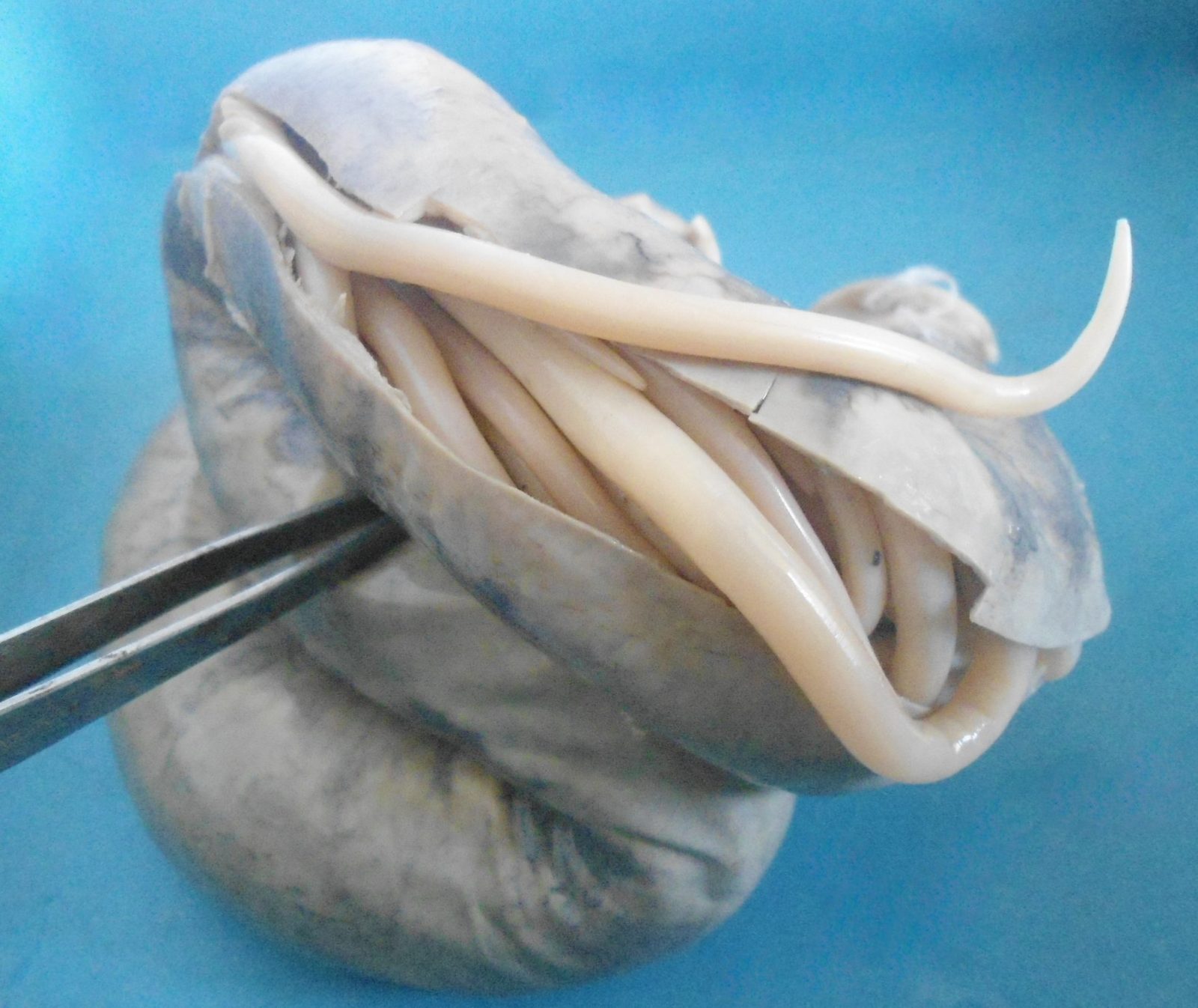 adult roundworms
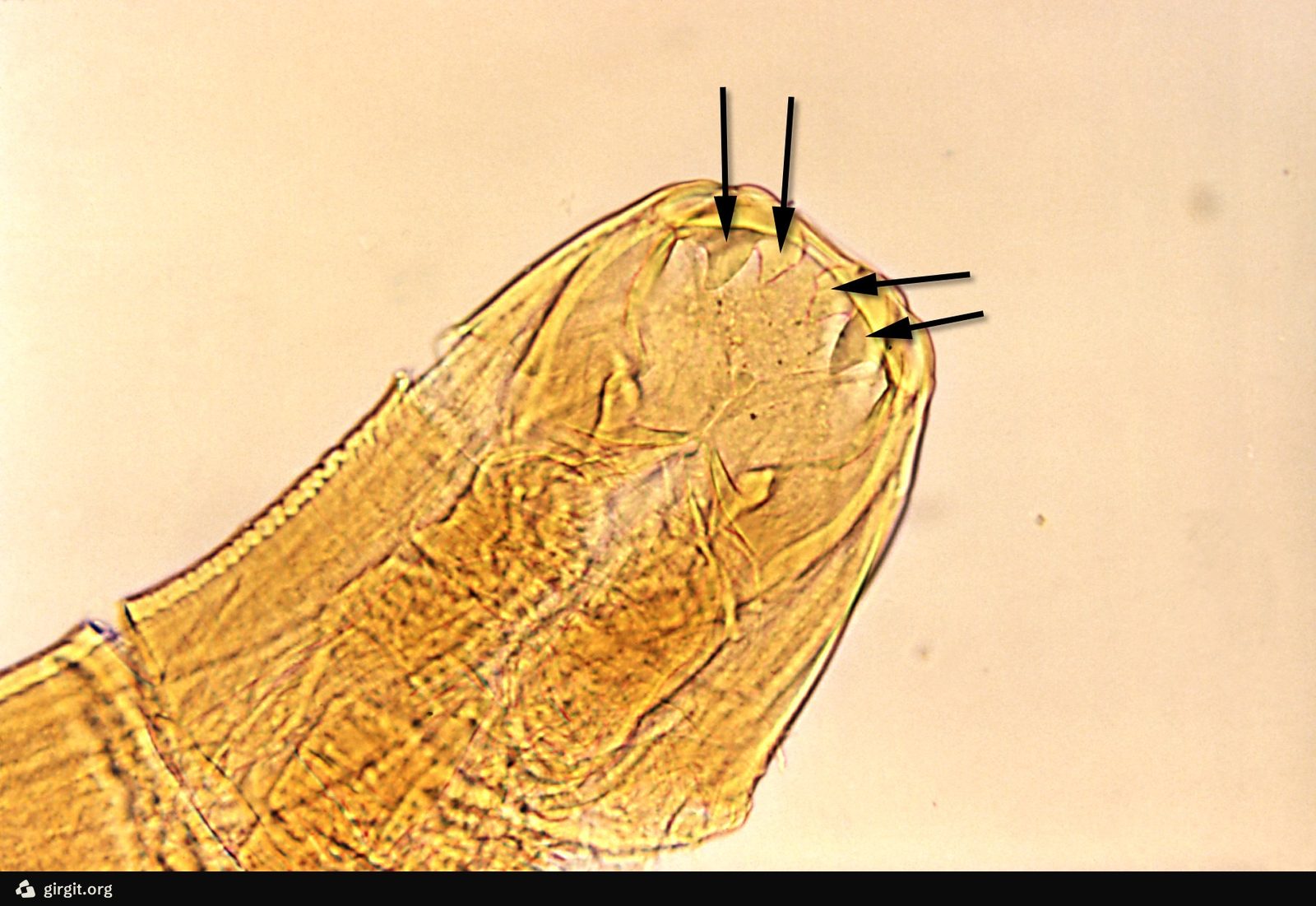 cutting teeth
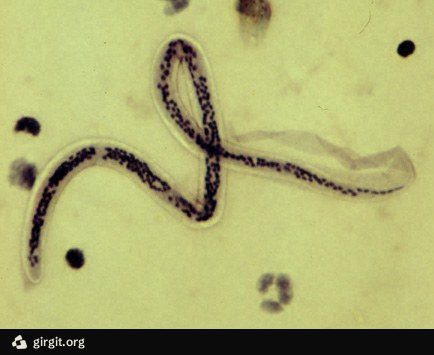 microfilariawhite blood cell
Phylum Annelida: segmented worms
From Latin annulus, "little ring". The body surface is clearly marked into segments, the metameres. Annelids live in water (sea and fresh) or on land, are mostly free-living and sometimes parasitic.
- Organ system level, bilateral, triploblastic, metamerically segmented, and coelomate: the first true coelom in our list.
- Longitudinal and circular muscles work against each other to move the body.
- Aquatic forms like Nereis have side flaps called parapodia for swimming.
- Closed circulatory system.
- Nephridia (singular nephridium) carry out osmoregulation and excretion.
- Nervous system: pairs of ganglia (knots of nerve cells), linked by side nerves to a nerve cord that is double and runs along the ventral (belly) side.
- Nereis is dioecious (separate sexes); earthworms and leeches are monoecious (both sexes in one animal). Reproduction is sexual.
Examples: Nereis, Pheretima (earthworm) and Hirudinaria (the blood-sucking leech, familiar to anyone who has walked through Kerala's forests in the monsoon).
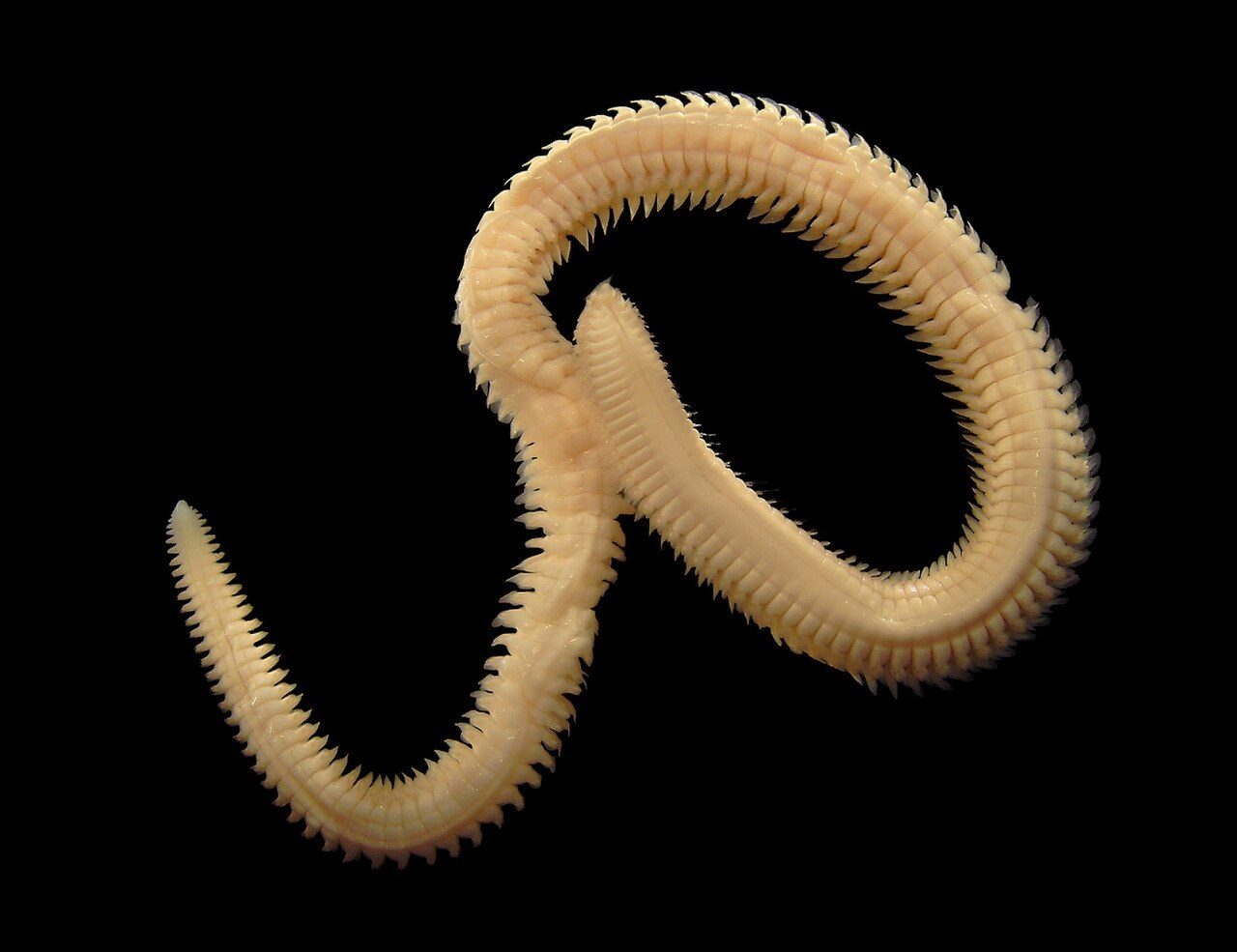 parapodia (side flaps)
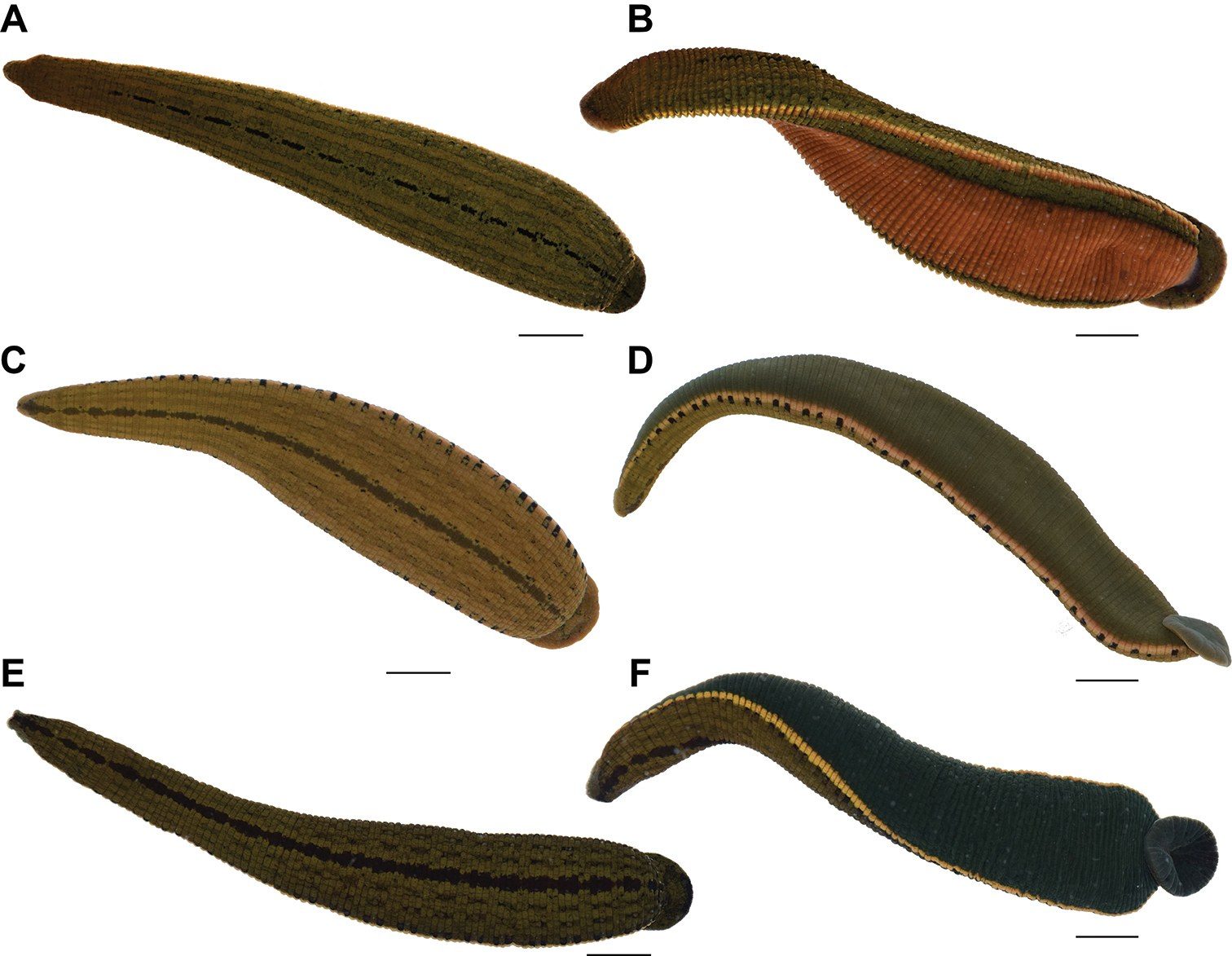 rear sucker
Side by side
| Platyhelminthes | Aschelminthes | Annelida | |
|---|---|---|---|
| Common name | Flatworms | Roundworms | Segmented worms |
| Level | Organ | Organ system | Organ system |
| Body cavity | Acoelomate | Pseudocoelomate | Coelomate |
| Segments | No | No | Yes (metameric) |
| Gut | Incomplete | Complete, muscular pharynx | Complete |
| Excretion | Flame cells | Excretory tube and pore | Nephridia |
| Sexes | Hermaphrodite | Separate (dioecious) | Nereis separate; earthworm, leech hermaphrodite |
| Remember | Taenia, Fasciola, Planaria | Ascaris, Wuchereria, Ancylostoma | Nereis, Pheretima, Hirudinaria |
Don't mix these up
- Excretion: flame cells (flatworms), nephridia (annelids), Malpighian tubules (arthropods).
- Bilateral + acoelomate = Platyhelminthes. Ctenophores have no coelom too, but they are radial.
- Earthworm and leech are monoecious; Nereis is dioecious.
Not in the current textbook, but NEET has asked it: metamorphosis is a big change of body form between larva and adult, as in a moth (caterpillar to moth), a starfish (bilateral larva to radial adult) or a tunicate (tadpole-like larva to fixed adult). The earthworm hatches as a small worm and grows directly, so it shows no metamorphosis.
Just remember
Nine genus names and three excretory organs. The names mostly describe the worm:
- Flatworms: Taenia, Fasciola, Planaria
- Taenia is Latin for a ribbon: the tapeworm. Fasciola, a little band: the liver fluke. Planaria, from planus, flat.
- Roundworms: Ascaris, Wuchereria, Ancylostoma
- Ancylo-stoma means "hooked mouth": the hookworm (look at its teeth above). Wuchereria is named after Otto Wucherer, who first saw its larvae in 1866. Ascaris was simply the Greek word for a gut worm.
- Annelids: Nereis, Pheretima, Hirudinaria
- Nereis is named after the Nereids, sea nymphs: the swimmer with parapodia. Hirudo is Latin for leech. Pheretima is the Indian earthworm you dissect in Chapter 7.
- Excretion: flame cells (flatworms), excretory pore (roundworms), nephridia (annelids)
- Flame for Flat. Nephridia for the annelids. The roundworm just has a pore, a hole.
- Dioecious: roundworms, Nereis. Monoecious: flatworms, earthworm, leech
- The sea swimmer Nereis is the odd one out among annelids.
- Endoparasite
- A parasite that lives inside its host's body.
- Flame cells
- Ciliated cells of flatworms for excretion and water balance.
- Dioecious
- Male and female are separate animals.
- Monoecious
- One animal has both male and female organs.
- Parapodia
- Paired side flaps of Nereis, used for swimming.
- Nephridia
- The excretory tubes of annelids.
- Regeneration
- Regrowing lost parts, even a whole body.
Words to know
Which pair of features would you find in a roundworm but NOT in a flatworm?
- A body cavity and a gut with two openings
- Bilateral symmetry and three germ layers
- Flame cells and suckers
- Segments and nephridia
Which annelid has separate sexes?
- Pheretima
- Hirudinaria
- Nereis
A child walking barefoot in moist soil picks up a parasitic worm through the skin of the foot. It is most likely
- Taenia
- Ancylostoma
- Wuchereria
- Fasciola
Deep dive · optional
How do worms live inside us, and how does a flatworm regrow?
Why parasitic worms look the way they do, how a flatworm rebuilds itself from a sliver, and how India beat one worm completely. The exam doesn't need it, but it explains the lists on this page.
The roots
- Why does a tapeworm have hooks and suckers but no gut?Because it lives in a river of food. Our intestine squeezes everything along towards the exit, so a worm that can't hold on is swept out; hooks and suckers are anchors. And the food around it is already digested by us, so it can simply absorb it through its skin. A gut would be wasted.
- Why can it absorb through its skin?Because it is flat. A flat body has a huge surface for its volume, and nothing in it is far from the surface, the same reason flatworms need no blood system (see concept 1).
- Why do parasitic worms lay so many eggs?Because the chance that any one egg reaches a new host is tiny. A female Ascaris can produce about 2,00,000 eggs a day. Most die in the soil; the few that get onto unwashed hands or vegetables are enough.
- Why do parasites need hosts at all?Because a parasite trades independence for an easy living: food, warmth and shelter supplied by another animal. The cost is that it must get from one host to the next, which shapes everything else about it: its eggs, its larvae, the way it enters (through bare feet, a mosquito bite, or undercooked meat).
Regeneration has a cellular root. A planarian's body is full of small dividing stem cells called neoblasts, scattered through its tissues. When the worm is cut, neoblasts near the wound multiply and turn into whatever is missing: brain, eyes, gut, muscle. In 2011, scientists killed all the dividing cells of planarians with radiation and then put a single neoblast of one special kind into each; that one cell was enough to rebuild the worm's ability to regenerate. The worm also keeps a map of front and back, which is why a middle piece puts its new head at the end that faced the old head.
The story
See it
The cost of a parasite in plain numbers: the widget above fills a jug with the blood a hookworm infection takes in a month. The hookworm's teeth that do it are in the photo on this page.
Solve it
Solve it
Suppose a female Ascaris lays 2,00,000 eggs a day for a year. In a population that stays the same size, each pair of adults is replaced, on average, by just two new adults. Roughly what fraction of her eggs grows into an adult worm?
Hint
Answer
Solve it
India's National Deworming Day (started in 2015) gives a single albendazole tablet to children twice a year, on 10 February and 10 August. Using the hookworm numbers in the widget, explain why a dose every six months still helps a child who will be reinfected.
Answer
Why can a tapeworm live without any digestive system?
- It does not need food
- It absorbs food already digested by its host, through its body surface
- Its flame cells digest food
Connect it
Connect it
- Worm diseases, Class 12. Ascariasis and filariasis as diseases: amoebiasis, worms and ringworm.
- Filariasis in India. About 345 districts in 20 states and union territories have lymphatic filariasis, spread by Culex mosquitoes; India aims to eliminate it by 2027 with mass drug administration.
- The earthworm, Ch 7. Pheretima in detail: the earthworm.
- Body cavities, concept 2. Why the three worms differ inside: symmetry, layers and coelom.
- Parasitism, Class 12. Hosts, adaptations and life cycles: parasitism.
Still confused?
Are earthworms and roundworms related, since both are "worms"?
Only distantly. "Worm" is just a shape. Earthworms are annelids with a true coelom and segments; roundworms have a pseudocoelom and no segments; flatworms have no cavity at all. Three different phyla share the long, thin shape because it suits burrowing and squeezing.
Can a cut earthworm also grow into two worms?
No. Some earthworms can regrow a few lost segments at the tail end, and some even a head, but cutting one in half does not give two worms. Planarians are the regeneration champions, thanks to their neoblasts.
Sources
- NIGMS: planarian regeneration and Morgan's 1/279
- Whitehead Institute (2011): single stem cells restore planarian regeneration
- CDC DPDx: Ascariasis
- StatPearls: Hookworm (blood loss per worm)
- WHO Weekly Epidemiological Record (2000): India certified free of dracunculiasis
- NCDC: Guinea Worm Eradication Programme
- PIB (2024): lymphatic filariasis elimination
- National Deworming Day (summary)
- Darwin (1881), The Formation of Vegetable Mould through the Action of Worms
Picture and video credits
Show 5 picture and video credits
- fasciola-liver-fluke.jpg: TiunovAV, CC BY-SA 4.0
- land-planarian-gliding.mp4: Subhashish Panigrahi, CC BY-SA 3.0
- ascaris-adults-calicut.jpg: Department of Pathology, Calicut Medical College, CC BY-SA 4.0
- polychaete-parapodia.jpg: Hans Hillewaert, CC BY-SA 4.0
- hirudinaria-leech.jpg: Jeratthitikul E, Jiranuntskul P, Nakano T et al. (ZooKeys, 2020), CC BY 4.0


